
 100% FREE ACCESS
11th Standard CBSE Syllabus & Materials
11th Standard CBSE
CBSE 11th Economics PART-A - Presentation of Data - New Sample Question Papers Study Material - QB365 Set A
NEW11th Standard CBSE
CBSE 11th Economics PART-A - Organisation of Data - New Sample Question Papers Study Material - QB365 Set A
NEW11th Standard CBSE
CBSE 11th Economics PART-A - Collection of Data - New Sample Question Papers Study Material - QB365 Set A
NEW11th Standard CBSE
CBSE 11th Economics PART-A - Introduction to Economics and Statistics - New Sample Question Papers Study Material - QB365 Set A
NEW11th Standard CBSE
CBSE 11th Business Studies International Trade Sample Question Papers Study Material - QB365 Set A
NEW11th Standard CBSE
CBSE 11th Business Studies Evolution and Fundamentals of Business Sample Question Papers Study Material - QB365 Set A

Published on: 21/10/2025
Download CBSE Class 11th Standard CBSE Mathematics question papers, sample papers, important questions, and previous year solved papers in PDF format. Get free study materials, NCERT solutions, and exam preparation resources for Class 11th Standard CBSE Mathematics
Questions + Answers key
Take MCQ Mathematics Test
1.
Show that the path of a moving point such that its distances from two lines 3x – 2y = 5 and 3x + 2y = 5 are equal is a straight line.
2.
A line is such that its segment between the lines 5x – y + 4 = 0 and 3x + 4y – 4 = 0 is bisected at the point (1, 5). Obtain its equation
3.
Find the distance of the line 4x – y = 0 from the point P (4, 1) measured along the line making an angle of 135° with the positive x-axis.
4.
Find the distance between the parallel lines 3x – 4y +7 = 0 and 3x – 4y + 5 = 0
5.
Find the slope of the lines:
(a) Passing through the points (3, – 2) and (–1, 4),
(b) Passing through the points (3, – 2) and (7, – 2),
(c) Passing through the points (3, – 2) and (3, 4),
(d) Making inclination of 60° with the positive direction of x-axis.
6.
If pth, qth, rth terms of an AP and GP are both a, band c, respectively, then show that \(a^{b-c} \cdot b^{c-a} \cdot c^{a-b}=1\)
7.
Find the sum of n terms of series \(\frac{1}{1 \times 2}+\frac{1}{2 \times 3}+\frac{1}{3 \times 4}+\ldots\)
8.
A person has 2 parents, 4 grandparents, 8 great grandparents, and so on. Find the number of his ancestors during the ten generations preceding his own.
9.
Find the angle between the lines \(\sqrt { 3x } \)+y=1 and x+\(\sqrt { 3y } \)=1.
10.
If p and q are the lengths of perpendiculars from the origin to the lines xcosθ−ysinθ=kcos2θ and x sec θ + y cosec θ = k, respectively, prove that p2 + 4q2 = k2.
11.
Find equation of the line passing through the point (2,2) cutting off intercepts on the axes whose sum is 9
12.
A farmer buys a used tractor for Rs 12000. He pays Rs 6000 cash and agrees to pay the balance in annual instalments of Rs 500 plus 12% interest on the unpaid amount. How much will the tractor cost him?
13.
Find the sum of the following series.
5+55+555+...upto n terms.
14.
If a,b,c are in AP and b,c,d are in GP and \(\frac { 1 }{ c } ,\frac { 1 }{ d } ,\frac { 1 }{ e } \) are in AP, then prove that a,c,e are in GP.
15.
If the first and the nth term of a G.P. are a and b, respectively, and if P is the product of n terms, prove that p2 = (ab)n.
16.
The sum of first three terms of a GP is \( \frac{39}{10}\) and their product is 1. Find the common ratio and the terms.
17.
Find a G.P. for which sum of the first two terms is – 4 and the fifth term is 4 times the third term.
18.
Prove that in a finite GP the product of the terms equidistant from the beginning and the end is always same and equal to the product of first and last term.
19.
The sum of two numbers is \(\frac{13}{6} \). An even number of Am's are being inserted between them.The sum of means inserted exceeds the number of means by 1.Find the number of AM's inserted.
20.
The Fibonacci sequence is defined by 1 = a1 = a2 and an = an - 1 + an = an - 2 n > 2. Find \(\frac { { a }_{ n+1 } }{ { a }_{ n } }\), for n = 1, 2, 3, 4 , 5.
1.
Given lines are
3x – 2y = 5 … (1)
and 3x + 2y = 5 … (2)
Let (h, k) is any point, whose distances from the lines (1) and (2) are equal. Therefore
\(\frac{|3 h-2 k-5|}{\sqrt{9+4}}=\frac{|3 h+2 k-5|}{\sqrt{9+4}} \text { or }|3 h-2 k-5|=|3 h+2 k-5|\)
which gives 3h – 2k – 5 = 3h + 2k – 5 or – (3h – 2k – 5) = 3h + 2k – 5.
Solving these two relations we get k = 0 or h \(\frac{5}{3}\)Thus, the point (h, k) satisfies the equations y = 0 or x =\(\frac{5}{3}\) which represent straight lines. Hence, path of the point equidistant from the lines (1) and (2) is a straight line.
2.
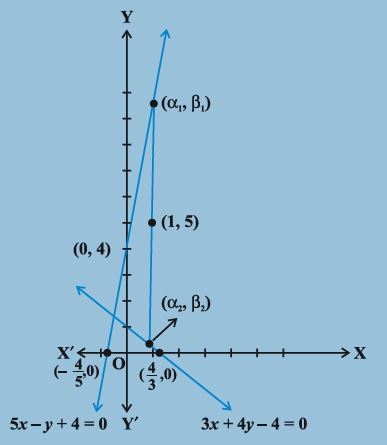
Given lines are
5x – y + 4 = 0 ... (1)
3x + 4y – 4 = 0 ... (2)
Let the required line intersects the lines (1) and (2) at the points, (\(\alpha\)1, \(\beta\)1) and (\(\alpha\)2, \(\beta\)2), respectively
Therefore \(5 \alpha_{1}-\beta_{1}+4=0 \text { and } \)\(3 \alpha_{2}+4 \beta_{2}-4=0\)
or \(\beta_{1}=5 \alpha_{1}+4 \text { and } \beta_{2}=\frac{4-3 \alpha_{2}}{4}\)
We are given that the mid point of the segment of the required line between (\(\alpha\)1, \(\beta\)1) and (\(\alpha\)2, \(\beta\)2)
Therefore \(\frac{\alpha_{1}+\alpha_{2}}{2}=1 \text { and } \frac{\beta_{1}+\beta_{2}}{2}=5\)
or \(\alpha_{1}+\alpha_{2}=2 \text { and } \frac{5 \alpha_{1}+4+\frac{4-3 \alpha_{2}}{4}}{2}=5\)
or \(\alpha_{1}+\alpha_{2}=2 \text { and } 20 \alpha_{1}-3 \alpha_{2}=20\) ..(3)
Solving equations in (3) for \(\alpha\)1 and \(\alpha\)2, we get
\(\alpha_{1}=\frac{26}{23} \text { and } \alpha_{2}=\frac{20}{23} \text { and hence, } \beta_{1}=5 \cdot \frac{26}{23}+4=\frac{222}{23} \text { . }\)
Equation of the required line passing through (1, 5) and (\(\alpha\)1, \(\beta\)1) is
\(y-5=\frac{\beta_{1}-5}{\alpha_{1}-1}(x-1) \text { or } y-5=\frac{\frac{222}{23}-5}{\frac{26}{23}-1}(x-1)\)
or 107x – 3y – 92 = 0,
which is the equation of required line
3.
Given line is 4x – y = 0 ... (1)
In order to find the distance of the line (1) from the point P (4, 1) along another line, we have to find the point of intersection of both the lines. For this purpose, we will first find the equation of the second line (Fig 9.16). Slope of second line is tan 135° = –1. Equation of the line with slope – 1 through the point P (4, 1) is
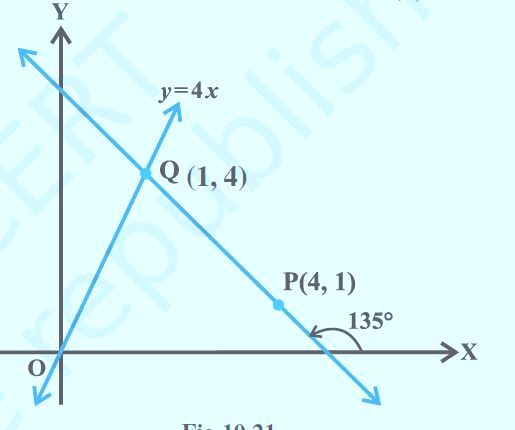
y – 1 = – 1 (x – 4) or x + y – 5 = 0 ... (2)
Solving (1) and (2), we get x = 1 and y = 4 so that point of intersection of the two lines is Q (1, 4). Now, distance of line (1) from the point P (4, 1) along the line (2)
= the distance between the points P (4, 1) and Q (1, 4).
\(=\sqrt{(1-4)^{2}+(4-1)^{2}}=3 \sqrt{2} \text { units. }\)
4.
Here A = 3, B = –4, C1 = 7 and C2 = 5. Therefore, the required distance is
\(d=\frac{|7-5|}{\sqrt{3^{2}+(-4)^{2}}}=\frac{2}{5}\)
5.
(a) The slope of the line through (3, – 2) and (– 1, 4) is
\(m=\frac{4-(-2)}{-1-3}=\frac{6}{-4}=-\frac{3}{2}\)
(b) The slope of the line through the points (3, – 2) and (7, – 2) is
\(m=\frac{-2-(-2)}{7-3}=\frac{0}{4}=0\)
(c) The slope of the line through the points (3, – 2) and (3, 4) is
\(m=\frac{4-(-2)}{3-3}=\frac{6}{0}\), which is not defined.
(d) Here inclination of the line \(\alpha\) = 60°. Therefore, slope of the line is
m = tan 60° = \(\sqrt{3}\)
6.
Let A and d be the first term and common difference of AP and x, R be the first term and common ratio of GP, respectively.
According to the given condition
A + (p -1) d = a ..(i)
A + (q-1)d = b ..(ii)
A + (r -1) d = c..(iii)
and \(a=x R^{p-1} \)..(iv)
\(b=x R^{q-1} \)..(v)
\(c=x R^{r-1}\)..(vi)
On subtracting Eq. (ii) from Eq. (i),we get
d(p -1 - q + 1)= a - b
\(\Rightarrow a-b=d(p-q)\)..(vii)
On subtracting Eq. (iii) from Eq. (ii),we get
\(d(q-1-r+1) =b-c\)
\(\Rightarrow b-c =d .(q-r)\)
On subtracting Eq. (i) from Eq. (iii), we get
\(d(r-1-p+1)=c-a \Rightarrow c-a=d(r-p)\)
Now, we have to prove \(a^{b-c} b^{c-a} c^{a-b}=1\)
LHS = \(a^{b-c} b^{c-a} c^{a-b}\)
Using Eqs. (iv), (v), (vi) and (vii), (viii), (ix),we get
LHS = \(\left(x R^{p-1}\right)^{d(q-r)}\left(x R^{q-1}\right)^{d(r-p)}\left(x R^{r-1}\right)^{d(p-q)}\)
\(=x^{d(q-r)+d(r-p)+d(p-q)}\)
\(R^{(p-1) d(q-r)+(q-1) d(r-p)+(r-1) d(p-q)}\)
\(\left.=x^{d(q-r+r}-p+p-q\right)\)
\(R^{d(p q-p r-q+r+q r-p q-r+p+r p-r q-p+q)}\)
\(=x^{0} R^{0}=1=\mathrm{RHS}\)
Hence proved.
7.
Let the given series be \(S= \frac{1}{1 \times 2}+\frac{1}{2 \times 3}+\frac{1}{3 \times 4}+\ldots\)
Then, nth term \(\left(T_{n}\right)=\frac{1}{n(n+1)}\)
Now, we will split the denominator of the nth term into two parts or we will write Tn as the difference of two terms.
\(\therefore T_{n} =\frac{1}{n(n+1)}=\frac{(n+1)-n}{n(n+1)} \)
\(=\frac{n+1}{n(n+1)}-\frac{n}{n(n+1)}=\frac{1}{n}-\frac{1}{n+1}\)
On putting n = 1, 2, 3, 4, ... successively, we get
\(T_{1}=\frac{1}{1}-\frac{1}{2}, \quad T_{2}=\frac{1}{2}-\frac{1}{3}, T_{3}=\frac{1}{3}-\frac{1}{4}\)
.............
..............
\(T_{n}=\frac{1}{n}-\frac{1}{n+1}\)
On adding all these terms, we get
\(S =T_{1}+T_{2}+T_{3}+\ldots+T_{n} \)
\(=\left(\frac{1}{1}-\frac{1}{2}\right)+\left(\frac{1}{2}-\frac{1}{3}\right)+\ldots+\left(\frac{1}{n}+\frac{1}{n+1}\right) \)
\(=1-\frac{1}{n+1} \)
\(=\frac{1}{1}-\frac{1}{n+1} \)
\(=\frac{n+1-1}{n+1} \)
\(\Rightarrow S =\frac{n}{n+1}\)
8.
Here a = 2, r = 2 and n = 10
Using the sum formula \(\mathrm{S}_{n}=\frac{a\left(r^{n}-1\right)}{r-1}\)
We have S10 = 2(210 – 1) = 2046
Hence, the number of ancestors preceding the person is 2046.
9.
We have \(\sqrt{3}x+y=1\)
\(\Rightarrow y=-\sqrt{3}x+1\)
\(\therefore m_1=-\sqrt{3}\)
Also \(x+\sqrt{3}y=1\)
\(\Rightarrow \sqrt{3}y=-x+1\)
\(\Rightarrow y=\frac{-1}{\sqrt{3}}x+\frac{1}{\sqrt{3}}\)
\(\therefore m_2=\frac{-1}{\sqrt{3}}\)
Let \(\theta\) be the angle between the lines. Then
\(\tan\theta=|\frac{-\sqrt{3}+\frac{1}{\sqrt{3}}}{1+(-\sqrt{3}(\frac{-1}{\sqrt{3}})}|\)
\(=|\frac{\frac{-3+1}{\sqrt{3}}}{1+1}|=|\frac{-2}{\sqrt{3}}\times \frac{1}{2}|\)
\(=|\frac{-1}{\sqrt{3}}|=\frac{1}{\sqrt{3}}\)
\(\tan\theta=\tan 30^o\) and \(\tan(180^o-30^o)\)
\(\theta=30^o\) and \(150^o\)
10.
Here, \(p=\frac { \left| 0.cos\theta -0.(-sin\theta )-k\quad cos\quad 2\theta \right| }{ \sqrt { { cos }^{ 2 }\theta +{ sin }^{ 2 }\theta } }\)
\( \Rightarrow p=\left| k\quad cos\quad 2\theta \right| \)
and \(q=\frac { \left| 0.sec\theta +0.cosec\theta -k \right| }{ \sqrt { { sec }^{ 2 }\theta +{ cosec }^{ 2 }\theta } }\)
\( \therefore q=\frac { \left| k \right| }{ \sqrt { \frac { 1 }{ { cos }^{ 2 }\theta } +\frac { 1 }{ { sin }^{ 2 }\theta } } } =\frac { \left| k \right| }{ \sqrt { \frac { { sin }^{ 2 }\theta +{ cos }^{ 2 }\theta }{ { sin }^{ 2 }\theta .{ cos }^{ 2 }\theta } } } \)
\(=\frac { \left| k \right| .\left| sin\theta cos\theta \right| }{ 1 } \times \frac { 2 }{ 2 } =\frac { 1 }{ 2 } \left| k\left( 2sin\theta \quad cos\theta \right) \right| \)
\(\Rightarrow q=\frac { 1 }{ 2 } \left| k\quad sin\quad 2\theta \right| \)
\(\Rightarrow 2q=\left| k\quad sin\quad 2\theta \right|\)
\( \therefore { p }^{ 2 }+{ 4q }^{ 2 }={ k }^{ 2 }{ cos }^{ 2 }2\theta +{ k }^{ 2 }{ sin }^{ 2 }2\theta \)
11.
Equation of the line in intercept form is
\(\frac { x }{ a } +\frac { y }{ b } =1\) ....(i)
Given, a + b = 9 ........(ii)
and line (i) passes through the point (2,2)
\(\frac { 2 }{ a } +\frac { 2 }{ b } =1\) ...(ii)
\(\Longrightarrow \frac { 2 }{ a } +\frac { 2 }{ 9-a } =1 \quad [from\quad Eq.(ii)]\)
a2 - 9a + 18 = 0
a = 6 or 3
b = 3 or 6
Hence, Eq.(i) becomes \(\frac { x }{ 6 } +\frac { y }{ 3 } =1or\frac { x }{ 3 } +\frac { y }{ 6 } =1\)
x + 2y = 6 or 2x+ y = 6
12.
Total cost of the tractor = Rs12000
Cash amount paid = Rs 6000
Balance amount = Rs12000 - Rs 6000 = Rs 6000
Interest of 1st instalment =Rs\(\frac { 6000\times 12\times 1 }{ 100 } \)=Rs 720
Amount of 1st instalment =Rs500+Rs720=Rs1220
Interest of second instalment =Rs \(\frac { 5500\times 12\times 1 }{ 100 } \)=Rs 660
Amount of second instalment =Rs 500+Rs 600=Rs1160
Interest of the 3rd instalment \(=\frac { 5000\times 12\times 1 }{ 100 } \)=Rs 600
Amount of third instalment = 500 + 600 = Rs1100
The sequence of instalment is 1220, 1160, 1100 ...
Here a = 1220 d = 1160 - 1220 = - 60 and n = 12
∴ Sn=\(\frac { n }{ 2 } \)[2a+(n-1)d]
∴ S12=\(\frac { 12 }{ 2 } \)[2 x 1220+(12-1) x -60]
=6[2400-660]=Rs 10680
Thus total cost of tractor =10680+6000=Rs 16680
13.
5+55+555+...n terms
\(=\frac { 5 }{ 9 } \)(9+99+999+...n terms)
\(=\frac { 5 }{ 9 } \) [(10-1)+(102-1)+(103-1)+...+(10n-1)]
\(=\frac { 5 }{ 9 } \) [(10+102+103+...+10n)-(1+1+...+1) n terms]
\(=\frac { 5 }{ 9 } \) \(\left[ 10\left( \frac { { 10 }^{ n }-1 }{ 10-1 } \right) -n \right] \)
Ans.\(\frac { 50 }{ 81 } ({ 10 }^{ n }-1)-\frac { 5n }{ 9 } \)
14.
b,c,d are in GP.
\(\Rightarrow \) C2 = bd...(ii)
Similarly, \(\frac { 1 }{ c } ,\frac { 1 }{ d } ,\frac { 1 }{ e } \)are in AP.
\(\Rightarrow \) \(\frac { 2 }{ d } =\frac { 1 }{ c } +\frac { 1 }{ e } \)
\(\Rightarrow \) \(d=\frac { 2ce }{ c+e } \)
On putting the values of b and d from Eq.(i) and (iii), in Eq.(ii), we get
\({ c }^{ 2 }=\left( \frac { a+c }{ 2 } \right) \times \left( \frac { 2ce }{ c+e } \right) \Rightarrow { c }^{ 2 }=ae\)
Therefore, a,c,e are in GP.
15.
Let the GP be A,AR,AR2,AR3....
Given , first term ,
A = a ....(i)
and nth term , ARn-1 = b ....(ii)
Now , p = Product of n terms
p = A\(\times\)AR1\(\times\)AR2\(\times\)AR3\(\times\).....\(\times\)n terms
p = A1+1+1+1+.....+n terms R1+2+3+....(n-1)
p = AnR \(\frac{n(n-1)}{2}\)
p2 = An An Rn(n-1) = An (ARn-1)n
p2 = anbn [using Eqs.(i) and (ii)]
16.
Here, \(\frac{a}{r}\) + a + ar = \(\frac{39}{10}\) and \((\frac{a}{r})\) \(\times\) ( a ) \(\times\) ( ar ) =1
\(\Rightarrow\) a3 = 1 \(\Rightarrow\) a =1
On putting the value of a = 1 in Eq.(i) we get
\(\frac{1}{r}\) + 1 + r = \(\frac{39}{10}\) \(\Rightarrow\) \(\frac{1+r+r^2}{r}\) = \(\frac{39}{10}\)
\(\Rightarrow\) 10r2- 29r + 10 = 0 \(\Rightarrow\) ( 5r - 2 )( 2r - 5 ) = 0
\(\therefore\) r = \(\frac{2}{5} \) or \(\frac{39}{10}\)
When a = 1 and = \( \frac{2}{5}\) , then the numbers are \(\frac{5}{2}\), 1, \(\frac{2}{5}\)
When a = 1 and = \(\frac{5}{2}\), then the numbers are \(\frac{2}{5}\), 1, \(\frac{5}{2}\)
17.
Given, a+ar=4
and T5=4T3 \(\Rightarrow \) ar5-1 = 4ar3-1 \(\Rightarrow \) r \(\pm\) 2
If r = 2 , then from eq .(i),
a+a(2)=-4 \(\Rightarrow \) 3a=-4
a=- \(\frac{4}{3}\)
If r =2, then from Eq.(i)
a + a ( 2 ) = -4 \(\Rightarrow \)-a = -a
\(\therefore\) a =- \( \frac{4}{3}\)
If r = -2, then from Eq.(i),
a + a ( -2 ) = -4
\(\Rightarrow \) -a = -4
\(\therefore\) a = 4
Hence , GP is -\(\frac{4}{3}\), \(\frac{8}{3}\), \(\frac{16}{3}\),..... or 4,-8,16,..
18.
ak = kth term from the beginning = a1rk-1
an-k+1 = kth term from the end = an \((\frac{1}{r}k-1)\)
where1
for all k satisfying 1
19.
Let a and b two numbers and A1, A2,.........A2n be 2n ( even numbers ) AMs.Then a + b = \(\frac{13}{6} \) and
A1 + A2 +......+ A2n = 2n \((\frac {a+b}{2})\) = \((\frac{13}{6})\) n
According to the question,
A1 + A2 +......+ A2n=2n+1 \(\Longrightarrow \) n=6
Ans. 12
20.
Given, 1 = a1 = a2 and an = an - 1 + an - 2, n > 2
On Putting n = 3, 4, 5 , 6 respectively, we get
For n =3, a3 = a3 - 1 + a3 -2 = a2 + a1 = 1 + 1 = 2
For n =4, a4 = a4 - 1 + a4 -2 = a3 + a2 = 2 + 1 = 3
For n =5, a5 = a5 - 1 + a5 -2 = a4 + a3 = 3 + 2 = 5
For n =6, a6 = a6 - 1 + a6 -2 = a5 + a4 = 5 + 3 = 8
Now, \(\frac { { a }_{ n+1 } }{ { a }_{ n } } \) , for n = 1, 2, 3, 4,5.
For n = 1, \(\frac { { a }_{ 2 } }{ { a }_{ 1 } } =\frac { 1 }{ 1 } =1\) :
For n =2, \(\frac { { a }_{ 3 } }{ { a }_{ 2 } } =\frac { 2 }{ 1 } =2\) :
For n =3, \(\frac { { a }_{ 4 } }{ { a }_{ 3 } } =\frac { 3 }{ 2 }\) :
For n =4, \(\frac { { a }_{ 5 } }{ { a }_{ 4 } } =\frac { 5 }{ 3 }\) :
For n =5, \(\frac { { a }_{ 6 } }{ { a }_{ 5 } } =\frac { 8 }{ 5 }\)
Hence, the required terms are 1, 2, \(\frac { 3 }{ 2 }\), \(\frac { 5 }{ 3 }\) and \(\frac { 8 }{ 5 }\)

11th Standard CBSE Syllabus & Materials
11th Standard CBSE
CBSE 11th Business Studies Forms of Business Organisation Sample Question Papers Study Material - QB365 Set A
NEW11th Standard CBSE
CBSE 11th Business Studies Business, Trade and Commerce Sample Question Papers Study Material - QB365 Set A
NEW11th Standard CBSE
CBSE 11th Physics Waves Sample Question Papers Study Material - QB365 Set A
NEW11th Standard CBSE
CBSE 11th Physics Kinetic Theory Sample Question Papers Study Material - QB365 Set A



NCERT Books

Syllabus

Exam Pattern

Sample Question Papers

Previous year Question Papers

Important Notes

MCQ Practice test

NCERT Exemplers

Case study Questions

Image Based Questions

Passage based Questions

HOT Questions

Value Based Questions

Model Questions Papers
NCERT ( Book Back ) Questions

Assertion and Reason
Important Questions And Answers

CBSE 11th Standard CBSE Subjects
CBSE Standards







