
 100% FREE ACCESS
11th Standard CBSE Syllabus & Materials
11th Standard CBSE
CBSE 11th Economics PART-A - Presentation of Data - New Sample Question Papers Study Material - QB365 Set A
NEW11th Standard CBSE
CBSE 11th Economics PART-A - Organisation of Data - New Sample Question Papers Study Material - QB365 Set A
NEW11th Standard CBSE
CBSE 11th Economics PART-A - Collection of Data - New Sample Question Papers Study Material - QB365 Set A
NEW11th Standard CBSE
CBSE 11th Economics PART-A - Introduction to Economics and Statistics - New Sample Question Papers Study Material - QB365 Set A
NEW11th Standard CBSE
CBSE 11th Business Studies International Trade Sample Question Papers Study Material - QB365 Set A
NEW11th Standard CBSE
CBSE 11th Business Studies Evolution and Fundamentals of Business Sample Question Papers Study Material - QB365 Set A

Published on: 21/10/2025
Download CBSE Class 11th Standard CBSE Mathematics question papers, sample papers, important questions, and previous year solved papers in PDF format. Get free study materials, NCERT solutions, and exam preparation resources for Class 11th Standard CBSE Mathematics
Questions + Answers key
Take MCQ Mathematics Test
1.
If A and B are two sets such that A ⊂ B, then what is A ∪ B?
2.
If A and B are two sets containing 3 and 6 elements respectively, what can be the minimum number of elements in A \(\cup \) b? Also, find the maximum number of elements in A \(\cup \) B.
3.
Let F1 be the set of parallelograms, F2 be the set of rectangles, F3 be the set of rhombus and F4 be the set of squares. Then, show that F1 is equal to the union of all sets.
4.
If X and Y are two sets such that X has 40 elements, X \(\cup \)Y has 60 elements and X\(\cap \)Y has 10 elements, then how many elements does Y have?
Use the formula, n(A\(\cup \)B)=n(A)+n(B)-n(A\(\cap \)B) and simplify it
5.
If A = { 0, 1, 2, 3, 4, 5, 6, 7, 8, 9, 10}, then insert appropriate symbol ∈∈ or ∉∉ in each of the following blank space.
12 ...A
6.
Which of the following are sets? Justify your answer.
The collection of all the months of a year beginning with the letter J.
7.
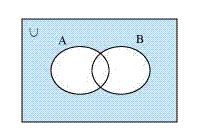
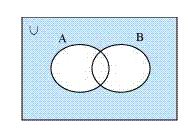
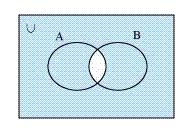
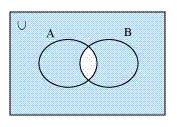
Draw appropriate Venn diagram for the following:
(i). (A ∪ B)′
(ii). A′ ∩ B′
(iii). (A ∩ B)′
(iv). A′ ∪ B′
8.
Make correct statements by filling in the symbols \(\subset\) or \(\not \subset\)in the blank spaces :
(i) { 2, 3, 4 } . . . { 1, 2, 3, 4,5 }
(ii) { a, b, c } . . . { b, c, d }
(iii) {x : x is a student of Class XI of your school}. . .{x : x student of your school}
(iv) {x : x is a circle in the plane} . . .{x : x is a circle in the same plane with radius 1 unit}
(v) {x : x is a triangle in a plane} . . . {x : x is a rectangle in the plane}
(vi) {x : x is an equilateral triangle in a plane} . . . {x : x is a triangle in the same plane}
(vii) {x : x is an even natural number} . . . {x : x is an integer}
9.
Match each of the set on the left in the roster form with the same set on the right described in set-builder form:
(i) {1, 2, 3, 6} (a) {x : x is a prime number and a divisor of 6}
(ii) {2, 3} (b) {x : x is an odd natural number less than 10}
(iii) {M,A,T,H,E,I,C,S} (c) {x : x is natural number and divisor of 6}
(iv) {1, 3, 5, 7, 9} (d) {x : x is a letter of the word MATHEMATICS}.
10.
Out of 100 students, 15 passed in English, 12 passed in Mathematics, 8 in Science, 4 in English and Science, 4 in all the three.Find how many students passed in English and Mathematics but not in Science?
11.
A college awarded 38 medals in football, 15 in basketball and 20 in cricket. If these medals went to a total of 58 men and only three men got medals in all the three sports, how many received medals in exactly two of the three sports?
12.
Show that for any sets A and B, A = (A \(\cap\) B) \(\cup\) (A-B) and A \(\cup\) (B-A)=(A \(\cup\) B).
13.
Let A = {I, 3, 5, 7, 9}, B = {2, 4, 6, 8, 10}, C = {2, 3, 4, 5}, Find.
(i) A - (B \(\cup\) C)
(ii) A-(B \(\cap\) C)
(iii) A \(\cap\) (B-C)
(iv) B-(A-C)
14.
Prove that n (n+1) (n+5) is a multiple of 3, for all \(n\in N\)
15.
Let A, B, Cbe three sets. If A \(\in\) Band B\(\subset\)C, then _____.
A \(\subset\) C
A \(\in\) C
A \(\notin\) C
None of these
16.
If A \(\subset\) B and A \(\neq\) B, then _____.
A is called a proper subset of B
A is called a super set of B
A is not a subset of B
B is a subset of A
17.
Which of the following is not a set?
(a) The collection of days of week.
(b) The collection of prime number less than 10.
(c) The collection of intelligent students in your class.
(d) All of the above.
18.
If A = {1, 2, 3, 4, 5, 6}then the number of proper sub-sets is _____.
64
36
26
63
19.
For any two sets A and B, A \(\cup\) B = A iff _____.
A ⊂ B
B∈A
A=B
A\(\ne\)B
20.
For any two sets A and B, \(A\cap(A\cup B)=\)_____.
B
A
ф
none of these
1.
If A and B are two sets such that A ⊂ B, then A ∪ B = B.
2.
Given n(A) = 3
and n (B) = 6
We know that,
n ( A \(\cup \) B) = n(A) + n(B) = n ( A \(\cap\) B)
Clearly, n ( A \(\cup \) B) will be maximum when n ( A \(\cap\) B) is minimum and it will be minimum n ( A \(\cap\) B) is minimum. Therefore, two cases arise
Case I when n ( A \(\cap\) B) is minimum
The minimum value of n ( A \(\cap\) B) = 0
\(\therefore\) n ( A \(\cup \) B) = n(A) + n(B) = 3 + 6 =9
Then, maximum value of n ( A \(\cup \) B) is 9
Case II When n ( A \(\cap\) B) is maximum
n ( A \(\cap\) B) will be maximum, if A \(\subseteq \) B
In this case, n ( A \(\cap\) B) = 3
ஃ n ( A \(\cap\) B) = 3 + 6 -3 = 6
Thus, the minimum number of elements in A \(\cup \) B is 6.
3.
All rectangles, Rhombus and square are parallelograms because its opposite sides are equal and parallel.
Therefore \({ F }_{ 2 }\subset { F }_{ 1 },{ F }_{ 3 }\subset { F }_{ 1 }\) and \({ F }_{ 4 }\subset { F }_{ 1 }\)
\({ F }_{ 1 }={ F }_{ 2 }\cup { F }_{ 3 }\subset { F }_{ 4 }\)
4.
Given, n(X)=40, n(X\(\cup \)Y)=60
and n(X\(\cap \)Y) = 10
clearly, n(X\(\cup \)Y)= n(X) + n(Y) - n(X\(\cap \)Y)
\(\Rightarrow \) 60= 40 + n(Y)-10
\(\Rightarrow \) 60= 30 + n(Y)
\(\Rightarrow \) n(Y)= 60-30
\(\therefore\) n(Y)=30
Hence, Y have 30 elements
5.
Given, A = { 0, 1, 2, 3, 4, 5, 6, 7, 8, 9, 10}
Since, 12 is not an element of A, therefore 12 \(\notin \) A
6.
We are sure that members of this collection are January, June, and July. So, this collection is well-defined. Hence, it is a set.
7.
(i) (A ∪ B)'
(ii). A′ ∩ B′
(iii). (A ∩ B)′
(iv). A′ ∪ B′
8.
(i) { 2, 3, 4 } . . . { 1, 2, 3, 4,5 }
{2, 3, 4} ⊂ {1, 2, 3, 4, 5}
(ii) { a, b, c } . . . { b, c, d }
{a, b, c} ⊄ {b, c, d}
(iii) {x : x is a student of Class XI of your school}. . .{x : x student of your school}
{x: x is a student of class XI of your school}⊂ {x: x is student of your school}
(iv) {x : x is a circle in the plane} . . .{x : x is a circle in the same plane with radius 1 unit}
{x: x is a circle in the plane} ⊄ {x: x is a circle in the same plane with radius 1 unit}
(v) {x : x is a triangle in a plane} . . . {x : x is a rectangle in the plane}
{x: x is a triangle in a plane} ⊄ {x: x is a rectangle in the plane}
(vi) {x : x is an equilateral triangle in a plane} . . . {x : x is a triangle in the same plane}
{x: x is an equilateral triangle in a plane}⊂ {x: x in a triangle in the same plane}
(vii) {x : x is an even natural number} . . . {x : x is an integer}
{x: x is an even natural number} ⊂ {x: x is an integer}
9.
(1) All the elements of this set are natural numbers as well as the divisors of 6. Therefore, (1) matches with (c).
(2) It can be seen that 2 and 3 are prime numbers. They are also the divisors of 6.
Therefore, (2) matches with (a).
(3) All the elements of this set are letters of the word MATHEMATICS. Therefore, (3) matches with (d).
(4) All the elements of this set are odd natural numbers less than 10. Therefore, (4) matches with (b)
10.
n(E)=15,n(M)=12,n(s)=8,\(n(E\cap M)=6\)
\(n(M\cap S)=7,n(E\cap S)=4,n(E\cap M\cap S)=4\)
(i)\(n(E\cap M\cap \overline { S } )=n(E\cap M)-n(E\cap M\cap S)\)
=6-4=2
11.
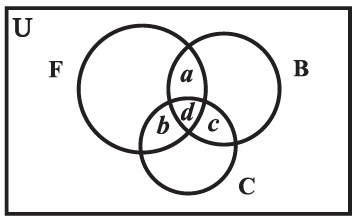
Let F, B and C denote the set of men who received medals in football, basketball and cricket, respectively.
Then n ( F ) = 38, n ( B ) = 15, n ( C ) = 20
n (F \(\cup\) B \(\cup\) C ) = 58 and n (F \(\cap\) B \(\cap\) C ) = 3
Therefore, n (F \(\cup\) B \(\cup\) C ) = n ( F ) + n ( B )
+ n ( C ) – n (F \(\cap\) B ) – n (F \(\cap\) C ) – n (B \(\cap\) C ) + n ( F \(\cap\) B \(\cap\) C ),
gives n ( F \(\cap\) B ) + n ( F \(\cap\) C ) + n ( B \(\cap\) C ) = 18
Consider the Venn diagram.
Here, a denotes the number of men who got medals in football and basketball only, b denotes the number of men who got medals in football and cricket only, c denotes the number of men who got medals in basket ball and cricket only and d denotes the number of men who got medal in all the three. Thus, d = n ( F \(\cap\) B \(\cap\) C ) = 3 and
a + d + b + d + c + d = 18
Therefore a + b + c = 9,
which is the number of people who got medals in exactly two of the three sports.
12.
(A \(\cap\) B) \(\cup\) (A - B)
= (A \(\cap\) B) \(\cup\) (A \(\cap\) B') = A \(\cap\) (B \(\cup\) B') (By distributive law)
=A\(\cap\)U=A
Hence A = (A\(\cap\) B) \(\cup\) (A - B)
Also A \(\cup\) (B - A)
=A\(\cup\)(B\(\cap\)A')
= (A \(\cup\) B) \(\cap\) (A \(\cup\) A') (By distributive law)
= (A\(\cup\)B) \(\cap\) U
=A\(\cup\)B
Hence A \(\cup\) (B - A) = A \(\cup\) B.
13.
(i) {1,7,9}
(ii) {1,3,5,7,9}
(iii) ф
(iv) {2,4,6,8,10}
14.
Step I Let P(n) be the given statement
i.e.P(n) : n(n + 1) (n + 5) is a multiple of 3.
Step II Forn = 1,we have P(1) : 1(1 + 1)(1 + 5) = 1 × 2 × 6 =12=3×4
Which is a multiple of 3.
So, P(1) is true.
Step III Let P(k) be true form = k.
i.e.P(k) : k(k + 1)(k + 5) is a multiple of 3.
Then,k(k + 1)(k + 5) = 3λ
⇒k(k2 + 5k + k5) = 3λ
⇒k3 + 6k2 + 5k = 3λ...(i)
Step IV Now,we shall prove the statement form = k + 1.
For this,we have to show that (k + 1)(k + 1 + 1)(k + 1+5)is a multiple of 3.
Then,(k+1)(k+1+1)(k+1+5)=(k+1)(k+2)(k+6)
=(k2+2k+k+2)(k+6)=(k2+3k+2)(k+6)
=k3+6k2+3k2+18k+2k+12
=k3+9k2+20k+12
=(3λ−6k2−5k)+9k2+20k+12 [fromEq.(i),k3=3λ−6k2−5k]
=3λ+3k2+15k+12=3(λ+k2+5k+4)
Which is a multiple of 3 .
Thus,P(k+1) is true, whenever P(k) is true.
Hence,by principle of mathematical induction,the statement is true for all natural numbers n.
15.
(b)
A \(\in\) C
16.
(a)
A is called a proper subset of B
17.
(c)
(c) The collection of intelligent students in your class.
18.
(d)
63
19.
(b)
B∈A
20.
(b)
A

11th Standard CBSE Syllabus & Materials
11th Standard CBSE
CBSE 11th Business Studies Forms of Business Organisation Sample Question Papers Study Material - QB365 Set A
NEW11th Standard CBSE
CBSE 11th Business Studies Business, Trade and Commerce Sample Question Papers Study Material - QB365 Set A
NEW11th Standard CBSE
CBSE 11th Physics Waves Sample Question Papers Study Material - QB365 Set A
NEW11th Standard CBSE
CBSE 11th Physics Kinetic Theory Sample Question Papers Study Material - QB365 Set A



NCERT Books

Syllabus

Exam Pattern

Sample Question Papers

Previous year Question Papers

Important Notes

MCQ Practice test

NCERT Exemplers

Case study Questions

Image Based Questions

Passage based Questions

HOT Questions

Value Based Questions

Model Questions Papers
NCERT ( Book Back ) Questions

Assertion and Reason
Important Questions And Answers

CBSE 11th Standard CBSE Subjects
CBSE Standards







