
 100% FREE ACCESS
11th Standard CBSE Syllabus & Materials
11th Standard CBSE
CBSE 11th Economics PART-A - Presentation of Data - New Sample Question Papers Study Material - QB365 Set A
NEW11th Standard CBSE
CBSE 11th Economics PART-A - Organisation of Data - New Sample Question Papers Study Material - QB365 Set A
NEW11th Standard CBSE
CBSE 11th Economics PART-A - Collection of Data - New Sample Question Papers Study Material - QB365 Set A
NEW11th Standard CBSE
CBSE 11th Economics PART-A - Introduction to Economics and Statistics - New Sample Question Papers Study Material - QB365 Set A
NEW11th Standard CBSE
CBSE 11th Business Studies International Trade Sample Question Papers Study Material - QB365 Set A
NEW11th Standard CBSE
CBSE 11th Business Studies Evolution and Fundamentals of Business Sample Question Papers Study Material - QB365 Set A

Published on: 21/10/2025
Download CBSE Class 11th Standard CBSE Mathematics question papers, sample papers, important questions, and previous year solved papers in PDF format. Get free study materials, NCERT solutions, and exam preparation resources for Class 11th Standard CBSE Mathematics
Questions + Answers key
Take MCQ Mathematics Test
1.
Solve the inequality 5x - 1> 3x + 7 and show the graph of the solution on number line.
2.
Let f = {(1,1), (2,3), (0, –1), (–1, –3)} be a linear function from Z into Z. Find f(x).
3.
Find the modulus and argument of the following complex number \(\frac { -16 }{ 1+\sqrt { 3 } i } \)
4.
Find the domain and range of the following functions:
f(x) = x2 - 3x +\({13\over4}\)
5.
How many different 4-digit numbers can be formed from the digits 2, 3, 4 and 6, if each digit is used only once in a number? Further, how many of these numbers
(ii) end at 3?
6.
If a cos\(\theta\)+b sin\(\theta\)=c, then \(\theta\)=2n\(\pi\)+\(\alpha \pm \beta \), where cos \(\alpha\)=\(\frac { a }{ \sqrt { { a }^{ 2 }+{ b }^{ 2 } } } \),cos \(\beta \)=\(\frac { c }{ \sqrt { { a }^{ 2 }+{ b }^{ 2 } } } \)and sin \(\alpha\)=\(\frac { b }{ \sqrt { { a }^{ 2 }+{ b }^{ 2 } } } \)
7.
List all the proper subsets of the set A={a,b}.
8.
Let f = \(\left\{\left(x, \frac{x^{2}}{1+x^{2}}\right): x \in R\right\}\) be a functions R into R determine the range of R.
9.
Find the value of sin 15°.
10.
How many 3-digit numbers can be formed from the digits 1, 2, 3, 4 and 5 assuming that
(i) repetition of the digits is allowed?
(ii) repetition of the digits is not allowed?
11.
How many natural numbers less than 1000 can be formed with the digits 1, 2, 3, 4, and 5, if repetition of digits is allowed?
12.
Solve graphically \(4x+3y\ge 12\quad and\quad 4x-5y\ge -20\)
13.
Find the value of x and y, if \(\frac { \left( 1+i \right) x-2i }{ 3+i } +\frac { \left( 2-3i \right) y+i }{ 3-i } =i\)
14.
The Moon's distance from the Earth is 360000 km and its diameter subtend an angle of 31' at the eye of observer. Find the diameter of the Moon.
15.
If X = {a,b,c,d} and Y = {f,b,d,g}, then find
Y - X
16.
In any triangle ABC, prove that \(\frac{a^2sin(B-C)}{sinB+sinC}+\frac{b^2sin(C-A)}{sinC+sinA}+\frac{c^2sin(A-B)}{sinA+sinB}=0\) .
17.
Find the values of x and y if (x+iy) (4+5i) =6-2i.
18.
Draw the Venn diagrams to illustrate the following relationship among sets, E, M and U, where E is the set of students studying English in a school, M is the set of students studying Mathematics in the same school, U is the set of all students in that school.
There is no student who studies both Mathematics and English.
19.
Let A = {1, 2, 3, 4} and B = {5, 6, 7}. If R = {(a, b) ; a \(\in\) A, b \(\in\) B} and a - b is even} then find R.
20.
There are 4 routes between Delhi and Patna. In how many different ways can a man o from Delhi to Patna and return , if for returning
(i) any of the routes is taken ?
(ii) the same routes is taken ?
(iii) the same routes is not taken ?
21.
Solve the following system of linear inqualities \(-2-\frac { x }{ 4 } \ge \frac { 1+x }{ 3 } \) and \(3-x<4\left( x-3 \right) \)
22.
If P(x) is a n degree polynomial, then number of roots are _______.
1
2
3
n
23.
Representation of z = x + iy in terms of rand e is called _______.
polar form of the complex number
cartesian form of the complex number
complex form of the complex number
real form of the complex number
24.
If a + ib = c + id, then _______.
\(a^{2}+c^{2}=0\)
\(b^{2}+c^{2}=0\)
\(b^{2}+d^{2}=0\)
\(a^{2}+b^{2}=c^{2}+d^{2}\)
25.
Eighteen guests have to be seated, half on each side of a long table. Four particular guests desire to sit on one particular side and three others on the other side. The number of ways in which the seating arrangement can be made, is _______.
\(\frac{11 !}{6 ! 5 !} \times 9 ! \times 9 !\)
\(9 ! \times 9 !\)
\(\frac{11 !}{6 ! 5 !} \times 5 ! 6 !\)
None of these
26.
If (n + 1)! = 12 x (n - 1)! then the value of n is equal to
4
3
16
11
27.
Sabnam has 2 school bags, 3 tiffin boxes and 2 water bottles. In how many ways can she carry these items ( choosing one each)?
11
12
13
14
28.
In an experiment, a solution of hydrochloric acid is to be kept between 30°C and 35°C.The range of temperature in degree Fahrenheit, if conversion formula is given byC \(=\frac{5}{9}(F-32)\) where Cand F represent temperature in degree Celsius and degree Fahrenheit respectively, is between _______.
86°F and 95°F
54°F and 63°F
54°F and 95°F
63°F and 86°F
29.
Two real numbers or two algebraic expressions related by the symbol '<', '>', '\(\le\)' or '\(\ge\)'forms an _______.
equation
inequality
set
None of the above
30.
Which of the following is the solution set of the inequality \(\frac{x}{4}<\frac{(5 x-2)}{3}-\frac{(7 x-3)}{5} ?\)
\((4, \infty)\)
\((-\infty, 4)\)
\({[4, \infty)}\)
\((-\infty, 4]\)
31.
Which of the following solution set represent the following figure?
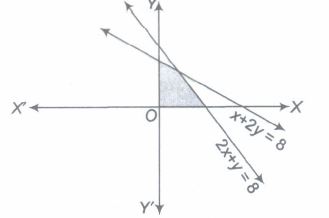
\(x+2 y \leq 8,2 x+y \leq 8, x \geq 0, y \geq 0 \)
\(x-2 y \leq 7, x+y \leq 8, x \geq 0, y \geq 0 \)
\(x+y<82 x+y<8, r>0 y>0\)
None of the above
32.
The value ofcos1°cos2°cos3° ... cos179° is ______.
\(\frac{1}{\sqrt{2}}\)
0
1
-1
33.
Angles of a triangle are in the ratio 4 : 1 : 1. The ratio between its greatest side and perimeter is ______.
\(\frac{3}{2+\sqrt{3}}\)
\(\frac{1}{2+\sqrt{3}}\)
\(\frac{\sqrt{3}}{\sqrt{3}+2}\)
\(\frac{2}{2+\sqrt{3}}\)
34.
The graph of the function defined by \(f(x)=\left\{\begin{array}{cl} 1-x, & x<0 \\ 1 & , x=0 \text { is } \\ 1+x, & x>0 \end{array}\right.\)______.
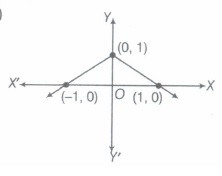
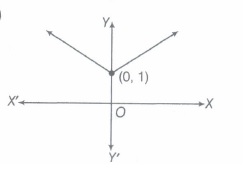
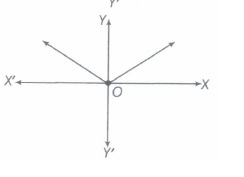
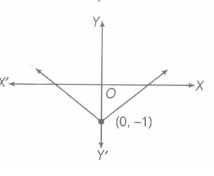
35.
Let R be a relation in N defined by \(R=\left\{\left(1+x, 1+x^{2}\right): x \leq 5, x \in N\right\}\). Which of the following is false?
R = {(2, 2), (3, 5), (4, 10), (5, 17), (6, 25)}
Domain of R = {2, 3, 4, 5, 6}
Range of R = {2,5, 10, 17, 26}
None of the above
36.
Domain of \(\sqrt{a^{2}-x^{2}}(a>0)\) is ______.
(- a, a)
[- a, a]
[0, a]
(- a, 0]
37.
The minute hand of a watch is 1.5 cm long. The distance travelled by the minute hand in 40 minutes is equal to ______.
3.28 cm
4.28 cm
5.28 cm
6.28 cm
38.
Radian measure of 40°20' is equal to ______.
\(\frac{120 \pi}{504}\) radian
\(\frac{121 \pi}{540}\) radian
\(\frac{121 \pi}{3}\) radian
None of these
39.
Let A and B be two sets such that n (A) = 0.16, n(B) = 0.14 and n(A \(\cup\) B) = 0.25. Then, n(A \(\cap\) B) is equal to_____.
0.3
0.5
0.05
None of these
40.
The set of all letters in the word 'BETTER' in roster form is _____.
{B, E, T, R}
{B, T, R}
{B,E,R}
{B, R}
41.
Which of the following is not a set?
(a) The collection of days of week.
(b) The collection of prime number less than 10.
(c) The collection of intelligent students in your class.
(d) All of the above.
42.
The water acidity in a pool is considered normal, when the average pH reading of three daily measurements is between 7.2 and 7.8. The first two pH reading are 7.48 and 7.85, and pH reading of 3rd day is x.
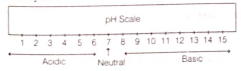
On the basis of above information, answer the following questions.
(i) The average pH of three days is
| (a) 5.11+x | (b) \(5.11+\frac{x}{3}\) | (c) 15.33+x | (d) None of these |
(ii) The system of linear inequality, which shows the given information is
| (a) \(7.2 \leq 5.11+\frac{x}{3} \leq 7.8\) | (b) \(7.2<5.11+\frac{x}{3} \leq 7.8\) | (c) \(7.2 \leq 5.11+\frac{x}{3}<7.8\) | (d) \(7.2<5.11+\frac{x}{3}<7.8\) |
(iii) The solution of linear inequality \(7.2 \leq 5.11+\frac{x}{3}\) is
| (a) x≥6.27 | (b) x>6.27 | (c) x≤6.27 | (d) x<6.27 |
(iv) The solution of linear inequality \(5.11+\frac{x}{3} \leq 78\) is
| (a) x≤8.07 | (b) x<8.07 | (c) x≥8.07 | (d) x>8.07 |
(v) The value of pH on third day is
| (a) [6.27,8.07] | (b) (627,8.07) | (c) (627,8.07] | (d) [6.27,8.07) |
43.
A complex number z is purely real if and only if \(\bar{z}=z\) and is purely imaginary if and only if \(\bar{z}=-z\). Based on the above information, anwer the following qustions.
(i) If \(\frac{3+2 i \sin \theta}{1-2 i \sin \theta}\) is purely real, then \(\theta\) is equal to
| (a) \(n \pi\) | (b) \(\frac{n \pi}{2}\) | (c) \(n \pi \pm \frac{\pi}{3}\) | (d) \(2 n \pi \pm \frac{\pi}{4}\) |
(ii) If x and y are rol numbers and the complex number \(\frac{(2+6) x-1}{4+1}+\frac{(1-6) y+21}{4}\) is purely teal, the relation between x and y is
| (a) 8x+7 y=15 | (b) 8x-17 y=16 | (c) 17x-8 y=15 | (d) 17x+8 y=15 |
(iii) If z be a complex number satisfying \(|\operatorname{Re}(z)|+|m(z)|=4\), then |z| cannot be
| (a) \(\sqrt{7}\) | (b) \(\sqrt{\frac{17}{2}}\) | (c) \(\sqrt{10}\) | (d) \(\sqrt{8}\) |
(iv) The smallest positive integer ( n ) for which \((1+i)^{2 n}=(1-i)^{2 n}\) is
| (a) 2 | (b) 3 | (c) 1 | (d) 4 |
(v) If \(z_1\) and z2 are complex numbers such that \(\left|\frac{z_1-z_2}{z_1+z_2}\right|=1\), then
| (a) \(\frac{z_1}{z_2}\) is purely real |
| (b) \(\frac{z_1}{z_2}\) is purely imaginary |
| (c) z1 is purely real |
| (d) z1 and z2 are purely imaginary |
44.
Consider thc information given below Let P (a, b) be any point on the unit circle given below, which has its centre at origin O. It is given that ∠AOP = x radian.
Now, answer the questions based on the figure given below.
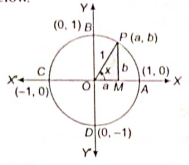
(i) If \(a = \frac{ \sqrt{3}}{2}\) and \(b = \frac{-1}{2}\) then the value of x in radian is
| (a) \(\frac{\pi}{6}\) | (b) \(\frac{7\pi}{6}\) | (c) \(\frac{5\pi}{6}\) | (d) \(\frac{11\pi}{6}\) |
(ii) If x = 75o, then the value of tan x is equal to
| (a) \(2 + \sqrt3\) | (b) \(2-\sqrt3\) | (c) \(\sqrt3 + 3\) | (d) \(\sqrt2 + 1\) |
(iii) If x = 25°, then the value of x in radian is
| (a) \(\frac{5\pi}{18}\) | (b) \(\frac{\pi}{18}\) | (c) \(\frac{5\pi}{36}\) | (d) \(\frac{\pi}{36}\) |
(iv) Which of the following is incorrect?
| (a) sin x is positive for 0 < x < π |
| (b) sin x isnegative for π < x < 2π |
| (c) cos x is positive for 0 < x < π/2 and 3π/2 < x < 2π |
| (d) cos x is positive for π/2 < x < 3π/2 |
1.
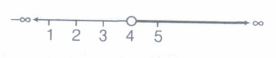
Subtracting (3x -1) from both sides of5x -1 > 3x + 7.
Ans : (4, \(\infty\))
2.
Since f is a linear function, f (x) = mx + c. Also, since (1, 1), (0, – 1) \(\in\) R, f (1) = m + c = 1 and f (0) = c = –1. This gives m = 2 and f(x) = 2x – 1.
3.
\(8,\frac { 2\pi }{ 3 } \)
4.
Domain = R, Range = [1,\(\infty\))
5.
The number of 4-digit numbers formed by the digits 2, 3, 4 and 6
= P(4,4) = \(\frac { 4! }{ 4-4! } \)= \(\frac { 4! }{ 0! } \) [\(\because \) nPr = \(\frac { n! }{ (n-r)! } ]\)
\(=\frac { 4! }{ 1 } = 4\times 3\times 2\times 1= 24\) \([\because 0!=1]\)
In this case, '3' is fixed at the unit's place. Therefore, remaining 3-digits can be 2, 4 and 6. Hence, the required number of 4- digits number = P (3, 3)
\(\frac { 3! }{ 0! } =6\) ... (ii)
6.
Given, a cos\(\theta\)+ b sin \(\theta\)=c....(i)
On dividing Eq.(i) throughout by \(\sqrt { { a }^{ 2 }+{ b }^{ 2 } } \), we get
\(\frac { a }{ \sqrt { { a }^{ 2 }+{ b }^{ 2 } } } cos\theta +\frac { b }{ \sqrt { { a }^{ 2 }+{ b }^{ 2 } } } sin\theta =\frac { c }{ \sqrt { { a }^{ 2 }+{ b }^{ 2 } } } \)
\(\Rightarrow\)cos\(\theta\)cos\(\alpha\)+sin\(\theta\)sin\(\alpha\)=cos\(\beta\)
where, cos\(\alpha\) =\(\frac { a }{ \sqrt { { a }^{ 2 }+{ b }^{ 2 } } } \) ,sin\(\alpha\) =\(\frac { b }{ \sqrt { { a }^{ 2 }+{ b }^{ 2 } } } \)and cos \(\beta\)=\(\frac { c }{ \sqrt { { a }^{ 2 }+{ b }^{ 2 } } } \)
\(\Rightarrow\)cos(\(\theta-\alpha\)) = cos\(\beta\)\(\Rightarrow\)\(\theta-\alpha\) = \(2n\pi \pm \beta \)
\(\therefore \theta =2n\pi +\alpha \pm \beta \)
7.
ϕ,{a},{b}
8.
f(x) is defined for all x \(\epsilon\) R. As x2+1 for any x \(\epsilon\) R.
Now, let \(y=f(x)=\frac{x^{2}}{r^{2}+1}\)
\(\Rightarrow x^{2}=\frac{y}{1-y} \Rightarrow x=\pm \sqrt{\frac{y}{1-y}}\)
Clearly, x will be real, if
\(\frac{y}{1-y} \geq 0 \text { and } y \neq 1\)
\(\begin{array}{ll}
\Rightarrow \frac{y}{y-1} \leq 0 \text { and } y \neq 1 \Rightarrow 0 \leq y<1 \\
\therefore \text { Range }(f)=[0,1) .
\end{array}\)
9.
We have sin 15° = sin (45° – 30°)
= sin 45° cos 30° – cos 45° sin 30°
\(=\frac{1}{\sqrt{2}} \times \frac{\sqrt{3}}{2}-\frac{1}{\sqrt{2}} \times \frac{1}{2}=\frac{\sqrt{3}-1}{2 \sqrt{2}}\)
10.
(i) There will be as many ways as there are ways of filling 3 vacant places in succession by the given five digits. In this case, repetition of digits is allowed. Therefore, the units place can be filled in by any of the given five digits. Similarly, tens and hundreds digits can be filled in by any of the given five digits.Thus, by the multiplication principle, the number of ways in which three-digit numbers can be formed from the given digits is 5 × 5 × 5 = 125
(ii) In this case, repetition of digits is not allowed. Here, if units place is filled in first, then it can be filled by any of the given five digits. Therefore, the number of ways of filling the units place of the three-digit number is 5. Then, the tens place can be filled with any of the remaining four digits and the hundreds place can be filled with any of the remaining three digits. Thus, by the multiplication principle, the number of ways in which three-digit numbers can be formed without repeating the given digits is 5 × 4 × 3 = 60
11.
Required numbers will be of 1-digit, 2-digit or 3-digit.
Ans. 155
12.
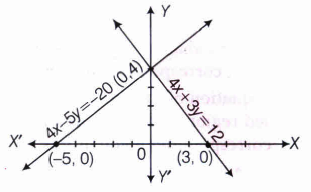
13.
Given \(\frac { \left( 1+i \right) x-2i }{ 3+i } +\frac { \left( 2-3i \right) y+i }{ 3-i } =i\)
\(\Rightarrow \frac { x+\left( x-2 \right) i }{ 3+i } +\frac { 2y+\left( 1-3y \right) i }{ 3-i } =i\)
\(\Rightarrow \frac { \left[ x+\left( x-2 \right) i \right] \left( 3-i \right) +\left[ 2y+\left( 1-3y \right) i \right] \left( 3+i \right) }{ \left( 3+i \right) \left( 3-i \right) } =i\)
\(\Rightarrow \left( 4x+9y-3 \right) +i\left( 2x-7y-3 \right) =10i\)
\(\Rightarrow 4x+9y-3=0\quad and\quad 2x-7y-3=10\)
\(Ans.\ x=3\ and \ y=-1\)
14.
\(\theta =31'=\left( \frac { 31 }{ 60 } \times \frac { \pi }{ 180 } \right) rad\quad and\quad r=360000km\)
\(\because \quad \theta =\frac { l }{ r } \therefore \frac { 31 }{ 60 } \times \frac { \pi }{ 180 } =\frac { 1 }{ 360000 } \)
Ans. 3247.62 km
15.
\(Y-X=\{ f,g\} \)
-S.png)
16.
From sine formula
\(\frac{a}{sinA}=\frac{b}{sinB}=\frac{c}{sinC}=k(say)\)
\(\therefore\) a=ksinA,b=ksinB and c=ksinC
L.H.S \(\frac{a^2sin(B-C)}{sinB+sinC}+\frac{b^2sin(C-A)}{sinC+sinA}+\frac{c^2sin(A-B)}{sinA+sinB}\)
\(=\frac{k^2sin^2A.sin(B-C)}{sinB+sinC}+\frac{k^2sin^2B.sin(C-A)}{sinC+sinA}+\frac{k^2sin^2C.sin(A-B)}{sinA+sinB}\)
\(=k^2[\frac{sinA.sin(\pi-\overline {B+C}).sin(B-C)}{sinB+sinC}+\frac{sinB.sin(\pi-\overline {C+A}).sin(C-A)}{sinC+sinA}+\frac{sinC.sin(\pi-\overline {A+B}).sin(A-B)}{sinA+sinB}]\)
\(=k^2[\frac{sinA.sin(B+C).sin(B-C)}{sinB+sinC}+\frac{sinB.sin(C+A).sin(C-A)}{sinC+sinA}+\frac{sinC.sin(A+B).sin(A-B)}{sinA+sinB}]\)
\(=k^2\frac{sinA(sin^2B-sin^2C)}{sinB+sinC}+\frac{sinB(sin^2C-sin^2A)}{sinC+sinA}+\frac{sinC(sin^2A-sin^2B)}{sinA+sinB}\)
= k2 [sin A (sin B - sin C) + sin B (sin C - sin A) + sin C (sin A - sin B)]
= k2 [sin A sin B - sin A sin C + sin B sin C - sin A sin B + sin A sin C - sin B sin C]
=k2[0]
=0 R.H.S.
17.
(x + iy)(4 + 5i) = 6-2i
⇒ 4x + 5xi + 4yi + 5yi2 = 6-2i
⇒ (4x - 5y) + (5x + 4y)i = 6-2i
Comparing real and imaginary parts on both sides,we have
4x - 5y = 6 and 5x + 4y = -2
Solving these two equations for x and y, we get
x=\(\frac { 14 }{ 41 } \) and y=\(-\frac { 38 }{ 41 } \)
18.
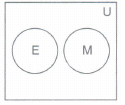
19.
Here A = {1, 2, 3, 4} and B = {5, 6, 7}, a \(\in\) A, b \(\in\) B.
\(\therefore\) a - b = 1 - 5, 1 - 6, 1 - 7, 2 - 5, 2 - 6, 2 - 7, 3 - 5, 3 - 6, 3 - 7, 4 - 5, 4-6,4-7
= -4, -5, -6, -3, -4, -5, -2, -3, -4, -1, -2,-3
R = {(1, 5), (1, 7), (2, 6), (3,5), (3, 7), (4,6)}.
20.
(i) Total number of different routes = 4 x 4
(ii) Total number of different routes = 4
(iii) Total number of different routes = 4 x 3
21.
No solution exists
22.
(d)
n
23.
(a)
polar form of the complex number
24.
(d)
\(a^{2}+b^{2}=c^{2}+d^{2}\)
25.
(a)
\(\frac{11 !}{6 ! 5 !} \times 9 ! \times 9 !\)
26.
(b)
3
27.
(b)
12
28.
(a)
86°F and 95°F
29.
(a)
equation
30.
(a)
\((4, \infty)\)
31.
(c)
\(x+y<82 x+y<8, r>0 y>0\)
32.
(b)
0
33.
(c)
\(\frac{\sqrt{3}}{\sqrt{3}+2}\)
34.
(b)
35.
(a)
R = {(2, 2), (3, 5), (4, 10), (5, 17), (6, 25)}
36.
(b)
[- a, a]
37.
(d)
6.28 cm
38.
(b)
\(\frac{121 \pi}{540}\) radian
39.
(c)
0.05
40.
(a)
{B, E, T, R}
41.
(c)
(c) The collection of intelligent students in your class.
42.
(i) (b)
(ii) (d)
(iii) (a)
(iv) (a)
(v) (b)
43.
(i) (a)
(ii) (b)
(iii) (a)
(iv) (a)
(v) (b)
44.
(i) (d) Hint \(a=\sqrt{3}\) and b=-2
\(\therefore x\) lies in 4 th quadrant.
\( \cot x=\frac{a}{b}=-\sqrt{3}=\cot \left(2 \pi-\frac{\pi}{6}\right) \)
\( \cot x=\cot \frac{11 \pi}{6} \Rightarrow x=\frac{11 \pi}{6}\)
(ii) (a) Hint \(\tan 75^{\circ} =\tan \left(45^{\circ}+30^{\circ}\right)=\frac{\tan 45^{\circ}+\tan 30^{\circ}}{1-\tan 45^{\circ} \tan 30^{\circ}} \)
\(=\frac{1+\frac{1}{\sqrt{3}}}{1-\frac{1}{\sqrt{3}}}=\frac{\sqrt{3}+1}{\sqrt{3}-1}=2+\sqrt{3}\)
(iii) (c) Hint \(x=25^{\circ}\)
\(25^{\circ}=\left(25 \times \frac{\pi}{180^{\circ}}\right) \text { radian }=\frac{5 \pi}{36}\)
(iv) (d) Hint cos x is negative in \(x \in\left(\frac{\pi}{2}, \frac{3 \pi}{2}\right)\).

11th Standard CBSE Syllabus & Materials
11th Standard CBSE
CBSE 11th Business Studies Forms of Business Organisation Sample Question Papers Study Material - QB365 Set A
NEW11th Standard CBSE
CBSE 11th Business Studies Business, Trade and Commerce Sample Question Papers Study Material - QB365 Set A
NEW11th Standard CBSE
CBSE 11th Physics Waves Sample Question Papers Study Material - QB365 Set A
NEW11th Standard CBSE
CBSE 11th Physics Kinetic Theory Sample Question Papers Study Material - QB365 Set A



NCERT Books

Syllabus

Exam Pattern

Sample Question Papers

Previous year Question Papers

Important Notes

MCQ Practice test

NCERT Exemplers

Case study Questions

Image Based Questions

Passage based Questions

HOT Questions

Value Based Questions

Model Questions Papers
NCERT ( Book Back ) Questions

Assertion and Reason
Important Questions And Answers

CBSE 11th Standard CBSE Subjects
CBSE Standards







