
 100% FREE ACCESS
11th Standard CBSE Syllabus & Materials
11th Standard CBSE
CBSE 11th Economics PART-A - Presentation of Data - New Sample Question Papers Study Material - QB365 Set A
NEW11th Standard CBSE
CBSE 11th Economics PART-A - Organisation of Data - New Sample Question Papers Study Material - QB365 Set A
NEW11th Standard CBSE
CBSE 11th Economics PART-A - Collection of Data - New Sample Question Papers Study Material - QB365 Set A
NEW11th Standard CBSE
CBSE 11th Economics PART-A - Introduction to Economics and Statistics - New Sample Question Papers Study Material - QB365 Set A
NEW11th Standard CBSE
CBSE 11th Business Studies International Trade Sample Question Papers Study Material - QB365 Set A
NEW11th Standard CBSE
CBSE 11th Business Studies Evolution and Fundamentals of Business Sample Question Papers Study Material - QB365 Set A

Published on: 21/10/2025
Download CBSE Class 11th Standard CBSE Mathematics question papers, sample papers, important questions, and previous year solved papers in PDF format. Get free study materials, NCERT solutions, and exam preparation resources for Class 11th Standard CBSE Mathematics
Questions + Answers key
Take MCQ Mathematics Test
1.
Find the number of terms in the expansions of the following expressions.
\((z+3 y)^{8}-(z-3 y)^{8}\)
2.
If the different permutations of all the letter of the word EXAMINATION are listed as in a dictionary, how many words are there in this list before the first word starting with E?
3.
Prove that: \(sin^2{\pi\over6}+cos^2{\pi\over3}-tan^2{\pi\over 4}=-{1\over2}\)
4.
Solve in the inequality 3(x-1)\(\underline { < } \)2(x - 3) for real x.
5.
Express \(\frac { \left( 3+\sqrt { 5i } \right) \left( 3-\sqrt { 5i } \right) }{ \left( \sqrt { 3 } +\sqrt { 2i } \right) -\left( \sqrt { 3 } -\sqrt { 2i } \right) } \)in the form of a+ib
6.
If h denote the number of honest people and p denotes the number of punctual people and a relation between honest people and punctual people is given as h=p+16.If P denotes the number of peolple who progress in life and a relation between number of people who
progress and honest is given as \(P=\left( \frac { h }{ 8 } \right) +5\)
Find the relation between number of people who progress in life and punctual.How does the punctuality is important in the progress of life?
7.
If U={a,b,c,d,e,f}, A={a,b,c}, B={c,d,e,f}, C={c,d,e}, D={d,e,f}, then tabulate the following set (U\(\cup \)A)'
8.
Compute (98)5.
9.
Express each of the complex number given in the Exercises in the form a + ib:
\(\left[\left(\frac{1}{3}+i \frac{7}{3}\right)+\left(4+i \frac{1}{3}\right)\right]-\left(-\frac{4}{3}+i\right)\)
10.
Prove that
\(\frac{\sin (x+y)}{\sin (x-y)}=\frac{\tan x+\tan y}{\tan x-\tan y}\)
11.
Show that if A ⊂ B, then C – B ⊂ C – A.
12.
How many 4-letter code can be formed using the first 10 letters of the English alphabet, if no letter can be repeated?
13.
Find all pairs of consecutive odd natural numbers, both of which are larger than 10, such that their sum is less than 40.
14.
If f(x) = x2, find \(\frac { f(1.1)-f(1) }{ 1.1-1 } \)
15.
Find the number of arrangements of the letters of the word INDEPENDENCE. In how many of these arrangements,
(i) do the words start with P
(ii) do all the vowels always occur together
(iii) do the vowels never occur together
(iv) do the words begin with I and end in P?
16.
Solve the inequality x \(\le\) 8 - 4y graphically
17.
Expand using binomial theorem \(\left[ 1+\left( \frac { x }{ 2 } -\frac { 2 }{ x } \right) \right] ^{ 4 },x\neq \)0.
18.
Find the values of other five trigonometric functions sin x = \({3\over 5},\) x lies in second quadrant.
19.
Find the real numbers x and y, if (x-iy) (3+5i) is the conjugate of -6 -24i.
20.
Find the range of the function \(f(x)=\frac { |x+4| }{ x+4 } .\)
21.
\(\text { If } x=\sqrt{-16}, \text { then }\)_______.
x = 4i
x = 4
x = -4
All of these
22.
If x2 + x + 1= 0, then which of the following are correct?
\(x=\frac{-1+\sqrt{3} i}{2}\)
\(x=\frac{-i-\sqrt{3}}{2}\)
\(x=\frac{1+\sqrt{3} i}{2}\)
\(x=\frac{1-\sqrt{3} i}{2}\)
23.
In every term, the sum of indices of a and b in the expansion of (a + b)n is _____.
n
n + 1
n + 2
n - 1
24.
The graphical solution of the system of linear inequalities 3x + 4y \(\ge\) 12,y\(\ge\) 1,x \(\ge\) 0 is _______.
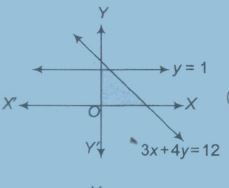
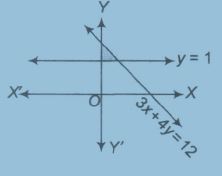
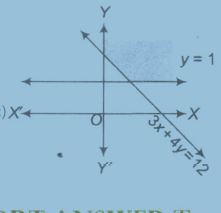
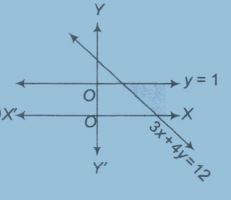
25.
In an experiment, a solution of hydrochloric acid is to be kept between 30°C and 35°C.The range of temperature in degree Fahrenheit, if conversion formula is given byC \(=\frac{5}{9}(F-32)\) where Cand F represent temperature in degree Celsius and degree Fahrenheit respectively, is between _______.
86°F and 95°F
54°F and 63°F
54°F and 95°F
63°F and 86°F
26.
The value ofcos1°cos2°cos3° ... cos179° is ______.
\(\frac{1}{\sqrt{2}}\)
0
1
-1
27.
Let R be a relation in N defined by \(R=\left\{\left(1+x, 1+x^{2}\right): x \leq 5, x \in N\right\}\). Which of the following is false?
R = {(2, 2), (3, 5), (4, 10), (5, 17), (6, 25)}
Domain of R = {2, 3, 4, 5, 6}
Range of R = {2,5, 10, 17, 26}
None of the above
28.
If U = {1, 2, 3,4, ... , 10} is the universal set of A, B where A = {2, 4, 6, 8, 10} and B = {4, 6}. Then given sets can be represented by Venn diagram as _____.
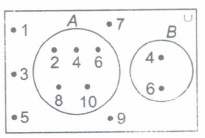
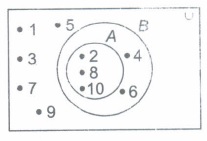
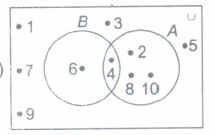
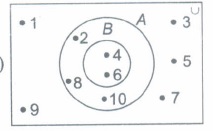
29.
If C0 + C1 + C2 +...+Cn = 256 then 2nC2 is equal to ______.
45
105
120
130
30.
The number of ways in which 8 men can be arranged in a row so that three particular men are seated consecutively is ______.
6! \(\times\)3!
5!
9! \(\times\) 3!
none of these
1.
Ans. 5
2.
In the given word EXAMINATION, there are 11 letters out of which, A, I, and N appear 2 times and all the other letters appear only once.
The words that will be listed before the words starting with E in a dictionary will be the words that start with A only.
Therefore, to get the number of words starting with A, the letter A is fixed at the extreme left position, and then the remaining 10 letters taken all at a time are rearranged.
Since there are 2 Is and 2 Ns in the remaining 10 letters,
Number of words starting with A = \(={10!\over 2!2!}\) \(={10\times9\times8\times7\times6\times5\times4\times3\times2!\over 2\times1\times2!}\)
= 907200
Thus, the required numbers of words is 907200.
3.
We have
L.H.S. =\(sin^2{\pi\over6}+cos^2{\pi\over3}-tan^2{\pi\over 4}\)
\(=({1\over2})^2+({1\over2})^2-(1)^2={1\over4}+{1\over4}-1\)
\(={1+1-4\over4}={-2\over4}={-1\over2}=R.H.S\)
4.
(-∞ , -3)
5.
Write the complex number in the form \(\frac { a+ib }{ c+id } \) and then rationalising the denominator, further simplify it
\(\frac { \left( 3+\sqrt { 5i } \right) \left( 3-\sqrt { 5i } \right) }{ \left( \sqrt { 3 } +\sqrt { 2i } \right) -\left( \sqrt { 3 } -\sqrt { 2i } \right) } \)
\(=\frac { { \left( 3 \right) }^{ 2 }-{ \left( \sqrt { 5i } \right) }^{ 2 } }{ \sqrt { 3 } +\sqrt { 2i } -\sqrt { 3 } +\sqrt { 2i } } \quad \left[ \because \ \left( { z }_{ 1 }+{ z }_{ 2 } \right) \left( { z }_{ 1 }-{ z }_{ 2 } \right) ={ z }_{ 1 }^{ 2 }-{ z }_{ 2 }^{ 2 } \right] \)
\(=\frac { 9+5 }{ 2\sqrt { 2i } } =\frac { 14 }{ 2\sqrt { 2i } } =\frac { 7 }{ \sqrt { 2i } } \times \frac { \sqrt { 2i } }{ \sqrt { 2i } } \)
[by rationalising the denominator]
\(=\frac { 7\sqrt { 2i } }{ 2{ i }^{ 2 } } =\frac { 7\sqrt { 2i } }{ -2 } =0-i\frac { 7\sqrt { 2 } }{ 2 } \)
\(=0+i\left( \frac { -7\sqrt { 2 } }{ 2 } \right) \)
Which is in the form of (a+ib).
6.
Given, relation between honest and punctual people is h=p+16
And relation between honest people and the people who progress in life is \(P=\left( \frac { h }{ 8 } \right) +5\)
Now, required relation between number of people who progress in life and punctual is given by
\(P=\left( \frac { h }{ 8 } \right) +5 \quad [\because h=p+16]\)
\(=\left( \frac { p }{ 8 } \right) +2+5=\left( \frac { p }{ 8 } \right) +7\)
If we are punctual, THisthen we can complete our work at time and the quality of work will also good.This help us to get progress in our life.
7.
\(\phi \)
8.
We express 98 as the sum or difference of two numbers whose powers are easier to calculate, and then use Binomial Theorem.
Write 98 = 100 – 2
Therefore, (98)5 = (100 – 2)5
= 5C0 (100)5 – 5C1 (100)4.2 + 5C2 (100)322
– 5C3 (100)2 (2)3 + 5C4 (100) (2)4 – 5C5 (2)5
= 10000000000 – 5 x 100000000 x 2 + 10 x 1000000 x 4 – 10 x10000 x 8 + 5 x 100 x 16 – 32
= 10040008000 – 1000800032 = 9039207968.
9.
\(\left[\left(\frac{1}{3}+i \frac{7}{3}\right)+\left(4+i \frac{1}{3}\right)\right]-\left(-\frac{4}{3}+i\right)\)
\( =\frac{1}{3}+\frac{7}{3} i+4+\frac{1}{3} i+\frac{4}{3}-i \)
\(=\left(\frac{1}{3}+4+\frac{4}{3}\right)+i\left(\frac{7}{3}+\frac{1}{3}-1\right) \)
\(=\frac{17}{3}+i \frac{5}{3} \)
10.
We have
\(\text { L.H.S. } =\frac{\sin (x+y)}{\sin (x-y)}=\frac{\sin x \cos y+\cos x \sin y}{\sin x \cos y-\cos x \sin y}\)
Dividing the numerator and denominator by cos x cos y, we get
\(\frac{\sin (x+y)}{\sin (x-y)}=\frac{\tan x+\tan y}{\tan x-\tan y}\)
11.
Let A ⊂ B
To show: C – B ⊂ C – A
Let x ∈ C – B
⇒ x ∈ C and x ∉ B
⇒ x ∈ C and x ∉ A [A ⊂ B]
⇒ x ∈ C – A
∴ C – B ⊂ C – A
12.
There are as many codes as there are ways of filling 4 vacant places  in succession by the first 10 letters of the English alphabet, keeping in mind that the repetition of letters is not allowed.The first place can be filled in 10 different ways by any of the first 10 letters of the English alphabet following which, the second place can be filled in by any of the remaining letters in 9 different ways. The third place can be filled in by any of the remaining 8 letters in 8 different ways and the fourth place can be filled in by any of the remaining 7 letters in 7 different ways.
Therefore, by multiplication principle, the required numbers of ways in which 4 vacant places can be filled is 10 × 9 × 8 × 7 = 5040
Hence, 5040 four-letter codes can be formed using the first 10 letters of the English alphabet, if no letter is repeated.
13.
Let x be the smaller of the two consecutive odd natural number, so that the other one is x +2. Then, we should have
x > 10 ... (1)
and x + ( x + 2) < 40 ... (2)
Solving (2), we get
2x + 2 < 40
i.e., x < 19 ... (3)
From (1) and (3), we get
10 < x < 19
Since x is an odd number, x can take the values 11, 13, 15, and 17. So, the required possible pairs will be
(11, 13), (13, 15), (15, 17), (17, 19)
14.
Given, f(x)=x2
\(\therefore \frac{\mathrm{f}(1.1)-\mathrm{f}(1)}{(1.1-1)}=\frac{(1.1)^2-(1)^2}{(1.1-1)}=\frac{1.21-1}{0.1}=\frac{0.21}{0.1}=2.1\)
15.
There are 12 letters, of which N appears 3 times, E appears 4 times and D appears 2 times and the rest are all different. Therefore
The required number of arrangements \(=\frac{12 !}{3 ! 4 ! 2 !}=1663200\)
(i) Let us fix P at the extreme left position, we, then, count the arrangements of the remaining 11 letters. Therefore, the required number of words starting with P
\(=\frac{11 !}{3 ! 2 ! 4 !}=138600\)
(ii) There are 5 vowels in the given word, which are 4 Es and 1 I. Since, they have to always occur together, we treat them as a single object EEEEI for the time being. This single object together with 7 remaining objects will account for 8 objects. These 8 objects, in which there are 3Ns and 2 Ds, can be rearranged in \(\frac{8 !}{3 ! 2 !}\) ways. Corresponding to each of these arrangements, the 5 vowels E, E, E, E and I can be rearranged in \(\frac{5 !}{4 !}\) ways. Therefore, by multiplication principle, the required number of arrangements
\(=\frac{8 !}{3 ! 2 !} \times \frac{5 !}{4 !}=16800\)
(iii) The required number of arrangements = the total number of arrangements (without any restriction) – the number of arrangements where all the vowels occur together.
= 1663200 – 16800 = 1646400
(iv) Let us fix I and P at the extreme ends (I at the left end and P at the right end). We are left with 10 letters. Hence, the required number of arrangements
\(=\frac{10 !}{3 ! 2 ! 4 !}=12600\)
16.
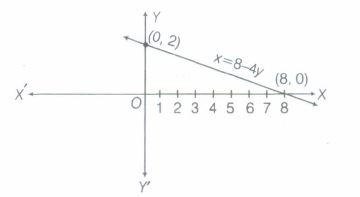
17.
We have \(\left[ 1+\left( \frac { x }{ 2 } -\frac { 2 }{ x } \right) \right] ^{ 4 }\)
=\(\left[ 1+\left( \frac { x }{ 2 } -\frac { 2 }{ x } \right) \right] ^{ 4 }\)
=4C0+4C1\(\left( \frac { x }{ 2 } -\frac { 2 }{ x } \right) \)+4C2\(\left( \frac { x }{ 2 } -\frac { 2 }{ x } \right) ^2\)+4C3\(\left( \frac { x }{ 2 } -\frac { 2 }{ x } \right) ^3\)+4C4\(\left( \frac { x }{ 2 } -\frac { 2 }{ x } \right) ^4\)
=1+4\(\left( \frac { x }{ 2 } -\frac { 2 }{ x } \right) \)+6\(\left( \frac { x^{ 2 } }{ 2 } -\frac { 2 }{ { x }^{ 2 } } -2 \right) \)+4\(\left( \frac { { x }^{ 3 } }{ 8 } -\frac { 8 }{ { x }^{ 3 } } -\frac { 3x }{ 2 } +\frac { 6 }{ x } \right) +\left[ ^{ 4 }C_{ 0 }\left( \frac { x }{ 2 } \right) ^{ 4 }-^{ 4 }C_{ 1 }\left( \frac { x }{ 2 } \right) ^{ 3 }\left( \frac { 2 }{ x } \right) +^{ 4 }C_{ 2 }\left( \frac { x }{ 2 } \right) ^{ 2 }\left( \frac { 2 }{ x } \right) ^{ 2 }-^{ 4 }C_{ 3 }\left( \frac { x }{ 2 } \right) \left( \frac { 2 }{ x } \right) ^{ 3 }+^{ 4 }C_{ 4 }\left( \frac { x }{ 2 } \right) ^{ 4 } \right] \)
=1+\(\left( 2x-\frac { 8 }{ x } \right) +\left( \frac { 3 }{ 2 } { x }^{ 2 }+\frac { 24 }{ { x }^{ 2 } } -12 \right) +\left( \frac { { x }^{ 3 } }{ 2 } -\frac { 32 }{ { x }^{ 3 } } -6x+\frac { 24 }{ x } \right) +\left( \frac { { x }^{ 4 } }{ 16 } -{ x }^{ 2 }+6\frac { 16 }{ { x }^{ 2 } } +\frac { 16 }{ { x }^{ 4 } } \right) \)
=-5-4x + \(\frac { { x }^{ 2 } }{ 2 } +\frac { { x }^{ 3 } }{ 2 } +\frac { { x }^{ 4 } }{ 16 } +\frac { 16 }{ x } +\frac { 8 }{ { x }^{ 2 } } +\frac { 32 }{ { x }^{ 3 } } -\frac { 16 }{ { 4 }^{ 4 } } \)
18.
Here sin x = \(3\over 5\)
Now sin2 x + cos2 x = 1
\(\Rightarrow ({3\over 5})^2+cos^2x=1\)
\(\Rightarrow cos^2 \ x=1-{9\over25}\)
\(\Rightarrow cos^2x={16\over25}\)
\(\Rightarrow cos x=\pm{4\over 5}\)
But x lies in second quadrant.
\(\therefore cos x =-{4\over 5}\)
Now cosec x=\({1\over sin \ x}={5\over3}\)
and secx=\({1\over cos x}=-{5\over4}\)
\(tan x={sin \ x\over cos \ x }={3/5 \over -4/5}={-3\over 4}\)
and cot x=\({cos x\over sin x}={-4/5\over 3/5}={-4\over 3}\)
19.
We have, (x-iy)(3+5i) is the conjugate of -6-24i =-6-24i.
\(\Rightarrow \) (x - iy) (3 + 5i) = -6 + 24i
[conjugate of -6-24i = -6 + 24i]
\(\Rightarrow \) 3x + 3iy + 5ix + 5i2y = -6+24i
\(\Rightarrow \) (3x + 5y) + i(5x - 3y) = -6+24i [i2=-1] ...(i)
On equating real and imaginary parts both sides of Eq. (i) we get
3x + 5y = -6 ....(ii)
5x - 3y = 24
On multiplying Eq, (i) by 3 and Eq. (ii) by 5, then adding the result, we get
9x + 15y + 25x - 15y = -18 + 120 \(\Rightarrow \) 34x = 102 \(\Rightarrow \) x = 3
On substituting x = 3 in Eq,...(ii) we get
9 + 5y = -6\(\Rightarrow \) 5y = -15 \(\Rightarrow \)y = -3
Hence, the required values of x and y are respectively 3 and -3
20.
{-1,1}
21.
(a)
x = 4i
22.
(a)
\(x=\frac{-1+\sqrt{3} i}{2}\)
23.
(a)
n
24.
(c)
25.
(a)
86°F and 95°F
26.
(b)
0
27.
(a)
R = {(2, 2), (3, 5), (4, 10), (5, 17), (6, 25)}
28.
(d)
29.
(c)
120
30.
(a)
6! \(\times\)3!

11th Standard CBSE Syllabus & Materials
11th Standard CBSE
CBSE 11th Business Studies Forms of Business Organisation Sample Question Papers Study Material - QB365 Set A
NEW11th Standard CBSE
CBSE 11th Business Studies Business, Trade and Commerce Sample Question Papers Study Material - QB365 Set A
NEW11th Standard CBSE
CBSE 11th Physics Waves Sample Question Papers Study Material - QB365 Set A
NEW11th Standard CBSE
CBSE 11th Physics Kinetic Theory Sample Question Papers Study Material - QB365 Set A



NCERT Books

Syllabus

Exam Pattern

Sample Question Papers

Previous year Question Papers

Important Notes

MCQ Practice test

NCERT Exemplers

Case study Questions

Image Based Questions

Passage based Questions

HOT Questions

Value Based Questions

Model Questions Papers
NCERT ( Book Back ) Questions

Assertion and Reason
Important Questions And Answers

CBSE 11th Standard CBSE Subjects
CBSE Standards







