
 100% FREE ACCESS
11th Standard CBSE Syllabus & Materials
11th Standard CBSE
CBSE 11th Economics PART-A - Presentation of Data - New Sample Question Papers Study Material - QB365 Set A
NEW11th Standard CBSE
CBSE 11th Economics PART-A - Organisation of Data - New Sample Question Papers Study Material - QB365 Set A
NEW11th Standard CBSE
CBSE 11th Economics PART-A - Collection of Data - New Sample Question Papers Study Material - QB365 Set A
NEW11th Standard CBSE
CBSE 11th Economics PART-A - Introduction to Economics and Statistics - New Sample Question Papers Study Material - QB365 Set A
NEW11th Standard CBSE
CBSE 11th Business Studies International Trade Sample Question Papers Study Material - QB365 Set A
NEW11th Standard CBSE
CBSE 11th Business Studies Evolution and Fundamentals of Business Sample Question Papers Study Material - QB365 Set A

Published on: 21/10/2025
Download CBSE Class 11th Standard CBSE Mathematics question papers, sample papers, important questions, and previous year solved papers in PDF format. Get free study materials, NCERT solutions, and exam preparation resources for Class 11th Standard CBSE Mathematics
Questions + Answers key
Take MCQ Mathematics Test
1.
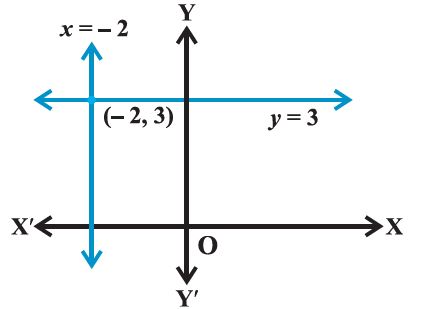
Find the equations of the lines parallel to axes and passing through (– 2, 3).
2.
Find the slope of the lines:
(a) Passing through the points (3, – 2) and (–1, 4),
(b) Passing through the points (3, – 2) and (7, – 2),
(c) Passing through the points (3, – 2) and (3, 4),
(d) Making inclination of 60° with the positive direction of x-axis.
3.
Find the angle between the lines \(\sqrt { 3x } \)+y=1 and x+\(\sqrt { 3y } \)=1.
4.
The base of an equilateral triangle with side 2a lies along the Y-axis such that the mid point of the base is at the origin.Find vertices of the triangle.
5.
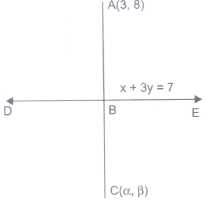
Find the image of the point (3, 8) with respect to the line x +3y = 7 assuming the line to be a plane mirror.
6.
Find the equation of the lines through the point (3, 2) which make an angle of 45° with the line x - 2y = 3.
7.
Reduce the following equations into intercept form and find their intercepts on the axes.
(i) 3x + 2y - 12 = 0,
(ii) 4x - 3y = 6,
(iii) 3y + 2 = 0.
8.
Reduce the following equation into slope intercept form and find their slopes and the y-intercepts
(i) x + 7y = 0,
(ii) 6x + 3y – 5 = 0,
(iii) y = 0.
9.
Find equation of the line parallel to the line 3x - 4y + 2 = 0 and passing through the point (-2, 3).
10.
Find equation of the line through the point (0, 2) making an angle \(2\pi\over 3\) with the positive x-axis. Also, find the equation of line parallel to it and crossing the y-axis at a distance of 2 units below the origin.
11.
Perpendicular distance from the origin is 5 units and the angle made by the perpendicular with the positive x-axis is 30°.
12.
Find a point on the x-axis, which is equidistant from the points (7, 6) and (3, 4).
13.
Find the distance between P(x1, y1) and Q(x2, y2) when: (i) PQ is parallel to the y-axis (ii) PQ is parallel to the x-axis.
14.
A ray of light passing through the point (1, 2) reflects on the x-axis at point A and the reflected ray passes through the point (5, 3). Find the coordinates of A.
15.
The equation of a line perpendicular to the line x - 2y + 3 = 0 and passing through the point (1, - 2) is ______.
y = 2x
x = 2y
x = - 2y
y = - 2x
16.
If Ax + By +C= 0, B \(\ne\) 0, then slope intercept form of this equation is ______.
\(y=\frac{A}{B} x+\frac{C}{B}\)
\(y=\frac{A}{B} x-\frac{C}{B}\)
\(y=-\frac{A}{B} x+\frac{C}{B}\)
\(y=-\frac{A}{B} x-\frac{C}{B}\)
17.
The value of x for which the points (x, - 1),(2,1) and (4, 5) are collinear, will be ______.
0
1
2
3
18.
Coordinates of the mid-point of the line segment joining the points (x1,y1) and (x2, y2) are ______.
\(\frac{x_{1}+x_{2}}{2}, \frac{y_{1}+y_{2}}{2}\)
\(\frac{x_{1}+x_{2}}{3}, \frac{y_{1}+y_{2}}{3}\)
\(\frac{x_{1}-x_{2}}{2}, \frac{y_{1}-y_{2}}{2}\)
\(\frac{x_{1}-x_{2}}{3}, \frac{y_{1}-y_{2}}{3}\)
19.
The study of coordinate geometry include ______.
coordinate axes and coordinate planes
plotting of points in a plane
distance between two points and section formulae
All of the above
20.
A line passes through the point (2, 2) and is perpendicular to the line 3x + y = 3. Its y intercept is ______.
1/3
5
3/4
4/3
1.
Position of the lines . The y-coordinate of every point on the line parallel to x-axis is 3, therefore, equation of the line parallel tox-axis and passing through (– 2, 3) is y = 3. Similarly, equation of the line parallel to y-axis and passing through (– 2, 3) is x = – 2.
2.
(a) The slope of the line through (3, – 2) and (– 1, 4) is
\(m=\frac{4-(-2)}{-1-3}=\frac{6}{-4}=-\frac{3}{2}\)
(b) The slope of the line through the points (3, – 2) and (7, – 2) is
\(m=\frac{-2-(-2)}{7-3}=\frac{0}{4}=0\)
(c) The slope of the line through the points (3, – 2) and (3, 4) is
\(m=\frac{4-(-2)}{3-3}=\frac{6}{0}\), which is not defined.
(d) Here inclination of the line \(\alpha\) = 60°. Therefore, slope of the line is
m = tan 60° = \(\sqrt{3}\)
3.
We have \(\sqrt{3}x+y=1\)
\(\Rightarrow y=-\sqrt{3}x+1\)
\(\therefore m_1=-\sqrt{3}\)
Also \(x+\sqrt{3}y=1\)
\(\Rightarrow \sqrt{3}y=-x+1\)
\(\Rightarrow y=\frac{-1}{\sqrt{3}}x+\frac{1}{\sqrt{3}}\)
\(\therefore m_2=\frac{-1}{\sqrt{3}}\)
Let \(\theta\) be the angle between the lines. Then
\(\tan\theta=|\frac{-\sqrt{3}+\frac{1}{\sqrt{3}}}{1+(-\sqrt{3}(\frac{-1}{\sqrt{3}})}|\)
\(=|\frac{\frac{-3+1}{\sqrt{3}}}{1+1}|=|\frac{-2}{\sqrt{3}}\times \frac{1}{2}|\)
\(=|\frac{-1}{\sqrt{3}}|=\frac{1}{\sqrt{3}}\)
\(\tan\theta=\tan 30^o\) and \(\tan(180^o-30^o)\)
\(\theta=30^o\) and \(150^o\)
4.
Let ABC be the given equilateral triangle with side 2a.
Accordingly, AB = BC = CA = 2a
Assume that base BC lies along the y-axis such that the mid-point of BC is at the origin.
i.e., BO = OC = a, where O is the origin.
Now, it is clear that the coordinates of point C are (0, a), while the coordinates of point B are (0, –a).
It is known that the line joining a vertex of an equilateral triangle with the mid-point of its opposite side is perpendicular.
Hence, vertex A lies on the y-axis.
On applying Pythagoras theorem to ΔAOC, we obtain
(AC)2 = (OA)2 + (OC)2
⇒ (2a)2 = (OA)2 + a2
⇒ 4a2 – a2 = (OA)2
⇒ (OA)2 = 3a2
⇒ OA = \(\sqrt{3}\)
\(\therefore\) coordinates of points \(A=(\pm \sqrt{3} a, 0)\)
thus, the vertics of the given equilateral triangle are \((0, a),(0,-a), \text { and }(\sqrt{3} a, 0) \text { or }(0, a),(0,-a)\) and \((-\sqrt{3} a, 0)\)
5.
Let the image of the point A(3, 8) in the line mirror DE be \(C(\alpha, \beta)\) . Then AC is perpendicular bisector of DE.
The coordinates of point B are \((\frac{\alpha+3}{2},\frac{\beta+8}{2})\)
Since point B lies on the line x + 3y = 7,
\(\therefore \frac{\alpha +3}{2}+\frac{3(\beta+8)}{2}=7\)
\(\Rightarrow \alpha +3+3\beta+24 =14\)
\(\therefore \alpha+3\beta+13=0\).....(i)
Since AC is perpendicular on DE
\(\therefore\) Slope of AC x Slope of DE = -1
\(\Rightarrow \frac{\beta-8}{\alpha-3}\times \frac{-1}{3}=-1\Rightarrow\beta-8=3 \alpha -9\)
\(\Rightarrow 3\alpha - \beta - 1 = 0\)
Solving (i) and (ii) we get
\(\alpha=-1\) and \(\beta =-4\)
Thus image of point (3, 8)is (-1, -4).
6.
Let m be the slope of required line
which passes through point (3, 2). Then equation of required line is
y - 2 = m(x - 3)... (i)
The equation of given line is x - 2y = 3
\(\Rightarrow y=\frac{x}{2}-\frac{3}{2}\)....(ii)
\(\therefore\) Slope of given line is \(\frac{1}{2}\)
It is given that line (i) and (ii) make an angle of 45o.
\(\therefore \tan 45^o=\left| \frac { m-\frac { 1 }{ 2 } }{ 1+\frac { m }{ 2 } } \right| \)
\(\therefore 1=|\frac{2m-1}{2+m}|\)
\(\Rightarrow \frac{2m-1}{2+m}=\pm 1\)
When \(\frac{2m-1}{2+m}=1\)
\(\Rightarrow\) 2m - 1 = 2 + m \(\Rightarrow\) m = 3
Then equation of required line is
y - 2 = 3(x - 3)
\(\Rightarrow\) y - 2 = 3x - 9 \(\Rightarrow\) 3x - y - 7 = 0
When \(\frac{2m-1}{2+m}=-1\Rightarrow\) 2m - 1 = -2 -m
\(\Rightarrow\) 3m = -1 \(\Rightarrow\) m = \(\frac{-1}{3}\)
Then the equation of required line is
\(y-2=\frac{-1}{3}(x-3)\)
\(\Rightarrow\) 3y - 6 = -x + 3 \(\Rightarrow\) x + 3y - 9 = 0.
7.
(i) The given equation is 3x + 2y – 12 = 0.
It can be written as
\(\Rightarrow\) 3x + 2y = 12
\(\Rightarrow \frac{3x}{12}+\frac{2y}{12}=1\Rightarrow\frac{x}{4}+\frac{y}{6}=1\)
\(\text { This equation is of the form } \frac{x}{a}+\frac{y}{b}=1 \text { , where } a=4 \text { and } b=6 \text { . }\)
Therefore, equation (1) is in the intercept form, where the intercepts on the x and y axes are 4 and 6 respectively.
(ii) The given equation is 4x – 3y = 6.
It can be written as
\(\Rightarrow \frac{4x}{6}-\frac{3y}{6}=1\Rightarrow \frac{2x}{3}-\frac{y}{2}=1\)
\(\Rightarrow \frac{x}{\frac{3}{2}}+\frac{y}{-2}=1\)
\(\text { This equation is of the form } \frac{x}{a}+\frac{y}{b}=1 \text { , where } a=\frac{3}{2} \text { and } b=-2 \text { . }\)
Therefore, equation (1) is in the intercept form, where the intercepts on the x and y axes are \(\frac {3}{2}\) and -2 respectively.
(iii) The given equation is 3y + 2 = 0.
It can be written as
\(\Rightarrow 3y=-2\Rightarrow\frac{3y}{2}=1\)
\(\Rightarrow{0x\over -2}+{3y\over -2}=1\Rightarrow {0x\over -2}+{y\over \frac{-2}{3}}=1\)
\(\text { This equation is of the form } \frac{x}{a}+\frac{y}{b}=1 \text { , where } a=0 \text { and } b=-\frac{2}{3} \text { . }\)
Therefore, equation (1) is in the intercept form, where the intercepts on the x and y axes are 0 and \(-\frac {2}{3}\) respectively.
8.
(i) The given equation is x + 7y = 0.
It can be written as
\(\Rightarrow 7y=-x\Rightarrow y=\frac{-1}{7}x\)
\(\Rightarrow y = \frac{-1}{7}x+0\)
\(\text { This equation is of the form } y=m x+c, \text { where } m=-\frac{1}{7} \text { and } c=0 \text { . }\)
Therefore, equation (1) is in the intercept form, where the intercepts on the x and y axes are \(-\frac{1}{7}\) and 0 respectively.
(ii) The given equation is 6x + 3y – 5 = 0
It can be written as
\(y=\frac{1}{3}(-6 x+5) \)
\(y=-2 x+\frac{5}{3}\)
\(\text { This equation is of the form } y=m x+c, \text { where } m=-2 \text { and } c=\frac{5}{3} \text { . }\)
Therefore, equation (2) is in the intercept form, where the intercepts on the x and y axes are-2 and \(\frac{5}{3}\) respectively.
(iii) The given equation is y = 0.
It can be written as
y = 0.x + 0
This equation is of the form y = mx + c, where m = 0 and c = 0.
Therefore, equation (3) is in the slope-intercept form, where the slope and the y-intercept are 0 and 0 respectively.
9.
The equation of the given line is
\(3 x-4 y+2=0 \)
\(\text { or } y=\frac{3 x}{4}+\frac{2}{4} \)
\(\text { or } y=\frac{3}{4} x+\frac{1}{2},\)
\(\text { which is of the form } y=m x+c\)
\(\text { Slope of the given line }=\frac{3}{4}\)
\(\text { It is known that parallel lines have the same slope. }\)
\(\text { Slope of the other line }=m=\frac{3}{4}\)
\(\text { Now, the equation of the line that has a slope of } \frac{3}{4} \text { and passes through the point }(-2,3) \text { is }\)
\((y-3)=\frac{3}{4}\{x-(-2)\} \)
\(4 y-12=3 x+6 \)
\(\text { i.e., } 3 x-4 y+18=0\)
10.
Here \(m=\tan\frac{2\pi}{3}=\tan 120^o\)
\(=\tan(90^o+30^o)=-\cot 30^o=-\sqrt{3}\)
Now, the Equation of the line passing through point (0, 2) having slope \(-\sqrt{3}\) is
\(y-2=-\sqrt{3}(x-0) \quad\left[\because y-y_{1}=m\left(x-x_{1}\right)\right] \)
\(\Rightarrow y-2=-\sqrt{3} x \Rightarrow \sqrt{3} x+y-2=0\)
Since, the line BD, parallel to AC, intersect below Y-axis. It means that the y-coordinate of intersection point is negative and x-coordinate is 0, Thus, intersection point is (0, - 2).
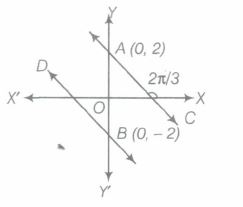
Hence, equation of line through the point B (0, - 2) and having slope \(-\sqrt{3}\) is
\(y+2=-\sqrt{3}(x-0)\left[\because y-y_{1}=m\left(x-x_{1}\right)\right] \)
\(\Rightarrow \sqrt{3} x+y+2=0\)
11.
Here p = 5 and \(\alpha\) = 30°
Putting these values in x cos \(\alpha\) + y sin \(\alpha\) =p, we have
x cos 30° + Y sin 30° = 5
\(\Rightarrow \frac{\sqrt{3}}{2}x+\frac{1}{2}y=5\Rightarrow\sqrt{3}x+y=10\)
12.
Let P(x, 0) be any point on the x-axis which is equidistant from Q(7, 6) and R(3,4).
Then \(PQ=\sqrt{(x-7)^2+(0-6)^2}\)
\(=\sqrt{x^2-14x+49+36}\)
\(=\sqrt{x^2-14x+85}\)
\(PR = \sqrt{(x-3)^2+(0-4)^2}\)
\(=\sqrt{x^2-6x+9+16}\)
\(=\sqrt{x^2-6x+25}\)
Since PQ = PR,
\(\therefore \sqrt{x^2-14x+85} = \sqrt{x^2-6x+25}\)
Squaring both sides, we have
x2 - 14x + 85 = x2 - 6x + 25
\(\Rightarrow\) -14x + 6x = 25 - 85 \(\Rightarrow\) -8x = -60
\(\Rightarrow\) \(x=\frac{15}{2}\)
Thus coordinates of point on the x-axis is \((\frac{15}{2},0)\)
13.
Here P(x1, Y1) and Q(x2, Y2) are two points.
Then \(PQ=\sqrt{(x_2-x_1)^2+(y_2-y_1)^2}\)
(i) PQ is parallel to the y-axis then x2 - x1 = 0
Then \(PQ=\sqrt{(y_2-y_1)^2}=|y_2-y_1|\)
(ii) PQ is parallel to the x-axis then y2 - y1 = 0
Then \(PQ=\sqrt{(x_2-x_1)^2}=|x_2-x_1|\)
14.
Let the coordinates of the point A be ( x, 0 ) .From the figure, the slope of the reflected ray is given by
tan \(\theta \) = \(\frac{3}{5 - x} \) .... ( i )
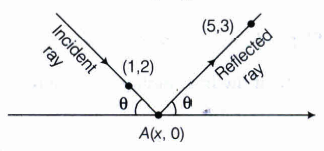
Again , the slope of the incident ray is given by
tan ( \(\pi\) - \(\theta\) ) = \(\frac{-2}{ x-1 }\) [ \(\because\) m = \(\frac{y_2-y_1}{x_2-x_1}\) ]
\(\Rightarrow\) - tan \(\theta\) = \( \frac{-2}{ x-1 }\) [ \(\because\) tan ( \(\pi\) - \(\theta\) = - tan \(\theta\) ) ]
\(\Rightarrow\) tan \(\theta\) = \( \frac{2}{ x - 1}\)
From Eqs.(i) and (ii), we get
\(\frac{3}{ 5 - x }\) = \(\frac{2}{ x - 1}\)
\(\Rightarrow\) 3x - 3 = 10 -2x
\(\Rightarrow\) x = \( \frac{13}{5}\)
Therefore , the required coordinates of the point A are ( \(\frac{13}{5}\),0 ).
15.
(d)
y = - 2x
16.
(d)
\(y=-\frac{A}{B} x-\frac{C}{B}\)
17.
(b)
1
18.
(a)
\(\frac{x_{1}+x_{2}}{2}, \frac{y_{1}+y_{2}}{2}\)
19.
(d)
All of the above
20.
(d)
4/3

11th Standard CBSE Syllabus & Materials
11th Standard CBSE
CBSE 11th Business Studies Forms of Business Organisation Sample Question Papers Study Material - QB365 Set A
NEW11th Standard CBSE
CBSE 11th Business Studies Business, Trade and Commerce Sample Question Papers Study Material - QB365 Set A
NEW11th Standard CBSE
CBSE 11th Physics Waves Sample Question Papers Study Material - QB365 Set A
NEW11th Standard CBSE
CBSE 11th Physics Kinetic Theory Sample Question Papers Study Material - QB365 Set A



NCERT Books

Syllabus

Exam Pattern

Sample Question Papers

Previous year Question Papers

Important Notes

MCQ Practice test

NCERT Exemplers

Case study Questions

Image Based Questions

Passage based Questions

HOT Questions

Value Based Questions

Model Questions Papers
NCERT ( Book Back ) Questions

Assertion and Reason
Important Questions And Answers

CBSE 11th Standard CBSE Subjects
CBSE Standards







