
 100% FREE ACCESS
11th Standard CBSE Syllabus & Materials
11th Standard CBSE
CBSE 11th Economics PART-A - Presentation of Data - New Sample Question Papers Study Material - QB365 Set A
NEW11th Standard CBSE
CBSE 11th Economics PART-A - Organisation of Data - New Sample Question Papers Study Material - QB365 Set A
NEW11th Standard CBSE
CBSE 11th Economics PART-A - Collection of Data - New Sample Question Papers Study Material - QB365 Set A
NEW11th Standard CBSE
CBSE 11th Economics PART-A - Introduction to Economics and Statistics - New Sample Question Papers Study Material - QB365 Set A
NEW11th Standard CBSE
CBSE 11th Business Studies International Trade Sample Question Papers Study Material - QB365 Set A
NEW11th Standard CBSE
CBSE 11th Business Studies Evolution and Fundamentals of Business Sample Question Papers Study Material - QB365 Set A

Published on: 21/10/2025
Download CBSE Class 11th Standard CBSE Mathematics question papers, sample papers, important questions, and previous year solved papers in PDF format. Get free study materials, NCERT solutions, and exam preparation resources for Class 11th Standard CBSE Mathematics
Questions + Answers key
Take MCQ Mathematics Test
1.
Find the distance of the line 4x + 7y + 5 = 0 from the point (1, 2) along the line 2x - y = 0.
2.
Find the equations of the lines, which cut-off intercepts on the axes whose sum and product are 1 and – 6, respectively.
3.
The owner of a milk store finds that, he can sell 980 litres of milk each week at Rs 14/litre and 1220 litres of milk each week at Rs 16/litre. Assuming a linear relationship between selling price and demand, how many litres could he sell weekly at Rs 17/litre?
4.
Passing through the point (- 4, 3) with slope \(1\over 2\)
5.
Write the equations for the x and y-axis.
6.
Find the coordinates of the foot of perpendicular from the point (–1, 3) to the line 3x – 4y – 16 = 0.
7.
If p is the length of perpendicular from the origin to the line whose intercepts on the axes are a and b, then show that \(\frac { 1 }{ { p }^{ 2 } } =\frac { 1 }{ { a }^{ 2 } } +\frac { 1 }{ { b }^{ 2 } } .\)
8.
Using slopes, show that the points A(-4,-1), B(-2,-4), C(4,0) and D(2,3) taken in order, are the vertices of a rectangle.
9.
By using the concept of equation of a line, prove that the three points (3, 0), (– 2, – 2) and (8, 2) are collinear.
10.
If three points (h,0), (a,b) and (0,k) lie on a line, show that \(\frac { a }{ h } +\frac { b }{ k } =1.\)
11.
Without using the Pythagoras theorem, show that the points (4, 4), (3, 5) and (–1, –1) are the vertices of a right angled triangle.
12.
Find the distance of the point (2, -3) from the line 2x - 3y + 6 = 0.
13.
Intersecting the x-axis at a distance of 3 units to the left of origin with slope –2.
14.
Without using distance formula, show that points (– 2, – 1), (4, 0), (3, 3) and (–3, 2) are the vertices of a parallelogram.
15.
Find the inclination of a line whose slope is
\(\frac { 1 }{ \sqrt { 3 } } \)
16.
Find the slope of a line whose inclination is
1350
17.
Reduce the following equation into slope intercept form and find their slopes and the y-intercepts
(i) x + 7y = 0,
(ii) 6x + 3y – 5 = 0,
(iii) y = 0.
18.
Three girls, Rani, Mansi, Sneha are talking to each other while maintaining a social distance due to covid - 19. They are standing on vertices of a triangle, whose coordinates are given.
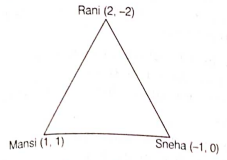
Based on the above information answer the following questions.
(i) The equation of lines formed by Rani and Mansi is
| (a) 3x−y=4 | (b) 3x+y=4 | (c) x−3y=4 | (d) x+3y=4 |
(ii) Slope of equation of line formed by Rani and Sneha is
| (a) \(\frac{2}{3}\) | (b) \(\frac{-3}{2}\) | (c) \(\frac{-2}{3}\) | (d) \(\frac{1}{3}\) |
(iii) The equation of median of lines through Rani is
| (a) 5x +4y= 2 | (b) 5x−4y=2 | (c) 4x−5y=1 | (d) None of these |
(iv) The equation of altitude through Mansi is
| (a) 3 x-2 y=1 | (b) 2x+3 y=5 | (c) x+2 y=3 | (d) None of these |
(v) The equation of line passing through the Rani and parallel to line formed by Mansi and Sneha is
| (a) x-2 y=4 | (b) x+2 y=6 | (c) x-2 y=6 | (d) 2x+y=4 |
19.
Population vs Year graph given below
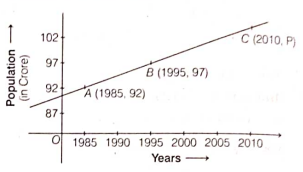
Based on the above information answer the following questions.
(i) The slope of line AB is
| (a) 2 | (b) 1 | (c) 1/2 | (d) 1/3 |
(ii) The equation of line AB is
| (a) x + 2y = 1791 | (b) x - 2y = 1801 | (c) x - 2y = 1791 | (d) x - 2y + 1801 = 0 |
(iii) The population (in crores) in year 2010 is
| (a) 104.5 | (b) 119.5 | (c) 109.5 | (d) None of these |
(iv) The equation of line perpendicular to line AB and passing through (1995, 97) is
| (a) 2x - y = 4087 | (b) 2x + y = 4087 | (c) 2x + y = 1801 | (d) None of these |
(v) In which year the population becomes 110 cr is
| (a) 2020 | (b) 2019 | (c) 2021 | (d) 2022 |
1.
\(\text { The given lines are }\)
\(2 x-y=0 \ldots(1) \)
\(4 x+7 y+5=0 \ldots(2)\)
\(\text { A }(1,2) \text { is a point on line }(1) \text { . }\)
\(\text { Let } \mathrm{B} \text { be the point of intersection of lines }(1) \text { and }(2) .\)
\(\text { On solving equations }(1) \text { and }(2), \text { we obtain } x=\frac{-5}{18} \text { and } y=\frac{-5}{9} \text { . }\)
\(\text { Coordinates of point } \mathrm{B} \text { are }\left(\frac{-5}{18}, \frac{-5}{9}\right) \text { . }\)
\(\text { By using distance formula, the distance between points } \mathrm{A} \text { and } \mathrm{B} \text { can be obtained as }\)
\(\mathrm{AB}=\sqrt{\left(1+\frac{5}{18}\right)^{2}+\left(2+\frac{5}{9}\right)^{2}} \text { units } \)
\(=\sqrt{\left(\frac{23}{18}\right)^{2}+\left(\frac{23}{9}\right)^{2}} \text { units } \)
\(=\sqrt{\left(\frac{23}{2 \times 9}\right)^{2}+\left(\frac{23}{9}\right)^{2}} \text { units } \)
\(=\sqrt{\left(\frac{23}{9}\right)^{2}\left(\frac{1}{2}\right)^{2}+\left(\frac{23}{9}\right)^{2}} \text { units } \)
\(=\sqrt{\left(\frac{23}{9}\right)^{2}\left(\frac{1}{4}+1\right)} \text { units } \)
\(=\frac{23}{9} \sqrt{\frac{5}{4}} \text { units } \)
\(=\frac{23}{9} \times \frac{\sqrt{5}}{2} \text { units } \)
\(=\frac{23 \sqrt{5}}{18} \text { units }\)
\(\text { Thus, the required distance is } \frac{23 \sqrt{5}}{18} \text { units }\)
2.
Let \(\frac{x}{a}+\frac{y}{b}=1\) be the equation of line.
It is given that a + b = 1 and ab = - 6.
We know that (a - b)2 = (a + b)2 - 4ab
\(\Rightarrow\) (a - b)2 = (1)2 - 4 x -6
= 1 + 24 = 25
\(\Rightarrow\) a - b = ±5
Solving a + b = 1 and a - b = 5, we have a = 3 and b = - 2
Solving a + b = 1 and a - b = - 5, we have a = -2 and b = 3
Thus the required equations are
\(\frac{x}{3}+\frac{y}{-2}=1\Rightarrow\) -2x + 3y
= -6 \(\Rightarrow\) 2x - 3y = 6
and \(\frac{x}{-2}+\frac{y}{3}=1\Rightarrow\) 3x - 2y
= -6 \(\Rightarrow\) -3x + 2y = 6.
3.
Here (x1, y1) = (980, 14) and (x2, y2) = (1220, 16).
Putting these values in
\(y-y_1=(\frac{y_2-y_1}{x_2-x_1})(x-x_1)\)
we have
\(y-14=[\frac{16-14}{1220-980}](x-980)\)
\(\Rightarrow y-14=\frac{2}{240}(x-980)\)
\(\Rightarrow y-14=\frac{1}{120}(x-980)\)
\(\Rightarrow 120(y-14)=x-980\)
Putting y = 17, we have
120(17 - 14) = x - 980
\(\Rightarrow\) 120 x 3 = x - 980
\(\Rightarrow\) x = 1340 litres.
4.
Here X0 = - 4, Y0 = 3 and m = \(1\over 2\)
Putting these values in Y - Y0 = m(x - x0), we have
\(\therefore y-3=\frac{1}{2}[x-(-4)]\Rightarrow \) 2y - 6 = x + 4
\(\Rightarrow\) x - 2y + 10 = 0.
5.
The y-coordinate of every point on the x-axis is 0.
Therefore, the equation of the x-axis is y = 0.
The x-coordinate of every point on the y-axis is 0.
Therefore, the equation of the y-axis is x = 0.
6.
Let (a,b) be the coordinates of the foot of the perpendicular from the point (−1,3) to the line 3x−4y−16=0
Slope of the line joining (-1,3) and (a, b), is \(m_1=\frac{b-3}{a+1}\)
Slope of the line 3x−4y−16=0 or \(y=\frac{3}{4} x-4, m_2=\frac{3}{4}\)
Since these two lines are perpendicular, \(\mathrm{m}_1 \mathrm{~m}_2=-1\)
\( \therefore\left\{\frac{b-3}{a+1}\right\} \cdot\left\{\frac{3}{4}\right\}=-1 \)
\( \Rightarrow \frac{3 b-9}{4 a+4}=-1 \)
\( \Rightarrow 3 b-9=4 a-4 \)
\( \Rightarrow 4 a+3 b=5 \ldots(1)\)
Point(a,b) lies on line 3x – 4y = 16
\(\therefore 3 \mathrm{a}-4 \mathrm{~b}=16 \text {....(2) }\)
On solving equation (1) and (2) we obtain
\(\mathrm{a}=\frac{68}{25} \text { and } \mathrm{b}=-\frac{49}{25}\)
Now find the point of intersection of lines (i) and (ii).
\(\left( \frac { 68 }{ 25 } ,\frac { -49 }{ 25 } \right) \).
7.
It is known that the equation of a line whose intercepts on the axes are a and b is
\(\frac{x}{a}+\frac{y}{b}=1 \)
\(\text { or } b x+a y=a b \)
\(\text { or } b x+a y-a b=0\)
\(\text { The perpendicular distance }(d) \text { of a line } A x+B y+C=0 \text { from a point }\left(x_{1}, y_{1}\right) \text { is given by } d=\frac{\left|A x_{1}+B y_{1}+C\right|}{\sqrt{A^{2}+B^{2}}} \text { . }\)
\(\text { On comparing equation (1) to the general equation of line } A x+B y+C=0 \text { , we obtain } A=D, B=a \text { , and } C = -ab\)
\(\text { Therefare, if } p \text { is the length of the perpendicular from point }\left(x_{1}, y_{1}\right)=(0,0) \text { to line }(1) \text { , we abtain }\)
\(p=\frac{|A(0)+B(0)-a b|}{\sqrt{b^{2}+a^{2}}} \)
\(\Rightarrow p=\frac{|-a b|}{\sqrt{a^{2}+b^{2}}}\)
\(\text { On squaring both sides, we abtain }\)
\(p^{2}=\frac{(-a b)^{2}}{a^{2}+b^{2}} \)
\(\Rightarrow p^{2}\left(a^{2}+b^{2}\right)=a^{2} b^{2} \)
\(\Rightarrow \frac{a^{2}+b^{2}}{a^{2} b^{2}}=\frac{1}{p^{2}} \)
\(\Rightarrow \frac{1}{p^{2}}=\frac{1}{a^{2}}+\frac{1}{b^{2}}\)
\(\text { Hence, we showed that } \frac{1}{p^{2}}=\frac{1}{a^{2}}+\frac{1}{b^{2}} \text { . }\)
8.
Slope of AB = Slope o fCD
Slope of BC = Slope of DA
Also, slope of AB × slope of BC = −1
9.
Equation of line joining the points A(3, 0), and B(- 2, - 2) is
\(y-0=\cfrac { -2-0 }{ -2-3 } \left( x-3 \right) \)
\(\Rightarrow \) 2x - 5y - 6 = 0
On putting the point C(8, 2) in Eq. (i), we get
\(2\times 8\times -5\times 2-6=0\Rightarrow 0\) , which is true.
Thus, point C also lies on the line.
Hence, the points are collinear.
10.
If the points A (h, 0), B (a, b), and C (0, k) lie on a line, then
Slope of AB = Slope of BC
\(\frac{b-0}{a-h}=\frac{k-b}{0-a}\)
\(\Rightarrow \frac{b}{a-h}=\frac{k-b}{-a}\)
\(\Rightarrow-a b=(k-b)(a-h)\)
\(\Rightarrow-a b=k a-k h-a b+b h\)
\(\Rightarrow k a+b h=k h\)
\(\text { On dividing both sides by } k h, \text { we obtain }\)
\(\frac{k a}{k h}+\frac{b h}{k h}=\frac{k h}{k h}\)
\(\Rightarrow \frac{a}{h}+\frac{b}{k}=1\)
\(\text { Hence, } \frac{a}{h}+\frac{b}{k}=1\)
11.
The vertices of the given triangle are A (4, 4), B (3, 5), and C (–1, –1).
It is known that the slope (m) of a non-vertical line passing through the points (x1, y1) and (x2, y2)
\(\text { is given by } m=\frac{y_{2}-y_{1}}{x_{2}-x_{1}}, x_{2} \neq x_{1} \text { . }\)
\(\text { Slope of } \mathrm{AB}\left(m_{1}\right)=\frac{5-4}{3-4}(-1)\)
\(\text { Slope of } \mathrm{BC}\left(m_{2}\right)=\frac{-1-5}{-1-3}=\frac{-6}{-4}=\frac{3}{2}\)
\(\text { Slope of } C A\left(m_{3}\right)=\frac{4+1}{4+1}=\frac{5}{5}=1\)
It is observed that m1m3 = –1
This shows that line segments AB and CA are perpendicular to each other
i.e., the given triangle is right-angled at A (4, 4).
Thus, the points (4, 4), (3, 5), and (–1, –1) are the vertices of a right-angled triangle.
12.
Given equation of line is
2x - 3y + 6 = 0
\(\therefore \) Required distance of the point from the line
= The perpendicular distance from point to the line
\(=\frac { \left| 2\times 2-3(-3)+6 \right| }{ \sqrt { { 2 }^{ 2 }+{ \left( -3 \right) }^{ 2 } } } =\frac { \left| 4+9+6 \right| }{ \sqrt { 4+9 } } =\frac { 19 }{ \sqrt { 13 } } \)
13.
Given, the line intersecting the X-axis to the left of origin. It means it cuts the negative X-axis at a distance of 3 units from the origin.
x- intercept of line on X-axis (d) = -3
Hence, required equation of the line is given by
y = - 2(x + 3) [y = m (x - d)]
y = - 2x - 6
2x + y + 6 = 0
14.
\(\text { Let } A(x, y) \equiv A(-2-1), B\left(x_{2}, y_{2}\right) \equiv B(4,0)\)\(C(x, y) \equiv C(33) \text { and } D\left(x, y_{j}\right) \equiv(-3,2)\)
Now, mid-point of AC \(=\left(\frac{x_{1}+x_{3}}{2}, \frac{y_{1}+y_{3}}{2}\right)\)
\(=\left(\frac{-2+3}{2}, \frac{-1+3}{2}\right)=\left(\frac{1}{2}, 1\right)\)...(i)
and mid-point of BD \(=\left(\frac{x_{2}+x_{4}}{2}, \frac{y_{2}+y_{4}}{2}\right)\)
\(=\left(\frac{4-3}{2}, \frac{0+2}{2}\right)=\left(\frac{1}{2}, 1\right)\) ...(ii)
From Eqs. (i) and (ii), we get Mid-point of AC = Mid-point of BC
Thus, mid-points of both diagonals are coincide each other.
Hence, the points A, B, C and D are vertices of a parallelogram.
15.
300
16.
Use the formula, m = tan θ
-1
17.
(i) The given equation is x + 7y = 0.
It can be written as
\(\Rightarrow 7y=-x\Rightarrow y=\frac{-1}{7}x\)
\(\Rightarrow y = \frac{-1}{7}x+0\)
\(\text { This equation is of the form } y=m x+c, \text { where } m=-\frac{1}{7} \text { and } c=0 \text { . }\)
Therefore, equation (1) is in the intercept form, where the intercepts on the x and y axes are \(-\frac{1}{7}\) and 0 respectively.
(ii) The given equation is 6x + 3y – 5 = 0
It can be written as
\(y=\frac{1}{3}(-6 x+5) \)
\(y=-2 x+\frac{5}{3}\)
\(\text { This equation is of the form } y=m x+c, \text { where } m=-2 \text { and } c=\frac{5}{3} \text { . }\)
Therefore, equation (2) is in the intercept form, where the intercepts on the x and y axes are-2 and \(\frac{5}{3}\) respectively.
(iii) The given equation is y = 0.
It can be written as
y = 0.x + 0
This equation is of the form y = mx + c, where m = 0 and c = 0.
Therefore, equation (3) is in the slope-intercept form, where the slope and the y-intercept are 0 and 0 respectively.
18.
(i) (b)
(ii) (c)
(iii) (a)
(iv) (a)
(v) (c)
19.
(i) (c)
(ii) (b)
(iii) (a)
(iv) (b)
(v) (c)

11th Standard CBSE Syllabus & Materials
11th Standard CBSE
CBSE 11th Business Studies Forms of Business Organisation Sample Question Papers Study Material - QB365 Set A
NEW11th Standard CBSE
CBSE 11th Business Studies Business, Trade and Commerce Sample Question Papers Study Material - QB365 Set A
NEW11th Standard CBSE
CBSE 11th Physics Waves Sample Question Papers Study Material - QB365 Set A
NEW11th Standard CBSE
CBSE 11th Physics Kinetic Theory Sample Question Papers Study Material - QB365 Set A



NCERT Books

Syllabus

Exam Pattern

Sample Question Papers

Previous year Question Papers

Important Notes

MCQ Practice test

NCERT Exemplers

Case study Questions

Image Based Questions

Passage based Questions

HOT Questions

Value Based Questions

Model Questions Papers
NCERT ( Book Back ) Questions

Assertion and Reason
Important Questions And Answers

CBSE 11th Standard CBSE Subjects
CBSE Standards







