
 100% FREE ACCESS
11th Standard CBSE Syllabus & Materials
11th Standard CBSE
CBSE 11th Economics PART-A - Presentation of Data - New Sample Question Papers Study Material - QB365 Set A
NEW11th Standard CBSE
CBSE 11th Economics PART-A - Organisation of Data - New Sample Question Papers Study Material - QB365 Set A
NEW11th Standard CBSE
CBSE 11th Economics PART-A - Collection of Data - New Sample Question Papers Study Material - QB365 Set A
NEW11th Standard CBSE
CBSE 11th Economics PART-A - Introduction to Economics and Statistics - New Sample Question Papers Study Material - QB365 Set A
NEW11th Standard CBSE
CBSE 11th Business Studies International Trade Sample Question Papers Study Material - QB365 Set A
NEW11th Standard CBSE
CBSE 11th Business Studies Evolution and Fundamentals of Business Sample Question Papers Study Material - QB365 Set A

Published on: 21/10/2025
Download CBSE Class 11th Standard CBSE Mathematics question papers, sample papers, important questions, and previous year solved papers in PDF format. Get free study materials, NCERT solutions, and exam preparation resources for Class 11th Standard CBSE Mathematics
Questions + Answers key
Take MCQ Mathematics Test
1.
Prove the following:
\({cos9x - cos 5x\over sin17x - sin 3x}=-{sin 2x\over cos 10x}\)
2.
Find the values of other five trigonometric functions sec x =\(13\over 5\) ,x lies in fourth quadrant.
3.
If \(A+B+C=180^{ \circ },\) then prove that \(cosA+cosB+cosC=1+4sin\frac { A }{ 2 } sin\frac { B }{ 2 } sin\frac { C }{ 2 } \)
4.
Find the value of the expression
\({ cos }^{ 4 }\frac { \pi }{ 8 } +{ cos }^{ 4 }\frac { 3\pi }{ 8 } +{ cos }^{ 4 }\frac { 5\pi }{ 8 } +{ cos }^{ 4 }\frac { 7\pi }{ 8 } .\)
5.
Show that tan 3 x tan 2 x tan x = tan 3x – tan 2 x – tan x.
6.
Prove that : sin 3x+sin 2x-sin x= 4sinxcos\({x\over2}cos{3x\over2}\)
7.
Prove that : sin x + sin 3x + sin 5x + sin 7x = 4 cos x cos2x sin 4x
8.
Prove the following:
\({sin \ x - sin \ y\over cos \ x + cos \ y }=\tan({x-y\over 2})\)
9.
Find the value of: (i) sin 75° (ii) tan 15°
10.
Find the degree measures corresponding to the following radian measures \((use \ \pi ={22\over 7})\)
(i) \(11\over 16\) (ii) -4 (iii) \(5\pi\over3\) (iv) \(7\pi\over6\)
11.
Find the value of cos (–1710°).
12.
Prove that : (cosx+cosy)2 +(sinx-siny)2=4cos2\({x+y\over2}\)
13.
Prove the following: sin 2x + 2 sin 4x + sin 6x = 4 cos2 x sin 4x
14.
Find the values of the trigonometric functions tan \({19\pi\over 3}\)
15.
The value of \(\sin \frac{\pi}{10} \sin \frac{13 \pi}{10}\) is ______.
\(\frac{1}{2}\)
\(-\frac{1}{2}\)
\(\frac{1}{4}\)
1
16.
Which among the following is/are called Napier's Analogy in a \(\Delta\)ABC?
\(\tan \frac{B-C}{2}=\frac{b-c}{b+c} \cot \frac{A}{2}\)
\(\tan \frac{C-A}{2}=\frac{c-a}{c+a} \cot \frac{B}{2}\)
\(\tan \frac{A-B}{2}=\frac{a-b}{a+b} \cot \frac{C}{2}\)
All of the above
17.
If sin\(\theta\) + cos\(\theta\) = 1, then the value of sin2\(\theta\) is ______.
1
0
\(\frac{1}{2}\)
-1
18.
The value of sin 50° - sin 70° + sin10° is ______.
1
0
\(\frac{1}{2}\)
2
19.
The value of cosl2° + cos84 ° + cos156° + cos132° is ______.
\(\frac{1}{2}\)
1
\(-\frac{1}{2}\)
\(\frac{1}{8}\)
20.
The value of tan 3A - tan2A - tan A is ______.
tan3A tan2A tanA
- tan3A tan2A tanA
tan A tan2A - tan2A tan3A - tan3A tanA
None of the above
21.
The value of sin(45° + \(\theta\)) - cos(45° - \(\theta\)) is ______.
2cos\(\theta\)
2sin\(\theta\)
1
0
22.
If \(\tan \theta=\frac{1}{2} \text { and } \tan \phi=\frac{1}{3},\) then the value of \(\theta\) + \(\phi\) is ______.
\(\frac{\pi}{6}\)
\(\pi\)
0
\(\frac{\pi}{4}\)
23.
If 4 sin2\(\theta=1\) then the values of \(\theta\) are ______.
\(2n\pi\pm{\pi\over3},n\in Z\)
\(n\pi\pm{\pi\over3},n\in Z\)
\(n\pi\pm{\pi\over6},n\in Z\)
\(2n\pi\pm{\pi\over6},n\in Z\)
24.
In a ΔABC, if the sides are 7cm, 4\(\sqrt { 3 } \) cm and .\(\sqrt { 13 } \) cm, then the smallest angle is ______.
45o
60o
30o
90o
25.
In the figure, it is given that ∠C = 90o, AD = DB, ED is perpendicular to AB, AB = 20 cm and AC = 12 cm.
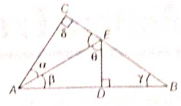
Based on the above information, answer the following questions.
(i) The value of \(\cos (\alpha+\theta)\) is
| (a) \(\frac{4}{5}\) | (b) \(\frac{3}{5}\) | (c) \(\frac{117}{125}\) | (d) \(\frac{44}{125}\) |
(ii) The value of \(\tan 2 \alpha\) is
| (a) \(\frac{3}{4}\) | (b) \(\frac{7}{24}\) | (c) \(\frac{336}{527}\) | (d) \(\frac{24}{25}\) |
(iii) Which of the following is true?
| (a) \(\gamma+\delta=0+\alpha\) | (b) \(\gamma+\delta>\theta+\alpha\) | (c) \(\gamma+\delta<0+\alpha\) | (d) \(\gamma+\delta<\alpha+\beta\) |
(iv) The value of \(\sin \left(\frac{\alpha+\theta+\gamma+\delta}{2}\right) \sin \left(\frac{\alpha+\theta-\gamma-\delta}{2}\right)\) is
| (a) \(\frac{4}{5}\) | (b) \(\frac{3}{5}\) | (c) \(\frac{117}{125}\) | (d) \(\frac{-119}{250}\) |
(v) The value of \(\tan \beta+\tan \theta\) is
| (a) \(\frac{16}{9}\) | (b) \(\frac{12}{25}\) | (c) \(\frac{25}{12}\) | (d) \(\frac{9}{16}\) |
1.
We have
L.H.S. =\({cos9x - cos 5x\over sin17x - sin 3x}\)
\(={-2sin({9x+5x\over 2})sin ({9x+5x\over 2})\over 2cos({17x+3x\over2})sin({17x+3x\over2})}\)
\(\left[\begin{array}{c} \because \cos \mathrm{C}-\cos \mathrm{D}=-2 \sin \frac{\mathrm{C}+\mathrm{D}}{2} \sin \frac{\mathrm{C}-\mathbf{D}}{2} \\ \sin \mathrm{C}-\sin \mathrm{D}=2 \cos \frac{\mathrm{C}+\mathrm{D}}{2} \sin \frac{\mathrm{C}-\mathrm{D}}{2} \end{array}\right]\)
\(={-2sin7xsin2x\over 2cos10xsin7x}=-{sin 2x\over cos 10x} = R.H.S\)
2.
Here sec x=\(13\over 5\)
Now sec2x = 1+ tan2 x
\(\Rightarrow ({13\over 5})^2=1+tan^2x\)
\(\Rightarrow tan^2 x={169\over25}-1\)
\(\Rightarrow tan^2x={144\over 25}\)
\(\Rightarrow tan x=\pm {12\over 5}\)
But x lies in fourth quadrant.
\(\therefore tan x={-12\over5}\)
\(cot \ x={1\over tan \ x}={-5\over 12}\)
\(cos x={1\over sec \ x}={5\over 13}\)
Also sin2 x + cos2 x = 1
\(\Rightarrow sin ^2x+({5\over 13})^2=1\)
\(\Rightarrow sin ^2x=1-{25\over 169}\)
\(\Rightarrow sin^2 x={144\over 169}\)
\(\Rightarrow sin \ x =\pm {12\over 13}\)
But x lies in fourth quadrant.
\(\therefore sin x={-12\over13}\)
3.
\(LHS=(cosA+cosB)+cosC\)
\(=2cos\left( \frac { A+B }{ 2 } \right) cos\left( \frac { A-B }{ 2 } \right) +1-2sin^{ 2 }\frac { c }{ 2 }\)
\(=2cos\left( \frac { \pi }{ 2 } -\frac { c }{ 2 } \right) cos\left( \frac { A-B }{ 2 } \right) -2sin^{ 2 }\frac { C }{ 2 } +1\)
\(=2sin\frac { C }{ 2 } cos\left( \frac { A-B }{ 2 } \right) -2sin^{ 2 }\frac { C }{ 2 } +1\)
\(=2sin\frac { C }{ 2 } \left[ cos\left( \frac { A-B }{ 2 } \right) -sin\frac { C }{ 2 } \right] +1\)
\(=2sin\frac { C }{ 2 } \left[ cos\left( \frac { A-B }{ 2 } \right) -cos\left( \frac { A+B }{ 2 } \right) \right] +1\)
\(=2sin\frac { C }{ 2 } \left[ -2sin\frac { A }{ 2 } sin\left( \frac { -B }{ 2 } \right) \right] +1\)
\(=4sin\frac { C }{ 2 } sin\frac { A }{ 2 } sin\frac { B }{ 2 } +1\)
4.
\(cos^{ 4 }\frac { \pi }{ 8 } +cos^{ 4 }\frac { 3\pi }{ 8 } +cos^{ 4 }\frac { 5\pi }{ 8 } +cos^{ 4 }\frac { 7\pi }{ 8 } \)
\(=cos^{ 4 }\frac { \pi }{ 8 } +cos^{ 4 }\frac { 3\pi }{ 8 } +cos^{ 4 }\left( \pi -\frac { 3\pi }{ 8 } \right) +cos^{ 4 }\left( \pi -\frac { \pi }{ 8 } \right) \)
\(= cos^{ 4 }\frac { \pi }{ 8 } +cos^{ 4 }\frac { 3\pi }{ 8 } +cos^{ 4 }\frac { \pi }{ 8 } \)
\(= 2\left[ cos^{ 4 }\frac { \pi }{ 8 } +cos^{ 4 }\frac { 3\pi }{ 8 } \right] =2\left[ cos^{ 4 }\frac { \pi }{ 8 } +cos^{ 4 }\left( \frac { \pi }{ 2 } -\frac { \pi }{ 8 } \right) \right] \)
\( =2-\left( sin\frac { 2\pi }{ 8 } \right) ^{ 2 }=\frac { 3 }{ 2 } \)
5.
We know that 3x = 2x + x
Therefore, tan 3x = tan (2x + x)
or \(\tan 3 x=\frac{\tan 2 x+\tan x}{1-\tan 2 x \tan x}\)
or tan 3x – tan 3x tan 2x tan x = tan 2x + tan x
or tan 3x – tan 2x – tan x = tan 3x tan 2x tan x
or tan 3x tan 2x tan x = tan 3x – tan 2x – tan x.
6.
We have
L.H.S. = sin 3x + sin 2x - sin x.
= (sin 3x - sin x) + sin 2x
\(=[2cos({3x+x\over2}) sin({3x+x\over2})]+2sin x cos x\)
\([\because \ sin C- sin D=2cos {C+D\over2}.sin{C-D\over2}]\)
= 2 cos 2x sin x + 2 sin x cos x
= 2 sin x [cos 2x + cos x]
= 2 sin x\([2cos({2cos ({2x+x\over2})}cos({2x+x\over2})]\)
\(=2sin x[2cos({3x\over2})cos({x\over2})]\)
= 4 sin x cos \({x\over2}\) cos \({3x\over2}\) =R.H.S
7.
We have
L.H.S.= sin x + sin 3x + sin 5x + sin 7x
= (sin 7x + sin x) + (sin 5x + sin 3x)
\(=[2sin({7x+x\over2})cos({7x-x\over2})]+[2sin({5x+3x\over2})cos({5x-3x\over2})]\)
= 2 sin 4x cos 3x + 2 sin 4x cos x
\([\because \ sinC+sin D=2sin{C+D\over2}.cos{C-D\over2}]\)
= 2 sin 4x [cos 3x + cos x]
= 2 sin 4x\([2cos({3x+x\over2})cos({3x-x\over2})]\)
\([\because \ cos C+cosD=2cos {{C+D\over2}.cos{C-D\over2}}]\)
= 2 sin 4x [2 cos 2x cos x]
= 4 cos x cos 2x sin 4x = R.H.S.
8.
We have
L.H.S.\(={sin \ x - sin \ y\over cos \ x+ cos \ y }\)
\(={2cos({x+y\over 2})sin({x-y \over 2})\over {2cos({x+y\over 2}) cos({x-y \over 2})}}\)
\(\left[\begin{array}{l} \because \sin \mathrm{C}+\sin \mathrm{D}=2 \sin \left(\frac{\mathrm{C}+\mathbf{D}}{2}\right) \cos \left(\frac{\mathbf{C}-\mathbf{D}}{2}\right) \\ \cos \mathrm{C}+\cos \mathrm{D}=2 \cos \left(\frac{\mathbf{C}+\mathrm{D}}{2}\right) \cos \left(\frac{\mathrm{C}-\mathrm{D}}{2}\right) \end{array}\right]\)
\(={sin {x-y\over 2}\over cos {x-y\over2}}=tan {x-y\over2}\)
=R.H.S
9.
(i) sin 75° = sin (45° + 30°)
= sin 45° cos 30° + cos 45° sin 30°
[\(\because\) sin (A+ B) = sin A cos B + sin B cos A]
\(={1\over\sqrt{2}}\times{\sqrt{3}\over2}+{1\over\sqrt{2}}\times{1\over2}\)
\(={\sqrt{3}\over2\sqrt{2}}+{1\over2\sqrt{2}}={\sqrt{3}+1\over2\sqrt{2}}\)
(ii) \({ tan15 }^{ 0 }=tan({ 60 }^{ 0 }-{ 45 }^{ 0 })\)
\(=\frac { { tan60 }^{ 0 }-{ tan45 }^{ 0 } }{ 1+{ tan60 }^{ 0 }{ tan45 }^{ 0 } } \left[ tan(A-B)=\frac { tanA-tanB }{ 1+tanAtanB } \right]\)
\(=\frac { \sqrt { 3 } -1 }{ 1+\sqrt { 3 } .1 } \left[ { tan45 }^{ 0 }=1\quad and\quad { tan60 }^{ 0 }=\sqrt { 3 } \right]\)
\(=\frac { \sqrt { 3 } -1 }{ 1+\sqrt { 3 } } =\frac { \sqrt { 3 } -1 }{ \sqrt { 3 } +1 } =\frac { \sqrt { 3 } -1 }{ \sqrt { 3 } +1 } \times \frac { \sqrt { 3 } -1 }{ \sqrt { 3 } -1 } \left[ on\quad rationalisation \right] \)
\(=\frac { { \left( \sqrt { 3 } -1 \right) }^{ 2 } }{ { \sqrt { 3 } }^{ 2 }-\left( { 1 }^{ 2 } \right) } \left[ (a-b)(a+b)={ a }^{ 2 }-{ b }^{ 2 } \right] \)
\(=\frac { { \sqrt { 3 } }^{ 2 }+{ 1 }^{ 2 }-2\sqrt { 3 } }{ 3-1 } \left[ { \left( a-b \right) }^{ 2 }={ a }^{ 2 }{ +b }^{ 2 }-2ab \right] \)
\(=\frac { { \sqrt { 3 } }^{ 2 }+{ 1 }^{ 2 }-2\sqrt { 3 } }{ 3-1 } =\frac { 4-2\sqrt { 3 } }{ 2 } =\frac { 2(2-\sqrt { 3 } ) }{ 2 } =(2-\sqrt { 3 } )\)
10.
To convert radian into degree measures,
we multiply by \(180\over \pi\)
We know that π radian = 180°
\(\therefore ({11\over 16})^C=12^o({2\over 5}\times 60)^o=({{11\over 16}\times{180\times7 \over 22 }})^o\)
\(=({315\over 8})^o=({39{5\over 8}})^o\)
\(=39^o({3\over 8}\times60)'=39^o({45\over 2})'\)
\(=39^o(22{1\over 2})'=39^o22'({1\over 2}\times 60)'\)
= 39o 22' 30"
(ii) (-4)
We know that π radian = 180°
=\(-(4\times {180\over \pi})^o\)
\(=-(4\times {180\times 7\over22})^C=-({2520\over 11})^o\)
\(=-({229{1\over11}})^o=-229^o({1\over 11}\times 60)'\)
\(=-229^o(5{5\over 11})'=-229^o5'({5\over11}\times 60)''\)
\(=-229^o5'27{3\over 11}''\)
(iii) We know that π radian = 180°
\(({5\pi\over 3})^C=({5\pi\over3}\times {180\over \pi})^o=300^o\)
(iv) We know that π radian = 180°
\(({7\pi\over 6})^C=({7\pi\over 6}\times {180\over \pi})^o=210^o\)
11.
We know that values of cos x repeats after an interval of 2\(\pi\) or 360°.
Therefore, cos (–1710°) = cos (–1710° + 5 × 360°)
= cos (–1710° + 1800°) = cos 90° = 0.
12.
We have
L.H.S.= (cos x + cosy)2 + (sin x - sin y)2\({x+y\over2}\)
\(=[2cos({x+y\over2})cos ({{x+y\over2}})]^2\)+\([2cos({x+y\over2})sin({x+y\over2})]^2\)
\(=4cos^2({x+y\over2})cos^2({x-y\over2})+4cos^2({x+y\over2})sin^2({x-y\over2})\)
\(=4cos^2({x+y\over2})[cos^2({x-y\over2})+sin^2({x-y\over2})]\)
\(=4cos^2({x+y\over2})=R.H.S\)
13.
We have
L.H.S. = sin 2x + 2 sin 4x + sin 6x
= [sin 4x+ sin 2x] + [sin 6x + sin 4x]
= 2 sin\(({4x+2x\over 2})cos({4x-2x\over2})\)+\(2 sin ({6x+4x\over 2})cos({6x-4x\over2})\)
\([\because sin C+sin D=2sin({C+D\over 2})cos({C-D\over 2})]\)
= 2 sin 2x cos x + 2 sin 5x cos x
= 2 cos x [sin 3x + sin 5x]
\(=2cos \ x[2sin({5x+3x\over2}).cos({5x-3x\over2})]\)
= 2 cos x [2 sin 4x . cos x]
= 4 cos2x sin 4x = R.H.S.
14.
tan \({19\pi\over 3}\)= tan \({19\over 3}\)x180
= tan 1140°
tan 1140° = tan (3 x 360° + 60°)
= tan 60° =\(\sqrt{3}\)
15.
(c)
\(\frac{1}{4}\)
16.
(d)
All of the above
17.
(c)
\(\frac{1}{2}\)
18.
(b)
0
19.
(c)
\(-\frac{1}{2}\)
20.
(a)
tan3A tan2A tanA
21.
(d)
0
22.
(d)
\(\frac{\pi}{4}\)
23.
(c)
\(n\pi\pm{\pi\over6},n\in Z\)
24.
(c)
30o
25.
Hint Given, AB = 20 cm, AC= 12 cm
\(\therefore B C =\sqrt{20^2-12^2}=16 \mathrm{cm} \)
\(\tan \gamma =\frac{A C}{B C}=\frac{12}{16}=\frac{3}{4}\)
\([\triangle D E A \cong \triangle D E B\) by SAS property]
\(\gamma =\beta \)
\(\cos \gamma =\frac{B D}{B E} \Rightarrow B E=\frac{10}{4 / 5}=\frac{25}{2} \)
\(\tan \gamma =\frac{D E}{B D} \Rightarrow D E=\frac{10}{4 / 3}=\frac{15}{2} \)
\(C E =B C-B E=16-\frac{25}{2}=\frac{7}{2} \)
\(\tan \alpha =\frac{C E}{A C}=\frac{7}{24}, \cos \alpha=\frac{24}{25}, \sin \alpha=\frac{7}{25} \)
\(\tan \theta =\tan \left(\frac{\pi}{2}-\beta\right)=\cot \beta=\cot \gamma=\frac{4}{3}, \)
\(\cos \theta =\frac{3}{5}, \sin \theta=\frac{4}{5}\)
(i) (d) Use formula cos (A+B)= cos A cos B-sin A sin B
(ii) (c) Use formula \(\tan 2 A=\frac{2 \tan A}{1-\tan ^2 A}\)
(iii) (c) Since, \( A E>C E \ \delta>\alpha \)
and \(A D>D E \beta<\theta \)
\( \gamma=\beta \quad \gamma<\theta\)
\( \therefore \gamma+\delta<\alpha+\theta\)
(iv) (d) Use formula
-2 sin A sin B=cos (A+B)-cos (A-B)
(v) (c)

11th Standard CBSE Syllabus & Materials
11th Standard CBSE
CBSE 11th Business Studies Forms of Business Organisation Sample Question Papers Study Material - QB365 Set A
NEW11th Standard CBSE
CBSE 11th Business Studies Business, Trade and Commerce Sample Question Papers Study Material - QB365 Set A
NEW11th Standard CBSE
CBSE 11th Physics Waves Sample Question Papers Study Material - QB365 Set A
NEW11th Standard CBSE
CBSE 11th Physics Kinetic Theory Sample Question Papers Study Material - QB365 Set A



NCERT Books

Syllabus

Exam Pattern

Sample Question Papers

Previous year Question Papers

Important Notes

MCQ Practice test

NCERT Exemplers

Case study Questions

Image Based Questions

Passage based Questions

HOT Questions

Value Based Questions

Model Questions Papers
NCERT ( Book Back ) Questions

Assertion and Reason
Important Questions And Answers

CBSE 11th Standard CBSE Subjects
CBSE Standards







