
 100% FREE ACCESS
11th Standard CBSE Syllabus & Materials
11th Standard CBSE
CBSE 11th Economics PART-A - Presentation of Data - New Sample Question Papers Study Material - QB365 Set A
NEW11th Standard CBSE
CBSE 11th Economics PART-A - Organisation of Data - New Sample Question Papers Study Material - QB365 Set A
NEW11th Standard CBSE
CBSE 11th Economics PART-A - Collection of Data - New Sample Question Papers Study Material - QB365 Set A
NEW11th Standard CBSE
CBSE 11th Economics PART-A - Introduction to Economics and Statistics - New Sample Question Papers Study Material - QB365 Set A
NEW11th Standard CBSE
CBSE 11th Business Studies International Trade Sample Question Papers Study Material - QB365 Set A
NEW11th Standard CBSE
CBSE 11th Business Studies Evolution and Fundamentals of Business Sample Question Papers Study Material - QB365 Set A

Published on: 21/10/2025
Download CBSE Class 11th Standard CBSE Mathematics question papers, sample papers, important questions, and previous year solved papers in PDF format. Get free study materials, NCERT solutions, and exam preparation resources for Class 11th Standard CBSE Mathematics
Questions + Answers key
Take MCQ Mathematics Test
1.
If \(\sin x=\frac{3}{5}, \cos y=-\frac{12}{13}\) where x and y both lie in second quadrant,find the value of sin (x + y).
2.
Prove that \(=\frac{\sin 5 x-2 \sin 3 x+\sin x}{\cos 5 x-\cos x}=\tan x\)
3.
Show that tan 3 x tan 2 x tan x = tan 3x – tan 2 x – tan x.
4.
Prove that
\(3 \sin \frac{\pi}{6} \sec \frac{\pi}{3}-4 \sin \frac{5 \pi}{6} \cot \frac{\pi}{4}=1\)
5.
Prove that,
2cos\({\pi\over13}\)cos\({9\pi\over13}\)+cos\({3\pi\over13}\)+cos\({5\pi\over13}\)=0
6.
Find the value of: (i) sin 75° (ii) tan 15°
7.
If cos x+cos y= \(\frac { 1 }{ 3 } \)and sin x+sin y= \(\frac { 1 }{ 4 } \),then prove that an \(\left( \frac { x+y }{ 2 } \right) =\frac { 3 }{ 4 } \)
8.
If \(\alpha+\beta=90^\circ\) then show that maximum value of \(\cos\alpha\cos\beta=\frac12\)
9.
Prove that \(cos\frac { \pi }{ 7 } cos\frac { 2\pi }{ 7 } cos\frac { 4\pi }{ 7 } =\frac { -1 }{ 8 } \)
10.
Prove that cos3A + cos5A + cos 7A + cos15A = 4cos4Acos5Acos6A
11.
If \(2cos\theta =x+\frac { 1 }{ x } ,\) then prove that \(2cos3\theta =x^{ 3 }+\frac { 1 }{ x^{ 3 } } .\)
12.
Prove that \((cosx-cosy)^{ 2 }+(sinx-siny)^{ 2 }=4sin^{ 2 }\left( \frac { x-y }{ 2 } \right) .\)
13.
Prove that sin 200 sin 400sin 600 sin 800 = \(\frac { 3 }{ 16 } \)
14.
Prove that cos 200 cos 400 cos 600 cos 800=\(\frac { 1 }{ 16 } \)
15.
Prove that tan 3150 cot(-4050)+cot 4950 tan(-5850)=2
16.
Prove that: \({cos 6\theta +6cos 4\theta+15cos 2\theta+10\over cos5\theta+5cos 3\theta+10cos\theta}=2cos \theta\)
17.
If cos \(\theta =-{1\over2}\) and \(\pi <\theta <{3\pi\over2},\) find the value of 4 tan2\(\theta\)- 3 cosec2 \(\theta\)
18.
In any ∆ABC, prove that: \(a\quad sin\frac { A }{ 2 } sin\frac { B-C }{ 2 } +b\quad sin\frac { B }{ 2 } sin\frac { C-A }{ 2 } +c\quad sin\frac { C }{ 2 } sin\left( \frac { A-B }{ 2 } \right) =0\)
19.
Find sin\({x\over2},cos{x\over2} and \ tan {x\over2}\) in each of the following: sin x =\({1\over4}\),x in quadrant II.
20.
Find sin\({x\over2},cos{x\over2} and \ tan {x\over2}\) in each of the following: cos x =\({-1\over3},x \) x in quadrant III.
21.
In \(\triangle ABC,\) prove that
\(tan\frac{B-C}{2}=\frac{b-c}{b+c}cot\frac{A}{2}\)
\(tan\frac{C-A}{2}=\frac{c-a}{c+a}cot\frac{B}{2}\)
\(tan\frac{A-B}{2}=\frac{a-b}{a+b}cot\frac{C}{2}\)
22.
Find the value of \([1+cos{\pi\over 8}][1+cos{3\pi\over 8}][1+cos{5\pi\over 8}][1+cos{{7\pi\over8}}]\)
23.
Prove the following:
\({cos9x - cos 5x\over sin17x - sin 3x}=-{sin 2x\over cos 10x}\)
24.
Prove the following: cot 4x (sin 5x +sin 3x) =cot x (sin 5x - sin 3x)
25.
If sec \(\theta\) = \(\sqrt{2}\) and \(\theta\) lies m fourth quadrant, find the value of \(1+tan \theta+cosec\theta\over 1+cot\theta-cosec\theta \)
26.
If sin \(\theta\) =\(-5\over 13\) and \(\theta\) lies in third quadrant, find the value of sec \(\theta\) + tan \(\theta\).
27.
If \(A+B+C=180^{ \circ },\) then prove that \(cosA+cosB+cosC=1+4sin\frac { A }{ 2 } sin\frac { B }{ 2 } sin\frac { C }{ 2 } \)
28.
Find the value of the expression
\({ cos }^{ 4 }\frac { \pi }{ 8 } +{ cos }^{ 4 }\frac { 3\pi }{ 8 } +{ cos }^{ 4 }\frac { 5\pi }{ 8 } +{ cos }^{ 4 }\frac { 7\pi }{ 8 } .\)
29.
Prove that \(cot7\frac { 1^{ \circ } }{ 2 } =tan82\frac { 1^{ \circ } }{ 2 } =(\sqrt { 3 } +\sqrt { 2 } )(\sqrt { 2 } +1).\)
30.
Find the general solution of the equation
tan\(\theta\)+tan2\(\theta\)+tan3\(\theta\)= tan\(\theta\)tan2\(\theta\)tan3\(\theta\)
31.
Find the values of other five trigonometric functions sin\(\theta\) =\({3\over5}\) ,\(\theta\) lies in third quadrant
32.
A railway train is travelling on a circular track of 1500 m radius at the speed of 60 km/hr. Through what angle in degrees does it turn in 10 seconds?
33.
The difference between two acute angles of a right angled triangle is \(2\pi\over 5\)radians. Find the angles in radians
34.
Find the radian measures corresponding to the following degree measures:-47o30'
35.
Find the principal solution of cosec x=-2
36.
Find the principal solution of tan x=\(\frac { 1 }{ \sqrt { 3 } } \)
37.
If \(A+B=\cfrac { \pi }{ 4 } \quad \)then prove that \((cotA-1)(cotB-1)=2\)
38.
Consider thc information given below Let P (a, b) be any point on the unit circle given below, which has its centre at origin O. It is given that ∠AOP = x radian.
Now, answer the questions based on the figure given below.
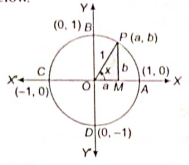
(i) If \(a = \frac{ \sqrt{3}}{2}\) and \(b = \frac{-1}{2}\) then the value of x in radian is
| (a) \(\frac{\pi}{6}\) | (b) \(\frac{7\pi}{6}\) | (c) \(\frac{5\pi}{6}\) | (d) \(\frac{11\pi}{6}\) |
(ii) If x = 75o, then the value of tan x is equal to
| (a) \(2 + \sqrt3\) | (b) \(2-\sqrt3\) | (c) \(\sqrt3 + 3\) | (d) \(\sqrt2 + 1\) |
(iii) If x = 25°, then the value of x in radian is
| (a) \(\frac{5\pi}{18}\) | (b) \(\frac{\pi}{18}\) | (c) \(\frac{5\pi}{36}\) | (d) \(\frac{\pi}{36}\) |
(iv) Which of the following is incorrect?
| (a) sin x is positive for 0 < x < π |
| (b) sin x isnegative for π < x < 2π |
| (c) cos x is positive for 0 < x < π/2 and 3π/2 < x < 2π |
| (d) cos x is positive for π/2 < x < 3π/2 |
1.
We know that
sin (x + y) = sin x cos y + cos x sin y ... (1)
Now \(\cos ^{2} x=1-\sin ^{2} x=1-\frac{9}{25}=\frac{16}{25}\)
Therefore \(\cos x=\pm \frac{4}{5}\)
Since x lies in second quadrant, cos x is negative.
Hence \(\cos x=- \frac{4}{5}\)
Now sin2y = 1 – cos2y = 1 \(-\frac{144}{169}=\frac{25}{169}\)
i.e. \(\sin y=\pm \frac{5}{13}\)
Since y lies in second quadrant, hence sin y is positive. Therefore,\(\sin y= \frac{5}{13}\) Substituting the values of sin x, sin y, cos x and cos y in (1), we get
\(\sin (x+y)=\frac{3}{5} \times\left(-\frac{12}{13}\right)+\left(-\frac{4}{5}\right) \times \frac{5}{13}=-\frac{36}{65}-\frac{20}{65}=-\frac{56}{65}\)
2.
We have
L.H.S. \(=\frac{\sin 5 x-2 \sin 3 x+\sin x}{\cos 5 x-\cos x}=\frac{\sin 5 x+\sin x-2 \sin 3 x}{\cos 5 x-\cos x} \)
\(=\frac{2 \sin 3 x \cos 2 x-2 \sin 3 x}{-2 \sin 3 x \sin 2 x}=-\frac{\sin 3 x(\cos 2 x-1)}{\sin 3 x \sin 2 x} \)
\(=\frac{1-\cos 2 x}{\sin 2 x}=\frac{2 \sin ^{2} x}{2 \sin x \cos x}=\tan x=\mathrm{R} . \mathrm{H.S}\)
3.
We know that 3x = 2x + x
Therefore, tan 3x = tan (2x + x)
or \(\tan 3 x=\frac{\tan 2 x+\tan x}{1-\tan 2 x \tan x}\)
or tan 3x – tan 3x tan 2x tan x = tan 2x + tan x
or tan 3x – tan 2x – tan x = tan 3x tan 2x tan x
or tan 3x tan 2x tan x = tan 3x – tan 2x – tan x.
4.
We have
L.H.S : \(3 \sin \frac{\pi}{6} \sec \frac{\pi}{3}-4 \sin \frac{5 \pi}{6} \cot \frac{\pi}{4}\)
\(=3 \times \frac{1}{2} \times 2-4 \sin \left(\pi-\frac{\pi}{6}\right) \times 1=3-4 \sin \frac{\pi}{6} \)
\(=3-4 \times \frac{1}{2}=1=\mathrm{R} . \mathrm{H.S} .\)
5.
We have
L.H.S. = 2cos\({\pi\over13}\)cos\({9\pi\over13}\)+cos\({3\pi\over13}\)+cos\({5\pi\over13}\)
\(=cos({9\pi\over13}+{\pi\over13})+cos({{9\pi\over13}-{\pi\over13}})+cos{3\pi\over13}+cos{5\pi\over13}\)
\([\because 2cos\ Acos \ B=cos (A+B)+cos(A-B)]\)
\(=cos{10\pi\over 13}+cos{8\pi\over13}+cos{3\pi\over13}+cos{5\pi\over13}\)
\(=cos({\pi-{3\pi\over13}})+cos({\pi-{5\pi\over13}})+cos{3\pi\over13}+cos{5\pi\over13}\)
[\(\because\)cos (\(\pi\) - \(\theta\)) = - cos \(\theta\)]
\(=-cos{3\pi\over13}-cos{5\pi\over13}+cos{3\pi\over13}+cos{5\pi\over13}=0\)
=R.H.S
6.
(i) sin 75° = sin (45° + 30°)
= sin 45° cos 30° + cos 45° sin 30°
[\(\because\) sin (A+ B) = sin A cos B + sin B cos A]
\(={1\over\sqrt{2}}\times{\sqrt{3}\over2}+{1\over\sqrt{2}}\times{1\over2}\)
\(={\sqrt{3}\over2\sqrt{2}}+{1\over2\sqrt{2}}={\sqrt{3}+1\over2\sqrt{2}}\)
(ii) \({ tan15 }^{ 0 }=tan({ 60 }^{ 0 }-{ 45 }^{ 0 })\)
\(=\frac { { tan60 }^{ 0 }-{ tan45 }^{ 0 } }{ 1+{ tan60 }^{ 0 }{ tan45 }^{ 0 } } \left[ tan(A-B)=\frac { tanA-tanB }{ 1+tanAtanB } \right]\)
\(=\frac { \sqrt { 3 } -1 }{ 1+\sqrt { 3 } .1 } \left[ { tan45 }^{ 0 }=1\quad and\quad { tan60 }^{ 0 }=\sqrt { 3 } \right]\)
\(=\frac { \sqrt { 3 } -1 }{ 1+\sqrt { 3 } } =\frac { \sqrt { 3 } -1 }{ \sqrt { 3 } +1 } =\frac { \sqrt { 3 } -1 }{ \sqrt { 3 } +1 } \times \frac { \sqrt { 3 } -1 }{ \sqrt { 3 } -1 } \left[ on\quad rationalisation \right] \)
\(=\frac { { \left( \sqrt { 3 } -1 \right) }^{ 2 } }{ { \sqrt { 3 } }^{ 2 }-\left( { 1 }^{ 2 } \right) } \left[ (a-b)(a+b)={ a }^{ 2 }-{ b }^{ 2 } \right] \)
\(=\frac { { \sqrt { 3 } }^{ 2 }+{ 1 }^{ 2 }-2\sqrt { 3 } }{ 3-1 } \left[ { \left( a-b \right) }^{ 2 }={ a }^{ 2 }{ +b }^{ 2 }-2ab \right] \)
\(=\frac { { \sqrt { 3 } }^{ 2 }+{ 1 }^{ 2 }-2\sqrt { 3 } }{ 3-1 } =\frac { 4-2\sqrt { 3 } }{ 2 } =\frac { 2(2-\sqrt { 3 } ) }{ 2 } =(2-\sqrt { 3 } )\)
7.
cos x + cos y = \(\frac { 1 }{ 3 }\)\(\Rightarrow \) 2cos \(\left( \frac { x+y }{ 2 } \right) \) cos \(\left( \frac { x-y }{ 2 } \right) =\frac { 1 }{ 3 } \) and sin x + sin y = \(\frac { 1 }{ 4 } \)\(\Rightarrow \) 2sin\(\left( \frac { x+y }{ 2 } \right) \) sin \(\left( \frac { x-y }{ 2 } \right) =\frac { 1 }{ 4 } \)
8.
Let x = \(cos\alpha cos\beta \frac { 1 }{ 2 } \)[2\(cos\alpha cos\beta \)]
\(=\frac{1}{2}[\cos (\alpha+\beta)+\cos (\alpha-\beta) \)
\(=\frac{1}{2}\left[\cos 90^{\circ}+\cos (\alpha-\beta)\right]=\frac{1}{2}[\cos ((\alpha-\beta)]\)
since \(-1 \leq \cos (\alpha-\beta) \leq 1-\frac{1}{2} \leq \frac{1}{2} \cos (\alpha-\beta) \leq \frac{1}{2} \Rightarrow-\frac{1}{2} \leq \mathrm{X} \leq \frac{1}{2}\)
9.
\(Let\quad A=\frac { \pi }{ 7 } ,then\)
\(LHS=cos\frac { \pi }{ 7 } cos\frac { 2\pi }{ 7 } cos\frac { { 2 }^{ 2 }\pi }{ 7 } \frac { sin{ 2 }^{ 3 }A }{ { 2 }^{ 3 }sinA }\)
\(=\frac { sin8A }{ 8sinA } =\frac { sin(7A+A) }{ 8sinA } \)
\(=\frac { sin(\pi +A) }{ 8sinA } =\frac { -sinA }{ 8sinA } \quad [\because A=\frac { \pi }{ 7 } ]\)
10.
\(LHS = \left( cos3A+cos7A \right) +(cos5A+cos15A)\)
\(= 2cos5Acos2A+2cos10Acos5A\)
\(= 2cos5A(cos2A+2cos10A)\)
\(= 2cos5A(2cos6Acos4A)\)
\(= 4cos4Acos5Acos6A\)
11.
\(2cos3\theta =2(4cos^{ 3 }\theta -3cos\theta )\)
\(= 8cos^{ 3 }\theta -6cos\theta =(2cos\theta )^{ 3 }-3(2cos\theta )\)
\(= \left( x+\frac { 1 }{ x } \right) ^{ 3 }-3\left( x+\frac { 1 }{ x } \right) \)
12.
\(LHS=(cos^{ 2 }x=sin^{ 2 }x)+(cos^{ 2 }y+sin^{ 2 }y)-2(cosxcosy+sinxsiny)\)
\(=(1+1-2cos(x-y)=2\left[ 1-cos(x-y) \right] \)
13.
\(=\frac { 1 }{ 2 } sin60^{ 0 }sin20^{ 0 }(2sin40^{ 0 }cos80^{ 0 })\)
\(=\frac { 1 }{ 2 } \times \frac { \sqrt { 3 } }{ 2 } sin20^{ 0 }(cos(-40^{ 0 })-cos(120^{ 0 })\)
\(=\frac { \sqrt { 3 } }{ 4 } sin20^{ 0 }\left( cos40^{ 0 }+\frac { 1 }{ 2 } \right) \)
\(=\frac { \sqrt { 3 } }{ 4 } \left[ \frac { 1 }{ 2 } (2sin20^{ 0 }cos40^{ 0 }+\frac { 1 }{ 2 } sin20^{ 0 } \right] \)
14.
LHS=\(\frac { 1 }{ 2 } \) cos600 cos 200(2 cos 400cos 800)
=\(\frac { 1 }{ 2 } \)x\(\frac { 1 }{ 2 } \) cos200(cos1200 + cos400)
= \(\frac { 1 }{ 4 } \)\(\left[ \frac { cos20^{ 0 } }{ 2 } +\frac { 1 }{ 2 } (cos60^{ 0 }+cos20^{ 0 } \right] \)
= \(\frac { 1 }{ 4 } \) \(\left[ \frac { 1 }{ 2 } \times \frac { 1 }{ 2 } \right] =\frac { 1 }{ 16 } \)
15.
LHS=tan(3600-450)[(-cot(3600+450)]+cot(3600+1350)-[-tan(3600+2250)]
=-tan450(-cot 450)+cot(1350)(-tan 2250)
=1-cot(900+450) tan(1800+450)
16.
cos 6\(\theta\) + 6 cos 4\(\theta\) + 15 cos 2\(\theta\) + 10
= (cos 6\(\theta\) + cos 4\(\theta\)) + (5 cos 4\(\theta\) + 5 cos 2\(\theta\)) + (10 cos 2\(\theta\) + 10)
= (cos 6\(\theta\) + cos 4\(\theta\)) + 5 (cos 4\(\theta\) + cos 2\(\theta\)) + 10 (cos 2\(\theta\)+ 1)
= 2cos 5\(\theta\) cos \(\theta\) + 5 x 2 cos 3\(\theta\) cos \(\theta\)+ 10 x 2 cos \(\theta\) cos \(\theta\)
= 2cos \(\theta\) [cos5\(\theta\) + 5 cos 3\(\theta\) + 10 cos \(\theta\)]
\(\therefore {cos \theta + 6 cos 4 \theta + 15 cos 2 \theta + 10 \over
cos 5 \theta + 5 cos 3 \theta + 10 cos \theta}=2cos \theta\)
17.
Since e lies in third quadrant, sin \(\theta\)is negative and tan\(\theta\) is positive.
\(\therefore sin \theta =-\sqrt{1-cos^2 \theta }\)
\(=-\sqrt{1-({-{1\over 2}})^2}\)
\(=-\sqrt{1-{1\over 4}}=-{\sqrt{3}\over 2}\)
\(tan \theta ={sin \theta \over cos \theta}={-{\sqrt{3}\over2}\over -{1\over2}}=\sqrt{3}\)
\(cosec \theta ={1\over sin \theta}={1\over-{\sqrt{3}\over2}}=-{2\over \sqrt{3}}\)
Now 4 tan2 \(\theta\) - 3 cosec2\(\theta\)
\(=4\times (\sqrt{3})^2-3\times (-{2\over \sqrt{3}})^2\)
= 4 x 3- 3 x\(4\over3\)= 12 - 4 = 8.
18.
L.H.S a sin\(\frac { A }{ 2 } \) .sin \(\frac { B-C }{ 2 } \)
= a sin\(\left( \frac { \pi }{ 2 } -\frac { B+C }{ 2 } \right) \).sin \(\left( \frac { B-C }{ 2 } \right) \)
= k sin A. cos \(\left( \frac { B+C }{ 2 } \right) \).sin \(\left( \frac { B-C }{ 2 } \right) \)
= k sin A. [sin B-sin C]
= [sin A sin B-sin A sin c] ..(i)
Similarly,
b sin \(\frac { B }{ 2 } sin\left( \frac { C-A }{ 2 } \right) \)
= \(\frac { k }{ 2 } \)[sin B sin C-sin B sin A]... (ii)
and C sin\(\frac { C }{ 2 } \) sin \(\left( \frac { A-B }{ 2 } \right) \)
=\(\frac { k }{ 2 } \) [sin C sin A-sin C sin B] ... (iii)
Adding (i), (ii) and (iii), we get
a sin \(\frac { A }{ 2 } \)sin\(\left( \frac { B-C }{ 2 } \right) \) +b sin\(\frac { B }{ 2 } \)sin \(\left( \frac { C-A }{ 2 } \right) \)+c sin \(\frac { C }{ 2 } \)sin \(\left( \frac { A-B }{ 2 } \right) \)
⇒ \(\frac { k }{ 2 } \) [sin A sin B-sin A sin C] + \(\frac { k }{ 2 } \)[sin B sin C-sin B sin A]+\(\frac { k }{ 2 } \) [sin C sin A-sin C sin B]
⇒ \(\frac { k }{ 2 } \)[sin A sin B-sin A sin C+sin B sin A-sin C sin A-sin C sin B]
⇒ \(\frac { k }{ 2 } \) [0]
⇒ 0 R.H.S
Hence proved
19.
Here sin x = =\({1\over4}\),x in quadrant II.
\(\therefore \ cos^2 x=1-sin^2 x\)
\(\Rightarrow\) cos2x= 1- \(({1\over4})^2=1-{1\over16}={15\over16}\)
\(\therefore cos x=\pm {\sqrt{15}\over4}\)
But x lies in second quadrant.
\(\therefore cos x=- {\sqrt{15}\over4}\)
Also \({x\over2}\)
So \({x\over2}\) lies in first quadrant.
\(\therefore \) sin\(x\over2\) ,cos\(x\over2\)and tan\(x\over2\)are all positive.
Now cos\({x\over2}={\sqrt{1+cos \ x\over 2}}=\sqrt{1+{\sqrt{15}\over4}\over2}\)
\(=\sqrt{4-\sqrt{15}\over 8}={\sqrt{8-2\sqrt{15}\over4}}\)
sin\({x\over2}={\sqrt{1-cos \ x\over 2}}=\sqrt{1+{\sqrt{15}\over4}\over2}\)
\(=\sqrt{4+\sqrt{15}\over 8}={\sqrt{8+2\sqrt{15}\over4}}\)
tan\(x\over2\) \(={sin {x\over2}\over cos {x\over2}}={{\sqrt{8+2\sqrt{15}}\over4}\over{\sqrt{8-2\sqrt{15}}\over4}}\)
\(={\sqrt{4+\sqrt{15}}\over\sqrt{4-\sqrt{15}}}\times {\sqrt{4+\sqrt{15}}\over\sqrt{4+\sqrt{15}}}\)
\(={{4+\sqrt{15}}\over\sqrt{16-16}}=4+\sqrt{15}\)
20.
Here cos x =\({-1\over3},x\) in quadrant III.
Now \(\pi\)
So\(x\over2\) lies in second quadrant.
\(\therefore\) sin \(x\over2\) is positive and cos\(x\over2\),tan\(x\over2\) are negative.
Now cos \({x\over2}=-{\sqrt{1+cos \ x\over 2}}=\sqrt{1-{1\over3}\over2}\)
\(=-\sqrt{1\over\sqrt{3}}\times {\sqrt{5}\over \sqrt{5}}={-\sqrt{3}\over3}\)
sin\({x\over2}={\sqrt{1+cos \ x\over 2}}=\sqrt{1-{1\over3}\over2}\)
\(=\sqrt{2\over3}\times {\sqrt{3}\over\sqrt{3}}={\sqrt{6}\over3}\)
tan \({x\over2}={sin{x\over2}\over cos{x\over2}}={\sqrt{2\over3}\over-\sqrt{1\over \sqrt{3}}}=-\sqrt{2}\)
21.
From Sine formula
Let \(\frac{a}{sinA}=\frac{b}{sinB}=\frac{c}{sinC}=k\)
Therefore, \(\frac{b-c}{b+c}=\frac{ksinB-ksinC}{ksinB+ksinC}\)
\(=\frac{sinB-sinC}{sinB+sinC}=\frac{2cos\frac{B+C}{2}.sin\frac{B-C}{2}}{2sin\frac{B+C}{2}.cos\frac{B-C}{2}}\)
\(=cot\frac{B+C}{2}.tan\frac{B-C}{2}=cot(\frac{\pi}{2}-\frac{A}{2}).tan\frac{B-C}{2}\)
\(=tan\frac{A}{2}.tan\frac{B-C}{2}=\frac{tan\frac{B-C}{2}}{cot\frac{A}{2}}\)
Therefore, \(tan\frac{B-C}{2}=\frac{b-c}{b+c}cot\frac{A}{2}\)
Similarly, we can prove other results also. These are known as Napier's Analogy.
22.
\(1\over8\)
23.
We have
L.H.S. =\({cos9x - cos 5x\over sin17x - sin 3x}\)
\(={-2sin({9x+5x\over 2})sin ({9x+5x\over 2})\over 2cos({17x+3x\over2})sin({17x+3x\over2})}\)
\(\left[\begin{array}{c} \because \cos \mathrm{C}-\cos \mathrm{D}=-2 \sin \frac{\mathrm{C}+\mathrm{D}}{2} \sin \frac{\mathrm{C}-\mathbf{D}}{2} \\ \sin \mathrm{C}-\sin \mathrm{D}=2 \cos \frac{\mathrm{C}+\mathrm{D}}{2} \sin \frac{\mathrm{C}-\mathrm{D}}{2} \end{array}\right]\)
\(={-2sin7xsin2x\over 2cos10xsin7x}=-{sin 2x\over cos 10x} = R.H.S\)
24.
We have L.H.S.
= cot 4x (sin 5x + sin 3x)
\(={cos \ 4x\over sin \ 4x}[2sin({5x+3x\over 2})cos ({5x-3x\over2})]\)
\(={cos 4x\over sin 4x}[2sin 4xcosx]\)
=2cos4x cos x
Wehave R.H.S.
= cot x [sin 5x - sin 3x]
\(={cos x\over sin x}[2cos({5x+3x\over 2})sin ({5x-3x\over2})]\)
\([\because \ sin C-sin D=2cos{C+D\over 2}:{C-D\over2}]\)
\(={cos \ x\over sin \ x}[2cos \ 4x \ sin x]\)
= 2 cos 4x cos x
Hence L.H.S. = R.H.S.
25.
-1
26.
\({-2\over3}\)
27.
\(LHS=(cosA+cosB)+cosC\)
\(=2cos\left( \frac { A+B }{ 2 } \right) cos\left( \frac { A-B }{ 2 } \right) +1-2sin^{ 2 }\frac { c }{ 2 }\)
\(=2cos\left( \frac { \pi }{ 2 } -\frac { c }{ 2 } \right) cos\left( \frac { A-B }{ 2 } \right) -2sin^{ 2 }\frac { C }{ 2 } +1\)
\(=2sin\frac { C }{ 2 } cos\left( \frac { A-B }{ 2 } \right) -2sin^{ 2 }\frac { C }{ 2 } +1\)
\(=2sin\frac { C }{ 2 } \left[ cos\left( \frac { A-B }{ 2 } \right) -sin\frac { C }{ 2 } \right] +1\)
\(=2sin\frac { C }{ 2 } \left[ cos\left( \frac { A-B }{ 2 } \right) -cos\left( \frac { A+B }{ 2 } \right) \right] +1\)
\(=2sin\frac { C }{ 2 } \left[ -2sin\frac { A }{ 2 } sin\left( \frac { -B }{ 2 } \right) \right] +1\)
\(=4sin\frac { C }{ 2 } sin\frac { A }{ 2 } sin\frac { B }{ 2 } +1\)
28.
\(cos^{ 4 }\frac { \pi }{ 8 } +cos^{ 4 }\frac { 3\pi }{ 8 } +cos^{ 4 }\frac { 5\pi }{ 8 } +cos^{ 4 }\frac { 7\pi }{ 8 } \)
\(=cos^{ 4 }\frac { \pi }{ 8 } +cos^{ 4 }\frac { 3\pi }{ 8 } +cos^{ 4 }\left( \pi -\frac { 3\pi }{ 8 } \right) +cos^{ 4 }\left( \pi -\frac { \pi }{ 8 } \right) \)
\(= cos^{ 4 }\frac { \pi }{ 8 } +cos^{ 4 }\frac { 3\pi }{ 8 } +cos^{ 4 }\frac { \pi }{ 8 } \)
\(= 2\left[ cos^{ 4 }\frac { \pi }{ 8 } +cos^{ 4 }\frac { 3\pi }{ 8 } \right] =2\left[ cos^{ 4 }\frac { \pi }{ 8 } +cos^{ 4 }\left( \frac { \pi }{ 2 } -\frac { \pi }{ 8 } \right) \right] \)
\( =2-\left( sin\frac { 2\pi }{ 8 } \right) ^{ 2 }=\frac { 3 }{ 2 } \)
29.
\(LHS=tan82\frac { { 1 }^{ \circ } }{ 2 } =tan\left( 90^{ \circ }-7\frac { 1^{ \circ } }{ 2 } \right) =cot7\frac { 1^{ \circ } }{ 2 } =cotA\quad (say)\)
\(where,\quad A=7\frac { 1^{ \circ } }{ 2 } \)
\(Now,\quad cotA=\frac { cosA }{ sinA } =\frac { cosA(2cosA) }{ sinA(2cosA) } =\frac { 1+cos2A }{ sin2A } \)
\(\because\ cot7\frac { 1^{ \circ } }{ 2 } =\frac { 1+cos2\left( \frac { 15 }{ 2 } \right) ^{ \circ } }{ sin2\left( \frac { 15 }{ 2 } \right) ^{ \circ } } =\frac { 1+cos15^{ \circ } }{ sin15^{ \circ } } =\frac { 1+cos(45^{ \circ }-30^{ \circ }) }{ sin(45^{ \circ }-30^{ \circ }) } \)
\(= \frac { 1+\left( \frac { 1 }{ \sqrt { 2 } } .\frac { \sqrt { 3 } }{ 2 } +\frac { 1 }{ \sqrt { 2 } } .\frac { 1 }{ 2 } \right) }{ \left( \frac { 1 }{ \sqrt { 2 } } .\frac { \sqrt { 3 } }{ 2 } -\frac { 1 }{ \sqrt { 2 } } .\frac { 1 }{ 2 } \right) } =\left( \sqrt { 2 } +1 \right) \left( \sqrt { 3 } +\sqrt { 2 } \right) \)
30.
tan\(\theta\)+tan2\(\theta\)=-tan 3\(\theta\)(1-tan\(\theta\)tan2\(\theta\))
\(\Rightarrow\) -tan3\(\theta\)=\(\frac { tan\theta +tan2\theta }{ 1-tan\theta tan2\theta } \)
\(\Rightarrow\)-tan3\(\theta\)=tan3\(\theta\)\(\Rightarrow\)tan3\(\theta\)=0
Ans
\(\theta = \frac { n\pi }{ 3 } ,n\in Z\)
31.
\(cos \theta={4\over5},tan \theta={3\over4},sec\theta={5\over4},cot\theta {4\over3},cosec\theta={5\over 3}\)
32.
6° 21' 49\(1\over 11\)''
33.
\({\pi\over 20},{9\pi\over 20}\)
34.
- 47° 30' = -\((47{30\over 60})^c=-({95\over 2})^o\)
\(=-({95\over 2}\times{\pi\over 180})^c=-({19\pi\over 72})^c\)
35.
\(\operatorname{cosec}=-2 \Rightarrow \sin x=\frac{-1}{2}\)
\(x=\frac{7 \pi}{6}, \frac{11 \pi}{6}\)
36.
\(\tan x=\frac{1}{\sqrt{3}} \Rightarrow \tan x=\tan \frac{\pi}{6}, \tan \frac{7 \pi}{6}\)
\(x=\frac{\pi}{6}, \frac{7 \pi}{6}\)
37.
\(RHS=cos(\theta -\phi )+\cfrac { cos(x+\phi ) }{ sin(x+\phi ) } sin(\theta -\phi )\)
\(=\cfrac { cos(\theta -\phi )sin(x+\phi )+cos(x+\phi )sin(\theta -\phi ) }{ sin(x+\phi ) } \)
\(=\cfrac { sin(x+\phi +\theta -\phi ) }{ sin(x+\phi ) } =\cfrac { sin(x+\theta ) }{ sin(x+\phi ) } \)
38.
(i) (d) Hint \(a=\sqrt{3}\) and b=-2
\(\therefore x\) lies in 4 th quadrant.
\( \cot x=\frac{a}{b}=-\sqrt{3}=\cot \left(2 \pi-\frac{\pi}{6}\right) \)
\( \cot x=\cot \frac{11 \pi}{6} \Rightarrow x=\frac{11 \pi}{6}\)
(ii) (a) Hint \(\tan 75^{\circ} =\tan \left(45^{\circ}+30^{\circ}\right)=\frac{\tan 45^{\circ}+\tan 30^{\circ}}{1-\tan 45^{\circ} \tan 30^{\circ}} \)
\(=\frac{1+\frac{1}{\sqrt{3}}}{1-\frac{1}{\sqrt{3}}}=\frac{\sqrt{3}+1}{\sqrt{3}-1}=2+\sqrt{3}\)
(iii) (c) Hint \(x=25^{\circ}\)
\(25^{\circ}=\left(25 \times \frac{\pi}{180^{\circ}}\right) \text { radian }=\frac{5 \pi}{36}\)
(iv) (d) Hint cos x is negative in \(x \in\left(\frac{\pi}{2}, \frac{3 \pi}{2}\right)\).

11th Standard CBSE Syllabus & Materials
11th Standard CBSE
CBSE 11th Business Studies Forms of Business Organisation Sample Question Papers Study Material - QB365 Set A
NEW11th Standard CBSE
CBSE 11th Business Studies Business, Trade and Commerce Sample Question Papers Study Material - QB365 Set A
NEW11th Standard CBSE
CBSE 11th Physics Waves Sample Question Papers Study Material - QB365 Set A
NEW11th Standard CBSE
CBSE 11th Physics Kinetic Theory Sample Question Papers Study Material - QB365 Set A



NCERT Books

Syllabus

Exam Pattern

Sample Question Papers

Previous year Question Papers

Important Notes

MCQ Practice test

NCERT Exemplers

Case study Questions

Image Based Questions

Passage based Questions

HOT Questions

Value Based Questions

Model Questions Papers
NCERT ( Book Back ) Questions

Assertion and Reason
Important Questions And Answers

CBSE 11th Standard CBSE Subjects
CBSE Standards







