
 100% FREE ACCESS
11th Standard CBSE Syllabus & Materials
11th Standard CBSE
CBSE 11th Economics PART-A - Presentation of Data - New Sample Question Papers Study Material - QB365 Set A
NEW11th Standard CBSE
CBSE 11th Economics PART-A - Organisation of Data - New Sample Question Papers Study Material - QB365 Set A
NEW11th Standard CBSE
CBSE 11th Economics PART-A - Collection of Data - New Sample Question Papers Study Material - QB365 Set A
NEW11th Standard CBSE
CBSE 11th Economics PART-A - Introduction to Economics and Statistics - New Sample Question Papers Study Material - QB365 Set A
NEW11th Standard CBSE
CBSE 11th Business Studies International Trade Sample Question Papers Study Material - QB365 Set A
NEW11th Standard CBSE
CBSE 11th Business Studies Evolution and Fundamentals of Business Sample Question Papers Study Material - QB365 Set A

Published on: 29/11/2018
NCERT Solutions for class 11 Maths has been written by expert teachers, who have many years of experience. It has been written to solve all the problems given in the textbook prescribed by the National Council of Education Research (NCERT), an autonomous organization that guides the government on how to set the curriculum for schools. Their prescribed textbook is widely used by schools following the Central Board of Secondary Education (CBSE). The class 11 Mathematics NCERT book solutions systematically cover solutions for problems from 16 chapters of the class 11 NCERT maths textbook. The solutions are arranged in a manner that ensures comprehensive learning and also makes better use of the student’s time. Even the most difficult problems are categorically broken down to make learning easier. The NCERT solutions for class 11 maths covers exercises given in Binomial Theorem, Trigonometric functions, Statistics, and many other chapters. The solutions have been worked out by some of the best teachers in the country, who have a thorough knowledge of the subject.
CBSE Class 11 Mathematics always important to practice last year board exam question paper to practice for the upcoming board exams. Here the questions are covered from last 10 years which you should practice understanding the paper pattern and type of questions which have come in previous board exams for class 11. This will help you to get better marks in class 11 board exams. Practice getting better marks in board exams.
In this question paper, the questions are covered from the entire syllabus of 11th Mathematics. Questions are prepared as per NCERT guideline with the help of expert teachers.
Download CBSE Class 11th Standard CBSE Mathematics question papers, sample papers, important questions, and previous year solved papers in PDF format. Get free study materials, NCERT solutions, and exam preparation resources for Class 11th Standard CBSE Mathematics
Questions + Answers key
Take MCQ Mathematics Test
1.
In a single throw of two die, find the probability of getting a total of 7 or 9.
2.
Write the following sets in roster form:
B = {x : x ∈ N and -1 < x - 3 < 6}
3.
Find the equation of hyperbola, having foci \((\pm 4,0)\) and length of latusrectum is 12.
4.
The 6th and 17th terms of an AP are 19 and 41 respectively, find the 40th term.
5.
Expand the following expansions.
\(\frac { 1 }{ \sqrt [ 3 ]{ \left( 27-6x \right) ^{ 2 } } } \)
6.
How many 4-digit numbers are there, when a digit may be repeated any number of times?
7.
The marks obtained by a student of class XI in first and second terminal examinations are 62 and 48, respectively. Find the minimum marks he should get in the annual examination to have an average of atleast 60 marks.
8.
Prove that the sum of first n even numbers is n(n+1).
9.
Let F1 be the set of parallelograms, F2 be the set of rectangles, F3 be the set of rhombus and F4 be the set of squares. Then, show that F1 is equal to the union of all sets.
10.
If A = { 0, 1, 2, 3, 4, 5, 6, 7, 8, 9, 10}, then insert appropriate symbol ∈ or ∉ in each of the following blank space.
-4 ... A
11.
Find the equation of line passing through the origin and the intersection of the line x - y - 7 = 0 and 2x + y - 2 = 0
12.
20 cards are numbered from 1 to 20.In those of them, one card is drawn at random.What is the probability that the number on the card drawn is an odd number?
13.
Two dice are thrown simultaneously. Find the probability of getting a multiple of 3 as the sum.
14.
Find the mean deviation from the mean for the following data
6, 5, 5.25, 5.5, 4.75, 4.5, 6.25, 7.75, 9.
15.
The mid-point of the sides of a triangle are (1, 5, -1), (0, 4, -2) and (2, 3, 4) find its vertices and also find the centroid of the triangle.
16.
Find the equation of hyperbola, when foci are at \((\pm 5,0)\) and transvere axis is of length 8.
17.
Find the equation of the parabola, whose focus is the point (4,0) and whose directrix is x = -4. Also, find the length of latusrectum
18.
If a,b,c are in AP and b,c,d are in GP and \(\frac { 1 }{ c } ,\frac { 1 }{ d } ,\frac { 1 }{ e } \) are in AP, then prove that a,c,e are in GP.
19.
If the integers r (>1), n (>2) and coefficients of (3r)th and (r + 2)nd terms in the expansion of (1 + x)2n are equal, then prove that n = 2r.
20.
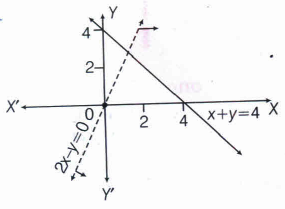
Solve the following system of inequalities graphically.
\(x+y\le 4,2x-y>0,x\ge 0\quad and\quad y\ge 0.\)
21.
If z = x + iy, w = \(\frac { 1-iz }{ z-i } \) and \(|w|=1\) then show that z is purely real.
22.
State the converse and contrapositive of each of the following statements:
(i) p: A positive integer is prime only if it has
no divisors other then 1 and itself.
(ii) q: I goto a beach whenever it is a sunny day.
(iii) r: if it is not outside, then you feel thirsty.
23.
Prove the following by using the principle of mathematical induction for all n ∊ N: \(\frac { 1 }{ 2.5 } +\frac { 1 }{ 5.8 } +\frac { 1 }{ 8.11 } +...+\frac { 1 }{ (3n-1)(3n+2) } \)= \(\frac { n }{ (6n+4) } \)
24.
If the fourth term in the expansion of \(\left( ax+\frac { 1 }{ x } \right) ^{ n }is \frac { 20 }{ 27 } \) then find the value of a and n.
25.
Three vertices of a parallelogram ABCD are A(3, – 1, 2), B (1, 2, – 4) and C (– 1, 1, 2). Find the coordinates of the fourth vertex.
26.
The mean and variance of eight observations are 9 and 9.25 respectively. If six of the observations are 6, 7, 10, 12, 12 and 13, find the remaining two observations.
27.
Find four numbers in G.P. whose sum is 85 and product is 4096.
28.
The sum and sum of squares corresponding to length x (in cm) and weight y (in gm) of 50 plant products are given below:
\(\sum _{ i=1 }^{ 50 }{ { x }_{ i } } =212,\sum _{ i=1 }^{ 50 }{ { x }_{ i }^{ 2 } } =902.8,\sum _{ i=1 }^{ 50 }{ { y }_{ i } } =261,\) \(\sum _{ i=1 }^{ 50 }{ { y }_{ i }^{ 2 }=1457.6 } \)
which is more varying, the length or weight?
29.
Find the intersection of each pair of sets of question 1above.
1.
\(\frac { 5 }{ 18 } \)
2.
B = {3,4, 5, 6, 7, 8}
3.
\(\frac { { x }^{ 2 } }{ 4 } -\frac { { y }^{ 2 } }{ 12 } =1\)
4.
19 = a + ( 6 - 1 ) d and 41 = a + ( 17 - 1 ) d = 87
5.
\(\frac { 1 }{ \sqrt [ 3 ]{ \left( 27-6x \right) ^{ 2 } } } =\left( 27-6x \right) ^{ -\frac { 2 }{ 3 } }=\left( 27 \right) ^{ -\frac { 2 }{ 3 } }(1-\frac { 2 }{ 9 } x)^{ -\frac { 2 }{ 3 } }\)
\(=\frac { 1 }{ 9 } (1+\frac { 4 }{ 27 } x+\frac { 20 }{ 729 } { x }^{ 2 }+\frac { 320 }{ 59049 } { x }^{ 3 }+...),\quad when\quad \left| x \right| <\frac { 9 }{ 2 } \)
6.
0 cannot be placed at thousand's place. So, thousand's place can be filled in 9 ways. Since repitition of digits is allowed, therefore each of the remaining 3 places can be filled in 10 ways.
Ans. 9000
7.
Let x be the marks obtained by student in the annual examination. Then
\(\frac{62+48+x}{3} \geq 60\)
or 110 + x \(\geq\) 180
or x \(\geq\)70
Thus, the student must obtain a minimum of 70 marks to get an average of at least 60 marks.
8.
Consider P(k):2+4+6+8+.....+2k = k(k+1)
Now, P(k+1):2+4+6+.....2(k)+2(k+1)
=k(k+1)+2(k+1)=k2 + 3k+2
=(k+1)(k+1)
9.
All rectangles, Rhombus and square are parallelograms because its opposite sides are equal and parallel.
Therefore \({ F }_{ 2 }\subset { F }_{ 1 },{ F }_{ 3 }\subset { F }_{ 1 }\) and \({ F }_{ 4 }\subset { F }_{ 1 }\)
\({ F }_{ 1 }={ F }_{ 2 }\cup { F }_{ 3 }\subset { F }_{ 4 }\)
10.
Given, A = { 0, 1, 2, 3, 4, 5, 6, 7, 8, 9, 10}
Since, -4 is not an element of A, therefore -4 \(\notin \) A
11.
The given equations are x - y - 7 = 0 and 2x + y - 2 = 0
Equation of any line which passes through the intersection of the given lines is
(x - y - 7) + k (2x + y - 2) = 0 ... (i)
If equation (i) also passes through the origin
i.e., (0, 0), we get
-7 -2k= 0
\(∴\ k={7\over 2}\)
Putting the value of k is equation (i), we get
(x - y - 7 ) - \(7\over2\) (2x + y. - 2) = 0
2x - 2y - 14 - 14x - 7y + 14 = 0
⇒ -12x- 9y = 0
⇒ 4x + 3y = 0
12.
Favourable outcomes are 1,3,5,7,9,11,13,15,17 and 19
\(\frac { 1 }{ 2 } \)
13.
Possible outcomes are (1,2),(2,1),(1,5),(2,4),(3,3),(4,2),(5,1),(3,6),(4,5),(5,4),(6,6)
\(\frac { 1 }{ 3 } \)
14.
Let \(\bar { x } \) be the mean of given data.
Then, \(\bar { x } \) =\(\frac { 6+5+5.25+5.5+4.75+4.5+6.25+7.75+9 }{ 9 } =\frac { 54 }{ 9 } =6\)
We make the table from the given data.
| \(x_{ i }\) | \(x_{ i }-\bar { x } =\quad x_{ i }-6\) | \(|x_{ i }-\bar { x } |\) |
| 6 | 0 | 0 |
| 5.0 | -1 | 1.00 |
| 5.25 | -0.75 | 0.75 |
| 5.5 | -0.5 | 0.50 |
| 4.75 | -1.25 | 1.25 |
| 4.5 | -1.50 | 1.50 |
| 6.25 | 0.25 | 0.25 |
| 7.75 | 1.75 | 1.75 |
| 9 | 3 | 3 |
| Total | 10.00 |
\(\therefore \) Mean deviation from mean,
\(MD(\bar { x } )=\frac { \sum { |x_{ i }-\bar { x } | } }{ n } =\frac { 10 }{ 9 } =1.1\)
Hence, mean deviation form mean is 1.1.
15.
The vertices of the triangle are A(1, 2, 3), B(3, 4, 5) and C(-1, 6, 7). Also, centroid of the triangles is G(1, 4, 1/3).
16.
Here, foci are at \((\pm 5,0)\)
\(\therefore \quad (\pm c,0)=(\pm 5,0)\Rightarrow c=5\)
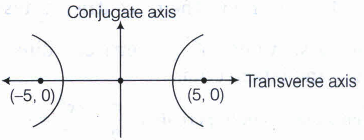
\(Also,\quad we\quad know\quad that,\quad { c }^{ 2 }={ a }^{ 2 }+{ b }^{ 2 }\)
\(\Rightarrow 25=16+{ b }^{ 2 }\)
\( \Rightarrow { b }^{ 2 }=9\)
\(Since,\quad the\quad foci\quad lies\quad on\quad x-axis.\)
\(\frac { { x }^{ 2 } }{ { a }^{ 2 } } -\frac { { y }^{ 2 } }{ { b }^{ 2 } } =1\)
\(On\quad putting\quad the\quad values\quad of\quad { a }^{ 2 }\quad and\quad { b }^{ 2 },\quad we\quad get\)
\(\frac { { x }^{ 2 } }{ 16 } -\frac { { y }^{ 2 } }{ 9 } =1\)
\(Which\quad is\quad the\quad required\quad equation\quad of\quad hyperbola.\)
17.
Here, focus is (4,0) and directrix is x + 4 = 0
Let p(x,y) be any moving point, then draw
from p to the directrix.
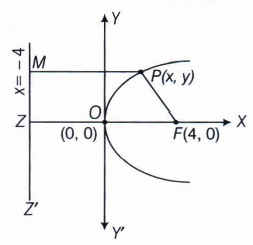
Now, FP=PM [by definition of parabola]
\(\Rightarrow \) FP2=PM2
\(\Rightarrow \) (x - 4)2 + (y - 0)2 = \(\frac { (x+4)^{ 2 } }{ (\sqrt { 1 } )^{ 2 } } \)
\(\Rightarrow \) x2- 8x + 16 + y2 = x2 + 8x + 16
\(\Rightarrow \) y2=16x
which is the required equation of parabola.
Length of latusrectum=16
18.
b,c,d are in GP.
\(\Rightarrow \) C2 = bd...(ii)
Similarly, \(\frac { 1 }{ c } ,\frac { 1 }{ d } ,\frac { 1 }{ e } \)are in AP.
\(\Rightarrow \) \(\frac { 2 }{ d } =\frac { 1 }{ c } +\frac { 1 }{ e } \)
\(\Rightarrow \) \(d=\frac { 2ce }{ c+e } \)
On putting the values of b and d from Eq.(i) and (iii), in Eq.(ii), we get
\({ c }^{ 2 }=\left( \frac { a+c }{ 2 } \right) \times \left( \frac { 2ce }{ c+e } \right) \Rightarrow { c }^{ 2 }=ae\)
Therefore, a,c,e are in GP.
19.
Here, r>1, n>2
\(\therefore \) T3r = 2nC3r-1 x3r-1; Tr+2 = 2nCr+1 xr+1
Then, 2nC3r-1= 2nCr+1
\(\Rightarrow \) 3r - 1 + r + 1 = 2n \(\Rightarrow \) n = 2r
20.
21.
We have,
\(|w|=1\ \Rightarrow \frac { |1-iz| }{ |z-i| } =1\)
\(\Rightarrow |1-iz|=|z-i|\)
\(\Rightarrow |1+y-ix|=|x+i(y-1)|\)
22.
(i) The contrapositive of the given statement is: If a positive integer has divisors other than 1 and itself then it is not prime. The converse of the given statement is: If a positive integer has no divisors other than 1 and itself, then it is a prime
(ii) The contrapositive of the given statement is: If! do not go to a beach then it is not a sunny day. The converse of the given statement is: If I go to beach, then it is a sunny day.
(iii) The contrapositive of the given statement IS: If you do not feel thirsty, then it is not hot outside. The converse of the given statement is: If you feel thirsty, then it is hot outside.
23.
Let P(n) =\(\frac { 1 }{ 2.5 } +\frac { 1 }{ 5.8 } +\frac { 1 }{ 8.11 } +...+\frac { 1 }{ (3n-1)(3n+2) } \)= \(\frac { n }{ (6n+4) } \)
For n =1
P(1)= \(\frac { 1 }{ (3\times 1-1)(3\times 1+2) } \)
=\(\frac { 1 }{ (6\times 1+4) } \)
⇒ \(\frac { 1 }{ 2\times 5 } =\frac { 1 }{ 10 } \Rightarrow \frac { 1 }{ 10 } =\frac { 1 }{ 10 } \)
∴ P(1) is true
Let P(n) be true for n = k
∴ P(k) =\(\frac { 1 }{ 2.5 } +\frac { 1 }{ 5.8 } +\frac { 1 }{ 8.11 } +......+\frac { 1 }{ (3k-1)(3k+2) }\)
\(\frac { k }{ (6k+4) } \)...(i)
For n = k + 1
P(k+1)= \(\frac { 1 }{ 2.5 } +\frac { 1 }{ 5.8 } +\frac { 1 }{ 8.11 } +......+\frac { 1 }{ (3k-1)(3k+2) } +\frac { 1 }{ [3(k+1)-1][2(k+1)+2] } \)
=\(\frac { k+1 }{ 6k+10 } \)
= \(\frac { k }{ 6k+4 } +\frac { 1 }{ (3k+2)(3k+5) } \)
= \(\frac { 1 }{ (3k+2) } \left[ \frac { k }{ 2 } +\frac { 1 }{ 3k+5 } \right] \)
= \(\frac { 1 }{ (3k+2) } \left[ \frac { { 3k }^{ 2 }+5k+2 }{ 2(3k+5) } \right] \)
=\(\frac { 1 }{ (3k+2) } \left[ \frac { { 3k }^{ 2 }+3k+2k+2 }{ 2(3k+5) } \right] \)
= \(\frac { 1 }{ (3k+2) } \left[ \frac { { 3k }(k+1)+2(k+1) }{ 2(3k+5) } \right] \)
= \(\frac { 1 }{ (3k+2) } \left[ \frac { (k+1)+(3k+2) }{ 2(3k+5) } \right] \)
= \(\frac { k+1 }{ 6k+10 } \)
∴ P(k + 1) is true
Thus P(k) is true ⇒ P(k + 1) is true
Hence by principle of mathematical induction, P(n) is true for all n ∊ N.
24.
It is given that T4 = \(\frac{20}{27}\)
Comparing\(\left( ax+\frac { 1 }{ x } \right) ^{ n }\) with (A+ B)n, we have
A=ax and B=\(\frac{1}{x}\)
∴ T4 = nC3 An-3\((\frac{1}{x})^3\)
= nC3 (ax)n-3\((\frac{1}{x})^3\)
∴ nc3 (ax)n-3\((\frac{1}{x})^3=\frac{20}{27}\)
∴ = nc3 an-3 xn-6=\(\frac{20}{27}...(i)\)
Now n - 6 = 0 ⇒ n = 6
Putting n = 6 in (i), we have
6C3 a6- 3x6 - 6=\(\frac{20}{27}\)
⇒ 20a3=\(\frac{20}{27}\)
⇒ a3=\(\frac{1}{27}\)
⇒ a=\(\frac{1}{3}\)
Thus n = 6 and a =\(\frac{1}{3}\)
25.
Let D(x, y, z) be the fourth vertex of parallelogram ABCD.
We know that diagonals of a parallelogram bisect each other. So the mid points ofAC and BD coincide.
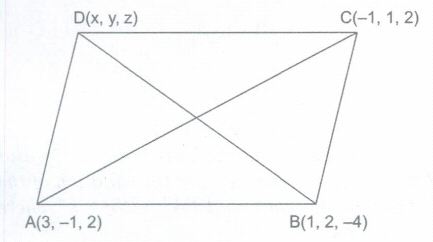
\(\therefore \) Coordinates of mid point of AC \(\left( \frac { 3-1 }{ 2 } ,\frac { -1+1 }{ 2 } ,\frac { 2+2 }{ 2 } \right) \)=(1,0,2)
Also coordiantes of mid point of BD \(\left( \frac { x+1 }{ 2 } ,\frac { y+2 }{ 2 } ,\frac { z-4 }{ 2 } \right) \)
\(\therefore \quad \frac { x+1 }{ 2 } =1\Rightarrow x+1=2\Rightarrow x=1\)
\(\frac { y+2 }{ 2 } =0\Rightarrow y+2=0\Rightarrow y=-2\)
\(\frac { z-4 }{ 2 } =2\Rightarrow z-4=4\Rightarrow z=8\)
Thus the coordinates of point Dare (1, -2,8).
26.
Let two remaining observations be x and y. Then
\(\frac { 6+7+10+12+12+13+x+y }{ 8 } =9\)
\(\therefore\) 60 + x + y = 72 \(\Rightarrow\) x + y = 12 ......(i)
Also \(\frac { 1 }{ 8 } ({ 6 }^{ 2 }+{ 7 }^{ 2 }+{ 10 }^{ 2 }+{ 12 }^{ 2 }+{ 12 }^{ 2 }+{ 13 }^{ 2 }+{ x }^{ 2 }+{ y }^{ 2 })-{ (9) }^{ 2 }=9.25\)
\(\Rightarrow \frac { 1 }{ 8 } (36+49+100+144+144+169+{ x }^{ 2 }+{ y }^{ 2 })-81=9.25\)
\(\Rightarrow\) 642 + x2 + y2 = 722
\(\Rightarrow\) x2 + y2 = 80 ......(ii)
Now (x+y)2 + (x-y)2 = 2(x2+y2)
\(\Rightarrow\) (12)2 + (x - y)2 = 2 x 80
\(\Rightarrow\) (x - y)2 = 160 - 144
\(\Rightarrow\) (x - y)2 = 16 \(\Rightarrow\) x - y = \(\pm \) 4
When x - y = 4
Solving x + y = 12 and x - y = 4 we get x = 8 and y = 4
When x - y = -4
Solving x + y = 12 and x - y = -4 we get x = 4 and y = 8.
27.
Let \(\frac { a }{ { r }^{ 3 } } ,\frac { a }{ { r } } \) ,ar,ar3 be the four numbers in G.P.
It is given that \(\frac { a }{ { r }^{ 3 } } +\frac { a }{ { r } } \)+ar+ar3=85 \(\Rightarrow \) a\(\left( \frac { 1 }{ { r }^{ 3 } } ,\frac { 1 }{ { r } } +r+{ r }^{ 3 } \right) \)=85....(i)
and \(\frac { a }{ { r }^{ 3 } } \times \frac { a }{ { r } } \)\(\times \)ar\(\times \)ar3=4096 \(\Rightarrow \) a44096 \(\Rightarrow \) a=8
Putting value of a in (i)
\(\therefore \) 8\(\left( \frac { 1 }{ { r }^{ 3 } } +\frac { 1 }{ r } +r+{ r }^{ 3 } \right) \) =85 \(\Rightarrow \) 8\(\left( { r }^{ 3 }+\frac { 1 }{ { r }^{ 3 } } \right) \)+8 \(\left( { r }+\frac { 1 }{ { r } } \right) \)=85
\(\Rightarrow \) 8 \(\left[ \left( r+\frac { 1 }{ r } \right) ^{ 3 }-3\left( r+\frac { 1 }{ r } \right) \right] \) \(\Rightarrow \) 8\(\left[ \left( r+\frac { 1 }{ r } \right) ^{ 3 }-16\left( r+\frac { 1 }{ r } \right) \right] \)-85=0
put r+\(\frac { 1 }{ r } \)=y then
8y3 - 16y - 85 = 0 \(\Rightarrow \)(2x-5)(4x2+10x + 17) = 0
\(\Rightarrow \) 2x-5=0 or (2x - 5)(4x2 +10x + 17) = 0
\(\Rightarrow \) 2x=5
or x=\(\frac { -10\pm \sqrt { \left( 10 \right) ^{ 2 }-4\times 4\times 17 } }{ 8 } =\frac { -10\pm \sqrt { 100-272 } }{ 8 } \)
\(\Rightarrow \) x=\(\frac { 5 }{ 2 } \)or \(\frac { -10\pm \sqrt { -172 } }{ 8 } \)(which is not possible)
\(\therefore \) r+\(\frac { 1 }{ r } \)=\(\frac { 5 }{ 2 } \) \(\Rightarrow \) 2r2-5r+2=0 \(\Rightarrow \)(r-2)(2r-1)=0
\(\Rightarrow \) r-2=0 or 2r-1=0
\(\Rightarrow \) r=2 or r= \(\frac { 1}{ 2 } \)
Thus four numbers in G.P. are 1, 4,16,64 or 64,16,4, 1.
28.
Here \(\sum _{ i=1 }^{ 50 }{ { x }_{ i }=212,\sum _{ i=1 }^{ 50 }{ { x }_{ i }^{ 2 } } =902.8, } \) \(\sum _{ i=1 }^{ 50 }{ { y }_{ i } } =261,\sum _{ i=1 }^{ 50 }{ { y }_{ i }^{ 2 } } =1457.6\)
Now \(\bar { x } =\frac { 212 }{ 50 } =4.24\)
\({ \sigma }_{ x }^{ 2 }=\frac { 1 }{ 50 } \times \times 902.8-{ \left( \frac { 212 }{ 50 } \right) }^{ 2 }\)
= 18.056 - 17.978 = 0.078
\({ \sigma }_{ x }=\sqrt { 0.078 } =0.28\)
Also \(\bar { y } =\frac { 261 }{ 50 } =5.22\)
\({ \sigma }_{ y }^{ 2 }=\frac { 1 }{ 50 } \times 1457.6-{ \left( \frac { 261 }{ 50 } \right) }^{ 2 }\)
= 29.152-27.248 = 1.904
\({ \sigma }_{ y }=\sqrt { 1.904 } =1.38\)
C.V. of length=\(\frac { 0.28 }{ 4.24 } \times 100=6.6\)
C.V. of weight=\(\frac { 1.38 }{ 5.22 } \times 100=26.45\)
C.V. of weight > C.V. of length
Thus weight have more variability than length.
29.
(i) Here X = {1, 3, 5}and Y = {1, 2, 3}
\(\therefore\) X \(\cap\)Y = {1, 3}
(ii) Here A = {a, e, i, o, u} and B = {a, b, c}
\(\therefore\) A \(\cap\) B= {a}
(iii) Here A = {x : x is a natural number and multiple of 3}
= {3, 6, 9, 12,...........} and
B = {x : x is a natural number less than 6}
= {1, 2, 3, 4, 5}
\(\therefore\) A \(\cap\) B = {3}
(iv) Here A = {x : x is a natural number and 1 < x \(\le\) 6}
= {2, 3, 4, 5, 6}
and B = {x : x is a natural number and 6 < x < 10}
= {7, 8, 9}
\(\therefore\) A \(\cap\) B=ф
(v) Here A = {1, 2, 3} and B =ф
\(\therefore\) A \(\cap\) B=ф

11th Standard CBSE Syllabus & Materials
11th Standard CBSE
CBSE 11th Business Studies Forms of Business Organisation Sample Question Papers Study Material - QB365 Set A
NEW11th Standard CBSE
CBSE 11th Business Studies Business, Trade and Commerce Sample Question Papers Study Material - QB365 Set A
NEW11th Standard CBSE
CBSE 11th Physics Waves Sample Question Papers Study Material - QB365 Set A
NEW11th Standard CBSE
CBSE 11th Physics Kinetic Theory Sample Question Papers Study Material - QB365 Set A



CBSE 11th Standard CBSE Subjects
CBSE Standards









