
 100% FREE ACCESS
11th Standard CBSE Syllabus & Materials
11th Standard CBSE
CBSE 11th Economics PART-A - Presentation of Data - New Sample Question Papers Study Material - QB365 Set A
NEW11th Standard CBSE
CBSE 11th Economics PART-A - Organisation of Data - New Sample Question Papers Study Material - QB365 Set A
NEW11th Standard CBSE
CBSE 11th Economics PART-A - Collection of Data - New Sample Question Papers Study Material - QB365 Set A
NEW11th Standard CBSE
CBSE 11th Economics PART-A - Introduction to Economics and Statistics - New Sample Question Papers Study Material - QB365 Set A
NEW11th Standard CBSE
CBSE 11th Business Studies International Trade Sample Question Papers Study Material - QB365 Set A
NEW11th Standard CBSE
CBSE 11th Business Studies Evolution and Fundamentals of Business Sample Question Papers Study Material - QB365 Set A

Published on: 21/10/2025
Download CBSE Class 11th Standard CBSE Physics question papers, sample papers, important questions, and previous year solved papers in PDF format. Get free study materials, NCERT solutions, and exam preparation resources for Class 11th Standard CBSE Physics
Questions + Answers key
Take MCQ Physics Test
1.
Define gravitational potential energy of a body. Derive an expression for the gravitational potential energy of a body of mass 'm' located at a distance 'r' from the centre of the earth.
2.
A rocket is fired with a velocity 0.6 times the escape velocity on the surface of earth. How high will it go from the surface?
3.
Find the angular velocity for an object to experience weightlessness at the equator of earth. Under this condition, also find the duration of a day.
4.
State Newton's law of Gravitation. Find the percentage decrease in the weight of the body when taken to a height of 16 km. above the surface of the earth. Radius of the earth is 6400 km.
5.
Three masses, each equal to M, are placed at the three corners of a square of side 'a'. Calculate the force of attraction on unit mass at the fourth corner.
6.
Derive an expression for the orbital velocity of a satellite in the orbit. Reduce it to an orbit close to the surface of earth. How is it related to escape velocity?
7.
Write Kepler's laws for planetary motion.
8.
Find the variation of acceleration due to gravity below the surface of earth at depth d.
9.
(a) Two particles of equal masses go around a circle of radius R under the action of their mutual gravitational force. Find the speed of each particle.
(b) What is the binding energy of a satellite? Derive an expression for it.
10.
Define escape speed. Show that its value on the surface is \(v_{e}=\sqrt{2 g R}\).R = Radius of planet (Earth)
11.
What is the effect of rotation on the value of 'g'? Derive the relation.
12.
Find an expression for the orbital velocity of a satellite revolving around the earth in a circular orbit at a height h above the surface of earth.
13.
Why do different planets have different escape velocities?
14.
Under what circumstances would your weight become zero?
15.
A comet orbits the sun in highly elliptical orbit. Does the comet has a constant potential energy
16.
A meteor is falling. How much gravitational acceleration would it experience when its height from the surface of the earth is equal to three times the radius of the earth?
17.
Does the escape speed of a body from the earth depends on the height of the location from where the body is launched?
18.
Does the escape speed of a body from the earth depends on the location from where it is projected
19.
Derive an expression for work done against gravity.
20.
Define period of revolution.Derive an expression of the period of revolution or time period of satellite.
1.
Gravitational potential energy. The work done in carrying a mass 'm' from infinity to a point at distance r is called gravitational potential energy.
\(\text { G.P.E. }=-\frac{\mathrm{GM} m}{r}\)
i.e., G.P.E = Mass x Gravitational potential
It is a scalar quantity measured in joule.
Negative sign means that the mass is bound to M.
The gravitational force of attraction between M and m when x is the distance between their centres is given by
\(\mathrm{F}=\frac{\mathrm{GMm}}{x^{2}}\)
Suppose the body is moved through a distance dx, therefore, work done is given by
\(d \mathrm{~W}=\mathrm{F} d x=\frac{\mathrm{GMm}}{x^{2}} d x\)
When the body is brought from infinity to some distance r,
we write \(\int d W=\int_{x=\infty}^{x=r} \frac{\mathrm{GMm}}{x^{2}} d x\)
or \(\mathrm{W}=\mathrm{GMm}\left[\frac{-1}{x}\right]_{\infty}^{r}\)
\(=-\mathrm{GM} m\left[\frac{1}{r}-\frac{1}{\infty}\right]=\frac{-\mathrm{GMm}}{r}\)
This amount of work done is the change in the potential energy of the body.
\(\therefore \text { P.E. } \ \mathrm{U}=-\frac{\mathrm{GMm}}{r}\)
2.
Velocity provided = 0.6 v e , \(v_{e}=\sqrt{\frac{2 \mathrm{GM}}{\mathrm{R}}}\)
Applying conservation
\(-\frac{\mathrm{GMm}}{\mathrm{R}}+\frac{1}{2} m\left(6 v_{e}\right)^{2}=-\frac{\mathrm{GMm}}{\mathrm{R}+h}\)
Solve for h to get
\(h=\frac{72}{28} \mathrm{R}\)
3.
Due to the rotation
\(g^{\prime}=g\left(1-\frac{\mathrm{R} \omega^{2}}{g} \cos ^{2} \theta\right)\)
where θ is the latitude
For weightlessness, g' = 0
At the equator, θ = 0°
\(\therefore 1-\frac{\mathrm{R} \omega^{2}}{g} \cos ^{2} 0^{\circ}=0\)
\(\text { or } \omega=\sqrt{\frac{g}{R}} \Rightarrow \omega=\sqrt{\frac{10}{6400 \times 10^{3}}}=\frac{1}{800}\)
\(\omega=\frac{2 \pi}{T} \Rightarrow \mathrm{T}=\frac{2 x}{\omega}=\frac{2 \times 3.14}{1 / 800}=5024 \mathrm{sec}\)
4.
It states that every body in the universe attracts every other body with a force which is directly propotional to the product of their masses and inversely propotional to square of distance between them.
\(\mathrm{F}=\frac{\mathrm{G} m_{1} m_{2}}{r^{2}}\)
m 1 and m2 ⟶ mass of two' bodies
r ⟶ distance between two bodies.
The acceleration due to gravity at a height' h' above the surface of the earth is
\(g^{\prime}=g\left(1-\frac{2 h}{\mathrm{R}}\right)\)
\(g-g^{\prime}=\left(\frac{2 h g}{R}\right)\)
\(\frac{m g-m g^{\prime}}{m g} \times 100=\frac{g-g^{\prime}}{g} \times 100\)
\(=\frac{2 h}{R} \times 100\)
\(=\frac{2 \times 16}{6400} \times 100=0.5 \%\)
5.
\(\mathrm{F}_{1}=\mathrm{F}_{2}=\frac{\mathrm{GM}}{a^{2}}\)
Resultant of F1 and F2 is \(\sqrt{2} \frac{\mathrm{GM}}{a^{2}}\) pointing towards the centre.
\(F_{3}=\frac{\mathrm{GM}}{(\sqrt{2} a)^{2}}=\frac{\mathrm{GM}}{2 a^{2}}\)
Both \(\frac{\sqrt{2} \mathrm{GM}}{a^{2}} \text { and } \frac{\mathrm{GM}}{2 a^{2}}\) act in the same direction (along the diagonal)
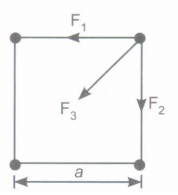
Their resultant is
\(\frac{\sqrt{2} \mathrm{GM}}{a^{2}}+\frac{\mathrm{GM}}{2 a^{2}} \text { or } \frac{\mathrm{GM}}{a^{2}}\left(\sqrt{2}+\frac{1}{2}\right)\)
6.
In an orbit of radius r, a satellite of mass m moves round a planet of mass M. Then
\(\frac{m v_{0}^{2}}{r}=\frac{\mathrm{GMm}}{r^{2}}\)
\(v_{\mathrm{o}}=\sqrt{\frac{\mathrm{GM}}{r}}=\sqrt{\frac{\mathrm{GM}}{\mathrm{R}+h}}\)
where h is the height at which the satellite is from the surface.
For close to earth orbits, h = 0
\(\therefore \ v_{\mathrm{o}}=\sqrt{\frac{\mathrm{GM}}{\mathrm{R}}}=\sqrt{g \mathrm{R}}\)
Since \(v_{e}=\sqrt{2 g \mathrm{R}}, v_{\mathrm{o}}=\frac{v_{e}}{\sqrt{2}}\)
7.
(i) Law of orbit: The planets including earth, go around the sun in elliptical orbits.
(ii) Law of area: The line joining the sun and the planet sweeps equal area in equal intervals of time.
(iii) Law of periods: The square of time period of revolution is directly proportional to the cube of semi-major axis of the elliptical orbit.
8.
Let the planet earth be made of material of density p with radius R.
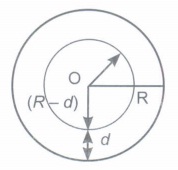
At depth d, the gravitational force is due to mass distributed in the sphere of radius (R -:d).
ஃThe acceleration due to gravity at depth
\(g^{\prime}=\frac{G M^{\prime}}{(R-d)^{2}}=G \frac{4 \pi}{3} \times \frac{(R-d)^{3} P}{(R-d)^{2}}\)
\(=G \frac{4}{3} \pi\left(R^{3}-d\right) \rho\)
\(\text { i.e. } \ \frac{g^{\prime}}{g}=\frac{(R-d)}{R}=g \frac{(R-d)}{R}=g\left(1-\frac{d}{R}\right)\)
ஃ g reduces as we move from surface to centre.
9.
(a) The particles will always remain diametrically opposite so that the force on each particle will be directed along the radius. Consider the motion of one of the particles. The force on the particle is given by
\(F=\frac{G m^{2}}{4 R^{2}}\)
\(\therefore \ \frac{G m^{2}}{4 R^{2}}=\frac{m v^{2}}{R}\)
\(\Rightarrow \ v=\sqrt{\frac{G m}{4 R}}\)
(b) Binding energy is the minimum energy required to free a satellite from the gravitational attraction.
\(T . E .=P . E .+K . E .=-\frac{G M m}{R}+\frac{1}{2} m v^{2}\)
\(T . E .=-\frac{G M m}{R}+\frac{1}{2} \frac{m G M}{R}=\frac{-G M m}{2 R}\)
Binding energy (B.E.) = \(-(T . E .)=\frac{G M m}{2 R}\)
10.
Escape Speed: It is defined as the minimum speed with which the body has to be projected vertically upwards from the surface of earth (or any other planet) so that it just crosses the gravitational field of earth (or of that planet) and never returns on its own.
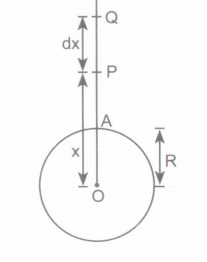
Let earth be a perfect sphere of mass M, radius R with centre at O. Let a body of mass m to be projected from a point A on the surface of earth, as shown in figure.
Join OA and produce it further.
P and Q are at a distance x and (x + dx) from the centre of the earth.
Gravitational force of attraction on the body at P is \(F=\frac{G M m}{x^{2}}\)
This much force has to be applied on the body to take the body in the upward direction. Work done in taking the body against gravitational attraction from P to Q is
\(d W=F d x=\frac{G M m}{x^{2}} d x\)
Total work done in taking the body against gravitational attraction from surface of earth (i.e. x = R) to a region beyond the gravitational field of earth (i.e. x = ∞) can be calculated by interchanging the above expression within the limits x = R to x = ∞. Thus, total work done is
\(W=\int_{R}^{\infty} \frac{G M m}{x^{2}} d x=G M m \int_{R}^{\infty} x^{-2} d x\)
\(=G M m\left[\frac{x^{-2+1}}{-2+1}\right]_{R}^{\infty}=-G M m\left[\frac{1}{x}\right]_{R}^{\infty}\)
\(=-G M m\left[\frac{1}{\infty}-\frac{1}{R}\right]=\frac{G M m}{R}\)
This work done is at the cost of kinetic energy given to the body at the surface of the earth.
K.E. of the body \(=\frac{1}{2} m v_{e}^{2}, v_{e}\) = escape speed of the body
\(\therefore \ \frac{1}{2} m v_{e}^{2}=\frac{G M m}{R}\)
or \(v_{e}^{2}=\frac{2 G M}{R} \text { or } v_{e}=\sqrt{\frac{2 G M}{R}}\)
or \(v_{e}=\sqrt{2 g R} \text { . }\)
11.
Consider a mass m placed at a latitude θ.
Two forces are experienced by it namely,
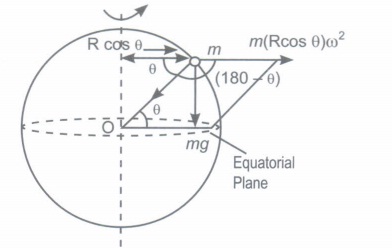
(i) The gravitational force 'mg' towards centre O.
(ii) The centrifugal force trying to lift the mass away. The net force is given by
\(m g_{0}=\sqrt{(m g)^{2}+\left(m R \cos \theta \omega^{2}\right)^{2}}\)
\(+2(m g)\left(m R \cos \theta \omega^{2}\right) \cos \left(180^{\circ}-\theta\right)\)
The radius is R cos θ, since the centrifugal force is due to the rotation about the axis of the earth
\(m g_{\theta}=m g\left(1+\left(\frac{R \omega^{2} \cos ^{2} \theta}{g}\right)^{2}-2 \frac{R \omega^{2}}{g} \cos ^{2} \theta\right)^{\frac{1}{2}}\)
\(\therefore \quad g_{\theta}=g\left(1-\frac{2 R \omega^{2}}{g} \cos ^{2} \theta\right)^{\frac{1}{2}}\)
Since \(\left(\frac{R \omega^{2}}{g}\right)^{2}\) is negligibly small.
\(g_{\theta}=g\left(1-\frac{R \omega^{2}}{g} \cos ^{2} \theta\right)\)
12.
Consider a satellite of mass m revolving around the earth at a height h from its surface so that radius of its orbit r = R + h. If vo be the orbital velocity of satellite then centripetal force needed by it for its uniform circular motion is
\(F=\frac{mv_0^2}{r}\)
This value of centripetal force is provided by the gravitational pull of the earth acting on the satellite i.e.,
\(F=\frac{GMm}{r^2}\)
For equilibrium, \(\frac{mv_0^2}{r}=\frac{GMm}{r^2}\)
\(\Rightarrow v_0=\sqrt {\frac{GM}{r}}=\sqrt {\frac{GM}{(R+h)}}\)
But \(g=\frac{GM}{R^2},\ hence\ GM=gR^2\)
\(\therefore v_0=\sqrt {\frac{gR^2}{(R+h)}}=R\sqrt {\frac{g}{(R+h)}}.\)
13.
Escape velocity, \(v=\sqrt {2gR}=\sqrt {\frac{2GM}{R}}.\)
Thus escape velocity of a planet depends upon (i) its mass (M) and (ii) its size (R). As different planets have different masses and sizes, so they have different escape velocities.
14.
The weight will become zero under the following circumstances :
(i) during free fall
(ii) at the centre of the earth
(iii) in an artificial satellite
(iv) at a point where gravitational pull of earth is equal to the gravitational pull of the Moon.
15.
Potential energy of the comet changes as its kinetic energy changes.
16.
\(\frac { g }{ 16 } \)
17.
Yes,escape velocity depends (through slightly) on the height of location from where the body is projected as g depends on height.
18.
Yes,escape velocity depends (through slightly) on the location from where the body is projected because with location g changes and so should \({ v }_{ e }(=\sqrt { 2gR) } \) change.
19.
Potential energy of the body on the surface of the earth = \(\frac { -GMm }{ R } \)
Potential energy of the body at a height h from the surface of the earth = \(\frac { -GMm }{ (R+h) } \)
Work done
\(=\left( -\frac { GMm }{ R+h } \right) -\left( -\frac { GMm }{ R } \right)\)
\( \\ =\frac { GMm }{ R } -\frac { GMm }{ R+h }\)
\(=GMm\left( \frac { 1 }{ R } -\frac { 1 }{ R+h } \right) \)
\(\\ =\frac { GMmh }{ R(R+h) } =\frac { MgR^{ 2 }h }{ R(R+h) } \left[ \because g=\frac { GM }{ R^{ 2 } } \right] \)
\(=\frac { (Mgh)R }{ (R+h) } =\frac { Mgh }{ 1+\frac { h }{ R } } \)
20.
Period of a revolution of a satellite is the time taken by the satellite to complete one revolution round the earth. It is denoted by T.
\(\therefore T=\frac { Circumference\ of\ circular\ orbit }{ Orbital\ velocity } \)
or \(T=\frac { 2\pi r }{ { v }_{ o } } \)
or \(T=\frac { 2\pi (R+h) }{ { v }_{ o } } \quad \quad \quad \quad \quad [\therefore r=R+H]\)
or \(T=2\pi (R+h)\sqrt { \frac { R+h }{ GM } } \left[ \because \quad { v }_{ o }=\sqrt { \frac { GM }{ R+h } } \right] \)
or \(T=2\pi \sqrt { \frac { (R+h)^{ 2 } }{ GM } } \)
Also, \(T=2\pi \sqrt { \frac { (R+h)^{ 2 }(R+h) }{ GM } } \)
or \(T=2\pi \sqrt { \frac { (R+h)^{ 3 } }{ gR^{ 2 } } } \)
\(\because \quad \quad g{ R }^{ 2 }=GM\)
\(\therefore T=2\pi \sqrt { \frac { (R+h)^{ 2 } }{ gR^{ 2 } } } \)

11th Standard CBSE Syllabus & Materials
11th Standard CBSE
CBSE 11th Business Studies Forms of Business Organisation Sample Question Papers Study Material - QB365 Set A
NEW11th Standard CBSE
CBSE 11th Business Studies Business, Trade and Commerce Sample Question Papers Study Material - QB365 Set A
NEW11th Standard CBSE
CBSE 11th Physics Waves Sample Question Papers Study Material - QB365 Set A
NEW11th Standard CBSE
CBSE 11th Physics Kinetic Theory Sample Question Papers Study Material - QB365 Set A



NCERT Books

Syllabus

Exam Pattern

Sample Question Papers

Previous year Question Papers

Important Notes

MCQ Practice test

NCERT Exemplers

Case study Questions

Image Based Questions

Passage based Questions

HOT Questions

Value Based Questions

Model Questions Papers
NCERT ( Book Back ) Questions

Assertion and Reason
Important Questions And Answers

CBSE 11th Standard CBSE Subjects
CBSE Standards







