
 100% FREE ACCESS
11th Standard CBSE Syllabus & Materials
11th Standard CBSE
CBSE 11th Economics PART-A - Presentation of Data - New Sample Question Papers Study Material - QB365 Set A
NEW11th Standard CBSE
CBSE 11th Economics PART-A - Organisation of Data - New Sample Question Papers Study Material - QB365 Set A
NEW11th Standard CBSE
CBSE 11th Economics PART-A - Collection of Data - New Sample Question Papers Study Material - QB365 Set A
NEW11th Standard CBSE
CBSE 11th Economics PART-A - Introduction to Economics and Statistics - New Sample Question Papers Study Material - QB365 Set A
NEW11th Standard CBSE
CBSE 11th Business Studies International Trade Sample Question Papers Study Material - QB365 Set A
NEW11th Standard CBSE
CBSE 11th Business Studies Evolution and Fundamentals of Business Sample Question Papers Study Material - QB365 Set A

Published on: 21/10/2025
Download CBSE Class 11th Standard CBSE Physics question papers, sample papers, important questions, and previous year solved papers in PDF format. Get free study materials, NCERT solutions, and exam preparation resources for Class 11th Standard CBSE Physics
Questions + Answers key
Take MCQ Physics Test
1.
A block moves with uniform circular motion because a cord tied to the block is anchored at the centre of a circle. Is the power of the force exerted on the block by the cord positive, negative or zero?
2.
An elevator can carry a maximum load of 1800 kg (elevator + passengers) is moving up with a constant speed of 2 m s–1 . The frictional force opposing the motion is 4000 N. Determine the minimum power delivered by the motor to the elevator in watts as well as in horse power.
3.
A body constrained to move along the z-axis of a coordinate system is subject to a constant force F given by F =\((-\hat{i}+\hat{2j}+\hat{3k})\) N, Where \(\hat{i}\), \( \hat{j} \)and \(\hat{k}\) are unit vectors along the x-, y- and z-axis of the system respectively. What is the work done by this force in moving the body a distance of 4 m along the z-axis ?
4.
What is the loss in kinetic energy after collision, if the target body is initially at rest?
5.
If, in Exercise, the speed of the stone is increased beyond the maximum permissible value, and the string breaks suddenly, which of the following correctly describes the trajectory of the stone after the string breaks :
(a) the stone moves radially outwards,
(b) the stone flies off tangentially from the instant the string breaks,
(c) the stone flies off at an angle with the tangent whose magnitude depends on the speed of the particle ?
6.
If force is acting on a moving body perpendicular to the direction of motion, then what will be its effect on the speed and direction of the body ?
7.
A stone is dropped from a height 'h'. Prove that the energy at any point in its path is mgh.
8.
A cyclist comes to a skidding stop in 10 m. During this process, the force on the cycle due to the road is 200 N and is directly opposed to the motion. (a) How much work does the road do on the cycle ? (b) How much work does the cycle do on the road ?
9.
Two billiard balls each of mass 0.05 kg moving in opposite directions with speed 6 m s -1 collide and rebound with the same speed. What is the impulse imparted to each ball due to the other ?
10.
Underline the correct alternative:
(a) When a conservative force does positive work on a body, the potential energy of the body increases/decreases/remains unaltered.
(b) Work done by a body against friction always results in a loss of its kinetic/potential energy.
(c) The rate of change of total momentum of a many particle system is proportional to the external force/sum of the internal forces of the system.
(d) In an inelastic collision of two bodies, the quantities which do not change after the collision are the total kinetic energy/total linear momentum/total energy of the system of two bodies.
11.
A rocket with a lift-off mass 20,000 kg is blasted upwards with an initial acceleration of 5.0 m s-2. Calculate the initial thrust (force) of the blast.
12.
A stone of mass 0.25 kg tied to the end of a string is whirled round in a circle of radius 1.5 m with a speed of 40 rev./min in a horizontal plane. What is the tension in the string ? What is the maximum speed with which the stone can be whirled around if the string can withstand a maximum tension of 200 N ?
13.
A batsman deflects a ball by an angle of 45° without changing its initial speed which is equal to 54 km/h. What is the impulse imparted to the ball ? (Mass of the ball is 0.15 kg.)
14.
A body of mass 5 kg is acted upon by two perpenticular forces 8 N and 6 N . Find the magnitude and direction of the acceleration.
15.
A body of mass 2 kg initially at rest moves under the action of an applied horizontal force of 7 N on a table with coefficient of kinetic friction = 0.1. Compute the
(a) Work done by the applied force in 10 s
(b) Work done by friction in 10 s
(c) Work done by the net force on the body in 10 s
(d) Change in kinetic energy of the body in 10 s and interpret your results.
16.
The sign of work done by a force on a body is important to understand. State carefully if the following quantities are positive or negative:
(a) work done by a man in lifting a bucket out of a well by means of a rope tied to the bucket.
(b) work done by gravitational force in the above case,
(c) work done by friction on a body sliding down an inclined plane,
(d) work done by an applied force on a body moving on a rough horizontal plane with uniform velocity,
(e) work done by the resistive force of air on a vibrating pendulum in bringing it to rest
17.
State if each of the following statements is true or false. Give reasons for your answer.
(a) In an elastic collision of two bodies, the momentum and energy of each body is conserved.
(b) Total energy of a system is always conserved, no matter what internal and external forces on the body are present.
(c) Work done in the motion of a body over a closed loop is zero for every force in nature.
(d) In an inelastic collision, the final kinetic energy is always less than the initial kinetic energy of the system.
18.
Give the magnitude and direction of the net force acting on a stone of mass 0.1 kg,
(i) Just after it is dropped from the window of a stationary train.
(ii) Just after it is dropped from the window of a train running at a constant velocity of 36 km / h
(iii) Just after it is dropped from the window of a train accelerating with 1 m /s2
(d) lying on the floor of a train which is accelerating with 1 m s-2, the stone being at rest relative to the train.
Neglect air resistance throughout.
19.
Give the magnitude and direction of the net force acting on
(i) a drop of rain falling down with a constant speed.
(ii) a cork of mass 10 g floating on water
(iii) a kite skillfully held stationary in the sky.
(iv) a car moving with a constant velocity of 30 km / h on a rough road.
(v) a high speed electron in space far from all gravitational (material) objects and free of electric and magnetic fields.
20.
The motion of a particle of mass m is described by y = ut + \(\frac { 1 }{ 2 } \) gt2. Find the force acting on the particle.
21.
In which case, work done will be zero
a weight-lifter while holding a weight of 100 kg on his shoulders for 1 min
a locomotive against gravity when it is running on a level plane with a speed of 60 kmh-1.
a person holding a suitcase on his head and standing at a bus terminal.
All of the above
22.
A heavy stone is thrown from a cliff of height h with a speed v. The stone will hit the ground with maximum speed if it is thrown
vertically downward
vertically upward
horizontally
the speed does not depend on the initial direction
23.
The work done by all the forces (external and internal) on a system equals the change in
total energy
kinetic energy
potential energy
none of these
24.
The dimension of Impulse is _______.
MLT-2
MLT-1
MLT-3
MLT
25.
Two bodies of equal masses moving along the same straight line collides with velocities 3m/s and -5m/s collide elastically. Their velocities after collision will be
4m/s for both
-3m/s and 5m/s
-4m/s and 4m/s
-5m/s and 3m/s
26.
Which of the following is a self adjusting force
Static friction
Limiting friction
Dynamic friction
Sliding friction
27.
A scooter of mass 120 kg is moving with a uniform velocity of 108 km/hour. The force required to stop the vehicle in 10 sec is _______.
360 N
720 N
180 N
120 x 10.8 N
28.
Inertia of a body has direct dependence on _______.
Velocity
Mass
Volume
Area
29.
A cricket player catches a ball of mass 100 g and moving with a velocity of 25 ms-1. If the ball is caught in 0.1 s, force of the blow exerted on the hand of the player is : _______.
4 N
25 N
40 N
250 N
30.
A gun of mass 1 kg fires a bullet of mass 1g with a velocity of 1 ms-1. The recoil velocity of the gun is _______.
1 ms-1
0.1 ms-1
0.01 ms-1
0.001 ms-1
31.
When we kick a stone, we get hurt. Due to which one of the following properties of the stone it _______.
Inertia
Velocity
Reaction
Momentum
32.
A body of mass 2 kg moves with an acceleration 3 ms-2. The change in momentum in one second is _______.
2/3 kg rns-1
3/2 kg ms-1
6 kg ms-1
None of the above
33.
34.
35.
Assertion: A rocket works on the principle of conservation of linear momentum.
Reason: Whenever there is change in momentum of one body, the same change occurs in the momentum of the second body of the same system but in the opposite direction.
Codes:
(a) Assertion is correct, reason is correct; reason is a correct explanation for assertion.
(b) Assertion is correct, reason is correct; reason is not a correct explanation for assertion
(c) Assertion is correct, reason is incorrect
(d) Assertion is incorrect, reason is correct.
36.
Assertion: On a rainy day, it is difficult to drive a car or bus at high speed.
Reason: The value of coefficient of friction is lowered due to wetting of the surface.
Codes:
(a) Assertion is correct, reason is correct; reason is a correct explanation for assertion.
(b) Assertion is correct, reason is correct; reason is not a correct explanation for assertion
(c) Assertion is correct, reason is incorrect
(d) Assertion is incorrect, reason is correct.
37.
38.
1.
\(\vec{F} \ and \ \vec{v}\)are perpendicular
So, Power \(=\vec{F} \cdot \vec{v}=F v \cos 90^{\circ}\)
= Zero (∵ cos 90° = 0)
2.
he downward force on the elevator is
F = m g + F f = (1800 x 10) + 4000 = 22000 N
The motor must supply enough power to balance this force. Hence,
P = F. v = 22000 x 2 = 44000 W
= 59 hp
3.
Here, F = \((-\hat{i}+\hat{2j}+\hat{3k})\) N and s = \((\hat{4k})\) m
W = F.s = Fz.Sz
= 3 \(\times\) 4
= 12N - m
= 12 J
4.
Loss in kinetic energy on collision is \(\frac{1}{2}\left(\frac{m_1m_2}{m_1+m_2} \right)\mu^2\)
5.
(i) The part correctly describes the trajectory of the stone after the spring breaks because when a stone tied to one end of a string is whirled round in a circle then velocity of the stone at any point is along the tangent at that point. If the string breaks suddenly, then stone flies off tangentially, along the direction of its velocity.
(ii) The part correctly describes the trajectory of the stone after the spring breaks because when a stone tied to one end of a string is whirled round in a circle then velocity of the stone at any point is along the tangent at that point. If the string breaks suddenly, then stone flies off tangentially, along the direction of its velocity.
(iii) The part correctly describes the trajectory of the stone after the spring breaks because when a stone tied to one end of a string is whirled round in a circle then velocity of the stone at any point is along the tangent at that point. If the string breaks suddenly, then stone flies off tangentially, along the direction of its velocity.
6.
No change in speed, but change in direction is possible. Forces acting on a body in circular motion is an example.
7.
Let a stone of mass m be dropped from a point A at a height h.
P.E. at A = mgh
K.E. = 0
Total energy at A = mgh
As it reaches B, it would have lost some P.E. and gained K.E.
Velocity on reaching
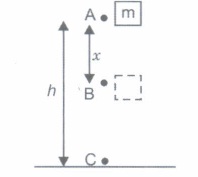
\(\mathrm{B}=\sqrt{2 g x}\)
P.E. at B = mg (h - x)
\(\mathrm{K.E.}=\frac{1}{2} m v_{B}^{2}=\frac{1}{2} m \cdot 2 g x=m g x\)
Total energy at
B = mg (h - x) + mgx = mgh
On reaching the ground C the mass must have gained a velocity \(\sqrt{2 g x}\) and the P.E must be zero.
P.E. at C = 0
\(\text { K.E. at } \mathrm{C}=\frac{1}{2} m v_{C}^{2}=\frac{1}{2} m(2 g h)=m g h\)
Total energy at C = mgh
Thus it is proved that the total energy at any point in its path is mgh.
8.
Work done on the cycle by the road is the work done by the stopping (frictional) force on the cycle due to the road.
(a) The stopping force and the displacement make an angle of 180o (π rad) with each other
Thus, work done by the road,
Wr = Fd cosθ
= 200 x 10 x cos π
= – 2000 J
It is this negative work that brings the cycle to a halt in accordance with WE theorem.
(b) From Newton’s Third Law an equal and opposite force acts on the road due to the cycle. Its magnitude is 200 N. However, the road undergoes no displacement. Thus, work done by cycle on the road is zero.
9.
Initial momentum of each ball before collision.
= 0.05 x 6 kg m s-l = 0.3 kg m s-l
Final momentum of each ball after collision
= - 0.05 x 6 kg m s-1 = - 0.3 kg ms-1
Impulse imparted to each ball due to the other
=final momentum - initial momentum
= - 0.3 kg ms-1 - 0.3 kg ms-1
=- 0.6 kg ms-1
= 0.6 kg ms-1 (in magnitude)
The two impulses are opposite in direction.
10.
(a) Potential energy of the body decreases, because the body in this case goes closer to the centre of the force.
(b) Kinetic energy, because friction does its work against motion.
(c) Internal forces can not change the total or net momentum of a system. Hence the rate of change of total momentum of many particle system is proportional to the external force on the system.
(d) In an inelastic collision of two bodies, the quantities which do not change after the collision are the total kinetic energy / total linear momentum/ total energy of the system of two bodies.
11.
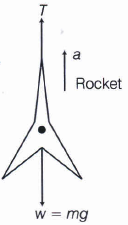
Initial mass of the rocket, m = 20000 kg
Initial acceleration a = 5.0m/s2 in upwards direction
Let initial thrust of the blast be T.
T - mg = ma
or T = mg + ma
= m(g + a)
= 20000 x (9.8+ 5.0)
= 2 x 104 x 14.8N
= 29.6 x 10⁴ N = 2.96 x 10⁵ N
12.
Mass of stone, m = 0.25 kg, Radius of the string, r = 1.5 m
Frequency, v = 40rev/min = \(\frac { 40 }{ 60 } \) rev/s = \(\frac { 2 }{ 3 } \) rev/s
Centripetal force required for circular motion is obtained from the tension in the string.
\(\therefore \) Tension in the string = Centripetal force
T = \(mr{ \omega }^{ 2 }\)
\(= mr\left( 2\pi n \right) ^{ 2 } \ \left[ \therefore \omega =2\pi v \right] \)
\(= mr4\pi ^{ 2 }{ v }^{ 2 }\)
\(T=0.25\times 1.5\times 4\times \left( \frac { 22 }{ 7 } \right) ^{ 2 }\times \left( \frac { 2 }{ 3 } \right) ^{ 2 }= 6.6N\)
Maximum tension which can be withstand by the string
\({ T }_{ max }=200\quad N=\frac { mv^{ 2 }max }{ r } \)
\(\\ { v }_{ max }=\sqrt { \frac { { T }_{ max }\times r }{ m } } =\sqrt { \frac { 200\times 1.5 }{ 0.25 } } =34.6{ m }/{ s }\)
13.
Suppose the point O as the position of bat. AO line shows the path along which the ball strikes the bat with velocity u and OB is the path showing deflection such that \(\angle\)AOB
= 45°. Now initial momentum of ball
= mu cos \(\theta\)
\(={0.15\times 54\times 1000\times cos 22.5\over 3600}\)
= 0.15 x 15 x 0.9239 along NO
Final momentum of ball = mu cos\(\theta\) along ON
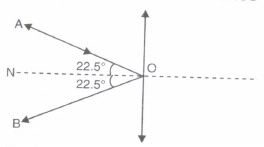
Impulse = change in momentum = mu cos \(\theta\) - (- mu cos \(\theta\))
= 2 mu cos \(\theta\) =2 x 0.15 x 15 x 0.9239 = 4.16 kg m-l.
14.
Given: The mass of the body is 5 kgand the two perpendicular forces are 8 N and 6 N.
The forces on the body are shown below:
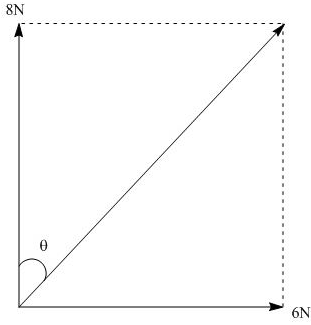
The resultant force is given as,
F R = 8 2 + 6 2 = 64+36 =10 N
The tangent of the angle is given as,
tanθ= 6 8 θ= tan −1 ( 3 4 ) =37°
Newton’s second law of the motion is given as,
F=ma
By substituting the given values in the above expression, we get
10 N=( 5 kg )a a=2 m/ s 2
Thus, the magnitude of acceleration is 2 m/ s 2 and its direction is along the direction of the resultant force. The direction of resultant force is at an angle of 37° with 8 N force.
15.
(a) We know that \({ \mu }_{ k }=\frac { frictional\ force }{ normal\ reaction } \)
\(\therefore\) frictional force = \({ \mu }_{ k }\times normal\ reaction\)
= 0.1 \(\times\) 2 kg wt = 0.1 \(\times\) 2 \(\times\) 9.8 N = 1.96 N
net effective force = (7-1.96)N = 5.04 N
acceleration = \(\frac { 5.04 }{ 2 } { ms }^{ -2 }=2.52\ { ms }^{ -2 }\)
distance, \(s=\frac { 1 }{ 2 } \times 2.52\times 10\times 10=126\ m\)
work done by applied force = 7 \(\times\) 126 J = 882 J
(b) Work done by friction = 1.96 \(\times\) 126 = -246.96 J
(c) Work done by net force = 5.04 \(\times\) 126 = 635.04 J
(d) Change in the kinetic energy of the body
= work done by the net force in 10 seconds
= 635.04 J (This is in accordance with work-energy theorem).
16.
(a) Positive In the given case, force and displacement are in the same direction. Hence, the sign of work done is positive. In this case, the work is done on the bucket.
(b) Negative In the given case, the direction of force (vertically downward) and displacement (vertically upward) are opposite to each other. Hence, the sign of work done is negative.
(c) Negative Since the direction of frictional force is opposite to the direction of motion, the work done by frictional force is negative in this case.
(d) Positive Here the body is moving on a rough horizontal plane. Frictional force opposes the motion of the body. Therefore, in order to maintain a uniform velocity, a uniform force must be applied to the body. Since the applied force acts in the direction of motion of the body, the work done is positive.
(e) Negative The resistive force of air acts in the direction opposite to the direction of motion of the pendulum. Hence, the work done is negative in this case.
17.
(a) False, in elastic collision the linear momentum and kinetic energy of the system as whole is conserved, but momentum and kinetic energy of each of individual body change.
(b) False, Although internal forces are balanced, they cause no work to be done on a body. It is the external forces that have the ability to do work. Hence, external forces are able to change the energy of a system.
(c) False, The work done in the motion of a body over a closed loop is zero for a conservation force only
(d) It is usually true but not always true.As an exmple in the exlposion of a cracker final kinetic energy is greater than the initial kinetic energy. Again final kinetic energy of gun-bullet system after firing is more than initial kinetic energy before collision.
18.
When any object is thrown from a train, the influence of train on the object becomes zero at the same moment, i.e. there is no effect of acceleration of train on the object.
\(\because \) Mass of stone (m) = 0.1 kg
(i) When stone is dropped from the window of a stationary train, it falls freely under gravity.
\(\therefore \) Net force acting on stone (F)
= mg = 0.1 x 10
= 1.0 N (vertical downward)
(ii)Just after the stone is dropped from the window of a train running at a constant velocity, i.e. acceleration of the train is zero. So, no force acts on the stone due to motion it falls freely under gravity.
The force acts on it is due to its weight only,
i.e. acceleration of the train is zero, so no force acts, on the stone due to this motion.
(iii)The train accelerate horizontally by 1 m/s2, but as the stone is left it moves under gravity only so the net force on it will be due to gravity only.
(iv) Lying on the floor of a train which is accelerating with 1 m/s2 , the stone being at rest relative to the train. Neglect air resistance throughout.
19.
Force F = ma, therefore force acting on a particle in unaccelerated (a = 0) motion is zero.
(i) As drop of rain is falling downward with a constant speed, therefore its acceleration is zero.
According to Newton's second law of motion, net force acting on drop F = ma = 0.
(ii) In floating condition, the weight of the body is balanced by the upthrust. Therefore, net force acting on a cork floating on water = 0
(iii) As kite is held stationary in the sky, therefore acceleration of the kite is zero. Therefore, net force acting on the car F = ma = 0.
(iv) As car is moving with a constant velocity, therefore, its acceleration is zero. i.e., a = 0 therefore, net force acting on the car F = ma = 0.
(v) As electron is in a space where there is no electric field, magnetic field and gravitational (material) objects, therefore, no electric, magnetic and gravitational force is acting on it. Hence, net force acting on electron is zero.
20.
We know, y = ut + \(\frac { 1 }{ 2 } \) gt2
Now, v = \(\frac { dy }{ dt } \) = u + gt
acceleration, a = \(\frac { dv }{ dt } \) = g
Then, the force is given by
F = ma = mg
Thus, the given equation describes the motion of a particle under acceleration due to gravity and y is the position coordinate in the direction of g.
21.
(d)
All of the above
22.
(d)
the speed does not depend on the initial direction
23.
(b)
kinetic energy
24.
(b)
MLT-1
25.
(d)
-5m/s and 3m/s
26.
(a)
Static friction
27.
(a)
360 N
28.
(b)
Mass
29.
(b)
25 N
30.
(d)
0.001 ms-1
31.
(c)
Reaction
32.
(c)
6 kg ms-1
33.
34.
35.
(a) Assertion is correct, reason is correct; reason is a correct explanation for assertion.
36.
(a) Assertion is correct, reason is correct; reason is a correct explanation for assertion.
On a rainy day, the roads are wet. Wetting of roads lowers the coefficient of friction between the types and the road. Therefore, grip on a road of car reduces and thus chances of skidding increases.
37.
38.

11th Standard CBSE Syllabus & Materials
11th Standard CBSE
CBSE 11th Business Studies Forms of Business Organisation Sample Question Papers Study Material - QB365 Set A
NEW11th Standard CBSE
CBSE 11th Business Studies Business, Trade and Commerce Sample Question Papers Study Material - QB365 Set A
NEW11th Standard CBSE
CBSE 11th Physics Waves Sample Question Papers Study Material - QB365 Set A
NEW11th Standard CBSE
CBSE 11th Physics Kinetic Theory Sample Question Papers Study Material - QB365 Set A



NCERT Books

Syllabus

Exam Pattern

Sample Question Papers

Previous year Question Papers

Important Notes

MCQ Practice test

NCERT Exemplers

Case study Questions

Image Based Questions

Passage based Questions

HOT Questions

Value Based Questions

Model Questions Papers
NCERT ( Book Back ) Questions

Assertion and Reason
Important Questions And Answers

CBSE 11th Standard CBSE Subjects
CBSE Standards







