
 100% FREE ACCESS
11th Standard CBSE Syllabus & Materials
11th Standard CBSE
CBSE 11th Economics PART-A - Presentation of Data - New Sample Question Papers Study Material - QB365 Set A
NEW11th Standard CBSE
CBSE 11th Economics PART-A - Organisation of Data - New Sample Question Papers Study Material - QB365 Set A
NEW11th Standard CBSE
CBSE 11th Economics PART-A - Collection of Data - New Sample Question Papers Study Material - QB365 Set A
NEW11th Standard CBSE
CBSE 11th Economics PART-A - Introduction to Economics and Statistics - New Sample Question Papers Study Material - QB365 Set A
NEW11th Standard CBSE
CBSE 11th Business Studies International Trade Sample Question Papers Study Material - QB365 Set A
NEW11th Standard CBSE
CBSE 11th Business Studies Evolution and Fundamentals of Business Sample Question Papers Study Material - QB365 Set A

Published on: 21/10/2025
Download CBSE Class 11th Standard CBSE Physics question papers, sample papers, important questions, and previous year solved papers in PDF format. Get free study materials, NCERT solutions, and exam preparation resources for Class 11th Standard CBSE Physics
Questions + Answers key
Take MCQ Physics Test
1.
Prove that the coefficient of static friction is "tangent" of the angle of repose.
2.
A constant force acting on a body of mass 3.0 kg changes its speed from 2.0 ms-1 to 3.5 ms -1 in 25 s. The direction of the motion of the body remains unchanged. What is the magnitude and direction of the force?
3.
Rain is falling vertically with a speed of 30 m/s. A woman rides a bicycle with a speed of 10 m/s in the North to South direction. What is the direction in which she should hold her umbrella?
4.
Read each statement below carefully and state, with reasons, if it is true or false :
(a) The net acceleration of a particle in circular motion is always along the radius of the circle towards the centre
(b) The velocity vector of a particle at a point is always along the tangent to the path of the particle at that point
(c) The acceleration vector of a particle in uniform circular motion averaged over one cycle is a null vector
5.
When a car is moving along a circle on a level road, then centripetal force is provided by f, where f denotes as _______.
\(f<\mu_{s} N=\frac{m v^{2}}{r}\)
\(\frac{m v^{2}}{r}=f \leq \mu_{s} N\)
\(f=\mu_{s} N^{k}=\frac{m v^{2}}{r}\)
\(f=\mu_{k} N=\frac{m v^{2}}{r}\)
6.
A book is lying on the table. What is the angle between the action of the book on the table and reaction of the table on the book?
0°
30°
45°
180°
7.
Three particles A, Band C projected from the same point with the same initial speeds making angle 30°,45° and 60°, respectively with the horizontally. Which of the following statements is correct?
A, B and C have unequal ranges
Ranges of A and C are less than that of B
Ranges of A and C are equal and greater than that of B
A, Band C have equal ranges
8.
Which of the following is a self adjusting force
Static friction
Limiting friction
Dynamic friction
Sliding friction
9.
An object is thrown along a direction inclined at an angle of 450 With the horizontal direcn6n. The horizontal range of the object is equal to
Vertical height
Twice the vertical height
Thrice the vertical height
Four times the vertical height
10.
What are the possible angles of projection with same velocity to have same range?
11.
A bus weighing 1000 kg is at rest on the bus stand. What is the linear momentum of the bus?
12.
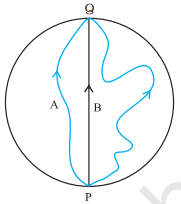
Three girls skating on a circular ice ground of radius 200 m start from a point P on the edge of the ground and reach a point Q diametrically opposite to P following different paths as shown in Fig.. What is the magnitude of the displacement vector for each ? For which girl is this equal to the actual length of path skate ?
13.
One end of a string of length I is connected to a particle of mass m and the other to a small peg on a smooth horizontal table. If the particle moves in a circle with speed v the net force on the particle (directed towards the centre) is:
(i) T, (ii) T\(-{mv^2\over l},\) (iii) T + \({mv^2\over l},\) (iv) 0
T is tile tension in the string. [Choose the correct alternative].
14.
A quarterback, standing on his opponents 35-yard line, throws a football directly down field, releasing the ball at a height of 2.00 m above the ground with an initial velocity of 20.0 m/s, directed 30.0° above the horizontal.
(i) How long does it take for the ball to cross the goal line, 32.0 m from the point of release?
(ii) The ball is thrown too hard and so passes over the head of the intended receiver at the goal line. What is the ball's height above the ground as it crosses the goal line?
15.
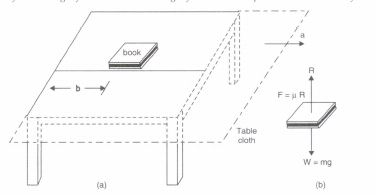
A book rests on a tablecloth spread over a table as shown in Fig. The centre of the book is at a distance of b from the edge of the table at time t = 0; the tablecloth is suddenly pulled at this instant with an acceleration a. Show that the cloth will slip from under the book if a > \(\mu\)g, where \(\mu\) is the coefficient of sliding friction between the tablecloth and the book. Assuming this condition to be satisfied, calculate
(i) time instant,
(ii) the velocity, and
(iii) the distance of the centre of the book from the edge of the table when the edge of the tablecloth passes over the centre of the book
16.
Assertion : Acceleration is proportional to the displacement. This condition is not sufficient for motion in simple harmonic.
Reason: In simple harmonic motion direction of displacement is also considered.
Codes:
A) If both assertion and reason are true and the reason is the correct explanation of the assertion.
B) If both assertion and reason are true but reason is not the correct explanation of the assertion.
C) If assertion is true but reason is false.
D) If the assertion and reason both are false.
E) If assertion is false but reason is true.
17.
Assertion : For projection angle tan−1(4), the horizontal range and the maximum height of a projectile are equal.
Reason : The maximum range of projectile is directly proportional to square of velocity and inversely proportional to acceleration due to gravity.
Codes:
A) If both assertion and reason are true and the reason is the correct explanation of the assertion.
B) If both assertion and reason are true but reason is not the correct explanation of the assertion.
C) If assertion is true but reason is false.
D) If the assertion and reason both are false.
E) If assertion is false but reason is true.
18.

19.
1.
The angle of repose is defined as the maximum inclination of the plane for which the mass kept over it can stay at rest. Let Ф be the angle of repose. Then,
N = mg cosФ , F f = mg sin Ф
Also, F f = μN
\(\therefore \ \mu m g \cos \phi=m g \sin \phi\)
i.e., μ = tan Φ
Since the body is at rest, the friction is static friction and the coefficient is for static case.
2.
Here, m 3.0 kg, u = 2.0 ms-1
v = 3.5 ms-1, t = 25 s
As F=ma
or F=m\(({v-u\over t}) [{\because a={v-u\over t}}]\)
\(\Rightarrow F={3.0(3.5-2.0)\over 25}=0.18N\)
The force is along the direction of motion.
3.
Figure shows vectorially the situations,
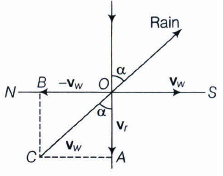
Velocity of rain falling vertically downward vr = 30 m/s
Velocity of woman riding a bicycle vw=10 m/s (North to South)
To protect herself from rain, the woman should hold her umbrella in the direction of relative velocityof the rain with respect to the woman i.e.vrw.
The relative velocity of rain with respect to the woman i.e.
vrw=vr-vw
\(\left| { v }_{ rw } \right| =\sqrt { { (30) }^{ 2 }+{ (10) }^{ 2 } } \)
\(=\sqrt { 900+100 } =\sqrt { 1000 } \)
= \(10\sqrt { 10 } \) m/s
If vrw makes an angle \(\alpha \) with the vertical, then
\(\tan { \alpha } =\frac { { v }_{ w } }{ { v }_{ r } } =\frac { OB }{ OA } =\frac { 10 }{ 30 } \)
=\(\frac { 1 }{ 3 } \) = 0.3333
\(\Rightarrow \alpha =18°26\prime \)
Hence, woman should hold her umbrella at an angle \(18°26\prime \) with the vertical towards South.
4.
(a) False, because the net acceleration of a particle is towards the centre only in case of a uniform circular motion.
(b) True, because while leaving the circular path, the particle moves tangentially to the circular path.
(c) True, because the direction of acceleration vector in a uniform circular motion is directed towards the centre of circular path.It is constantly changing with time. The resultant of all these vectors will be a zero vector.
5.
(b)
\(\frac{m v^{2}}{r}=f \leq \mu_{s} N\)
6.
(d)
180°
7.
(b)
Ranges of A and C are less than that of B
8.
(a)
Static friction
9.
(d)
Four times the vertical height
10.
θ and (90 - θ) are two values of projection angle at which range is same, for same velocity of projection.
11.
Linear momentum, \(\overrightarrow{p}=\overrightarrow{mv}.As \ \overrightarrow {v}=0,therefore \overrightarrow{p}=0.\)
12.
Displacement for each girl =\(\overset\rightarrow{PQ}\)
\(\therefore\) Magnitude of the displacement for each girl
= PQ = diameter of circular ice ground
= 2 x 200 = 400 m.
13.
(i) T
When a particle connected to a string revolves in a circular path around a centre, the centripetal force is provided by the tension produced in the string. Hence, in the given case, the net force on the particle is the tension T, i.e.,
F=T=mv2 / l
Where F is the net force acting on the particle.
14.
To better visualise the solution described here, we first sketch the trajectory as shown in figure
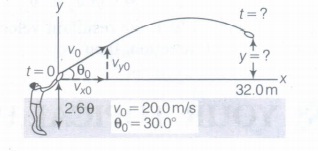
(i) The problem here is to find t when x = 32.0 m. We can use (x = v xo t), if we first find v xo. From figure, we see that v xo = Vo cos \(\theta\)0= (20.0 m / s) (cos 30.0°)
= 17.3 m/s
Using the relation and solve for t
x = vxo t
\(t=\frac{x}{v_{x 0}}=\frac{32.0 \mathrm{~m}}{17.3 \mathrm{~m} / \mathrm{s}}=1.85 \mathrm{~s}\)
(ii) We want to find y when x = 32.0 m, or since we have already found the time in part (a), we can state this, find y when t = 1.85 s. Using the relation
\(y=v_{y_{0}} t-\frac{1}{2} g t^{2}\)
where vy0 = Vo sin \(\theta\)0 = (20.0 m /s) (sin 30.0°)
= 10.0m/s
Thus \(y=(10.0 \mathrm{~m} / \mathrm{s})(1.85 \mathrm{~s})-\frac{1}{2}\left(9.80 \mathrm{~m} / \mathrm{s}^{2}\right)(1.85 \mathrm{~s})^{2}\)
= 1.73 m
Since, y = 0 is 2.00 m above the ground, this means the ball is 3.73 m above the ground as it crosses the goal line too much high to be caught at that point.
15.
The forward pulling of the tablecloth will tend to push the book backwards. The force of friction on the book will, therefore, be in the forward direction and will have a magnitude
\(F=\mu R =\mu m g\)
where m is the mass of the book. The acceleration of the book will, therefore, be
\({F\over m}={\mu m g \over m}=\mu g\)
Thus if,\(\mu\)g < a, the acceleration of the tablecloth, the cloth will slip from under the book. At the instant (say t = t), the edge of the tablecloth comes under the centre of the book, the distance of the tablecloth edge and the centre of the book from the edge of the table must be the same. Now the distance moved by the edge of the tablecloth (the initial distance from the edge of the table is zero) in a time t is
\(x'={0+{1\over2}a t^2}\) (the tablecloth is at rest at t = 0)
The distance moved by the centre of the book in time t is
\(x'={b+{1\over2}(\mu g)t^2}\) (acceleration of the book =\(\mu\),g)
The time instant t is, therefore, given by
\({1\over 2}a \ t^2={1\over2}\mu g t^2 +b\)
or t2 (a -\(\mu\)g)=2 b
or \(t=\sqrt{2b\over (a-\mu g)}\)
The velocity of the book and the distance of its centre from the edge of the table at this instant are given by
\(v=0+\mu g \sqrt{2b\over (a-\mu g)}\)
\(=\sqrt{2b\mu^2 g^2\over (a-\mu g)}\)
and \(s=b+{1\over2}\mu g{2b\over(a-\mu g)}\)
\(=b\{ {1+{\mu g\over (a- \mu g)}} \}\)
\(={ab\over (a-\mu g)}\)
16.
A) If both assertion and reason are true and the reason is the correct explanation of the assertion.
In SHM, the acceleration is always in a direction opposite to that of the displacement i.e., proportional to (y).
17.
B) If both assertion and reason are true but reason is not the correct explanation of the assertion.
We know \(R=4 H \cot \theta \text { lif } R=H \text { then } \cot \theta=\left(\frac{1}{4}\right)|\operatorname{or} \tan \theta=(4)| \text { and } R=\frac{u^{2} \sin 2 \theta}{g}\left|\backslash R \propto \frac{u^{2}}{g}\right|\)
18.
19.

11th Standard CBSE Syllabus & Materials
11th Standard CBSE
CBSE 11th Business Studies Forms of Business Organisation Sample Question Papers Study Material - QB365 Set A
NEW11th Standard CBSE
CBSE 11th Business Studies Business, Trade and Commerce Sample Question Papers Study Material - QB365 Set A
NEW11th Standard CBSE
CBSE 11th Physics Waves Sample Question Papers Study Material - QB365 Set A
NEW11th Standard CBSE
CBSE 11th Physics Kinetic Theory Sample Question Papers Study Material - QB365 Set A



NCERT Books

Syllabus

Exam Pattern

Sample Question Papers

Previous year Question Papers

Important Notes

MCQ Practice test

NCERT Exemplers

Case study Questions

Image Based Questions

Passage based Questions

HOT Questions

Value Based Questions

Model Questions Papers
NCERT ( Book Back ) Questions

Assertion and Reason
Important Questions And Answers

CBSE 11th Standard CBSE Subjects
CBSE Standards







