
 100% FREE ACCESS
11th Standard CBSE Syllabus & Materials
11th Standard CBSE
CBSE 11th Economics PART-A - Presentation of Data - New Sample Question Papers Study Material - QB365 Set A
NEW11th Standard CBSE
CBSE 11th Economics PART-A - Organisation of Data - New Sample Question Papers Study Material - QB365 Set A
NEW11th Standard CBSE
CBSE 11th Economics PART-A - Collection of Data - New Sample Question Papers Study Material - QB365 Set A
NEW11th Standard CBSE
CBSE 11th Economics PART-A - Introduction to Economics and Statistics - New Sample Question Papers Study Material - QB365 Set A
NEW11th Standard CBSE
CBSE 11th Business Studies International Trade Sample Question Papers Study Material - QB365 Set A
NEW11th Standard CBSE
CBSE 11th Business Studies Evolution and Fundamentals of Business Sample Question Papers Study Material - QB365 Set A

Published on: 21/10/2025
Download CBSE Class 11th Standard CBSE Physics question papers, sample papers, important questions, and previous year solved papers in PDF format. Get free study materials, NCERT solutions, and exam preparation resources for Class 11th Standard CBSE Physics
Questions + Answers key
Take MCQ Physics Test
1.
What are the three forms of energy possessed by a flowing fluid? Find their expressions.
2.
Derive the expression for excess pressure inside:
(a) a liquid drop
(b) a liquid bubble
(c) an air bubble.
3.
A metal block of area 0.10 m2 is connected to a 0.01 kg mass via a string that passes over an ideal pulley (considered massless and fricticnless). as in figure. A liquid with a film thickness of 0.30 mm is placed between the block and the table. When released the block moves to the right with a constant speed of 0.085 ms-1. Find the coefficient of viscosity of the liquid.
4.
In a car lift compressed air exerts a force F1 on a small piston having a radius of 5.0 cm.This pressure is transmitted to a second piston of radius 15 cm.If the mass of the car to lifted to 1350 kg, calculate F1 .What is the pressure necessary to accomplish this task?(g = 9.8 ms-2).
5.
Why does air bubble in a liquid rise up?
6.
What are the values of Reynolds number (NR) for different types of flows?
7.
What is (i) velocity head (ii) pressure head?
8.
A 50 kg girl wearing high heel shoes balances on a single heel. The heel is circular with a diameter 1.0 cm. What is the pressure exerted by the heel on the horizontal floor ?
9.
What is gauge pressure?
10.
On what factors does the critical speed of fluid flow depend?
11.
Why does the velocity increase when liquid flowing in a wider tube enters a narrow tube?
12.
The sap in trees, which consists mainly water in summer, rises in a system of capillaries of radius r = 2.5\(\times\)10-5m. The surface tension of sap is S = 7.28\(\times\)10-2 N/m and angle of contact is 00 . Does surface tension alone account for the supply of water to the pot of all trees?
13.
Why soap bubble bursts after some time?
14.
If the excess pressure inside a spherical soap bubble of radius 1 cm is balanced by that due to a column of oil of specific gravity 0.9, 1.36 mm high. Calculate the surface tension.
15.
A U-tube contains water and methylated spirit separated by mercury. The mercury columns in the two arms are in level with 10.0 cm of water in one arm and 12.5 cm of spirit in the other. What is the specific gravity of spirit ?
16.
Application of Bernaull's Theorem can be seen in
dynamic lift of aeroplane
hydraullic press
helicopter
none of the above
17.
What is the shape when a non-wetting liquid in displaced in a capillary tube?
Concave upwards
Convex upwards
Concave downwards
Convex downwards
18.
The mass of water rises in capillary tube of radius R is M. The mass of water that rises in tube of radius 2R is
M
M/2
2M
4M
19.
The Bernauli's Theorem is based on the conservation of:
mass
energy
momentum
all
1.
Three forms of energy possessed by a flowing fluid are as follows:
1. Pressure energy:
Let an ideal fluid of density P be contained in a rectangular vessel, provided with a small side tube at a depth ho below the free surface of fluid in the vessel. At the level of side tube, pressure of fluid along the axis of side tube
p = h0pg
If we want to introduce more fluid into the vessel at this very pressure, we can force it through the side tube by doing work on the piston, If 'A' be the cross-section area of the piston, then force acting on the piston F = PA.
\(\therefore\) Work done in moving the piston through a small distance \(\Delta r\) will be
\(\Delta W=F\Delta x=PA\Delta x=P\Delta V\)
As a result of motion of piston, the mass of the fluid forced in the vessel
\(\Delta m=\rho A\Delta x=\rho\Delta V\)
The work done is stored up in the liquid in the form of its pressure energy.
\(\therefore\) Pressure energy of liquid per unit mass = Work done per unit mass
\(=\frac{\Delta W}{\Delta m}=\frac{P\Delta V}{\rho\Delta V}=\frac{p}{\rho}\)
and pressure energy per unit volume = p.
2. Gravitational potential energy:
Let at any stage of its flow a fluid element of mass "m' be situated at a height 'h' from the reference line (generally taken to be earth's surface), then its gravitational potential energy in that position is mgh.
\(\therefore\) Gravitational potential energy per unit mass = \(\frac{mgh}{m}=gh\)
and gravitational potential energy per unit volume = pgh.
3. Kinetic energy:
Let at any stage of its flow, a fluid element of mass 'm' be moving with a speed 'v', then the kinetic energy of this fluid element is \(\frac{1}{2}v^2\)
\(\therefore\) Kinetic energy per unit mass = \(\frac{\frac{1}{2}mv^2}{m}=\frac{1}{2}v^2\)
and kinetic energy per unit volume = \(\frac{1}{2}\rho v^2\)
These three forms of energy possessed by a flowing fluid are mutually convertible from one form to another.
2.
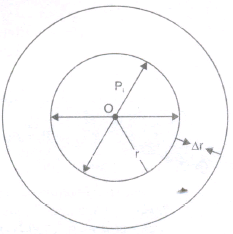
(a) Inside a liquid drop
Let r = radius of a spherieal liquid drop of centre O. T = surface tension of the liquid. Let Pi and Po be the values of pressure inside and outside the drop.
\(\therefore\) Excess pressure inside the liquid drop = Pi - Po
Let \(\Delta\)r be the increase in its radius due to excess pressure. It has one free surface outside.
\(\therefore\) increase in surface area of the liquid drop
= \(4\pi(r+\Delta r)^2-4\pi r^2\)
= \(4\pi[r^2+(\Delta r)^2+2r\Delta r-r^2]\)
= \(8\pi r\quad \Delta r\) .................(i)
\(\therefore\) increase in surface energy of the drop is
W = Surface tension x increase in area
= \(T\times 8\pi r\quad \Delta r\) .............. (ii)
Also W = Force due to excess of pressure x displacement
= Excess pressure x Area of drop x increase in radius
= \((p_i-p_0)4\pi r^2\Delta r\) ............(iii)
\(\therefore\) From eqns (ii) and (iii), we get
\((p_i-p_0)\times 4\pi r^2\quad \Delta r=T\times 8\pi r\quad \Delta r\)
\(\Rightarrow p_i-p_0=\frac{2T}{r}\)
(b) Inside a liquid bubbles:
A liquid bubble has air both inside and outside it and therefore it has two free surfaces.
Thus increase in its surfaces area
= \(2[4\pi (r+\Delta r)^2-4\pi r^2]\)
= \(2\times 8\pi r\Delta r=16\pi r\quad\Delta r\)
\(\therefore\) W = \(T\times 16\pi r\Delta r\) ...............(i)
Also W = \((p_i-p_0)4\pi r^2\times \Delta r\) ........(ii)
From eqnd (i) and (ii), we get
\((p_i-p_0)\times 4\pi r^2\times \Delta r=T.16\pi r\quad \Delta r\)
or \((p_i-p_0)=\frac{4T}{r}\)
(c) Inside an air bubble:
Air bubble is formed inside liquid, thus air bubble has one free surface inside it and liquid is outside.
If r = radius of air bubble
\(\Delta\)r = increase in its radius due to excess of pressure
(Pi - P0) inside it.
T = surface tension of the liquid in which bubble is formed.
\(\therefore\) increase in surface area = \(8\pi r \Delta r\).
\(\therefore\) W = T x \(8\pi r \Delta r\)
Also W = \((p_i-p_0)\times 4\pi r^2\Delta r\)
\(\therefore (p_i-p_0)\times 4\pi r^2\Delta r=T\times 8\pi r^2\Delta r\)
or \(p_i-p_0=\frac{2T}{r}\)
3.
The metal block moves to the right because of the tension in the string. The tension T is equal in magnitude to the weight of the suspended mass m. Thus, the shear force F is
F = T = mg = 0.010 x 9.8 = 9.8 x 10⁻² N
Shear stress on the fluid
\(\frac { F }{ A } =\frac { 9.8\times { 10 }^{ -2 } }{ 0.10 } =0.98N/{ m }^{ 2 }\)
Strain rate,
\(\eta =\frac { stress }{ Strain\ rate } s^{-1}\)
\( =\frac{\left(9.8 \times 10^{-2} \mathrm{~N}\right)\left(0.30 \times 10^{-3} \mathrm{~m}\right)}{\left(0.085 \mathrm{~m} \mathrm{~s}^{-1}\right)\left(0.10 \mathrm{~m}^2\right)}\)
\( =3.46 \times 10^{-3} \mathrm{~Pa} \mathrm{~s}
\)
4.
Since pressure is transmitted undiminished throughout the fluid,
\(F_{1}=\frac{A_{1}}{A_{2}} F_{2}=\frac{\pi\left(5 \times 10^{-2} \mathrm{~m}\right)^{2}}{\pi\left(15 \times 10^{-2} \mathrm{~m}\right)^{2}}\left(1350 \mathrm{~kg} \times 9.8 \mathrm{~ms}^{-2}\right)\)
= 1470 N
≈ 1.5 x 10³ N
The air pressure that will produce this force is
\(P=\frac{F_{1}}{A_{1}}=\frac{1.5 \times 10^{3} \mathrm{~N}}{\pi\left(5 \times 10^{-2}\right)^{2} \mathrm{~m}}=1.9 \times 10^{5} \mathrm{~Pa}\)
This is almost double the atmospheric pressure.
5.
Because terminal velocity of air bubble is negative.
6.
For streamline or laminar flow 0 < NR < 2000,
for turbulent flow, NR > 3000
If NR lies between 2000 to 3000, the flow is unstable i.e., change from streamline flow to turbulent flow.
7.
(i) \(\frac{v^2}{2g}\)
(ii) \(\frac{p}{\rho g}\)
8.
Given, mass of girl (m) = 50kg
Diameter of circular heel (2r) = 1.0cm
\(\therefore \)Radius (r) = 0.5 cm = \(5\times 10^{ -3 }\)m
Area of circular heel (A) = \({ \pi r }^{ 2 }=3.14\times (5\times 10^{ -3 })^{ 2 }m^{ 2 }\)
\(=78.50\times 10^{ -6 }m^{ 2 }\)
\(\therefore \) Pressure exerted on the horizontal floor
\(\rho =\frac { F }{ A } =\frac { mg }{ A } =\frac { 50\times 9.8 }{ 78.50\times 10^{ -6 } } =6.24\times 10^{ 6 }Pa\)
9.
The difference between absolute pressure and atmospheric p[ressure is known as gauge pressure.
As,pabsolute= pa+ρgh
So,pabsolute− pa=ρghi.e.pgauge=ρgh
Here,ρ is the density of a fluid of depth h.
10.
The critical speed of a fluid depends on ( a ) diameter of tube, ( b ) density of fluid, ( c ) coefficient of viscosity of the fluid.
11.
This is due to equation of continuity, a1 vI = a2 v2
∵∵ a1 > a2
∴∴ v2 > v1
12.
\(Given,\ radius\ (r)=2.5\times { 10 }^{ -5 }m\)
\(\\ Surface\ tension(S)=7.28\times { 10 }^{ -2 }N/m\)
\(\\ Angle\ of\ contact\ (\theta )={ 0 }^{ 0 }\)
\(\\ density\ of\ water\ (\rho )={ 10 }^{ 3 }kg/{ m }^{ 3 }\)
\(\\ The\ maximum\ height\ which\ sap\ can\ rise\ in\ trees\ through\ capillarity\ action\ given\ by\)
\(\\ h=\frac { 2Scos\theta }{ r\rho g } \)
\(\\ h=\frac { 2\times 7.28\times { 10 }^{ -2 }\times cos\theta }{ 2.5\times { 10 }^{ -5 }\times 1\times { 10 }^{ 3 }\times 9.8 } \)
But, the height of many trees are more than 0.59m, therefore, the rise of sap in all trees is not possible through capillarity action alone.
13.
Soap bubble bursts after some time because the pressure inside it become more than the outside pressure.
14.
Radius, r = 1 cm; p = 0.9 g cm-3
h = 1.36 mm = 0.136 cm
Pressure, p = hpg = 0.136 x 0.9 x 980
= 119.95 dyne cm-2
Let T be surface tension of soap solution
\(\therefore\) Excess pressure, p = \(\frac{4T}{r}\)
or T = \(\frac{Pr}{4}\)
= \(\frac{119.95\times 1}{4}\)
= 29.988 dyne cm-1.
15.
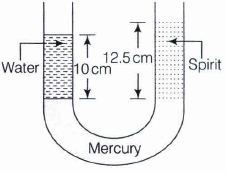
Height of water column, h1 = 10.0 cm
Density of water, \({ \rho }_{ 1 }\) = 1g/ cm 3
Height of spirit column, h2 = 12.S cm
Density of spirit,\({ \rho }_{ 2 }\) =?
The mercury column in both arms of the U-tube are at same level, therefore, pressure in both arms will be same.
Pressure exerted by water column = pressure exerted by spirit column
p1= p2
\({ h }_{ 1 }{ \rho }_{ 1 }g={ h }_{ 2 }{ \rho }_{ 2 }g\ or\ { \rho }_{ 2 }=\frac { { h }_{ 1 }{ \rho }_{ 1 } }{ { h }_{ 2 } } =\frac { 10\times 1 }{ 12.5 } =0.80g/{ cm }^{ 3 }\)
Specific gravity of spirit=\(\frac { Density\ of\ spirit }{ Density\ of\ water } =\frac { 0.80 }{ 1 } =0.80\)
16.
(a)
dynamic lift of aeroplane
17.
(c)
Concave downwards
18.
(b)
M/2
19.
(b)
energy

11th Standard CBSE Syllabus & Materials
11th Standard CBSE
CBSE 11th Business Studies Forms of Business Organisation Sample Question Papers Study Material - QB365 Set A
NEW11th Standard CBSE
CBSE 11th Business Studies Business, Trade and Commerce Sample Question Papers Study Material - QB365 Set A
NEW11th Standard CBSE
CBSE 11th Physics Waves Sample Question Papers Study Material - QB365 Set A
NEW11th Standard CBSE
CBSE 11th Physics Kinetic Theory Sample Question Papers Study Material - QB365 Set A



NCERT Books

Syllabus

Exam Pattern

Sample Question Papers

Previous year Question Papers

Important Notes

MCQ Practice test

NCERT Exemplers

Case study Questions

Image Based Questions

Passage based Questions

HOT Questions

Value Based Questions

Model Questions Papers
NCERT ( Book Back ) Questions

Assertion and Reason
Important Questions And Answers

CBSE 11th Standard CBSE Subjects
CBSE Standards







