
 100% FREE ACCESS
11th Standard CBSE Syllabus & Materials
11th Standard CBSE
CBSE 11th Economics PART-A - Presentation of Data - New Sample Question Papers Study Material - QB365 Set A
NEW11th Standard CBSE
CBSE 11th Economics PART-A - Organisation of Data - New Sample Question Papers Study Material - QB365 Set A
NEW11th Standard CBSE
CBSE 11th Economics PART-A - Collection of Data - New Sample Question Papers Study Material - QB365 Set A
NEW11th Standard CBSE
CBSE 11th Economics PART-A - Introduction to Economics and Statistics - New Sample Question Papers Study Material - QB365 Set A
NEW11th Standard CBSE
CBSE 11th Business Studies International Trade Sample Question Papers Study Material - QB365 Set A
NEW11th Standard CBSE
CBSE 11th Business Studies Evolution and Fundamentals of Business Sample Question Papers Study Material - QB365 Set A

Published on: 21/10/2025
Download CBSE Class 11th Standard CBSE Physics question papers, sample papers, important questions, and previous year solved papers in PDF format. Get free study materials, NCERT solutions, and exam preparation resources for Class 11th Standard CBSE Physics
Questions + Answers key
Take MCQ Physics Test
1.
Describe stress-strain relationship for a loaded steel wire and hence explain the terms : Elastic limit, yield point, tensile strength.
2.
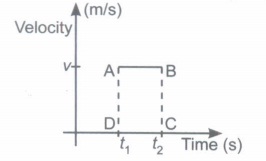
(a) With the help of a simple case of an object moving with constant velocity show that the area under velocity-time curve represents the displacement over a given time interval.
(b) Establish the relation \(x=v_{0} t+\frac{1}{2} a t^{2}\) graphically.
(c) A car moving with a speed of 126 km/h is brought to a stop within a distance of 200 m. Calculate the retardation of the car and the time required to stop it.
3.
What do you mean by elastic collision? For an elastic head on collision, find expressions for final velocities of the bodies after collision.
4.
Two bodies of masses M1 and M2 are placed at a distance d apart. What is the potential at the position where the gravitational field due to them is zero?
5.
Dot Product of Two Vectors
Find the angle between the vectors
\(A=\hat { i } -2\hat { j } -\hat { k } and\quad B=\hat { -i } +\hat { j } -\hat { 2k } \)
6.
Define power. Obtain an expression for it in terms of force and velocity.
7.
Name the physical quantity which remains same in an uniform circular motion.
8.
Can the scalar product of two vectors be negative?
9.
Why are curved roads generally banked?
10.
Define displacement of a particle.
11.
What is Poisson's ratio?
12.
What would happen if the force of gravity were to disappear suddenly?
13.
A mass M1 revolves around another mass M2 in a path of radius T, what is the angular momentum associated with M1?
14.
State and explain Work-Energy theorem.
15.
State law of conservation of linear momentum. Derive the law of conservation of momentum from Newton's third law of motion.
16.
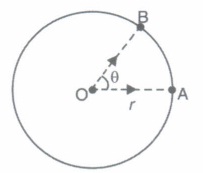
Define a uniform circular motion. For uniform circular motion, prove that: Linear velocity v = rω
17.
A ball is thrown vertically upwards with a velocity of 20 m/s from the top of a building of height 25 m from the ground.
(a) How high will the ball reach?
(b) How long will it take for the ball to reach the ground?
(c) Trace the trajectory of motion of this ball.
18.
State parallelogram law of vector addition. Show that resultant of two vectors A and B inclined a angle θ is R \(=\sqrt{\mathbf{A}^{2}+\mathbf{B}^{2}+\mathbf{2} \mathbf{A} \mathbf{B} \cos \theta}\)
19.
Write the dimensions of the following
(i) Gravitational potential
(ii) Variable force
(iii) Pressure gradient
(iv) Moment of inertia
(v) Buoyant force
(vi) Angular momentum
(vii) Work done by torque
(viii) Moment of momentum
(ix) Moment of force
(x) Pressure energy
20.
Differentiate between average and instantaneous velocity.
21.
Does the escape speed of a body from the earth depends on the direction of the projection
22.
A body is thrown with a velocity of 10 ms-1 at an angle of 60° with the horizontal. Its velocity at the highest point is
zero
5 ms-1
10 ms -1
8.66 ms -1
23.
A wire is stretched to double its length. The strain is
2
1
Zero
0.5
24.
The velocity of the planet when it is closest to sun is
maximum
minimum
can-have any value
None of the above
25.
A body is rotating with angular velocity \(\omega=(3 \mathbf{i}-4 \mathbf{j}-\hat{\mathbf{k}})\) .The linear velocity of a point having position vector \(\mathbf{r}=(5 \hat{\mathbf{i}}-6 \hat{\mathbf{j}}+6 \hat{\mathbf{k}})\) is
\(6 \hat{\mathbf{i}}+2 \hat{\mathbf{j}}-3 \hat{\mathbf{k}}\)
\(-18 \hat{\mathbf{i}}-23 \hat{\mathbf{j}}+2 \hat{\mathbf{k}}\)
\(-30 \hat{\mathbf{i}}-23 \hat{\mathbf{j}}+2 \hat{\mathbf{k}}\)
\(6 \hat{\mathbf{i}}-2 \hat{\mathbf{j}}+8 \hat{\mathbf{k}}\)
26.
In an inelastic collision,
conservation of momentum is not followed
conservation of mechanical energy is not followed
conservation of mechanical energy is followed
None of the above
27.
The number of significant figures in the numbers 4.8000 x 10⁴ and 48000.50 are respectively,_____.
5 and 6
5 and 7
2 and 7
2 and 6
28.
Pascal is the unit of _____.
force
stress
work
energy
29.
Young's modulus of a wire depends on
its material
its length
its area of cross-section
both (b) and (c)
30.
The dimension of Impulse is _______.
MLT-2
MLT-1
MLT-3
MLT
31.
The unit of G/g is :
kg/m
m2/kg
kg2/m
m/kg
kg2/m
32.
Area under velocity time graph is
Displacement
Velocity
Acceleration
None
33.
A particle revolves round a circular path. The acceleration of the particle is :
Along the circumference of the circle
Along the tangent
Along the radius
Zero
34.
A projectile has time of flight T and range R. If the Time of night is doubled, what happens to the range
R/4
R/2
2R
4R
35.
KE of a body of mass 1 kg is 18 J. Its momentum is
9 kgm/s
16 kgm/s
6 kgm/s
None
36.
Inertia of a body has direct dependence on _______.
Velocity
Mass
Volume
Area
37.
Two perpendicular forces of 8N and 6N can produce the effect of a single force equal to
5N
6N
8N
10N
38.
These qualitative observations lead to the second law of motion expressed by Newton as follows:
The rate of change of momentum of a body is directly proportional to the applied force and takes place in the direction in which the force acts. Thus, if under the action of a force F for time interval Δt, the velocity of a body of mass m changes from v to v + Δv i.e. its initial momentum
p = m v changes by Δp = mΔv. According to the Second Law
Where k is a constant of proportionality. Mathematically,
F = ma, the unit of force is kg-m/s2 or Newton, which has the symbol N. Let us note at this stage some important points about the second law:
In the second law, F = 0 implies a = 0. The second law is obviously consistent with the first law.
The second law of motion is a vector law.
The second law of motion given by is applicable to a single point particle as well as to the rigid body but internal forces are not considered in F.
The second law of motion is a local relation which means that force F at a point in space (location of the particle) at a certain instant of time is related to an at that point at that instant. Answer the following questions.
1) SI unit of force is
a) Newton
b) Pascal
c) m/s
d) None of the above
2) According to the second law of motion The rate of change of momentum of a body is directly proportional to
a) Velocity of a body
b) Applied force
c) Only the mass of the body
d) None of the above.
3) The second law of motion is
a) Vector law
b) Scalar law
4) Newton’s second law of motion is applicable to which of the following?
a) Only rigid bodies
b) Only single point particles
c) Both single point particles and rigid bodies
d) Neither single point particles nor rigid bodies
5) Which of the following statements is true regarding the second law of motion?
a) It is inconsistent with the first law of motion.
b) It only considers internal forces.
c) It is a vector law.
d) It is applicable to non-rigid bodies.
6) If a car with a mass of 1000 kg is accelerating at 2 m/s², what is the net force acting on the car?
a) 500 N
b) 1000 N
c) 2000 N
d) 5000 N
7.A body experiences no acceleration. What can be concluded about the net external force acting on it?
a) It is acting in the opposite direction to motion.
b) It is equal to the weight of the body.
c) It is zero.
d) It is infinite.
39.
1.
In figure
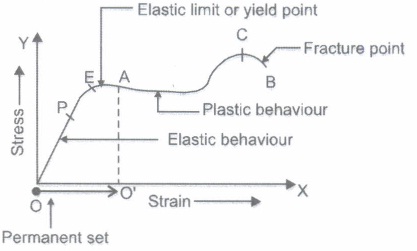
Elastic region : O to E.
Plastic region: E to B.
Upto the point E, the steel wire will regain its status immediately on the removal of stress and the ratio of \(\frac{\text { Stress }}{\text { Strain }}\) will be a constant.
(i) Strain increases in proportion to the load upto P. But beyond P, it increases by an increasingly greater amount for a given increase in the load. Beyond the elastic limit E, it does not retrace the curve backward. The wire is unloaded but returns to 'O' along the dotted line AO'. Point O corresponding to zero load which implies a permanent strain in wire.
(ii) Prom C to B, strain increases even if the wire is being unloaded and at B it fractures. Stress upto that corresponding to C can be applied without causing fracture.
2.
(a) Let a body with constant velocity v, between time t1 and t2 as shown in graph.
Area below = area ABCD = v (t2 - t1)
Also, the displacement
= velocity x time = v x (t2 - t1)
Thus proved.
(b) Slope of v- t graph is constant. So there is uniform acceleration. Area below the graph gives the displacement (x).
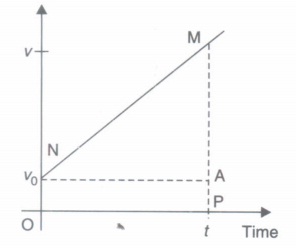
Displacement = Area of trapezium
\(=\mathrm{ON} \times \mathrm{OP}+\frac{1}{2} \mathrm{NA} \times \mathrm{MA}\)
\(=v_{0} \times t+\frac{1}{2}(t)\left(v-v_{0}\right)\)
Since \(a=\frac{v-v_{0}}{t}\)
We have, \(x=v_{0} t+\frac{1}{2} t \text { at }=v_{0} t+\frac{1}{2} a t^{2}\)
(c) u = 126 km/hr = 35 m/sec, v = 0, S = 200 m
using, v2 = u 2 + 2as
\(a=\frac{v^{2}-u^{2}}{2 s}=\frac{35^{2}}{2 \times 200}\)
= - 3.00 ms-2
v = u + at
0 = 35 - 3 x t
\(t=\frac{35}{3}=11.66 \mathrm{sec}\)
3.
Elastic collision is one in which both momentum and energy are conserved. Consider two bodies A and B of masses m1 and m2 moving in a straight line with velocities u1 and u2 respectively (u1 > u2). After collision, let their velocities change to v1 and v2 respectively. If the centres of two colliding bodies are in one line, then the collision is said to be head-on-collision.
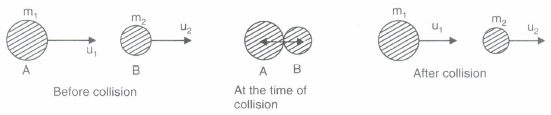
Total linear momentum of the system before collision = m1 u2 + m2u2
Total linear momentum of the system after collision = m1 v1 + m2v2
As collision is elastic, so the linear momentum and kinetic energy of the system are conserved.
According to the law of conservation of linear momentum,
m1u1 + m2u2 = m1v1 + m2v2 ..........(1)
or m1 (u1 - v1) = m2 (v2 - u2) ..........(2)
According to the law of conservation of kinetic energy,
\(\frac { 1 }{ 2 } { m }_{ 1 }{ u }_{ 1 }^{ 2 }+\frac { 1 }{ 2 } { m }_{ 2 }{ u }_{ 2 }^{ 2 }=\frac { 1 }{ 2 } { m }_{ 1 }{ v }_{ 1 }^{ 2 }+\frac { 1 }{ 2 } { m }_{ 2 }{ u }_{ 2 }^{ 2 }\) ......(3)
or \({ m }_{ 1 }({ u }_{ 1 }^{ 2 }-{ u }_{ 1 }^{ 2 })={ m }_{ 2 }({ v }_{ 2 }^{ 2 }-{ u }_{ 2 }^{ 2 })\)
or m1 (u1 + v1) (u1 - v1)= m2 (v2 + u2) (v2 - u2) .......(4)
Dividing eqn. (4) by eqn. (2), we get
u1 + v1 = v2 + u2 ............(5)
u1 + u2 = v2 + v1 ............(6)
From eqn. (6) v2 = u1 - u2 + v1 ........(7)
Substituting the value of v2 in eqn. (2), we get
m1(u1-v1) = m2 [u1-2u2+v1]
or \({ v }_{ 1 }=\frac { 2{ m }_{ 2 }{ u }_{ 2 }+{ u }_{ 1 }({ m }_{ 1 }-{ m }_{ 2 }) }{ ({ m }_{ 1 }+{ m }_{ 2 }) } \)
Substituting value of v1 in eqn. (7), we get
\({ v }_{ 2 }=\frac { 2{ m }_{ 1 }{ u }_{ 1 }+{ u }_{ 2 }({ m }_{ 2 }-{ m }_{ 1 }) }{ ({ m }_{ 1 }+{ m }_{ 2 }) } \)
4.
Let the field be zero at a point at distance x from M1.
\(\therefore \frac{GM_1}{x^2}=\frac{GM_2}{(d-x)^2}\)
\(\therefore \frac{x}{d-x}=\sqrt {\frac{M_1}{M_2}}\Rightarrow x\sqrt {M_2}=\sqrt {M_1}.d-x\sqrt {M_1}\)
\(x[\sqrt {M_!}+\sqrt {M_2}]=\sqrt {M_1}.d\)
\(x=\frac{d\sqrt {M_2}}{\sqrt {M_1}+\sqrt {M_2}}\)
\(d-x=\frac{d\sqrt {M_2}}{\sqrt {M_1}+\sqrt {M_2}}\)
Potential at this point due to both the masses will be
\(=-\frac{GM_1}{x}-\frac{GM_2}{(d-x)}=-G[\frac{M_1(\sqrt {M_1}+\sqrt {M_2})}{d\sqrt {M_1}}+\frac{M_2(\sqrt {M_1}+\sqrt {M_2})}{d\sqrt {M_2}}]\)
\(=-\frac{G}{d}(\sqrt {M_1}+\sqrt {M_2})^2=\frac{G}{d}(M_1+M_2+2\sqrt {M_1}\sqrt {M_2}).\)
5.
The angle between two vectors is included in the expression of dot product or scalar product.
A.B = ABcos Q
The magnitude of \(\overrightarrow { A } \) is given by
\(A=\quad \sqrt { \left( 1 \right) ^{ 2 }+\left( 2 \right) ^{ 2 }+\left( -1 \right) ^{ 2 } } =\sqrt { 6 } \)
The magnitude of \(\overrightarrow { B } \) is given by
\(B=\quad \sqrt { \left( -1 \right) ^{ 2 }+\left( 1 \right) ^{ 2 }+\left( -2 \right) ^{ 2 } } =\sqrt { 6 } \)
We can separately evaluate the left side of Eq.(i) by writing the vectors in unit vector notation and using the distributive law.
\(A.B=\left( \hat { i } +\hat { 2j } -\hat { k } \right) .\left( \hat { -i } +\hat { j } -\hat { 2k } \right)\)
\(=\left( 1.-1 \right) \left( \hat { i } .\hat { i } \right) +\left( 1.1 \right) \left( \hat { i } .\hat { j } \right) +\left( 1.-2 \right) \left( \hat { i } .\hat { k } \right) +\left( 1.-1 \right) \)
\(\\ \left( \hat { i } .\hat { j } \right) +\left( 2.1 \right) \left( \hat { j } .\hat { j } \right) +\left( 2.-2 \right) \left( \hat { j } .\hat { k } \right) +\left( -1.-1 \right)\)
\( \\ \left( \hat { k } .\hat { i } \right) +\left( -1.1 \right) \left( \hat { k } .\hat { j } \right) +\left( -1.-2 \right) \left( \hat { k } .\hat { k } \right) \)
\(\left[ \begin{matrix} \hat { i } .\hat { i } =1,\hat { i } .\hat { j } =1,\hat { i } .\hat { k } =1 \\ \hat { j } .\hat { j } =1,\hat { j } .\hat { i } =1,\hat { j } .\hat { k } =1 \\ \hat { k } .\hat { k } =1,\hat { k } .\hat { i } =1,\hat { k } .\hat { j } =1 \end{matrix} \right] \)
Substituting the values of A from Eq.(ii) and B from Eq.(iii) and A.B=6 in Eq.(i)we get
\(3=\left( \sqrt { 6 } \right) \left( \sqrt { 6 } \right) cos\theta \)
\(\\ \Rightarrow cos\theta =\frac { 3 }{ 6 } =\frac { 1 }{ 2 } \Rightarrow \theta =cos^{ -1 }\left( \frac { 1 }{ 2 } \right) =60^{ 0 }\)
6.
Power. The rate of doing work is called power.
\(\mathrm{P}=\underset{\Delta t \rightarrow 0}{L t} \frac{\Delta \mathrm{W}}{\Delta t}=\frac{d \mathrm{~W}}{d t}\)
\(=\frac{d}{d t}(\vec{F} \cdot \vec{s})=\vec{F} \cdot \frac{d \vec{s}}{d t}\)
\(\mathrm{P}=\vec{F} \cdot \vec{v}\)
⇒ P = Fv
7.
Kinetic energy and speed
8.
Yes, it will be negative if the angle between the two vectors lies between 900 to 270 o.
9.
Curved roads are generally banked so as to help in providing centripetal force needed to balance the centrifugal force, arising due to circular motion on the curved road.
10.
The change in the position co-ordinates of a particle over a given period of time is called the displacement of the particle.
11.
The ratio of lateral strain to the longitudinal strain is called Poisson's ratio.
12.
The universe would collapse. We would be thrown away because of the centrifugal force. Eating, drinking and infact all activities would become impossible.
13.
Angular momentum L is the product of twice the mass and aerial velocity.
\(\therefore \ \mathrm{L}=2 \mathrm{M} \frac{d \mathrm{~A}}{d t}=2 \mathrm{M}_{1} \times \frac{\pi r^{2}}{\mathrm{~T}}\)
\(=2 \mathrm{M}_{1} \frac{\pi r^{2} v}{2 \pi r}\)
\(=\mathbf{M}_{1} r \sqrt{\frac{\mathrm{GM}_{2}}{r}}\)
\(=\mathrm{M}_{1} \sqrt{\mathrm{GM}_{2} r}\)
14.
Work done on a body is reflected as change in kinetic energy, according to Work-Energy theorem.
\(\mathrm{W}=\int \mathrm{F} d x=\int m \frac{d v}{d f} d x\)
\(=\int m v d v=\left|\frac{1}{2} m v^{2}\right|_{v i}^{v_{f}}\)
Work done \(=\frac{1}{2} m\left(v_{f}^{2}-v_{i}^{2}\right)\)
\(=\frac{1}{2} m v_{f}^{2}-\frac{1}{2} m v_{i}^{2}\)
Work done = Change in kinetic energy.
15.
When no external force acts on a body, there is no change in linear momentum or the total momentum of an isolated system of interacting particles remain conserved.
Let us consider an isolated system (which is free from the influence of any external forces) comprising of two bodies A and B with initial momentum P A and P B. Let them collide for a small time Δt and separate with final momentum \(\overrightarrow{p_{A}}^{\prime} \text { ând } \overrightarrow{p_{B}}^{\prime} \mathrm{r}\) respectively. During collision, If \(\overrightarrow{F_{A B}}\) is force on A exerted by B, and \(\overrightarrow{F_{B A}}\) is force on B exerted by A, then according to Newton's second law.
\(\overrightarrow{F_{A B}} \times \Delta t\) = Change in momentum of A
\(=\overrightarrow{p_{A}^{\prime}}-\overrightarrow{p_{A}}\) ...........(i)
\(\overrightarrow{F_{B A}} \times \Delta t\) = Change in momentum of B
\(=\overrightarrow{p_{B}}^{\prime}-\overrightarrow{p_{B}}\) .............(ii)
According to Newton's third law,
\(\overrightarrow{F_{A B}}=-\overrightarrow{F_{B A}}\)
ஃ From (i) and (ii),
\(\overrightarrow{p_{A}}^{\prime}-\overrightarrow{p_{A}}=-\left(\overrightarrow{p_{B}^{\prime}}-\overrightarrow{p_{B}}\right)\)
Which shows that total final momentum of the isolated system is equal to its total initial momentum.
\(\Rightarrow \overrightarrow{p_{A}}+\overrightarrow{p_{B}}=\overrightarrow{p_{A}}+\overrightarrow{p_{B}}\)
This proves the law of conservation of linear momentum.
16.
If the speed of the particle in circular path remains constant, the motion is uniform circular motion. We know, the arc length x covered with an angular displacement θ is x = rθ.
Differentiating,
\(\frac{d x}{d t}=r \frac{d \theta}{d t} \quad \because r \text { is constant, } \quad \therefore v=r \omega \text { . }\)
17.
(a) \(h_{1}=\frac{u^{2}}{2 g}=\frac{20^{2}}{2 \times 10}=20 \mathrm{~m}\)
Total height = 25 + 20 = 45 m
(b) \(h=u t-\frac{1}{2} g t^{2}\)
\(-25=20 t-\frac{1}{2} \times 10 \times t^{2}\)
5t2 - 20t - 25 = 0
(t - 5) (t + 1) = 0
⇒ t = 5 sec
(c) Trajectory will be a vertical line
\(y=u t+\frac{1}{2} g t^{2}\)
x = 0, y ≠ 0
18.
Parallelogram law of vector addition. If two vectors \(\overrightarrow{\mathrm{A}}\) and \(\overrightarrow{\mathrm{B}}\) represent two adjacent sides of a parallelogran. the sum of the vectors is represented by the diagonal of the parallelogram.
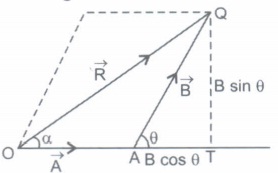
Let \(\overrightarrow{\mathrm{A}} \text { and } \overrightarrow{\mathrm{B}}\) be two vectors at an angle θ between them. According to the law of parallelogram of vectors, the diagonal of the parallelogram indicates the sum of the other two sides/vectors \(\overrightarrow{\mathrm{A}} \text { and } \overrightarrow{\mathrm{B}}\)
\(|\overrightarrow{\mathrm{OQ}}|=|\overrightarrow{\mathrm{A}}+\overrightarrow{\mathrm{B}}|=\sqrt{\mathrm{OT}^{2}+\mathrm{TQ}^{2}}\)
\(|\vec{R}|=\sqrt{(A+B \cos \theta)^{2}+(B \sin \theta)^{2}}\)
\(\mathrm{R}=\sqrt{\mathrm{A}^{2}+\mathrm{B}^{2}+2 \mathrm{AB} \cos \theta}\)
The resultant R is at an angle α to \(\overrightarrow{\mathrm{A}}\) given by
\(\alpha=\tan ^{-1}\left(\frac{\mathrm{B} \sin \theta}{\mathrm{A}+\mathrm{B} \cos \theta}\right)\)
19.
(i) [M0L2T-2]
(ii) [MLT-2]
(iii) [ML-2T-2]
(iv) [ML 2T0]
(v) [MLT2]
(vi) [ML2T-1]
(vii) [ML2T-2]
(viii) [ML2T-1]
(ix) [ML2T-2]
(x) [ML2T-2]
20.
Average velocity: Average velocity is the displacement divided by the time interval in which the displacement occurs.
\(\overrightarrow { v_{ av } } =\frac { \Delta \overrightarrow { x } }{ \Delta t } \)
Instantaneous velocity: Instantaneous velocity is defined as the limit of the average velocity as the time interval M becomes infinitesimally small.
\(\overrightarrow { v } =\lim _{ \Delta t\rightarrow 0 }{ \frac { \Delta \overrightarrow { x } }{ \Delta t } } =\frac { dx }{ dt } \)
21.
No, escape velocity is independent of the direction of projection
22.
(b)
5 ms-1
23.
(b)
1
24.
(a)
maximum
25.
(c)
\(-30 \hat{\mathbf{i}}-23 \hat{\mathbf{j}}+2 \hat{\mathbf{k}}\)
26.
(c)
conservation of mechanical energy is followed
27.
(b)
5 and 7
28.
(b)
stress
29.
(a)
its material
30.
(b)
MLT-1
31.
(b)
m2/kg
32.
(a)
Displacement
33.
(c)
Along the radius
34.
(d)
4R
35.
(c)
6 kgm/s
36.
(b)
Mass
37.
(d)
10N
38.
39.

11th Standard CBSE Syllabus & Materials
11th Standard CBSE
CBSE 11th Business Studies Forms of Business Organisation Sample Question Papers Study Material - QB365 Set A
NEW11th Standard CBSE
CBSE 11th Business Studies Business, Trade and Commerce Sample Question Papers Study Material - QB365 Set A
NEW11th Standard CBSE
CBSE 11th Physics Waves Sample Question Papers Study Material - QB365 Set A
NEW11th Standard CBSE
CBSE 11th Physics Kinetic Theory Sample Question Papers Study Material - QB365 Set A



NCERT Books

Syllabus

Exam Pattern

Sample Question Papers

Previous year Question Papers

Important Notes

MCQ Practice test

NCERT Exemplers

Case study Questions

Image Based Questions

Passage based Questions

HOT Questions

Value Based Questions

Model Questions Papers
NCERT ( Book Back ) Questions

Assertion and Reason
Important Questions And Answers

CBSE 11th Standard CBSE Subjects
CBSE Standards







