
 100% FREE ACCESS
11th Standard CBSE Syllabus & Materials
11th Standard CBSE
CBSE 11th Economics PART-A - Presentation of Data - New Sample Question Papers Study Material - QB365 Set A
NEW11th Standard CBSE
CBSE 11th Economics PART-A - Organisation of Data - New Sample Question Papers Study Material - QB365 Set A
NEW11th Standard CBSE
CBSE 11th Economics PART-A - Collection of Data - New Sample Question Papers Study Material - QB365 Set A
NEW11th Standard CBSE
CBSE 11th Economics PART-A - Introduction to Economics and Statistics - New Sample Question Papers Study Material - QB365 Set A
NEW11th Standard CBSE
CBSE 11th Business Studies International Trade Sample Question Papers Study Material - QB365 Set A
NEW11th Standard CBSE
CBSE 11th Business Studies Evolution and Fundamentals of Business Sample Question Papers Study Material - QB365 Set A

Published on: 21/10/2025
Download CBSE Class 11th Standard CBSE Physics question papers, sample papers, important questions, and previous year solved papers in PDF format. Get free study materials, NCERT solutions, and exam preparation resources for Class 11th Standard CBSE Physics
Questions + Answers key
Take MCQ Physics Test
1.
A lady walking towards east on a road with velocity of 10 m/s encounters rain falling vertically with a velocity of 30 m/s. At what angle she should hold her umbrella to protect herself from the rain?
2.
Pick out the two scalar quantities in the following list : force, angular momentum, work, current, linear momentum, electric field, average velocity, magnetic moment, relative velocity.
3.
An aircraft executes a horizontal loop of radius 1.00 km with a steady speed of 900 km/h. Compare its centripetal acceleration with the acceleration due to gravity.
4.
A stone tied to the end of a string 80 cm long is whirled in a horizontal circle with a constant speed. If the stone makes 14 revolutions in 25 s, what is the magnitude and direction of acceleration of the stone ?
5.
A woman rides a carnival ferris wheel at radius 15m, completing five turns about its horizontal axis every minute. What are
(i) the period of the motion,
(ii) the magnitude and
(iii) direction of her centripetal acceleration at the highest point
(iv) magnitude and (v) direction of her centripetal acceleration at the lowest point
6.
A passenger arriving in a new town wishes to go from the station to a hotel located 10 km away on a straight road from the station. A dishonest cabman takes him along a circuitous path 23 km long and reaches the hotel in 28 min. What is
(a) the average speed of the taxi,
(b) the magnitude of average velocity ? Are the two equal ?
7.
The dot product of two vectors vanished when vectors are orthogonal and has maximum value when vectors are parallel to each other.Explain
8.
If \(\overrightarrow{\mathrm{A}}=(-2 \hat{i}+3 \hat{j}-4 \hat{k})\) are \(\overrightarrow{\mathrm{B}}=3 \hat{i}-4 \hat{j}+5 \hat{k} \text { find } \overrightarrow{\mathrm{A}} \times \overrightarrow{\mathrm{B}} \text { and } \overrightarrow{\mathrm{A}} \cdot \overrightarrow{\mathrm{B}}\)
9.
Prove that the vectors \((\hat{i}+2 \hat{j}+3 \hat{k}) \text { and }(2 \hat{i}-\hat{j})\) are perpendicular to each other.
10.
Calculate the area of a parallelogram whose adjacent sides are given by the vectors.\(\overrightarrow{\mathbf{A}}=\hat{i}+2 \hat{j}+3 \hat{k} ; \overrightarrow{\mathbf{B}}=2 \hat{i}-3 \hat{j}+\hat{k}\)
11.
Rain is falling vertically with a speed of 10\(\sqrt{3} \mathrm{~ms}^{-1}\). A man riding on a bicycle is moving with a speed of 10 ms-1 in north to south direction. What is the direction in which he should hold his umbrella?
12.
Two balls of different masses m1 and m2 (m1 > m2 ) are thrown vertically upwards with the same initial speed v0 simultaneously.
(a) Which one of the two balls, will rise to the greater height?
(b) Which of the two balls, will come back with greater speed to the point of projection?
(c) Which of the two balls, will come back first to the point of projection?
13.
Find a unit vector parallel to the vector \(3 \hat{i}+7 \hat{j}+4 \hat{k}\)
14.
Prove the following relations by calculus method:
\(\text { (i) } s=u t+1 / 2 a t^{2}\)
(ii) v2 - u 2 = 2as
15.
Find the angle between force \(\vec{F}=(3 \vec{i}+\overrightarrow{4 j}-5 \vec{k})\) unit and displacement \(\vec{d}=(5 \vec{i}+4 \vec{j}+3 \vec{k})\) unit. Also find the projection of \(\vec{F} \text { on } \vec{d}\)
16.
A man can swim at the rate of 5 krn/h in still water. A river 1km wide flows at the rate of 3km/h. A swimmer wishes to cross the river straight.
(i) Along what direction must he strike?
(ii) What should be his resultant velocity?
(iii) How much time fie would take to cross?
17.
Show that vectors \(\mathrm{A}=2 \hat{\mathrm{i}}-3 \hat{\mathrm{j}}-\hat{\mathrm{k}}\) and \(\mathrm{B}=-6 \hat{\mathrm{i}}+9 \hat{\mathrm{j}}+3 \hat{\mathrm{k}}\) are parallel.
18.
A vector has magnitude and direction.
(i) Does it have a location in space?
(ii) Can it vary with time?
(iii) Will two equal vectors a and b at different locations in space necessarily have identical physical effects? Give examples in support of your answer.
19.
There are two displacement vectors,one of the magnitude 3m and the other of 4m.How would two vectors be added so that the magnitude of the resultant vector be (i) 7 m (ii) 1 m and (iii) 5 m.
1.
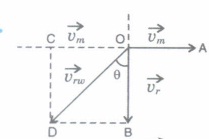
\(\overrightarrow{v_{w}}=10 \mathrm{~m} / \mathrm{s}=\overrightarrow{\mathrm{OA}}\)
\(\vec{v}_{r}=30 \mathrm{~m} / \mathrm{s}=\overrightarrow{\mathrm{OB}}\)
\(\therefore \quad \overrightarrow{v_{r w}}=\sqrt{v_{r}^{2}+v_{w}^{2}}\)
\(=\sqrt{(10)^{2}+(30)^{2}}=31.6 \mathrm{~m} / \mathrm{s}\)
\(\tan \theta=\frac{\mathrm{BD}}{\mathrm{OB}}=\frac{10}{30}=0.33(\mathrm{BD}=\mathrm{OA})\)
θ = 18°16' with vertical direction.
2.
Work and current are the scalar quantities in the given list
3.
Here, r = 1 km = 1000 m,
v = 900 kmh-1 = 900 x (1000m(/(60 x 60s) = 250 ms-1
Centripetal acceleration, a = \(\frac { { v }^{ 2 } }{ r } =\frac { { (250) }^{ 2 } }{ 1000 } \)
Now, \(\frac { a }{ g } =\frac { { (250) }^{ 2 } }{ 1000 } \times\frac { 1 }{ 9.8 } =6.38\)
4.
Here, r = 80 cm = 0.8 m, f = 14/25 s-1
\(\therefore \omega =2\pi f=2\times\frac { 22 }{ 7 } \times\frac { 14 }{ 25 } =\frac { 88 }{ 25 } rad/s\)
The cantripetal acceleration
\(a={ \omega }^{ 2 }r=(\frac { 88 }{ 25 } { ) }^{ 2 }\times0.80=9.90m{ s }^{ -1 }\)
The direction of centripetal acceleration is along the string directed towards the centre of circular path.
5.
(i) 12s,
(ii) 4.1 m /s 2,
(iii) down and
(iv) up
6.
Here, actual path length travelled, s = 23 km; Displacement = 10 km;
Time taken, t = 28 min = \(\frac{28}{60} h\)
(a) Average speed of taxi = \(\frac{\text { actual path length }}{\text { time taken }}=\frac{23}{\frac{28}{60}} k \frac{m}{h}=49.3 \mathrm{~km} / \mathrm{h}\)
(b) Magnitude of average velocity = \(=\frac{\text { displacement }}{\text { time taken }}=\frac{10}{\frac{28}{60}} \mathrm{~km} / \mathrm{h}=21.4 \mathrm{~km} / \mathrm{h}\)
The average speed is not equal to the magnitude of average velocity. The two are equal for the motion of taxi along a straight path in one direction.
7.
We know that \(A.B=ABcos\theta \) when vectors are orthogonal \(\theta ={ 90 }^{ o }\)
So, \(A.B=ABcos90^{ o }=0\) when vectors are parallel \(\theta ={ 0 }^{ o }\) so, \(A.B=ABcos{ 0 }^{ o }=AB\ (maximum)\)
8.
(i) \(\overrightarrow{\mathrm{A}} \times \overrightarrow{\mathrm{B}}=\left|\begin{array}{ccc}
\hat{i} & \hat{j} & \hat{k} \\
-2 & 3 & -4 \\
3 & -4 & 5
\end{array}\right|\)
\(=\hat{i}\left|\begin{array}{rr}
3 & -4 \\
-4 & 5
\end{array}\right|-\hat{j}\left|\begin{array}{rr}
-2 & -4 \\
3 & 5
\end{array}\right|+\hat{k}\left|\begin{array}{rr}
-2 & 3 \\
3 & -4
\end{array}\right|\)
\(=\hat{i}(15-16)-\hat{j}(-10+12)+\hat{k}(8-9)\)
\(=-\hat{i}-2 \hat{j}-\hat{k}\)
(ii) \(\overrightarrow{\mathrm{A}} \cdot \overrightarrow{\mathrm{B}}=(-2 \hat{i}+3 \hat{j}-4 \hat{k}) \cdot(3 \hat{i}-4 \hat{j}+5 \hat{k})\)
= - 6 - 12 - 20 = -38
9.
\(\overrightarrow{\mathrm{A}}=\hat{i}+2 \hat{j}+3 \hat{k}\)
\(\overrightarrow{\mathrm{B}}=2 \hat{i}-\hat{j}\)
\(\overrightarrow{\mathrm{A}}\) is perpendicular to \(\overrightarrow{\mathrm{B}}\)
\(\text { if } \quad \overrightarrow{\mathrm{A}} \cdot \overrightarrow{\mathrm{B}}=0\)
\(\therefore(\hat{i}+2 \hat{j}+3 \hat{k}) \cdot(2 \hat{i}-\hat{j})=2-2=0\)
Thus \(\overrightarrow{\mathrm{A}}\) is perpendicular to \(\overrightarrow{\mathrm{B}}\).
10.
Area of the parallelogram = \(|\overrightarrow{\mathrm{A}} \times \overrightarrow{\mathrm{B}}|\)
\(\overrightarrow{\mathrm{A}} \times \overrightarrow{\mathrm{B}}=\left|\begin{array}{rrr}
\hat{i} & \hat{j} & \hat{k} \\
1 & 2 & 3 \\
2 & -3 & 1
\end{array}\right|=11 \hat{i}+5 \hat{j}-7 \hat{k}\)
\(\therefore \quad|\overrightarrow{\mathrm{A}} \times \overrightarrow{\mathrm{B}}|=\sqrt{121+25+49}=\sqrt{195} \text { sq. units }\)
11.
Let the velocity of rain be \(\overrightarrow{v_{A}}=(10 \sqrt{3}) \mathrm{ms}^{-1},\) vertically downwards
Velocity of the man on the bicycle \(\overrightarrow{v_{B}}=10 \mathrm{~ms}^{-1}\) north to south
Relative velocity of rain W.r.t. man
\(\vec{v}=\overrightarrow{v_{A}}-\overrightarrow{v_{B}}\)
From ΔOLM \(\overrightarrow{\mathrm{ML}}=\overrightarrow{v_{\mathrm{A}}}=(10 \sqrt{3}) \mathrm{ms}^{-1}\)
\(\overrightarrow{\mathrm{LO}}=-\overrightarrow{v_{B}}=-10 \mathrm{~ms}^{-1}\)
\(\vec{v}=\overrightarrow{v_{A}}+\left(-\overrightarrow{v_{B}}\right)=\overrightarrow{\mathrm{MO}}\)
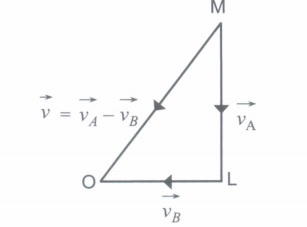
Using trigonometric considerations,
\(\tan \theta=\frac{10 \sqrt{3}}{10}=\sqrt{3}=\tan 60^{\circ}\)
ஃ θ = 60°
Thus, in order to guard himself, the man should keep his umbrella along OM., i.e., at 60° to the horizontal.
12.
Two balls of different masses m1 and m2 (m1 > m2 ) are thrown vertically upward with the same initial speed v0 simultaneously.
(a) Both balls will rise to the same height
\(\because v^{2}-v_{0}^{2}=-2 g h\) here at highest point, v = 0
\(\therefore h=\frac{v_{0}^{2}}{2 g}\)
(b) Both balls will come back with the same speed V0 to the point of projection.
(c) Both balls will come back at the same time to the point of projection.
\(\because t=2 v_{0} / g\)
13.
Let \(3 \hat{i}+7 \hat{j}+4 \hat{k}=\vec{a}\)
\(|\vec{a}|=\sqrt{3^{2}+7^{2}+4^{2}}=\sqrt{9+49+16}=\sqrt{74}\)
Unit vector in the direction of
\(\vec{a}=\frac{\vec{a}}{|\vec{a}|}=\frac{3 \hat{i}+7 \hat{j}+4 \hat{k}}{\sqrt{74}}\)
14.
(i) Consider an object moving in a straight line with uniform acceleration 'a', let at any instant of time 't', dx be the displacement of the objects.
ஃ instantaneous velocity, v \(=\frac{d x}{d t} \text { or } d x=v \mathrm{dt}\)
dx = (u + at) dt (∵v = u + at)
let x0 and x be the displacements of the object at time 'zero' and 't'
\(\int_{x_{0}}^{x} d x=\int_{0}^{t}(u+a t) d t=u \int_{0}^{t} d t+a \int_{0}^{t} t d t\)
\((x)_{x_{0}}^{x}=u(t)_{0}^{t}+a\left(\frac{t^{2}}{2}\right)_{0}^{t}\)
\(x-x_{0}=u t+\frac{1}{2} a t^{2}\)
If x = x0 = s (distance) covered by the object.
\(s=u t+\frac{1}{2} a t^{2}\)
(ii) Consider a particle moving in a straight line with initial velocity 'v' and acceleration 'a'.
Then \(a=\frac{d v}{d t}=\frac{d v}{d x} \times \frac{d x}{d t}=\frac{d v}{d x} \times v\)
adx = vdv
Integrating,\(\int_{x_{0}}^{x} a d x \quad=\int_{u}^{V} v d v\)
\(\Rightarrow \quad a|x| x_{0}^{x}=\left.\frac{v^{2}}{2_{}}\right|_{u} ^{V}\)
\(a\left(x-x_{0}\right)=\frac{v^{2}}{2}-\frac{u^{2}}{2}\)
v 2 - u 2 = 2as
15.
\(\vec{F}=(3 \vec{i}+\overrightarrow{4 j}-5 \vec{k})\)
\(\vec{d}=(5 \vec{i}+4 \vec{j}+3 \vec{k})\)
\(F=\sqrt{9+16+25}=\sqrt{50}\)
\(d=\sqrt{25+16+9}=\sqrt{50}\)
\(\vec{F} \cdot \vec{d}=(3 \hat{i}+4 \hat{j}-5 \hat{k}) \cdot(5 \hat{i}+4 \hat{j}+3 \hat{k})\)
= 15 + 16 - 15 = 16
Let Q be the angle between \(\vec{F} \text { on } \vec{d}\)
\(W=\vec{F} \cdot \vec{d}=F d \cos \theta\)
\(16=\sqrt{50} \sqrt{50} \cos \theta\)
\(\frac{16}{50}=\cos \theta \Rightarrow \theta=\cos ^{-1}(0.32)=71.3^{\circ}\)
Unit vector along d is
\(\hat{d}=\frac{5 \hat{i}+4 \hat{j}+3 \hat{k}}{\sqrt{5^{2}+4^{2}+3^{2}}}=\frac{5 \hat{i}+4 \hat{j}+3 \hat{k}}{\sqrt{50}}\)
\(\vec{F} \cdot \vec{d}=\frac{16}{\sqrt{50}}\)
component vector of \(\vec{F}\) along \(\vec{d}\)is
\((\vec{F} \cdot \vec{d}) \hat{d}=\frac{16}{\sqrt{50}}\left(\frac{5 \hat{i}+4 \hat{j}+3 \hat{k}}{\sqrt{50}}\right)\)
\(=0.32(5 \hat{i}+4 \hat{j}+3 \hat{k})\)
16.
Width of the river, d= 1km
Velocity of swimmer, v s = 5 km/h
Velocity of water flowing in river vr = 3 km/h along OQ
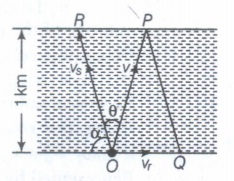
(i) The swimmer wants to cross the river straight if the resultant of the velocity of the river flow and swimmer acts perpendicular to the direction of the river flow i.e. along OP. This will be so if the swimmer moves making an angle \(\alpha\) with upstream i.e. along OR.
\(\text { But, } \alpha+\theta=90^{\circ} \text { or } \theta=90^{\circ}-\alpha\)
From \(\triangle\)OPR, we have
\(\sin \theta=\sin \left(90^{\circ}-\alpha\right)=\cos \alpha=\frac{R P}{R O}=\frac{3}{5}=0.6\)
\(\therefore \cos \alpha=\cos 53^{\circ} 8^{\prime} \Rightarrow \alpha=53^{\circ} 8^{\prime}\) upstream
(ii)The resultant velocity along oris given by
\(v=\sqrt{v_{s}^{2}-v_{r}^{2}}=\sqrt{5^{2}-3^{2}}=4 \mathrm{~km} / \mathrm{h}\)
(iii) Time taken by swimmer to cross the river
\(t=\frac{d}{v}=\frac{1}{4}=0.25 \mathrm{~h}=15 \mathrm{~min}\)
17.
The given vectors are
\(\mathbf{A}=2 \hat{\mathbf{i}}-3 \hat{\mathbf{j}}-\mathbf{k}\)
and \(\mathbf{B}=-6 \hat{\mathbf{i}}+9 \hat{\mathbf{j}}+3 \hat{\mathbf{k}}\)
Then, the vectors are parallel, if Ax B = 0
\(\therefore \quad \mathbf{A} \times \mathbf{B}=\left|\begin{array}{ccc} \hat{\mathbf{i}} & \hat{\mathbf{j}} & \hat{\mathbf{k}} \\ 2 & -3 & -1 \\ -6 & 9 & 3 \end{array}\right|\)
\(=\hat{\mathbf{i}}(-9+9)-\hat{\mathbf{j}}(6-6)+\hat{\mathbf{k}}(18-18)=0\)
\(\text { But }|\mathbf{A} \times \mathbf{B}|=0\)
or AB sin \(\theta\) = 0 \([\because \mathbf{A} \neq 0 \text { and } \mathbf{B} \neq 0]\)
\(\therefore\) sin \(\theta\) = 0 or \(\theta\) = 0
Hence, the vectors A and B are parallel.
18.
(i) A vector in general has no definite location in space because a vector remains unaffected whenever it is displaced anywhere in space provided its magnitude and direction do not change. However, a position vector has a definite location in space.
(ii) A vector can vary with time e.g. the velocity vector of an accelerated particle varies with time.
(iii) Two equal vectors at different locations in space do not necessarily have same physical effects. e.g. two equal forces acting at two different points on a body which can cause the rotation of a body about an axis will not produce equal turning effect.
19.
(i) The magnitude of resultant R of two vectors A and B is
Given by,
\(R=\sqrt { { A }^{ 2 }+B^{ 2 }+2AB\quad cos\quad \theta } \)
\(=\sqrt { { 3 }^{ 2 }+{ 4 }^{ 2 }+2\times 3\times 4\quad cos\quad \theta } \)
R is 7m,if \(\theta ={ 0 }^{ o }\)
(ii) The magnitude of resultant R of two vectors A and B is
Given by,
\(R=\sqrt { { A }^{ 2 }+B^{ 2 }+2AB\quad cos\quad \theta } \)
\(=\sqrt { { 3 }^{ 2 }+{ 4 }^{ 2 }+2\times 3\times 4\quad cos\quad \theta } \)
R is m,if \(\theta ={ 180 }^{ o }\)
(iii) The magnitude of resultant R of two vectors A and B is
Given by,
\(R=\sqrt { { A }^{ 2 }+B^{ 2 }+2AB\quad cos\quad \theta }\)
\(=\sqrt { { 3 }^{ 2 }+{ 4 }^{ 2 }+2\times 3\times 4\quad cos\quad \theta } \)
R is m ,if \(\theta ={ 90 }^{ o }\)

11th Standard CBSE Syllabus & Materials
11th Standard CBSE
CBSE 11th Business Studies Forms of Business Organisation Sample Question Papers Study Material - QB365 Set A
NEW11th Standard CBSE
CBSE 11th Business Studies Business, Trade and Commerce Sample Question Papers Study Material - QB365 Set A
NEW11th Standard CBSE
CBSE 11th Physics Waves Sample Question Papers Study Material - QB365 Set A
NEW11th Standard CBSE
CBSE 11th Physics Kinetic Theory Sample Question Papers Study Material - QB365 Set A



NCERT Books

Syllabus

Exam Pattern

Sample Question Papers

Previous year Question Papers

Important Notes

MCQ Practice test

NCERT Exemplers

Case study Questions

Image Based Questions

Passage based Questions

HOT Questions

Value Based Questions

Model Questions Papers
NCERT ( Book Back ) Questions

Assertion and Reason
Important Questions And Answers

CBSE 11th Standard CBSE Subjects
CBSE Standards







