
 100% FREE ACCESS
11th Standard CBSE Syllabus & Materials
11th Standard CBSE
CBSE 11th Economics PART-A - Presentation of Data - New Sample Question Papers Study Material - QB365 Set A
NEW11th Standard CBSE
CBSE 11th Economics PART-A - Organisation of Data - New Sample Question Papers Study Material - QB365 Set A
NEW11th Standard CBSE
CBSE 11th Economics PART-A - Collection of Data - New Sample Question Papers Study Material - QB365 Set A
NEW11th Standard CBSE
CBSE 11th Economics PART-A - Introduction to Economics and Statistics - New Sample Question Papers Study Material - QB365 Set A
NEW11th Standard CBSE
CBSE 11th Business Studies International Trade Sample Question Papers Study Material - QB365 Set A
NEW11th Standard CBSE
CBSE 11th Business Studies Evolution and Fundamentals of Business Sample Question Papers Study Material - QB365 Set A

Published on: 21/10/2025
Download CBSE Class 11th Standard CBSE Physics question papers, sample papers, important questions, and previous year solved papers in PDF format. Get free study materials, NCERT solutions, and exam preparation resources for Class 11th Standard CBSE Physics
Questions + Answers key
Take MCQ Physics Test
1.
An aeroplane is flying in a horizontal direction with a velocity of 600 km/hr and at a height of 1960 m. When it is vertically above the point A on the ground, a body is dropped from it. The body strikes the ground at point B. Calculate the distance AB.
2.
A particle of mass 200 g is whirled into a vertical circle of radius 80 cm using a massless string. The speed of particle when the string makes an angle 60° with the vertical line is 1.5 ms-1. What is the tension in the string is this position?
3.
A constant retarding force of 50 N is applied to a body of mass 20 kg moving initially with a speed of 15m s-1. How long does the body take to stop?
4.
The ceiling of a long hall is 25 m high. What is the maximum horizontal distance that a ball thrown with a speed of 40 m s-1 can go without hitting the ceiling of the hall ?
5.
To what angle a cyclist has to bend to negotiate a curved path? Derive an expression.
6.
Are the magnitude and direction of \((\overrightarrow{\mathbf{A}}-\overrightarrow{\mathbf{B}})\) same as that of \((\overrightarrow{\mathbf{B}}-\overrightarrow{\mathbf{A}}) ?\)
7.
If, in Exercise, the speed of the stone is increased beyond the maximum permissible value, and the string breaks suddenly, which of the following correctly describes the trajectory of the stone after the string breaks :
(a) the stone moves radially outwards,
(b) the stone flies off tangentially from the instant the string breaks,
(c) the stone flies off at an angle with the tangent whose magnitude depends on the speed of the particle ?
8.
An aircraft executes a horizontal loop of radius 1.00 km with a steady speed of 900 km/h. Compare its centripetal acceleration with the acceleration due to gravity.
9.
A.nairline passenger late for a flight walks on an airport moving sidewalk at a speed of 5.00 km/h relative to the sidewalk, in the direction of its motion. The sidewalk is moving at 3.00 km/h relative to the ground and has a total length of 135m.
(i) What is the passenger's speed relative to the ground?
(ii) How long does it take him to reach the end of the-Sidewalk?
(iii) How much of the sidewalk has he covered by the time he reaches the end?
10.
Force on the Block
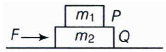
A block P of mass 4 kg is placed on another block Q of mass 5 kg, and the block Q rests on a smooth horizontal table. For sliding block P on Q, horizontal force of 12 Nis required to be applied on P. How much maximum force can applied on Q so that both P and Q move together? Also, find out acceleration produced by this force.
11.
Two forces \(F_{1}=3 \hat{\mathbf{i}}-4 \hat{\mathbf{j}}\) and \(F_{2}=2 \hat{\mathbf{i}}-3 \hat{\mathbf{j}}\) are acting upon a body of mass 2 kg. Find the force F3 which when acting on the body will make it stable.
\(5 \hat{\mathbf{i}}+7 \hat{\mathbf{j}}\)
\(-5 \hat{\mathbf{i}}-7 \hat{\mathbf{j}}\)
\(-5 \hat{\mathbf{i}}+7 \hat{\mathbf{j}}\)
\(5 \hat{\mathbf{i}}-7 \hat{\mathbf{j}}\)
12.
A body with mass 5 kg is acted upon by a force \(\mathbf{F}=(-3 \hat{\mathbf{i}}+4 \hat{\mathbf{j}}) \mathrm{N}\) .If its initial velocity at t = 0 is \(v=(6 \hat{\mathbf{i}}-12 \hat{\mathbf{j}}) \mathrm{ms}^{-1} \text { , }\) the time at which it will just have a velocity along the y-axis is _______.
never
10 s
2 s
15 s
13.
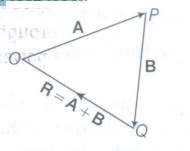
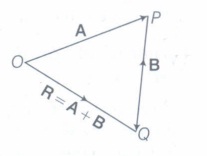
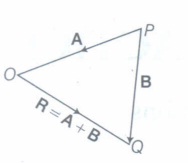
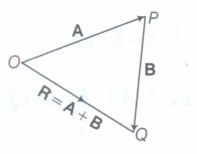
A and B are two inclined vectors. R is their sum. Choose the correct figure for the given description
14.
Two bodies of mass 10 kg and 5 kg are moving in concentric orbits of radii R and r such that their periods are the same. Then the ratio their centripetal acceleration is
R/r
r/R
R2/r2
r2/R2
15.
A man getting down a running bus falls forward because: _______.
Due to inertia of rest, road is left behind and man reaches forward
Due to inertia of motion upper part of body continues to be in motion in forward direction while feet come to rest as soon as they touch the ground
He leans forward as a matter of habit
Of the combined effect of all the three factors stated in [a], [b] and [c]
16.
17.
18.
19.
1.
Velocity of aeroplane in horizontal direction is
vox = 600 km/hr = 600 x \({5\over18}ms^{-1}\)
\(={500\over 3}ms^{-1}\)
This velocity remains constant throughout the flight of the body.
voy = 0 and y = h = 1960 m
Let t = the time taken by the body to reach the ground
Now y = voy t + \({1\over2}gt^{2}\)
Here, y = h = 1960 m; voy = 0 (initial vertical velocity)
\(\therefore \ 1960={1\over2}\times 9.8t^2\)
\(\therefore t=\sqrt{1960\over4.9}s=\sqrt{400}s=20s\)
Distance travelled by the body in the horizontal direction
\(=v_{ox}t={500\over3}\times20={10000\over3}=3333m\)
= 3.333 km
\(\therefore\) AB = 3.333 km
2.
Here m = 200 g = 0.2 kg
r = 80 cm = 0.8 m
V = 1.5 ms-1
\(\theta\) = 60°
\(\therefore\) Required tension in the string
\(T={mV^2\over r}+mg cos \theta\)
\(={0.2\times(1.5)^2\over 0.8}+0.2\times 10\times cos 60^o\)
\(={2.25\over 4}+0.2\times 10 \times {1\over2}\)
= 0.56 + 1
= 1.56 N
3.
Here m= 20 kg, F = - 50 N (retardation force)
As F = ma
\(\Rightarrow a={F\over m}={-50\over 20}=-2.5 ms^{-2}\)
Using equation, v = u + at
Given, u 15 ms-1, v = 0
Now, 0 15 + (- 25) t
or, t = 6 s.
4.
Given, initial velocity (u) = 40m/s
Height of the hall (H) = 25m
Let the angle of projection of the ball be \(\theta \), when maximum height attained by it be 25m.
Maximum height attained by the ball
\(H=\frac { { u }^{ 2 }{ sin }^{ 2 }\theta }{ 2g } \Rightarrow 25=\frac { { (40) }^{ 2 }{ sin }^{ 2 }\theta }{ 2\times 9.8 }\)
\(or\ { \sin }^{ 2 }\theta =\frac { 25\times 2\times 9.8 }{ 1600 } =0.3068\)
\(or\ \sin\theta =0.5534=\sin{ 33.6 }^{ 0 }\)
\(or\ \theta ={ 33.6 }^{ 0 }\)
\( \therefore \text{ Horizontal range (R)}=\frac { { u }^{ 2 }\sin2\theta }{ g }\)
\( \\ =\frac { { (40) }^{ 2 }sin2\times { 33.6 }^{ 0 } }{ 9.8 } =\frac { 1600\times sin{ 67.2 }^{ 0 } }{ 9.8 } \)
\(\\ =\frac { 1600\times 0.9219 }{ 9.8 } =150.5m\)
5.
As the cyclist leans by an angle θ with the vertical, the normal,can be acting as shown. If v is the speed of the cyclist, the necessary centripetal force is provided by the component N sin θ of normal reaction and N cos θ provides balancing for weight.
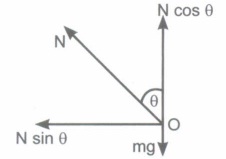
ஃ N sin θ = mv2/r, N cos θ = mg
Dividing \(\tan \theta=\frac{v^{2}}{r g}\)
\(\Rightarrow \ \theta=\tan ^{-1}\left(\frac{v^{2}}{r g}\right)\)
6.
Magnitude is same when θ between \(\overrightarrow{\mathbf{A}}\) and \(\overrightarrow{\mathbf{B}}\) is 90°, and is different if θ is other than 90°, but the direction is opposite between them.
7.
(i) The part correctly describes the trajectory of the stone after the spring breaks because when a stone tied to one end of a string is whirled round in a circle then velocity of the stone at any point is along the tangent at that point. If the string breaks suddenly, then stone flies off tangentially, along the direction of its velocity.
(ii) The part correctly describes the trajectory of the stone after the spring breaks because when a stone tied to one end of a string is whirled round in a circle then velocity of the stone at any point is along the tangent at that point. If the string breaks suddenly, then stone flies off tangentially, along the direction of its velocity.
(iii) The part correctly describes the trajectory of the stone after the spring breaks because when a stone tied to one end of a string is whirled round in a circle then velocity of the stone at any point is along the tangent at that point. If the string breaks suddenly, then stone flies off tangentially, along the direction of its velocity.
8.
Here, r = 1 km = 1000 m,
v = 900 kmh-1 = 900 x (1000m(/(60 x 60s) = 250 ms-1
Centripetal acceleration, a = \(\frac { { v }^{ 2 } }{ r } =\frac { { (250) }^{ 2 } }{ 1000 } \)
Now, \(\frac { a }{ g } =\frac { { (250) }^{ 2 } }{ 1000 } \times\frac { 1 }{ 9.8 } =6.38\)
9.
The situation is sketched in figure. We assign a letter to each body in relative motion, P passenger, S sidewalk, G ground. The relative velocities VPS and VSG are given
vPS = 5.00 km /h, to the right
vSG = 3.00 km /h, to the right
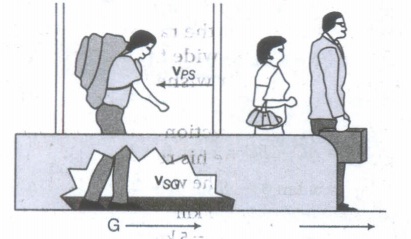
(i) Here we must find the magnitude of the vector vPG given the magnitude and direction of two other vectors. We find the velocity vPGby using the relation
VPG = VPS +VSG
Here the vectors are parallel, and so the vector addition is quite simple see figure. We add vectors by adding magnitudes
VPG = VPS +VSG
= 5.00 km / h + 3.00 km/h
= 8.00km/h
(ii) The length of the sidewalk is 135 m, and so this is the distance \(\triangle\)xG the passenger travels relative to the ground. So, our problem is to find \(\triangle\)t when \(\triangle\)xG = 135 m. The rate at which this distance along the ground is covered by the passenger is v PG where
\(v_{P G}=\frac{\Delta x_{G}}{\Delta t}\)
Therefore,
\(\Delta t=\frac{\Delta x_{G}}{v_{P G}}=\frac{135 \mathrm{~m}}{8.00 \mathrm{~km} / \mathrm{h}\left(\frac{1.00 \mathrm{~m} / \mathrm{s}}{3.60 \mathrm{~km} / \mathrm{h}}\right)}=60.8 \mathrm{~s}\)
The problem here is to determine how much of the sidewalk's surface the passenger moves over. If he was standing still and not walking along the surface, he would cover none of it. Because he is moving relative to the surface at velocity vPS he does move some distance \(\triangle\)x s relative to the surface. The problem is to find \(\triangle\)sx , when \(\triangle\)t = 60.8 s, since we found in part (b) that this is the time interval during which he is on the moving sidewalk. His velocity relative to the sidewalk is \(v_{P S}=\Delta x_{\mathrm{s}} / \Delta t\) and so
\(\Delta x_{s}=v_{P S} \Delta t\)
\(=(5.00 \mathrm{~km} / \mathrm{h})\left(\frac{1.00 \mathrm{~m} / \mathrm{s}}{3.60 \mathrm{~km} / \mathrm{h}}\right)(60.8 \mathrm{~s})\)
= 84.4m
10.
Here, m1 = 4 kg, m2 = 5 kg
Force applied on block P = 12 N
This force must be equal to the kinetic .friction applied on P by Q.
\(12={ F }_{ k }={ \mu }_{ k }R={ \mu }_{ k }{ m }_{ 1 }g \)
\(\\ 12={ \mu }_{ k }\times 4g\ or\ { \mu }_{ k }={ \frac { 12 }{ 4g } }=\frac { 3 }{ g }\)
acceleration of P=\(\frac { 12 }{ 4 } =3m/s\)
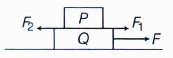
When force F is applied on Q to create common motion in P & Q, the forces created (friction) is shown in the diagram above. F, force will be created on P and F2 force will be created on Q.
Considering forces on Q, we have
\(F-{ F }_{ 2 }(net\quad force)={ m }_{ 2 }\times a={ m }_{ 2 }\times 3\)
Since,
\({ F }_{ 1 }={ F }_{ 2 }={ \mu }_{ 1 }{ m }_{ 1 }g\)
\(\\ F-{ \mu }_{ k }{ m }_{ 2 }g={ m }_{ 2 }\times 3\)
\(\\ F={ \mu }_{ k }{ m }_{ 2 }g+{ m }_{ 2 }\times 3=\frac { 3 }{ g } \times 4\times g+5\times 3=12+15=27N\)
As this force moves both the blocks together on a smooth table, so the acceleration produced is
\(a=\frac { F }{ { m }_{ 1 }+{ m }_{ 2 } } =\frac { 27 }{ 4+5 } =3m/s\)
11.
(c)
\(-5 \hat{\mathbf{i}}+7 \hat{\mathbf{j}}\)
12.
(b)
10 s
13.
(d)
14.
(a)
R/r
15.
(b)
Due to inertia of motion upper part of body continues to be in motion in forward direction while feet come to rest as soon as they touch the ground
16.
17.
18.
19.

11th Standard CBSE Syllabus & Materials
11th Standard CBSE
CBSE 11th Business Studies Forms of Business Organisation Sample Question Papers Study Material - QB365 Set A
NEW11th Standard CBSE
CBSE 11th Business Studies Business, Trade and Commerce Sample Question Papers Study Material - QB365 Set A
NEW11th Standard CBSE
CBSE 11th Physics Waves Sample Question Papers Study Material - QB365 Set A
NEW11th Standard CBSE
CBSE 11th Physics Kinetic Theory Sample Question Papers Study Material - QB365 Set A



NCERT Books

Syllabus

Exam Pattern

Sample Question Papers

Previous year Question Papers

Important Notes

MCQ Practice test

NCERT Exemplers

Case study Questions

Image Based Questions

Passage based Questions

HOT Questions

Value Based Questions

Model Questions Papers
NCERT ( Book Back ) Questions

Assertion and Reason
Important Questions And Answers

CBSE 11th Standard CBSE Subjects
CBSE Standards







