
 100% FREE ACCESS
11th Standard CBSE Syllabus & Materials
11th Standard CBSE
CBSE 11th Economics PART-A - Presentation of Data - New Sample Question Papers Study Material - QB365 Set A
NEW11th Standard CBSE
CBSE 11th Economics PART-A - Organisation of Data - New Sample Question Papers Study Material - QB365 Set A
NEW11th Standard CBSE
CBSE 11th Economics PART-A - Collection of Data - New Sample Question Papers Study Material - QB365 Set A
NEW11th Standard CBSE
CBSE 11th Economics PART-A - Introduction to Economics and Statistics - New Sample Question Papers Study Material - QB365 Set A
NEW11th Standard CBSE
CBSE 11th Business Studies International Trade Sample Question Papers Study Material - QB365 Set A
NEW11th Standard CBSE
CBSE 11th Business Studies Evolution and Fundamentals of Business Sample Question Papers Study Material - QB365 Set A

Published on: 21/10/2025
Download CBSE Class 11th Standard CBSE Physics question papers, sample papers, important questions, and previous year solved papers in PDF format. Get free study materials, NCERT solutions, and exam preparation resources for Class 11th Standard CBSE Physics
Questions + Answers key
Take MCQ Physics Test
1.
Give an example of Pseudo force.
2.
What are co-initial and collinear vectors?
3.
A body starts from rest and travels in straight line with a uniform acceleration of 5 m/s2 for 5 seconds. What is the velocity and distance travelled in this time?
4.
Calculate the power of an electric engine which can lift 20 tonne of coal per hour from a mine 180 m deep.
5.
Calculate the surface area of a solid cylinder of diameter 4 cm and height 20 cm in mm2
6.
A large mass 'M' and a small mass 'm' hang at the two ends of a string that passes over a smooth tube. The mass m moves around in a circular path which
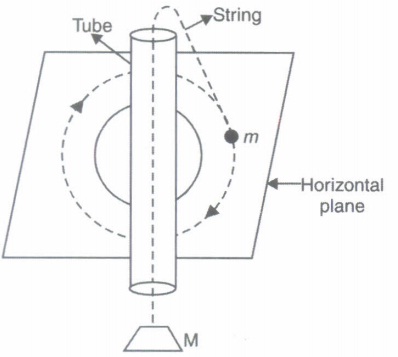
lies in the horizontal plane. The length of the string from the mass m to the top of the tube is I and 8 is the angle this length makes with the vertical. What should be the frequency of rotation of the mass m so that mass M remains stationary?
7.
A stone is dropped from the top of a tall cliff and 'n' second later another stone is thrown vertically downwards with a velocity of 'u' m/s. How far below the top of the cliff will the second stone overtake the first?
8.
A force of 400 N acting horizontal pushes up a 20 kg block placed 'On a rough inclined plane which makes an angle of 45° with the horizontal. The acceleration experienced by the block is 0.6 m/s2, Find the coefficient of sliding friction between the box and incline.
9.
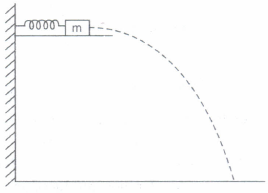
A small block of mass 'm' is pressed against a horizontal spring fixed at one end to compress the spring through 5.0 cm. When released the block moves horizontally till it leaves the spring. Where will it hit the ground at a distance 2m below the slab?
10.
If instead of mass, length and time as fundamental quantities, we choose velocity, acceleration and force as fundamental quantities and express their dimensions by V, A and F respectively, show that the dimensions of Young's modulus can be expressed as [FA2V-4].
11.
A stone of mass 0.25 kg tied to the end of a string is whirled round in a circle of radius 1.5 m with a speed of 40 rev./min in a horizontal plane. What is the tension in the string ? What is the maximum speed with which the stone can be whirled around if the string can withstand a maximum tension of 200 N ?
12.
Rahul and Shyam are two friends. They were playing cricket in a field. Rahul was balling and Shyam was hitting the ball with his bat. Rahul went to search the ball, he found a big stone in the field then he called Shyam and both decided to remove the stone from the field. Rahul pushed stone in a particular direction and Shyam pushed the stone in such a way that they made angle of 600 with each other.
What will be net force exerted on the stone by Rahul and Shyam?
13.
If the time period (T) of vibration of a liquid drop depends on surface tension(s) and radius (r) of the drop, and density(\(\rho \)) of the liquid.Derive an expression for T using dimensional analysis.
14.
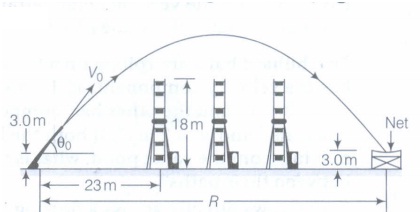
Around 1939-1940, Emanuel Zacchini took human-cannon ball act to an extreme. After being shot from a cannon, it soared over three Ferris wheels and into a net as shown in figure. Assume that it is launched with a speed of 26.5 m/s and at an angle of 53.0°.
(i) Treating it as a particle, calculate its clearance over the first wheel.
(ii) If he reached maximum height over the middle wheel, by how much did he clear it?
(iii) How far from the cannon should the net's centre have been positioned (neglect air drag)?
15.
A particle located at x = 0 at time t = 0 starts moving along the positive x direction with a velocity v that varies as v = \(\alpha\sqrt{x}\) . How do the displacement, velocity and acceleration of the particle vary with time? What is the average velocity of the particle over the first s metres of its path?
16.
Answer the following :
(a) The casing of a rocket in flight burns up due to friction. At whose expense is the heat energy required for burning obtained? The rocket or the atmosphere?
(b) Comets move around the sun in highly elliptical orbits. The gravitational force on the comet due to the sun is not normal to the comet’s velocity in general. Yet the work done by the gravitational force over every complete orbit of the comet is zero. Why
(c) An artificial satellite orbiting the earth in very thin atmosphere loses its energy gradually due to dissipation against atmospheric resistance, however small. Why then does its speed increase progressively as it comes closer and closer to the earth ?
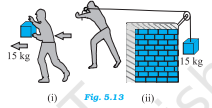
(d) In Fig. 5.(i) the man walks 2 m carrying a mass of 15 kg on his hands. In Fig. (ii), he walks the same distance pulling the rope behind him. The rope goes over a pulley, and a mass of 15 kg hangs at its other end. In which case is the work done greater ?
17.
Figure shows a pirateship 560 m from a fort defending a harbour entrance. A defence cannon, located at sea level, fires balls at initial speed, u0 = 82 m/s.
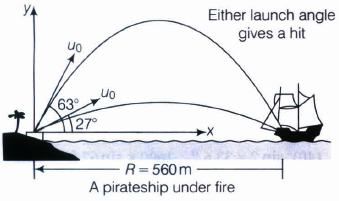
(i) At what angle, \({ \theta }_{ 0 }\) from the horizontal must a ball be fired to hit the ship?
(ii) What is the maximum range of the cannon balls?
18.
In Fig . a body A of mass m slides on plane inclined at angle θ1 to the horizontal and μ1 is the coefficient of friction between A and the plane. A is connected by a light string passing over a frictionless pulley to another body B, also of mass m,sliding on a frictionless plane inclined at angle θ2 to the horizontal. Which of the following statements are true?
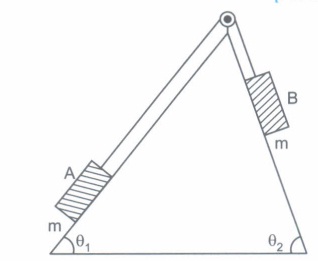
A will never move up the plane
A will just start moving up the plane when \(\mu=\left(\sin \theta_{2}-\sin \theta_{1}\right) / \cos \theta_{1}\)
For A to move up the plane, θ2 must always be greater than θ1.
B will always slide down with constant speed.
19.
A force F = - k/ x2 (x \(\neq\) 0) acts on a particle in X -direction. Find the work done by the force in displacing the particle from x = - a to x = 2a.
3k / 2a
4k / a 2
- 3k / 2a2
\(\frac{-9 k}{a^{2}}\)
20.
If the velocity of a particle is v = At + Bt2 , where A and B are constants, then the distance travelled by it in 1s is
3A+7B
\(\frac{3}{2} A+\frac{7}{3} B\)
\(\frac{A}{2}+\frac{B}{3}\)
\(\frac{3}{2} A+4 B\)
21.
The displacement of a car is given as - 240 m. Here negative sign indicates
direction of displacement
negative path length
position of car is at point whose coordinate is -120
no significance of negative sign
22.
If \(\overrightarrow { { a }_{ 1 } } \) and \(\overrightarrow { { a }_{ 2 } } \) are two non collinear unit vectors and if \(\left| \overrightarrow { { a }_{ 1 } } +\overrightarrow { { a }_{ 2 } } \right| \) =\(\sqrt{3}\), then the value of \(\left( \overrightarrow { { a }_{ 1 } } -\overrightarrow { { a }_{ 2 } } \right) .\left( 2\overrightarrow { { a }_{ 1 } } +\overrightarrow { { a }_{ 2 } } \right) \) is
2
\(\frac{3}{2}\)
\(\frac{1}{2}\)
1
23.
The SI units of the universal gravitational constant G are _____.
kg m2 S-2
kg-l m3 S-2
Nm2 kg-2
N kg2m-2
24.
The position time (x - t) graph for two children A and B returning from their school O to their homes P and Q respectively is shown in the figure
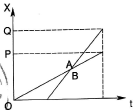
Child A lives closer to the school
Child B lives closer to the school
Both live at the same distance from the school
All the above statement are wrong
25.
A particle at rest suddenly disintegrated into two particles of equal masses and Starts moving. The two fragments will
Move in the same direction
Move in opposite direction with same speed
Move in opposite direction with unequal speed
Move in any direction
26.
In an elastic collision between to bodies of different masses
Both momentum and KE conserved
Momentum is conserved but KE not conserved
KE conserved but momentum not conserved
The two bodies inter change their velocities
27.
The ratio of angular speed of hours hand and seconds hand of a clock is
1:720
1:60
1:7200
3600:1
28.
Two equal vectors have a resultant equal to either of them. The angle between them is
60°
90°
100°
120°
29.
KE of a body of mass 1 kg is 18 J. Its momentum is
9 kgm/s
16 kgm/s
6 kgm/s
None
30.
A ball P moving with a velocity u strikes an identical stationary ball Q such that after the collision, the direction of motion of balls P and Q makes an angle 30° with the original direction of motion of ball P as shown.
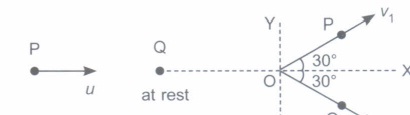
(i) Determine the speed V1 of ball P after collision.
(ii) Determine the ratio of the total kinetic energy of the balls after collision to that before collision.
(iii) Determine the ratio of velocity V1 and v 2 after the collision in terms of coefficient of restitution e.
(iv) A ball hits a floor and rebounds after an inelastic collision. What change would occur in total energy, kinetic energy and momentum of ball?
31.
32.
Assertion : The height attained by a projectile is twenty five percent of range, when projected for maximum range.
Reason : The height is independent of initial velocity of projectile.
Codes:
A) If both assertion and reason are true and the reason is the correct explanation of the assertion.
B) If both assertion and reason are true but reason is not the correct explanation of the assertion.
C) If assertion is true but reason is false.
D) If the assertion and reason both are false.
E) If assertion is false but reason is true.
33.
Assertion : If two protons are brought near one another, the potential energy of the system will increase.
Reason : The charge on the proton is +1.6 x 10⁻¹⁹C.
Codes:
A) If both assertion and reason are true and the reason is the correct explanation of the assertion.
B) If both assertion and reason are true but reason is not the correct explanation of the assertion.
C) If assertion is true but reason is false.
D) If the assertion and reason both are false.
E) If assertion is false but reason is true.
1.
Centrifugal force.
2.
Two vectors having the same initial point are called co-initial vectors. Two vectors which either act along the same line or along parallel lines are called collinear vectors.
3.
Velocity after 5 seconds
= v = u + at = 0 + 5 x 5 = 25 ms-1
Distance travelled in 5 seconds
\(\mathrm{S}=u t+\frac{1}{2} a t^{2}\)
\(=0+\frac{1}{2} 5 \times 5^{2}=62.5 \mathrm{~m}\)
4.
Power \(=\frac { \text{Work done }}{ \text{Time taken} } =\frac { mgh }{ t } \)
\(=\frac { 20\times 1000\times 9.8\times 180 }{ 60\times 60 }\)
=9800 W=9.8 kW
5.
27657.1 mm2
6.
The various forces acting on M and m are
T = Mg ............(i)
T cos θ = mg ..............(ii)
\(\mathrm{T} \sin \theta=\frac{m v^{2}}{r}=m r \omega^{2}\) .............(iii)
where r is the radius of the circular path and ω is the angular velocity.
r = I sin θ
From (iii) T sin θ = mrω2 = m(l sin θ)ω2,
But T = Mg
ஃ Mg sin θ = ml sin θ ω2
or \(\omega^{2}=\frac{\mathrm{Mg}}{m l}\)
or \(v=\frac{\omega}{2 \pi}=\frac{1}{2 \pi} \sqrt{\frac{\mathrm{Mg}}{m l}}\)
Thus, the frequency of rotation of m, so that M remains stationary is given by
\(v=\frac{1}{2 \pi} \sqrt{\frac{\mathrm{Mg}}{m l}}\)
7.
The second stone will 'catch up' with the first stone when the distance covered by it in (t - n) second will equal the distance covered by the first stone in t second.
Now distance covered by the first stone in t second = '2 gt2 and distance covered by the second stone in (t-n) second.
= u (t-n) + \(\frac { 1 }{ 2 } \)g (t-n)2
∴ \(\frac { 1 }{ 2 } \) gt2 = u(t-n) + \(\frac { 1 }{ 2 } \)g (t-n)2
or \(\frac { 1 }{ 2 } \)g [t2- (t-n)2] = u(t-n)
or \(\frac { 1 }{ 2 } \)g [(2t-n)n] = u(t-n)
or gnt- \(\frac { 1 }{ 2 } \)or gn2 = ut-un
or t(gn-u) = \(\left( \frac { 1 }{ 2 } gn-u \right) n\)
or \(t=\frac { n\left( \frac { 1 }{ 2 } gn-u \right) }{ (gn-u) } \)
The distance covered by the first stone in this time is
h \(\frac { 1 }{ 2 } gt^{ 2 }=\frac { 1 }{ 2 } g\left[ \frac { n\left( \frac { 1 }{ 2 } gn-u \right) }{ (gn-u) } \right] ^{ 2 }\)
Thus the second stone will overtake the first at distance
\(\frac { 1 }{ 2 } g=\frac { 1 }{ 2 } g\left[ \frac { n\left( \frac { gn }{ 2 } -u \right) }{ (gn-u) } \right] ^{ 2 }\)below the top of the cliff.
8.
The horizontally directed force 400 N and weight 20 kg of the block are resolved into two mutually perpendicular components, parallel and perpendicular to the plane as shown.
N =20 g cos 45° + 400 sin 45° = 421.4 N
The frictional force experienced by the block F = \(\mu\)N =\(\mu\) x 421.4 = 421.4 \(\mu\)N.
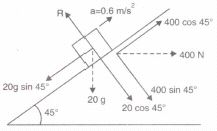
As the accelerated motion is taking place up the plane.
400 cos 45° - 20g sin 45° - f = 20a
\({400\over \sqrt{2}}-{20\times 9.8\over \sqrt{2}}-421.4\mu=20a=20\)
\(\mu=({400\over \sqrt{2}}-{196\over \sqrt{2}}-12)\times {1\over 421.4}\)
\(={282.8-138.6-12\over 421.4}=0.3137\)
The coefficient of sliding friction between the block and the incline = 0.3137
9.
Here \(\frac { 1 }{ 2 } { kx }^{ 2 }=\frac { 1 }{ 2 } { mv }^{ 2 }\)
or \(v=\sqrt { \frac { k }{ m } { x }^{ 2 } } =\sqrt { \frac { 100 }{ 100 } \times \frac { 25\times { 10 }^{ -4 } }{ 10^{ -3 } } } { ms }^{ -1 }\)
\(=\sqrt { 25 } \) ms-1
Height = 2m = \(\sqrt { \frac { 2h }{ g } } =\sqrt { 0.4 } \)
The horizontal length covered = \(\sqrt { 0.4 } \times \sqrt { 25 } m\)
= 1 m.
10.
We know that the usual dimensions of Y are
\(\frac { [ML{ T }^{ -2 }] }{ [{ { L }^{ 2 }] } } ,i.e.,[M{ L }^{ -1 }{ T }^{ -2 }]\)
To express these in terms of F, A and V, we must express, M, Land T in terms of these new 'fundamental' quantities.
\([V]=[L{ T }^{ -1 }],[A]=[L{ T }^{ -2 }],[F]=[ML{ T }^{ -2 }]\)
\(\\ M=F{ A }^{ -1 },T=V{ A }^{ -1 },L={ V }^{ 2 }{ A }^{ -1 }\)
\(\\ [Y]=[M{ L }^{ -1 }{ T }^{ -2 }]\)
\(=[F{ A }^{ -1 }][{ V }^{ 2 }{ A }^{ -1 }]{ [V{ A }^{ -1 }] }^{ -2 }\ \)
\(=F{ A }^{ 2 }{ V }^{ -4 }\)
Thus the 'new' dimensions of Young's modulus are \([F{ V }^{ -4 }{ A }^{ 2 }]\)
11.
Mass of stone, m = 0.25 kg, Radius of the string, r = 1.5 m
Frequency, v = 40rev/min = \(\frac { 40 }{ 60 } \) rev/s = \(\frac { 2 }{ 3 } \) rev/s
Centripetal force required for circular motion is obtained from the tension in the string.
\(\therefore \) Tension in the string = Centripetal force
T = \(mr{ \omega }^{ 2 }\)
\(= mr\left( 2\pi n \right) ^{ 2 } \ \left[ \therefore \omega =2\pi v \right] \)
\(= mr4\pi ^{ 2 }{ v }^{ 2 }\)
\(T=0.25\times 1.5\times 4\times \left( \frac { 22 }{ 7 } \right) ^{ 2 }\times \left( \frac { 2 }{ 3 } \right) ^{ 2 }= 6.6N\)
Maximum tension which can be withstand by the string
\({ T }_{ max }=200\quad N=\frac { mv^{ 2 }max }{ r } \)
\(\\ { v }_{ max }=\sqrt { \frac { { T }_{ max }\times r }{ m } } =\sqrt { \frac { 200\times 1.5 }{ 0.25 } } =34.6{ m }/{ s }\)
12.
The net force exerted on the stone by both of them will be
\(F_{ R }=\sqrt { { F }^{ 2 }+{ F }^{ 2 }+2{ F }^{ 2 }\cos { { 60 }^{ 0 } } } \)
\( =\sqrt { 2{ F }^{ 2 }+2{ F }^{ 2 }\times 1/2 } \)
\(=\sqrt { 2{ F }^{ 2 }+{ F }^{ 2 } } =\sqrt { 3 } F\)
13.
The correct option is A T=\(k \sqrt{ρr^3/S}\)
Dimensional formula of,
Time period, T
[T]=[M0L0T1]
Surface tension, S
[S]=[ML0T−2]
Radius, r
[r]=[M0LT0]
Density, ρ
[ρ]=[M1L−3T0]
Let us suppose the relation is
T=kρarbSc
⇒[T]=[kρarbSc]
⇒[M0L0T1]=[M1L−3T0]a × [M0LT0]b × [ML0T−2]c
⇒[M0L0T1]=[M(a+c)L(−3a+b)T(−2c)]
On comparing, we get,
a+c=0(1)
−3a+b=0(2)
−2c=1(3)
On solving these equations, we get,
a=1/2,b=3/2 and c=−1/2
Thus,
T=kρarbSc ⇒\(T=\frac { { pr }^{ 3 } }{ s } \)
14.
(a) 5.3 m,
(b) 7.9 m and
(c) 69 m
15.
v = \(\frac{dx}{dt}\)
Since v = \(\alpha\sqrt{x}\)
we have \( \frac{dx}{dt}=\alpha\sqrt{x} \) or \(\frac{dx}{\sqrt{x}}=\alpha dt\)
Intefrating from \( t=0(x=0) to \ t=t(x=x)\)
we have \( \overset { x }{ \underset { 0 }{ \int } } { x }^{ -1/2 }dx=\alpha \overset { t }{ \underset { 0 }{ \int } } dt\)
∴ \({ \left| \frac { { x }^{ 1/2 } }{ 1/2 } \right| }_{ 0 }^{ x }=\alpha t\)
or \( x = \frac{\alpha^2t^2}{4}\)
The time dependence of the velocity is obtained by differentiating both sides of this relation w.r.t. time t. Thus
\(v=\frac{dv}{dt}=\frac{\alpha.2t}{4}=\frac{\alpha^2}{2}t\)
The velocity x of the particle is thus increasing in direct proportion to time.
Similarly, the time dependence of acceleration is obtained by differentiating both sides of this relation w.r.t. 't', Thus
\( a=\frac{dv}{dt}=\frac{\alpha^2}{2}\)
The particle is thus moving with a constant acceleration.
To find the average velocity over the first s metre, we assume that the time taken to cover this distance is T. Using
\( x=\frac{\alpha^2t^2}{4}\)
we get s= \(\frac{\alpha^2T^2}{4} or \ T=\frac{2\sqrt{s}}{\alpha}\)
The average velocity vav \((=s/T)\) is, therefore
\( v_{av}=(\frac{\alpha}{2}\sqrt{s}) \).
16.
(i) Heat energy required for burning of casing of rocket comes from the rocket itself. As a result of work done against friction the kinetic energy of rocket continuously decreases and this work against friction reappears as heat energy.
(ii) The gravitational force is a conservative force, hence, work done by the gravitational force over one complete (closed) orbit of comet is zero.
(iii) As an artificial satellite gradually loses its energy due to dissipation against atmospheric resistance, its potential energy decreases rapidly. As a result, kinetic energy of satellite slightly increases i.e. its speed increases progressively.
(iv) In figure, the man carries the mass of 15 kg on his hands and walks 2m. In this case, he is actually doing work against the friction force. Friction force contribution by mass
\(f=\mu N=\mu mg\times 15\times 9.8N\)
and work done against friction
\({ W }_{ 1 }={ f }_{ S }=\mu \times 15\times 9.8\)= 294 \(\mu \)J
In figure (ii) the tension in string, T = mg =15 \(\times \) 9.8 N
Hence, force applied by man for pulling the rope F =T =15\(\times \) 9.8N
\(\therefore \) Work done by man, Wz = Fs =15\(\times \) 9.8\(\times \) 2 = 294 J and additional work has to be done against friction also.
Thus, it is clear that W2 > W1.
17.
(i) A fired cannon ball is a projectile and we want an equation that relates the launch angle \({ \theta }_{ 0 }\) to the ball horizontal displacement i. e. range as it moves from the cannon to the ship.
\(\therefore \quad { \theta }_{ 0 }=\frac { 1 }{ 2 } \sin ^{ -1 }{ \left( \frac { gR }{ { u }_{ 0 }^{ 2 } } \right) } =\frac { 1 }{ 2 } \sin ^{ -1 }{ \left( \frac { 9.8\times 560 }{ { (82) }^{ 2 } } \right) } \)
= \(\frac { 1 }{ 2 } \sin ^{ -1 }{ (0.816) } =27°\)
If one angle is \(27°\), then other angle \(\left( 90°-{ \theta }_{ 0 } \right) \) is = \(90°-27°\) = \(63°\)
(ii) Maximum range at \({ \theta }_{ 0 }\) = \(45°\)
\(\therefore \quad R=\frac { { u }^{ 2 } }{ g } \sin { 2{ \theta }_{ 0 } } =\frac { { (82) }^{ 2 } }{ 9.8 } \times \sin { 90° } \quad \)
= 686 m
18.
(b)
A will just start moving up the plane when \(\mu=\left(\sin \theta_{2}-\sin \theta_{1}\right) / \cos \theta_{1}\)
19.
(a)
3k / 2a
20.
(c)
\(\frac{A}{2}+\frac{B}{3}\)
21.
(a)
direction of displacement
22.
(c)
\(\frac{1}{2}\)
23.
(c)
Nm2 kg-2
24.
(a)
Child A lives closer to the school
25.
(b)
Move in opposite direction with same speed
26.
(a)
Both momentum and KE conserved
27.
(a)
1:720
28.
(d)
120°
29.
(c)
6 kgm/s
30.
(i) From the conservation of X and Y components of linear momentum
mu = mv1 cos 30° + mv2 cos 30°
\(
\Rightarrow \ u=\left(v_{1}+v_{2}\right) \frac{\sqrt{3}}{2}
\)
and 0 = mv1 sin 30 - mV2 sin 30 \(\Rightarrow\) v1 = v2
\(
v_{1}=\frac{u}{\sqrt{3}}
\)
(ii) Total K.E before collision is \(
\mathrm{K}_{i}=\frac{1}{2} m u^{2}
\) and after collision \(
\mathrm{K}_{f}=\frac{1}{2} m v_{1}^{2}+\frac{1}{2} m v_{2}^{2}
\)
\(
=\frac{1}{2} m\left(v_{1}^{2}+v_{2}^{2}\right)=\frac{1}{2} m\left(2 v_{1}^{2}\right)=\frac{m u^{2}}{3}
\)
\(
\frac{\mathrm{K}_{f}}{\mathrm{~K}_{i}}=\frac{2}{3}
\)
(iii) \(
e=\frac{v_{2}-v_{1}}{u_{1}-u_{2}}=0
\)
(iv) As the collision is inelastic, body loses some energy so that K.E of ball does not remain the same. However, total energy and total momentum of ball and earth system remain the same.
31.
32.
C) Range will be maximum when θ = 45∘and in this condition R = 4HÞ H = R/4(always) because R = 4 Hcot θ and θ = 45∘ So maximum height is 25% of maximum range.It does not depends upon the velocity of projection.
33.
B) If both assertion and reason are true but reason is not the correct explanation of the assertion.
If two protons are brought near one another, work has to be done against electrostatic force because same charge repel each other. This work done is stored as potential energy in the system.

11th Standard CBSE Syllabus & Materials
11th Standard CBSE
CBSE 11th Business Studies Forms of Business Organisation Sample Question Papers Study Material - QB365 Set A
NEW11th Standard CBSE
CBSE 11th Business Studies Business, Trade and Commerce Sample Question Papers Study Material - QB365 Set A
NEW11th Standard CBSE
CBSE 11th Physics Waves Sample Question Papers Study Material - QB365 Set A
NEW11th Standard CBSE
CBSE 11th Physics Kinetic Theory Sample Question Papers Study Material - QB365 Set A



NCERT Books

Syllabus

Exam Pattern

Sample Question Papers

Previous year Question Papers

Important Notes

MCQ Practice test

NCERT Exemplers

Case study Questions

Image Based Questions

Passage based Questions

HOT Questions

Value Based Questions

Model Questions Papers
NCERT ( Book Back ) Questions

Assertion and Reason
Important Questions And Answers

CBSE 11th Standard CBSE Subjects
CBSE Standards







