
 100% FREE ACCESS
11th Standard CBSE Syllabus & Materials
11th Standard CBSE
CBSE 11th Economics PART-A - Presentation of Data - New Sample Question Papers Study Material - QB365 Set A
NEW11th Standard CBSE
CBSE 11th Economics PART-A - Organisation of Data - New Sample Question Papers Study Material - QB365 Set A
NEW11th Standard CBSE
CBSE 11th Economics PART-A - Collection of Data - New Sample Question Papers Study Material - QB365 Set A
NEW11th Standard CBSE
CBSE 11th Economics PART-A - Introduction to Economics and Statistics - New Sample Question Papers Study Material - QB365 Set A
NEW11th Standard CBSE
CBSE 11th Business Studies International Trade Sample Question Papers Study Material - QB365 Set A
NEW11th Standard CBSE
CBSE 11th Business Studies Evolution and Fundamentals of Business Sample Question Papers Study Material - QB365 Set A

Published on: 21/10/2025
Download CBSE Class 11th Standard CBSE Physics question papers, sample papers, important questions, and previous year solved papers in PDF format. Get free study materials, NCERT solutions, and exam preparation resources for Class 11th Standard CBSE Physics
Questions + Answers key
Take MCQ Physics Test
1.
Rockets can move in air-free space but jet plane cannot. Why?
2.
A vertical spring with constant 200 N/m has a light platform on its top. When a 500 g mass is kept on the platform spring compresses 2.5 cm.Mass is now pushed down 7.50 cm further and released. How far above later position will the mass fly? (g = 10 ms-1).
3.
Calculate the velocity of the bob of a simple pendulum at its mean position if it is able to rise to a vertical height of 10 cm. [g = 9.8 m/s2]
4.
A hiker begins a trip by walking 25.0 km South East from her base camp.On the second day she walks 40.0 km in direction 60,0o North to east, at which point she discover a forest ranger's tower?
Find the magnitude and direction of the displacement from base camp.
5.
If the velocity of a particle is given by \(v=\sqrt { 180-16x } \ m/s,\) what will be its acceleration?
6.
Derive the dimensions formula of physical quantities. Impulse
7.
Write Kepler's laws for planetary motion.
8.
At a certain time, a 0.25 kg object has a position vector \(\mathbf{r}=2 \hat{\mathbf{i}}-2 \hat{\mathbf{k}} \ \mathrm{m}\). At that, .instant, its velocity is \(\mathbf{v}=-5 \hat{\mathbf{i}}+5 \hat{\mathbf{k}} \mathrm{m} / \mathrm{s}\) and the-force acting on it is \(\mathbf{F}=4 \hat{\mathbf{j}} \mathrm{N}\) .
(i) What is the angular momentum of the object about the origin?
(ii) What is torque on it?
9.
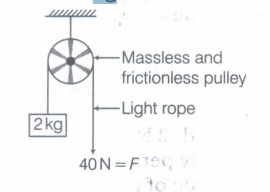
For the given pulley block system, find the acceleration of 2 kg block.
10.
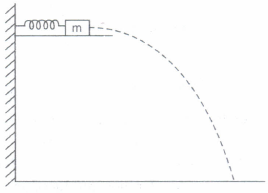
A small block of mass 'm' is pressed against a horizontal spring fixed at one end to compress the spring through 5.0 cm. When released the block moves horizontally till it leaves the spring. Where will it hit the ground at a distance 2m below the slab?
11.
Under what circumstances would your weight become zero?
12.
The escape speed of a projectile on the earth’s surface is 11.2 km s–1. A body is projected out with thrice this speed. What is the speed of the body far away from the earth? Ignore the presence of the sun and other planets.
13.
A pump on the ground floor of a building can pump up water to fill a tank of volume 30 m3 in 15 min. If the tank is 40 m above the ground, and the efficiency of the pump is 30%, how much electric power is consumed by the pump ?
14.
A man walks on a straight road from his home to a market 2.5 km away with a speed of 5 km/h. Finding the market closed, he instantly turns and walks back with a speed of 7.5 km/h. What is the
(i) magnitude of average velocity
(ii) average speed of the man, over the interval of time 0 to 40 min?
15.
(a) State the laws of limiting friction.
(b) Calculate the amount of work done in moving a body up a rough inclined plane. (The object is moved very slowly.)
16.
A projectile is fired at an angle θ with the horizontal.
(a) Show that its trajectory is a parabola.
(b) Obtain expression for:
(i) the maximum height attained.
(ii) the time of its flight and
(iii) the horizontal range.
(c) At what value of θ is the horizontal range maximum?
(d) Prove that, for a given velocity of projection, the horizontal range is same for θ and (90o - θ).
17.
Derive the three basic kinematic equations by calculus method.
18.
Star Heavier than Sun
A star 2.5 times mass of the sun and collapsed to a size of 12 km and rotates with a speed of 1.2 revolutions per second. (Extremely compact stars of this kind are known as neutron stars. Certain stellar object placed on its equator remain stuck to its surface due to gravity?
(mass of the sun = 2x1030 kg)
19.
A 70 kg boy stands 1 m away from a 60 kg boy. Calculate the force of gravitational attraction between them.
20.
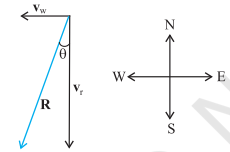
Rain is falling vertically with a speed of 35 m s–1. Winds starts blowing after sometime with a speed of 12 m s–1 in east to west direction. In which direction should a boy waiting at a bus stop hold his umbrella ?
21.
A body rolls down an inclined plane without slipping. The fraction of total energy associated with its rotation will be
(K2 + R2)
K2 + R2
k2 / (K2 + R2)
R2 /(K2 + R2)
22.
The gravitational potential at a distance r from the centre of the earth (r > R) is given by (consider, mass ofthe earth = Me, radius ofthe earth = R)
\(\frac{-G M_{e}}{R}\)
\(\frac{G M_{e}}{R}\)
\(\frac{-G M_{e}}{r}\)
\(\frac{+G M_{e}}{r}\)
23.
If the gravitation force on body 1 due to 2 is given by F12 and on body 2 due to 1 is given as F21, then
F12 = F 21
F12 - F21
\(\mathbf{F}_{12}=\frac{\mathbf{F}_{21}}{4}\)
None of the above
24.
A force \(\mathbf{F}=5 \hat{\mathbf{i}}+6 \hat{\mathbf{j}}-4 \hat{\mathbf{k}}\) acting on a body produces a displacement s \(=6 \hat{\mathbf{i}}+5 \hat{\mathbf{k}}\) .The work done by the force is
18 units
15 units
12 units
10 units
25.
If a car is moving in uniform circular motion, then what should be the value of velocity of a car, so that car will not moving away from the circle,_______.
\(v<\sqrt{\mu_{s} R g}\)
\(v \leq \sqrt{\mu_{s} R g}\)
\(v<\sqrt{\mu_{k} R g}\)
None of these
26.
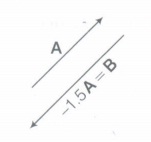
Choose the correct option regarding the given figure.
B = A
B = - A
I B I = I A I
\(|\mathbf{B}| \neq|\mathbf{A}|\)
27.
The x-t graph representing an object at rest is
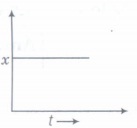
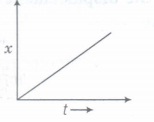
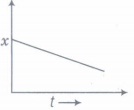
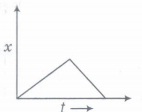
28.
The length and breadth of a rectangular sheet are 16.2 cm and 10.1 cm, respectively. The area of the sheet in appropriate significant figures and error is _____.
164 ± 3 cm2
163.62 ± 2.6 cm2
163.6 ± 2.6 cm2
163.62 ± 3 cm2
29.
The radius of gyration of a uniform rod of length L about an axis passing through its centre of mass is:
\(\frac { L }{ \sqrt { 12 } } \)
\(\frac { l }{ \sqrt { 2 } } \)
\(\frac { { L }^{ 2 } }{ 12 } \)
\(\frac { { L }^{ 2 } }{ \sqrt { 3 } } \)
30.
The pulley in the diagram is smooth and light. The masses of A and B are 5 kg and 2 kg. The acceleration of the system is _______.
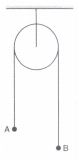
g
\({7\over3}g\)
\({3\over7}g\)
\({1\over7}g\)
31.
A body is moving along a circular path of radius R. It reaches diametrically opposite point in 't' second. The average velocity of the body is
\({{R}\over{t}}\)
\({{2R}\over{t}}\)
\({{\pi R}\over{t}}\)
zero
32.
Out of the following derived quantity is _____.
Time
Mass
Velocity
Length
33.

34.
Galileo was the first to recognise the fact that irrespective of their masses, bodies fall towards the earth with a constant acceleration. Later on gravity and its laws were given by Newton in his universal law of gravitation and motion of planets around the sun was explained by Kepler in his laws of planetary motion. Newton's universal law of gravitation and third law of motion have a similarity that two bodies exert equal and opposite force on each other.
(i) What does the word 'Gravity' mean?
(ii) Define acceleration due to gravity
(iii) State Newton's law of gravitation.
(iv) What would be the gravitational force on a point mass body situated insde the hollow spherical shell of uniform density?
(v) State Kepler's law of period for planetary motion.
(vi) Give relationship between angular momentum and areal velocity of a planet around sun.
(vii) At what distance force of gravitation between two bodies would be zero?
35.
Assertion : Soldiers are asked to break steps while crossing the bridge.
Reason : The frequency of marching may be equal to the natural frequency of bridge and may lead to resonance which can break the bridge.
Codes:
A) If both assertion and reason are true and the reason is the correct explanation of the assertion.
B) If both assertion and reason are true but reason is not the correct explanation of the assertion.
C) If assertion is true but reason is false.
D) If the assertion and reason both are false.
E) If assertion is false but reason is true.
36.
Assertion : When a vehicle takes a turn on the road, it travels along a nearly circular path.
Reason: In circular motion, velocity of vehicle remains same.
Codes:
A) If both assertion and reason are true and the reason is the correct explanation of the assertion.
B) If both assertion and reason are true but reason is not the correct explanation of the assertion.
C) If assertion is true but reason is false.
D) If the assertion and reason both are false.
E) If assertion is false but reason is true.
37.
Assertion : Power developed in circular motion is always zero.
Reason : Work done in case of circular motion is zero.
Codes:
A) If both assertion and reason are true and the reason is the correct explanation of the assertion. B) If both assertion and reason are true but reason is not the correct explanation of the assertion.
C) If assertion is true but reason is false.
D) If the assertion and reason both are false.
E) If assertion is false but reason is true.
38.
Assertion: If the displacement of the body is zero, the distance covered by it may not be zero.
Reason: Displacement is a vector quantity and distance is a scalar quantity.
Codes:
A) If both assertion and reason are true and the reason is the correct explanation of the assertion.
B) If both assertion and reason are true but reason is not the correct explanation of the assertion.
C) If assertion is true but reason is false.
D) If the assertion and reason both are false.
E) If assertion is false but reason is true.
1.
Jet planes use atmospheric oxygen for burning fuel but rockets carry their own fuel and oxygen and do not depend on atmospheric oxygen.
2.
When the external force is removed after the push, the mass gets detached when spring obtain its natural length and say, mass m rises h height from the pushed position.
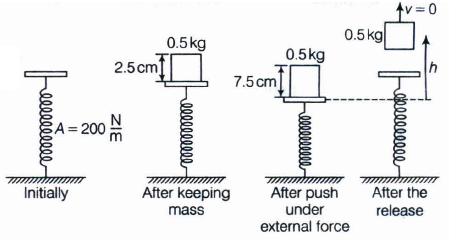
Loss in potential energy of spring = Gain in gravitational potential energy
\(\frac { 1 }{ 2 } k[{ x }^{ 2 }]\ =mgh\)
\(\frac { 1 }{ 2 } \times 200[{ 0.1 }^{ 2 }]\quad =0.5\times 10\times h\)
1 = 5 h \(\Rightarrow \) h = 0.2 m
3.
\(\left.\begin{array}{l}\text { K.E. of the } \\ \text { bob at its } \\ \text { mean position }\end{array}\right\}=\left\{\begin{array}{l}\text { P.E. at } \\ \text { its highest } \\ \text { position }\end{array}\right.\)
i.e., \(\frac{1}{2} m v^2=m g h\)
Velocity of the bob
\(v =\sqrt{2 g h} \)
\(=\sqrt{2 \times 9.8 \times 10} \)
\(=\sqrt{1.96} \)
\(v =1.4 \mathrm{~m} / \mathrm{s}\)
4.
\(R=41.3\ and \ \theta =24,1^{ o }\)
5.
-8 m/s2
6.
\(Impulse=force\times time=\left[ MLT^{ -2 } \right] \times \left[ T \right] =\left[ MLT^{ -1 } \right] \)
7.
(i) Law of orbit: The planets including earth, go around the sun in elliptical orbits.
(ii) Law of area: The line joining the sun and the planet sweeps equal area in equal intervals of time.
(iii) Law of periods: The square of time period of revolution is directly proportional to the cube of semi-major axis of the elliptical orbit.
8.
Angular momentum, L = r x p = r x mv = m (r x v)
\(\text { Now, } \mathbf{r} \times \mathbf{v}=\left|\begin{array}{ccc}
\hat{\mathbf{i}} & \hat{\mathbf{j}} & \hat{\mathbf{k}} \\
2 & 0 & -2 \\
-5 & 0 & 5
\end{array}\right|\)
\(=\hat{\mathrm{i}}[(0 \times 5)-(0 \times-2)]-\hat{\mathrm{j}}[(2 \times 5)-(-2 \times-5)]\) \(+\hat{\mathbf{k}}[2 \times 0-(0 \times-5)]\)
= 0
So, angular momentum of particle is zero
\(\text { and } \tau=\text { torque }=\mathbf{r} \times \mathbf{F}=\left|\begin{array}{ccc}
\hat{\mathbf{i}} & \hat{\mathbf{j}} & \hat{\mathbf{k}} \\
2 & 0 & -2 \\
0 & 4 & 0
\end{array}\right|=8 \hat{\mathbf{i}}+8 \hat{\mathbf{k}} \mathrm{N}-\mathrm{m}\)
9.
20m/s 2
10.
Here \(\frac { 1 }{ 2 } { kx }^{ 2 }=\frac { 1 }{ 2 } { mv }^{ 2 }\)
or \(v=\sqrt { \frac { k }{ m } { x }^{ 2 } } =\sqrt { \frac { 100 }{ 100 } \times \frac { 25\times { 10 }^{ -4 } }{ 10^{ -3 } } } { ms }^{ -1 }\)
\(=\sqrt { 25 } \) ms-1
Height = 2m = \(\sqrt { \frac { 2h }{ g } } =\sqrt { 0.4 } \)
The horizontal length covered = \(\sqrt { 0.4 } \times \sqrt { 25 } m\)
= 1 m.
11.
The weight will become zero under the following circumstances :
(i) during free fall
(ii) at the centre of the earth
(iii) in an artificial satellite
(iv) at a point where gravitational pull of earth is equal to the gravitational pull of the Moon.
12.
Let ve be the escape velocity and v be the velocity of the body outside the gravitational field of the earth.
According to law of conservation of energy,
Initial KE of the body = energy spent by the body in crossing the earth's gravitational field+kinetic energy left with the body once outside the earth's gravitational field,
i.e
\(\frac { 1 }{ 2 } m({ 3v }_{ e })^{ 2 }=\frac { 1 }{ 3 } { mv }_{ e }^{ 2 }+\frac { 1 }{ 2 } m{ v }^{ 2 }\)
or \(\frac { 9 }{ 2 } { mv }_{ e }^{ 2 }=\frac { 1 }{ 2 } { mv }_{ e }^{ 2 }+\frac { 1 }{ 2 } m{ v }^{ 2 }\quad or\quad { v }^{ 2 }={ 8 }_{ e }^{ 2 }\)
or \(v=\sqrt { { 8v }_{ e }^{ 2 } } =2\sqrt { 2 } { v }_{ e }\)
As \({ v }_{ e }=11.2\quad km/s\Rightarrow v=2\sqrt { 2 } \times 11.2km/s\)
or \(v=31.7km/s\)
13.
Here,volume of water lifted V = volume of tank = 30 m, time t = 15 min = 900s,
Height of tank, h = 40 m and efficiency of motor, n = 30%
= mgh = Vpgh
\(\therefore \text{Output power}=\frac { Vpgh }{ t } =\frac { 30\times { 10 }^{ 3 }\times 9.8\times 40 }{ 900 } \)
\(=1.307\times { 10 }^{ 4 }W\)
\(\text{ Input power }=\ \frac { Output\ power }{ n } =+\frac { 1.307\times{ 10 }^{ 4 } }{ \frac { 30 }{ 100 } }\)
\( =\frac { 1.307\times{ 10 }^{ 4 }\times100 }{ 30 } =4.357\times{ 10 }^{ 4 }\quad W\)
\( =43.54 \ kW\ [1kW=1000W]\)
14.
Time taken by man to go from his home to market
\({ t }_{ 1 }=\frac { Distance }{ Speed } =\frac { 2.5 }{ 5 } h\)
Time taken by man to go from mae=rket to his home
\({ t }_{ 2 }=\frac { 2.5 }{ 5 } =\frac { 1 }{ 3 } h\)
Total time taken,t1+ t2 \(=\frac { 1 }{ 2 } +\frac { 1 }{ 3 } =\frac { 5 }{ 6 } h=50min\)
Distance moved in 30 in (from home to market)
= 25 km
Distance moved in 10 min (from market to home) with speed
7.5 km/h \(=7.5\times \frac { 10 }{ 60 } =1.25km\)
So, displacement = 2.5-1.25 = 1.25km
Distance travelled = 2.5+1.25 = 3.75 km
(a) Average velocity \(=\frac { 1.25 }{ (40/60) } =1.875km/h\)
(b) Average speed \(=\frac { 3.75 }{ (40/60) } =5.625km/h\)
15.
(a) laws of limiting friction.
1.The magnitude of the force of limiting friction (F) between any two bodies in constant is directly proportional to the normal reaction (R) between them, i.e., F ∝ R.
2. The direction of limiting friction is always opposite to the direction of motion.
3. The force of limiting friction is independent of the apparent area of contact; so long as normal reaction between the two bodies in contact remains the same.
4. The limiting friction depends on the nature of material of the surfaces in contact (i.e. force of adhesion) and their roughness or smoothness.
(b) Suppose m is the mass of a body that has to be moved up a rough plane AB, inclined to the horizontal at an angle e. The various forces involved are:
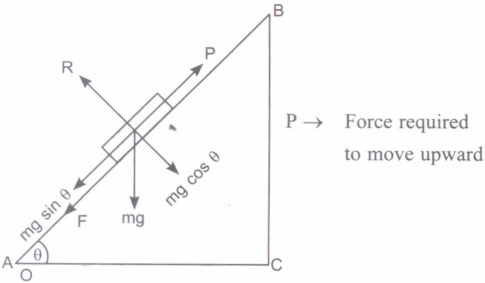
(i) Weight (mg) of the body, acting vertically downwards.
(ii) Normal reaction (R), acting perpendicular to the inclined plane AB.
(iii) Force of friction (F), acting down the inclined plane AB, as the body moves up the plane. In equilibrium,
R = mg cos θ ..............(i)
and P = mg sin θ + F ............(ii)
Where P is the force required to be applied in moving the body up the rough inclined plane AB. Under the action of this force, suppose the body moves through a distance S up the plane.
Work done = Force x Distance
W = P x S
W = (mg sin θ + F)S ............(iii)
W = (mg sin θ + μ)S
Where μ is the coefficient of friction between the two surfaces in contact.
W = (mg sin θ + μ mg cos θ)S [Using (i)]
W = mg(sin θ + μ cos θ)S
16.
When a body is projected in the air in any direction, then the body is called a projectile.
(a) Suppose a body is projected with velocity u at an angle θ with the horizontal, P(x, y) is any point on its trajectory at time t.
Horizontal component of velocity is unaffected by gravity, but the vertical component (u sin θ) changes due to gravity.
ஃ x = (u cos θ)t.
\(y=(u \sin \theta) t-\frac{1}{2} g t^{2}\)
\(=u \sin \theta \times \frac{x}{u \cos \theta}-\frac{1}{2} g\left(\frac{x}{u \cos \theta}\right)^{2}\)
\(y=x \tan \theta-\frac{g x^{2}}{2 u^{2} \cos ^{2} \theta}\) ............(i)
(b) The greatest vertical distance attained by the projectile above the horizontal plane from the point of projection is called maximum height.
Maximum height, LN = H
(i) At maximum height
v = 0
\(\therefore \quad v^{2}-u_{y}^{2}=-2 g H, \text { where }\)
uy = u sin θ
or (u sinθ )2 = 2 gH
\(\text { or } \quad H=\frac{u^{2} \sin ^{2} \theta}{2 g}\)
(ii) At maximum height
v = 0
ஃ 0 = u sin θ - gt
\(\text { or } \quad t=\frac{u \sin \theta}{g}\)
But time of flight
\(\mathrm{T}=2 t=\frac{2 u \sin \theta}{g}\)
(iii) When the body returns to the same horizontal level y = 0
\(\therefore \quad 0=x \tan \theta-\frac{g x^{2}}{2 u^{2} \cos ^{2} \theta} \quad[\text { From }(i)]\)
\(\text { or } x \tan \theta=\frac{g x^{2}}{2 u^{2} \cos ^{2} \theta}\)
\(\text { or } \quad x=\frac{2 u^{2} \sin \theta \cos \theta}{g}=\frac{u^{2} \sin 2 \theta}{g}\)
But coordinates of M are (R, 0). Putting x = R,
we have
\(\mathrm{R}=\frac{u^{2} \sin 2 \theta}{g}\)
(c) θ = 45°
(d) When an object is projected with velocity u making an angle θ with horizontal direction
\(R_{1}=\frac{u^{2} \sin 2 \theta}{g}\) ...........(i)
When an object is projected with u making an angle (90o - θ)
\(\mathrm{R}_{2}=\frac{u^{2} \sin 2\left(90^{\circ}-\theta\right)}{g}\)
\(=\frac{u^{2}}{g} \sin \left(180^{\circ}-2 \theta\right)\)
\(=\frac{u^{2}}{g} \sin 2 \theta\) ............(ii)
from (i) and (ii) R1 = R2
ஃ The horizontal range IS same for two complementary angles.
17.
(i) Velocity attained by a particle after time t:
Let dt: be the change in velocity of the particle in time dt. Therefore, the acceleration of the particle is given by
\(a=\frac{dv}{dt} \ or \ dv=a \ dt\)
By integrating both sides, we get
\(\int{dv}= \int{a dt}\)
or \(\int{dv}= a \int{ dt}\)
or v = at + k --- (i)
where k is constant of integration.
when t = 0, v = u
Putting these values in equation (i), we get
k = u
Now putting the value of k in equation (i), we get
v = u + at
(ii) Displacement of the particle after time t:
Let dx be the displacement of the particle in time dt. Therefore, the velocity of the particle is given by
\(v=\frac{dx}{dt}\ or \ dx=vdt\)
Since v =u + at
∴ dx=(u+at)dt
Integrating both sides, we get
\(\int{dx}=\int{(u+at)}dt\)
or \(\int{dx}=\int{u}dt+\int{at \ dt}\)
\(x= u\int{dt}+a \int{t\ dt}\) [∵ u and a are constants]
or \(x=ut+a \frac{t^{2}}{2}+k\)
where k is constant of proportionality
where t = 0, x = x0
∴ from equation (ii), we get
\(x=x_{0}+ut+\frac{1}{2}at^{2}\)
or \(x-x_{0}=ut+\frac{1}{2}at^{2}\)
since x-x0= S, displacement of the particle in the time interval t.
S = \(ut+\frac{1}{2}at^{2}\)
(iii) Velocity attained by a particle after travelling a distance S:
We know, \(v=\frac{dx}{dt}\)
Multiplying and dividing R.H.S. by dv, we get
\(v=\frac{dx}{dt}.\frac{dv}{dv}=\frac{dx}{dv}.\frac{dv}{dt}\)
As \(\frac{dv}{dt}=a (acceleration)\)
∴ v = a\(\frac { dx }{ dv } \) or v dv=a dx
Integrating both sides, we get \(\int { v\ dv=\int { a\ dx=a\int { dx } } } \)
or = \(\frac { v^{ 2 } }{ 2 } \)ax+k
when x = 0,v = u
Then,from eqn.(i),k = \(\frac { u^{ 2 } }{ 2 } \)
Putting the value of k in eqn. (i), we get
\(\frac { v^{ 2 } }{ 2 } \)-ax+\(\frac { u^{ 2 } }{ 2 } \)
or \(\frac { v^{ 2 } }{ 2 } -\frac { u^{ 2 } }{ 2 } =ax\)
or v2-u2= 2ax
x = s, then
v2-u2 = 2 aS.
18.
We are given mass of neutron star,
i.e \(M=2.5\times 2\times 10^{ 30 }kg\)
\(=5\times 10^{ 30 }kg\)
\(\\ Radius \ of \ star, \ R=12\ km=1.2\times 10^{ 4 }m\)
\(\\ Frequency\ of\ rotation,\ v=1.5\)
19.
\(2.7972\times { 10 }^{ -7 }N\)
20.
The velocity of the rain and the wind are represented by the vectors vr and vw in Fig. and are in the direction specified by the problem. Using the rule of vector addition, we see that the resultant of vr and vw is R as shown in the figure. The magnitude of R is
R = \(\sqrt { v_r^{ 2 }+{ v_w }^{ 2 } } =\sqrt { (35)^{ 2 }+{ (12) }^{ 2 } } \) ms-1 = 37 ms-1
The direction θ that R makes with the vertical is given by
\(\tan { \theta } =\frac { v_w }{ v_r } = \frac { 12 }{ 35 } \) = 0.343 or
\(\theta =\tan ^{ -1 }{ \left( 0.343 \right) } =19°\)
There, the boy should hold his umbrella in the vertical plane at an angle \(19°\) with vertical towards East.
21.
(c)
k2 / (K2 + R2)
22.
(c)
\(\frac{-G M_{e}}{r}\)
23.
(b)
F12 - F21
24.
(d)
10 units
25.
(b)
\(v \leq \sqrt{\mu_{s} R g}\)
26.
(d)
\(|\mathbf{B}| \neq|\mathbf{A}|\)
27.
(a)
28.
(a)
164 ± 3 cm2
29.
(a)
\(\frac { L }{ \sqrt { 12 } } \)
30.
(c)
\({3\over7}g\)
31.
(b)
\({{2R}\over{t}}\)
32.
(c)
Velocity
33.
34.
(i) Gravity is the force of attraction exerted by earth towards its centre on a body lying on or near the surface of earth. Weight of body is equal to gravitational pull.
(ii) It is the force of gravity acting on unit mass of the body placed on or near the surface of earth.
(iii) Every body in this universe attracts every other body with a force which is directly proportional to the product of their masses and is inversly proportional to the square of the distance between them
\(F=G \frac{m_{1} m_{2}}{r^{2}}\)
(iv) Zero, it is so because gravitational forces on the point mass due to various small regions ofthe spherical shell will be acting in various directions which cancel out each other.
(v) It states that the square of the time period of revolution of a planet around the sun is directly proportional to the cube of semi major axis of its elliptical orbit. i.e \(\tau^{2} \alpha R^{3}\)
(vi) \(\vec{L}=2 m \times \frac{d \overrightarrow{\mathrm{A}}}{d t}\)
(vii) Force of gravitation between two bodies would be zero if the separation between them becomes infinity.
35.
A) If both assertion and reason are true and the reason is the correct explanation of the assertion.
If the soldiers while crossing a suspended bridge march in steps, the frequency of marching steps of soldiers may match with the natural frequency of oscillations of the suspended bridge. In that situation resonance will take place, then the amplitude of oscillation of the suspended bridge will increase enormously, which may cause the collapsing of the bridge. To avoid situations the soldiers are advised to go out steps on suspended bridge.
36.
C) If assertion is true but reason is false.
In circular motion the frictional force acting towards the centre of the horizontal circular path provides the centripetal force and avoid overturning of vehicle. Due to the change in direction of motion, velocity changes in circular motion.
37.
E) If assertion is false but reason is true.
Work done and power developed is zero in uniform circular motion only.
38.
A) If both assertion and reason are true and the reason is the correct explanation of the assertion.

11th Standard CBSE Syllabus & Materials
11th Standard CBSE
CBSE 11th Business Studies Forms of Business Organisation Sample Question Papers Study Material - QB365 Set A
NEW11th Standard CBSE
CBSE 11th Business Studies Business, Trade and Commerce Sample Question Papers Study Material - QB365 Set A
NEW11th Standard CBSE
CBSE 11th Physics Waves Sample Question Papers Study Material - QB365 Set A
NEW11th Standard CBSE
CBSE 11th Physics Kinetic Theory Sample Question Papers Study Material - QB365 Set A



NCERT Books

Syllabus

Exam Pattern

Sample Question Papers

Previous year Question Papers

Important Notes

MCQ Practice test

NCERT Exemplers

Case study Questions

Image Based Questions

Passage based Questions

HOT Questions

Value Based Questions

Model Questions Papers
NCERT ( Book Back ) Questions

Assertion and Reason
Important Questions And Answers

CBSE 11th Standard CBSE Subjects
CBSE Standards







