
 100% FREE ACCESS
11th Standard CBSE Syllabus & Materials
11th Standard CBSE
CBSE 11th Economics PART-A - Presentation of Data - New Sample Question Papers Study Material - QB365 Set A
NEW11th Standard CBSE
CBSE 11th Economics PART-A - Organisation of Data - New Sample Question Papers Study Material - QB365 Set A
NEW11th Standard CBSE
CBSE 11th Economics PART-A - Collection of Data - New Sample Question Papers Study Material - QB365 Set A
NEW11th Standard CBSE
CBSE 11th Economics PART-A - Introduction to Economics and Statistics - New Sample Question Papers Study Material - QB365 Set A
NEW11th Standard CBSE
CBSE 11th Business Studies International Trade Sample Question Papers Study Material - QB365 Set A
NEW11th Standard CBSE
CBSE 11th Business Studies Evolution and Fundamentals of Business Sample Question Papers Study Material - QB365 Set A

Published on: 21/10/2025
Download CBSE Class 11th Standard CBSE Physics question papers, sample papers, important questions, and previous year solved papers in PDF format. Get free study materials, NCERT solutions, and exam preparation resources for Class 11th Standard CBSE Physics
Questions + Answers key
Take MCQ Physics Test
1.
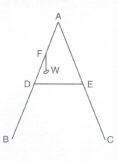
As shown in Fig. the two sides of a step ladder BA and CA are 1.6 m long and hinged at A. A rope DE, 0.5 m is tied halfway up. A weight 40 kg is suspended from a point F, 1.2 m from B along the ladder BA. Assuming the floor to be frictionless and neglecting the weight of the ladder, find the tension in the rope and forces exerted by the floor on the ladder. (Take g = 9.8 m s2)
(Hint: Consider the equilibrium of each side of the ladder separately)
2.
To maintain a rotor at a uniform angular speed of 200 rad s-1, an engine needs to transmit a torque of 180 N m. What is the power required by the engine ? (Note: uniform angular velocity in the absence of friction implies zero torque. In practice, applied torque is needed to counter frictional torque). Assume that the engine is 100% efficient.
3.
A disc of mass 5 kg and radius 50 em rolls on the ground at the rate of 10 ms-1 . Calculate the K.E. of the disc \(\left(\text { Given }: I=\frac{1}{2} \mathbf{M R}^{2}\right)\)
4.
Show that moment of a couple does not depend on the point about which you take the moments.
5.
A particle on a rotating disc have initial and final angular position are -2rad, +6rad. In which case, particle undergoes a negative displacement.
6.
Torques of equal magnitude are applied to a hollow cylinder and a solid sphere, both having the same mass and radius. The cylinder is free to rotate about its standard axis of symmetry, and the sphere is free to rotate about an axis passing through its centre. Which of the two will acquire a greater angular speed after a given time.
7.
Prove the Kepler's law, that the line joining the sun and the planet sweeps equal areas in equal time, using the angular momentum conservation with the planet.
8.
How will you distinguish between a hard boiled egg and a raw egg by spinning each on a table top?
9.
What are the units and dimensions of moment of inertia? Is it a vector quantity
10.
An automobile engine develop 100 kW when rotating at a speed of 1800 rpm. Find the torque produced.
11.
The acceleration of a solid cylinder rolling down an inclined plane of inclination 30° is
g/3
g/2
g
g/4
12.
If a r and at a represent radial and tangential acceleration, the motion of a particle will be circular is
ar = 0 and at = 0
ar = 0 and at ≠ 0
ar ≠ 0 and at = 0
ar ≠ 0 and at ≠ 0
13.
Total KE. of a sphere of mass M rolling with velocity V is:
\(\frac{7}{10} M V^{2}\)
\(\frac{5}{6} M V^{2}\)
\(\frac{7}{5} M V^{2}\)
\(\frac{10}{7} M V^{2}\)
14.
A loaded spring gun of mass M fires a 'shot' of mass m with a velocity \(\vartheta \) at an angle of elevation \(\theta\). The gun is initially at rest on a horizontal frictionless surface. After firing, the centre of mass of the gun-shot system
moves with a velocity \(\vartheta \) m / M
moves with velocity \(\frac { \vartheta m }{ M } \)cos \(\theta\) in the horizontal direction
remains at rest
moves with a velocity \(\frac { \vartheta (M-m) }{ (M+m) } \) in the horizontaI direction.
15.
Moment of inertia of a body about a given axis is the rotational inertia of the body about that axis. It is represented by 1= MK2, where M is mass of body and K is radius of gy ration of the body about that axis. it is a scalar quantity, which is measured in kg m2.
When a body rotates about a given axis and the axis of rotation also moves, then total K.E of body = K.E of translation + kinetic energy of rotation.
\(K=\frac{1}{2} m v^{2}+\frac{1}{2} I \omega^{2}\)
(i) Is the M.I of a body about a given axis is vector or scalar quantity?
(ii) On what factors does M.I of a body depend?
(iii) Determine the moment of inertia of circular disc and circular ring of same mass and radius about an axis perpendicular to plane.
(iv) A 40 kg flywheel in the form of a uniform circular disc of diameter 1 m is making 120 rpm. What is the M.I about a transverse axis through its centre?
(v) Determine kinetic of rotation of the flywheel in the above case.
(vi) Calculate radius of gyration of a cylindrical rod of mass m and length L about an axis of rotation perpendicular to its length and passing through its centre,
(vii) Determine the ratio of the radii of gyration of a circular disc about a tangential axis in the plane of the disc and of a circular ring of the same radius about a tangential axis in the plane of the ring.
16.
17.
Assertion: The velocity of a body at the bottom of an inclined plane of given height, is more when it slides down the plane, compared to when it is rolling down the same plane.
Reason: In rolling, down, a body acquires both, kinetic energy of translation and rotation.
Codes:
(a) Assertion is correct, reason is correct; reason is a correct explanation for assertion.
(b) Assertion is correct, reason is correct; reason is not a correct explanation for assertion
(c) Assertion is correct, reason is incorrect
(d) Assertion is incorrect, reason is correct.
1.
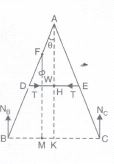
Here, W = 40 kg = 40\(\times\)9.8 N = 392 N, AB = AC = 1.6 m, BD
= \(\frac { 1 }{ 2 } \)\(\times\)1.6 m = 0.8 m
BF = 1.2 m and DE = 0.5 m
In \(\triangle\)ADE and \(\triangle\)ABC are similar triangles ,hence
BC = \(DE\times \frac { AB }{ AD } =\frac { 0.5\times 1.6 }{ 0.8 } \)=1.0 m
Now, considering equilibrium at point B, Σፒ = 0
∴ W\(\times\)(MB) = Nc\(\times\)(CB) ...(i)
But MB= \(\frac { KB\times BF }{ BA } =\frac { 0.5\times 1.2 }{ 1.6 } \) = 0.375 m
Substituting this value in (i), we get
∴ Nc=\(\frac { W\times (MB) }{ (CB) } =\frac { 392\times 0.375 }{ 1 } \) =147N
Again considering equilibrium at point C in similar manner, we have
∴ W\(\times\)(MB) = NB\(\times\)(CB)
NB=\(\frac { W\times (MB) }{ (BC) } \frac { W\times (BC-BM) }{ (BC) } \)
= \(\frac { 392\times (1-0.375) }{ 1 } \)= 245 N
Now, it can be easily shown that tension in the string T = NB - NC = 245- 147 = 98 N.
2.
Work done by torque in turing rotor by angle d \(\theta \) is
= \(\tau \) d \(\theta \)
So, power delivered by engine
P = \(\frac { Work\ done }{ Time\ taken } =\tau \frac { d\theta }{ dt } \)
[dt= time for turing by angle dθ]
or P = \(\tau \omega \)
So, power required = 180 x 200 = 36000 W
= 36 k W [ 1 k W = 1000 W]
3.
Here, mass of the disc, M = 5 kg, Radius of the disc R = 50 cm = 1/2 m.
Linear velocity of the disc, v = 10 ms-1.
As \(v=R \omega \quad \therefore 10=\frac{1}{2} \omega\)
or ω = 10 x 2 = 20 radian/sec.
Also, moment of inertia of disc about or axis through its centre.
\(\mathrm{I}=\frac{1}{2} \mathrm{MR}^{2}\)
K.E. of the disc
\(=\frac{1}{2} \mathrm{I} \omega^{2}+\frac{1}{2} \mathrm{M} v^{2}\)
\(=\frac{1}{2} \frac{\mathrm{MR}^{2}}{2} \omega^{2}+\frac{1}{2} \mathrm{M} v^{2}\)
\(=\frac{1}{4} \times 5 \times\left(\frac{1}{2}\right)^{2} \times(20)^{2}+\frac{1}{2} \times 5 \times(10)^{2}\)
= 375 J.
4.
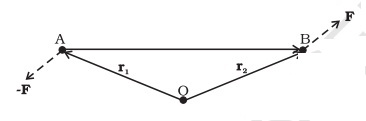
Consider a couple as shown in Fig acting on a rigid body. The forces F and -F act respectively at points B and A. These points have position vectors r1 and r2 with respect to origin O. Let us take the moments of the forces about the origin.
The moment of the couple = sum of the moments of the two forces making the couple
= r1 x (–F) + r2 x F
= r2 x F – r1 x F
= (r2 –r1 ) x F
But r1 + AB = r2 , and hence AB = r2 – r1 .
The moment of the couple, therefore, is AB x F
Clearly this is independent of the origin, the point about which we took the moments of the forces.
5.
Angular displacement is
\(\Delta \theta ={ \theta }_{ f }-{ \theta }_{ i }=6-(-2)=8rad\)
6.
Let M and R be the mass and radius of the sphere and hollow cylinder.
Let torque \(\tau \) of equal magnitude be applied on hollow cylinder and solid sphere. The angular accelerations produced in it are\({ \alpha }_{ 1 }\ and\ { \alpha }_{ 2 }\) , respectively.
\(\therefore \ \tau ={ I }_{ 1 }{ \alpha }_{ 1 }\ and\ \tau ={ I }_{ 2 }{ \alpha }_{ 2 }\)
Therfore, \({ I }_{ 1 }{ \alpha }_{ 1 } ={ I }_{ 2 }{ \alpha }_{ 2 }\)
or \(\frac { { \alpha }_{ 1 } }{ { \alpha }_{ 2 } } =\frac { { I }_{ 1 } }{ { I }_{ 2 } } =\frac { \frac { 2 }{ 5 } { MR }^{ 2 } }{ { MR }^{ 2 } } =\frac { 2 }{ 5 } \)
or \({ \alpha }_{ 2 }=\frac { 5 }{ 2 } { \alpha }_{ 1 }=2.5{ \alpha }_{ 1 }\)
Let after time t,\({ \omega }_{ 1 }{ and\omega }_{ 2 }\) be the angular speeds of the hollow cylinder and solid sphere, respectively.
\(\therefore { \omega }_{ 1 }={ \omega }_{ 0 }+{ \alpha }_{ 1 }t\)
\(\\ and\ \ { \omega }_{ 2 }={ \omega }_{ 0 }+{ \alpha }_{ 2 }t\)
From Eqs. (ii) and (iii), we get \({ \omega }_{ 2 }{ >\omega }_{ 1 }\)
Therefore, solid sphere will acquire a greater angular speed after a given time.
7.
When the planet moves along the line joining the sun and the planet it sweeps some area given by
\(\mathrm{A}=\frac{1}{2} r^{2} \theta\) where θ is the angular displacement.
\(\therefore \quad \frac{d \mathrm{~A}}{d t}=\frac{1}{2} r^{2} \frac{d \theta}{d t}=\frac{1}{2} r^{2} \omega\)
\(\frac{d \mathrm{~A}}{d t}=\frac{1}{2 m} m r^{2} \omega=\frac{\mathrm{L}}{2 m}\)
Since no torque acts, angular momentum Lis a constant, so \(\frac{d \mathrm{~A}}{d t}\) is a constant, i.e., the line Joining t e sun and the planet sweeps equal areas in equal intervals of time.
8.
To distinguish between a hard boiled egg and a raw egg, we spin each on a table top. The egg which spins at a slower rate shall be a raw egg. This is because in a raw egg, fiquid matter inside tries to get away from the axis of rotation. Therefore, its moment of inertia I increases. As τ = Iα = constant, therefore, a decreases, i.e., raw egg will spin with smaller angular acceleration. The reverse is true for a hard boiled egg which will rotate more or less like a rigid body.
9.
The units of moment of inertia are kg m2 and its dimensional formula is [M1L2T0].No, it is not a vector quantity.
10.
531 N-m.
11.
(a)
g/3
12.
(c)
ar ≠ 0 and at = 0
13.
(a)
\(\frac{7}{10} M V^{2}\)
14.
(c)
remains at rest
15.
(i) Moment of inertia of a body about a given axis is a scalar quantity.
(ii) Moment of inertia of a body depends on
(i) Mass of the body
(ii) Size and shape of the body
(iii) axis of rotation of the body.
(iii) \(I_{d i s c}=\frac{1}{2} M R^{2}, I_{r i n g}=M R^{2}\)
(iv) \(\mathrm{I}=\frac{1}{2} M R^{2}=\frac{1}{2} \times 40\left(\frac{1}{2}\right)^{2}=5 \mathrm{~kg} \mathrm{~m}^{2}\)
(v) K.E of rotation = \(\frac{1}{2} I \omega^{2}=\frac{1}{2} I(2 \pi n)^{2}\)
\(\frac{1}{2} \times 5\left(2 \pi \times \frac{120}{60}\right)^{2}=394.8 \mathrm{~J}\)
(vi) \(I=\frac{M L^{2}}{2}=M K^{2} \text { or } K=\frac{L}{2 \sqrt{3}}\)
(vii) \(I_{1}=M K_{1}^{2}=\frac{5}{4} M R^{2} \Rightarrow K_{1}=\sqrt{\frac{5}{4}} R\)
M.I of circular ring of same radius about a tangential axis in the plane of the ring.
\(I_{1}=M K_{2}^{2}=\frac{3}{2} M R^{2}\)
\(K_{2}=\sqrt{\frac{3}{2} R}\)
\(\therefore \quad \frac{K_{1}}{K_{2}}=\sqrt{\frac{5}{4} \times \frac{2}{3}}=\sqrt{\frac{5}{6}}\)
16.
17.
(a) Assertion is correct, reason is correct; reason is a correct explanation for assertion.

11th Standard CBSE Syllabus & Materials
11th Standard CBSE
CBSE 11th Business Studies Forms of Business Organisation Sample Question Papers Study Material - QB365 Set A
NEW11th Standard CBSE
CBSE 11th Business Studies Business, Trade and Commerce Sample Question Papers Study Material - QB365 Set A
NEW11th Standard CBSE
CBSE 11th Physics Waves Sample Question Papers Study Material - QB365 Set A
NEW11th Standard CBSE
CBSE 11th Physics Kinetic Theory Sample Question Papers Study Material - QB365 Set A



NCERT Books

Syllabus

Exam Pattern

Sample Question Papers

Previous year Question Papers

Important Notes

MCQ Practice test

NCERT Exemplers

Case study Questions

Image Based Questions

Passage based Questions

HOT Questions

Value Based Questions

Model Questions Papers
NCERT ( Book Back ) Questions

Assertion and Reason
Important Questions And Answers

CBSE 11th Standard CBSE Subjects
CBSE Standards







