
 100% FREE ACCESS
11th Standard CBSE Syllabus & Materials
11th Standard CBSE
CBSE 11th Economics PART-A - Presentation of Data - New Sample Question Papers Study Material - QB365 Set A
NEW11th Standard CBSE
CBSE 11th Economics PART-A - Organisation of Data - New Sample Question Papers Study Material - QB365 Set A
NEW11th Standard CBSE
CBSE 11th Economics PART-A - Collection of Data - New Sample Question Papers Study Material - QB365 Set A
NEW11th Standard CBSE
CBSE 11th Economics PART-A - Introduction to Economics and Statistics - New Sample Question Papers Study Material - QB365 Set A
NEW11th Standard CBSE
CBSE 11th Business Studies International Trade Sample Question Papers Study Material - QB365 Set A
NEW11th Standard CBSE
CBSE 11th Business Studies Evolution and Fundamentals of Business Sample Question Papers Study Material - QB365 Set A

Published on: 21/10/2025
Download CBSE Class 11th Standard CBSE Physics question papers, sample papers, important questions, and previous year solved papers in PDF format. Get free study materials, NCERT solutions, and exam preparation resources for Class 11th Standard CBSE Physics
Questions + Answers key
Take MCQ Physics Test
1.
. lf the acceleration due to gravity at earth is 'g' and mass of earth is 80 times that of moon and radius of earth is 4 times that of moon, the value of 'g' at the surface of moon will be
g
g/20
g/5
320/g
2.
The earth is an approximate sphere. If the interior contained matter which is not of the same density everywhere, then on the surface of the earth, the acceleration due to gravity
will be directed towards the centre but not the same everywhere.
will have the same value everywhere but not directed towards the centre.
will be same everywhere in magnitude directed towards the centre.
cannot be zero at any point.
3.
A constant force is acting perpendicular to the velocity of a particle. For this situation which one is correct?
Velocity is constant.
Acceleration is constant
Momentum will be constant
Particle will follow elliptical path.
4.
Angle that the vector \(\vec{A}=2 \hat{i}+2 \hat{j}\) makes with y-axis is
tan -1 (3/2)
tan-1(2/3)
sin-1 (2/3) .
cos -1(3/2)
5.
The length of seconds hand of a watch is 1 cm, The change in velocity of its tip in 15 seconds in cm/s is
zero
\(\frac{x}{(30 \sqrt{2})}\)
\(\frac{\pi}{30}\)
\(\frac{2 \pi}{(30 \sqrt{2})}\)
6.
A particle moving with a uniform acceleration travels 24 metre and 64 metre in first two consecutive intervals of 4 seconds each. Its initial velocity is
1 m/s
2 m/s
5 m/s
10 m/s
7.
Pressure is defined as: ______.
Momentum per unit area
Momentum per unit area per unit time
Momentum per unit volume
Energy per unit volume
8.
In our solar system/the inter-planetary region has chunks of matter (much smaller in size compared to planets) called asteroids. They
will not move around the sun, since they have very small masses compared to the sun
will move in an irregular way because of their small masses and will drift away into outer space
will move around the sun in closed orbits but not obey Kepler's laws
will move in orbits like planets and obey Kepler's laws
9.
A point mass m is placed at the centre of the square ABCD of side a units as shown below.
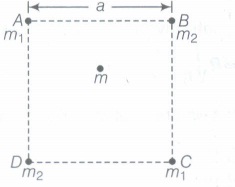
The resultant gravitational force on mass m due to masses m1 and m2 plant on the vertices of square is
\(\frac{G m_{1} m_{2}}{(a \sqrt{2})^{2}}\)
\(\frac{2 G m\left(m_{1}+m_{2}\right)}{a^{2}}\)
zero
\(\frac{G m\left(m_{1}+m_{2}\right)}{(a \sqrt{2})^{2}}\)
10.
Two cars A and B move along a concentric circular path of radius rA and rB with velocities vA and vB maintaining constant distance, the \(\frac{v_{A}}{v_{B}}\) is equal to
\(\frac{r_{B}}{r_{A}}\)
\(\frac{r_{A}}{r_{B}}\)
\(\frac{r_{A}^{2}}{r_{B}^{2}}\)
\(\frac{r_{B}^{2}}{r_{A}^{2}}\)
11.
The quantities Ax and Ay are called x and y components of the vector A. Note that Ax is itself not a vector, but Ax \(\hat{\mathbf{i}}\) is a vector, and so is Ay\(\hat{\mathbf{j}}\). Using simple trigonometry, we can express Ax and Ay in terms of the magnitude of A and the angle it makes with the x-axis
Ax = A cos\(\theta\)
Ay = A sin\(\theta\)
Choose the correct figure on the basis of given description.
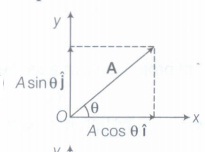
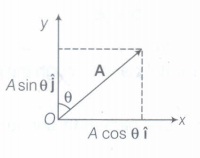
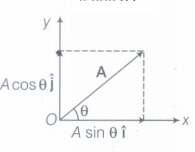
None of these
12.
A man standing on a road has to hold his umbrella at 30° with the vertical to keep the rain away. He throws the umbrella and starts running at 10 kmh -1. He finds that raindrops are hitting his head vertically. The actual speed of raindrops is
20 kmh -1
\(10 \sqrt{3} \mathrm{kmh}^{-1}\)
\(20 \sqrt{3} \mathrm{kmh}^{-1}\)
10 kmh -1
13.
The coordinates of object with respect to a frame of reference at t = 0 are (-1,0, 3). 1ft = 5 s, its coordinates are (-1, 0, 4), then the object is in
motion along z-axis
motion along x-axis
motion along y-axis
rest position between t = 0 sand t = 5 s
14.
Among the given following system of unit which is not based on unit of mass, length and time?
CGS
FPS
MKS
SI
15.
Which one of the following physical quantities is not a fundamental quantity?
Luminous intensity
Thermodynamic temperature
Electric current
Work
16.
The density of a material in CGS system is 10 g cm-3 . If unit of length becomes 10 cm and unit of mass becomes 100 g, the new value of density will be _____.
10 units
100 units
1000 units
1 unit
17.
Given, force \(=\frac{\alpha}{\text { Density }+\beta^{3}}\) What are the dimensions of \(\alpha ,\beta\) _____.
\(\left[\mathrm{ML}^{2} \mathrm{~T}^{-2}\right],\left[\mathrm{ML}^{-1 / 3}\right]\)
\(\left[M^{2} L^{4} T^{-2}\right],\left[M^{1 / 3} L^{-1}\right]\)
\(\left[\mathrm{M}^{2} \mathrm{~L}^{-2} \mathrm{~T}^{-2}\right],\left[\mathrm{M}^{1 / 3} \mathrm{~L}^{-1}\right]\)
\(\left[\mathrm{M}^{2} \mathrm{~L}^{-2} \mathrm{~T}^{-2}\right],\left[\mathrm{ML}^{-2}\right]\)
18.
Which of the following sets have different dimensions?
Dipole moment, Electric field and Electric flux
Pressure, Young's modulus, Stress
Heat, Work, Energy
Emf, Potential difference and potential.
19.
The mean length of an object is 5 cm. Which of the following measurements is most accurate?
4.9 cm
4.805 cm
5.25 cm
5.4 cm
20.
The ratio of the volume of the atom to the volume of the nucleus is of the order of _____.
1015
1025
1020
1010
21.
The damping force on an oscillator is directly proportional to the velocity. The unit of the constant of proportionality is _____.
Kg ms-1
kg ms -2
kg s-1
kg s
22.
In case of a moving body
displacement > distance
displacement < distance
displacement ≥ distance
displacement ≤ distance
23.
The area under the velocity time graph between any two instants t = t1 and t = t2 gives the distance covered in a time \(\delta \) t = t2 - t1.
only if the particle moves with a uniform acceleration
only if the particle moves with a uniform velocity.
only if the particle moves with an acceleration increasing at a uniform rate.
in all cases irrespective of whether the motion is one of uniform velocity, or of uniform acceleration or of variable acceleration
24.
The displacement x of a particle varies with time according to the relation x=\(\frac { a }{ b } \)(1-e-bt). Then
At t =\(\frac { 1 }{ b } \) , the displacement of the particle is nearly (2/3) (a/b).
The particle cannot reach a point at a distance x from its starting position if x> a/ b.
The velocity and acceleration of the particle at t = 0 are a and - ab respectively.
The particle will come back to its starting point as t ⇾∞.
25.
Two planets have same density but different radii.The acceleration due to gravity would be
same on both the planets
greater on the smaller planet
greater on the larger planet
dependent of the distance of planet from sun
26.
A spaceship moving through the earth's atmosphere is likely to catch fire.This is due to
surface tension of air
viscosity of air
high temperature of the upper atmosphere
greater portion of O2 in atmosphere is at higher height
27.
Mass of Mars is 1/9 and radius 1/2 that of the earth. A body Weights 5.4kg wt on the surface of the earth, its Weight on the surface of the mars will be (in kg. wt)
5.4
2.4
1.2
12
24
28.
The dimensional formula for gravitational constant G is
ML3T-2
M-1L-3T2
M-1L-3T-2
M-1L-3T2
M-1L3T2
29.
A car travels from A to B at a speed 'v' and comes back to A at a speed 60 kmph. If the average speed of the car is 48 kmph. 'v' is:
40 kmph
50 kmph
45 kmph
None
30.
A student goes from his house to his friend's house with speed v1. Finding the door of his friend's house closed, returns back to his own house with the speed v2. Then the average speed of the student is:
(v1+v2)2
\(\sqrt{{v}_{1}}{v}_{2}\)
2v1v2/v1+v2
v1v2
31.
In the above problem, the average velocity of the car is;
48 Kmph
50 Kmph
55 Kmph
Zero
None
32.
A vehicle travels a distance in 20 minutes in such a way that in first 10 minutes the speed is 40 Kmph and in last 10 minutes, the speed is 60 Kmph. The average speed of the vehicle is: ______.
48 Kmph
50 Kmph
55 Kmph
60 Kmph
None
33.
If the range of a gun Which fires of a shell with velocity V is R, then the angle of elevation of the gun is:
cos-1(V2/gR)
1/2(gR/V2)
1/2sin-1(gR/V2)
1/2V2/gR
34.
Two perpendicular forces of 8N and 6N can produce the effect of a single force equal to
5N
6N
8N
10N
35.
If n is the numerical value and u is the unit of physical quantity \(\rho\), then _____.
\(\rho\) = mu
\(\rho\) = mu
\(\rho\) = mu
\(\rho\) = mu
1.
(c)
g/5
2.
(d)
cannot be zero at any point.
3.
(b)
Acceleration is constant
4.
(b)
tan-1(2/3)
5.
6.
(a)
1 m/s
7.
(b)
Momentum per unit area per unit time
8.
(d)
will move in orbits like planets and obey Kepler's laws
9.
(c)
zero
10.
(b)
\(\frac{r_{A}}{r_{B}}\)
11.
(a)
12.
(a)
20 kmh -1
13.
(a)
motion along z-axis
14.
(d)
SI
15.
(d)
Work
16.
(b)
100 units
17.
(c)
\(\left[\mathrm{M}^{2} \mathrm{~L}^{-2} \mathrm{~T}^{-2}\right],\left[\mathrm{M}^{1 / 3} \mathrm{~L}^{-1}\right]\)
18.
(a)
Dipole moment, Electric field and Electric flux
19.
(a)
4.9 cm
20.
(a)
1015
21.
(c)
kg s-1
22.
(d)
displacement ≤ distance
23.
(d)
in all cases irrespective of whether the motion is one of uniform velocity, or of uniform acceleration or of variable acceleration
24.
(a)
At t =\(\frac { 1 }{ b } \) , the displacement of the particle is nearly (2/3) (a/b).
25.
(c)
greater on the larger planet
26.
(b)
viscosity of air
27.
(b)
2.4
28.
(c)
M-1L-3T-2
29.
(a)
40 kmph
30.
(c)
2v1v2/v1+v2
31.
(d)
Zero
32.
(b)
50 Kmph
33.
(c)
1/2sin-1(gR/V2)
34.
(d)
10N
35.
(d)
\(\rho\) = mu

11th Standard CBSE Syllabus & Materials
11th Standard CBSE
CBSE 11th Business Studies Forms of Business Organisation Sample Question Papers Study Material - QB365 Set A
NEW11th Standard CBSE
CBSE 11th Business Studies Business, Trade and Commerce Sample Question Papers Study Material - QB365 Set A
NEW11th Standard CBSE
CBSE 11th Physics Waves Sample Question Papers Study Material - QB365 Set A
NEW11th Standard CBSE
CBSE 11th Physics Kinetic Theory Sample Question Papers Study Material - QB365 Set A



NCERT Books

Syllabus

Exam Pattern

Sample Question Papers

Previous year Question Papers

Important Notes

MCQ Practice test

NCERT Exemplers

Case study Questions

Image Based Questions

Passage based Questions

HOT Questions

Value Based Questions

Model Questions Papers
NCERT ( Book Back ) Questions

Assertion and Reason
Important Questions And Answers

CBSE 11th Standard CBSE Subjects
CBSE Standards







