
 100% FREE ACCESS
11th Standard CBSE Syllabus & Materials
11th Standard CBSE
CBSE 11th Economics PART-A - Presentation of Data - New Sample Question Papers Study Material - QB365 Set A
NEW11th Standard CBSE
CBSE 11th Economics PART-A - Organisation of Data - New Sample Question Papers Study Material - QB365 Set A
NEW11th Standard CBSE
CBSE 11th Economics PART-A - Collection of Data - New Sample Question Papers Study Material - QB365 Set A
NEW11th Standard CBSE
CBSE 11th Economics PART-A - Introduction to Economics and Statistics - New Sample Question Papers Study Material - QB365 Set A
NEW11th Standard CBSE
CBSE 11th Business Studies International Trade Sample Question Papers Study Material - QB365 Set A
NEW11th Standard CBSE
CBSE 11th Business Studies Evolution and Fundamentals of Business Sample Question Papers Study Material - QB365 Set A

Published on: 21/10/2025
Download CBSE Class 11th Standard CBSE Physics question papers, sample papers, important questions, and previous year solved papers in PDF format. Get free study materials, NCERT solutions, and exam preparation resources for Class 11th Standard CBSE Physics
Questions + Answers key
Take MCQ Physics Test
1.
Discuss the variation of g with depth. Derive an expression for it. What is the value of g at the centre of earth?
2.
Define escape speed. Show that its value on the surface is \(v_{e}=\sqrt{2 g R}\).R = Radius of planet (Earth)
3.
Prove the following relations by calculus method:
(i) s = ut + 1/2at2
(ii) v2 - u 2 = 2as
4.
Define period of revolution.Derive an expression of the period of revolution or time period of satellite.
5.
Calculation of Instantaneous Acceleration
The velocity of a particle is given by v = 2t2 - 3t + 10 m/s.Find the instantaneous acceleration at t = 5s
6.
Check whether the given equation is dimensionally correct \(\frac { 1 }{ 2 } mv^{ 2 }=mgh\)
7.
State the number of significant figures in the following :
(a) 0.007 m2.
(b) 2.64 × 1024 kg
(c) 0.2370 g/cm3
(d) 6.320 J
(e) 6.032 N/m2.
(f) 0.0006032 m2.
8.
A physical quantity x is calculated from the relation \(x=\frac { { a }^{ 3 }{ b }^{ 3 } }{ c\sqrt { d } } \). If percentage error in a, b, c, d are 2%, 1%, 3% and 4%, respectively. What is percentage error in x?
9.
What is the acceleration due to gravity at the bottom of a sea 30 km deep taking radius of the earth as 6.3 x 10⁶ km?
10.
State Kepler's laws of planetary motion and deduce Newton's Law of gravitation from them.
11.
A car moving at a speed of 10 m/s is accelerated at the rate of 2 m/s2. Find out the velocity after 6 sec.
12.
Write two important points to distinguish displacement from distance.
13.
Find the dimensional formulae of
(i) Kinetic energy and
(ii) pressure
14.
The density of air is 1.293 kg/m3. Express it in CGS units.
15.
A car starting from rest, accelerates uniformly with 5 m/s2 for sometime and then decelerates to come to rest with 3 m/s2. Find the maximum velocity attained during the motion and the distance covered in a total time of 6 seconds of the journey.
16.
Derive the three basic kinematic equations by calculus method.
17.
State Kepler's laws of planetary motion.
What would be the speed of rotation of the earth in order that a body on the equator has no weight?
Determine the apparent weights of the bodies situated at a latitude of 60° and at the poles. The radius of the earth = 6400 km and g = 9.8 ms-1.
18.
A 70 kg boy stands 1 m away from a 60 kg boy. Calculate the force of gravitational attraction between them.
19.
The frequency\('\nu '\)of vibration of stretched string depends upon
(i) its length l,
(ii) its mass per unit length 'm' and
(iii) the tension T in the string
Obtain dimensionally an expression for frequency \(\nu \)
20.
Dimension of Gravitational Constant
Find out the dimensions of universal gravitational constant used in Newton's law of gravitation
21.
Measure of two quantities along with the precision of respective measuring instrument is A = 2.5 m/s ± 0.5 m/s, B = 0.10 s ± 0.01 s. The value of AB will be ______.
(0.25 ± 0.08) m
(0.25 ± 0.5) m
(0.25 ± 0.05) m
(0.25 ± 0.135) m
22.
The units of electrical permittivity are: ______.
N-1m-2C2
Nm-2C2
C2/Nm2
n/Cm2
23.
The velocity v of a particle is given in terms of time t is \(v=a t+\frac{b}{t+c}\) The dimensions of a, b, c are _____.
L 2 ; TLT-2
LT2 ; LT; L
lT-2 ; L; T
L; LT; T 2
24.
If a particle is fired vertically upwards from the surface of earth and reaches a height of 6400 km, the initial velocity of the particle is (assume R = 6400 km and g = 10 ms-2)
4 km/ sec
2 km/ sec
8 km/ sec
16 km/ sec
25.
The acceleration due to gravity on a planet is 1.96 ms2. If it is safe to jump from a height of 3m on the earth, the corresponding height the planet will be
3m
6m
9m
15m
1.5m
26.
The mass of the earth is 9 times that Of Mars and the radius of the earth is twice that of Mars. If the escape velocity of the earth is 12km/sec; the escape velocity on Mars is
√2 kms-1
342kms-1
4√2 kms-1
6 kms-1
12 kms-1
27.
If the distance between two masses is doubled, the gravitational attraction between them
is doubled
becomes four times
is reduced to a quarter
reduced to half
28.
A car is moving towards North ar 30kmph and another car is moving towards east a 40kmph. Their relative velocity is
70kmph
10kmph
50kmph
zero
29.
A student goes from his house to his friend's house with speed v1. Finding the door of his friend's house closed, returns back to his own house with the speed v2. Then the average speed of the student is:
(v1+v2)2
\(\sqrt{{v}_{1}}{v}_{2}\)
2v1v2/v1+v2
v1v2
30.
A car goes from the station X to the station Y at a speed of 40 Kmph and returns to X at a speed of 60 Kmph. The average speed of the car during the entire journey is ______.
48 Kmph
50 Kmph
55 Kmph
Zero
None
31.
A body travels a circular path. The ratio of the distance to displacement of the particle during half of a revolution is: ______.
\(\pi:2\)
\(\pi:1\)
\(2:\pi\)
\(1:\pi\)
None
32.
Which of the following systems of unit is not based on units of mass, length and time alone.
SI
FPS
CGS
MKS
33.
Assertion: The speed of a body can be negative.
Reason: If the body is moving in the opposite direction of positive motion, then its speed is negative.
Codes:
A) If both assertion and reason are true and the reason is the correct explanation of the assertion.
B) If both assertion and reason are true but reason is not the correct explanation of the assertion.
C) If assertion is true but reason is false.
D) If the assertion and reason both are false.
E) If assertion is false but reason is true.
34.
Assertion: L/R and CR both have same dimensions.
Reason: L/R and CR both have dimension of time.
Codes:
A) If both assertion and reason are true and the reason is the correct explanation of the assertion.
B) If both assertion and reason are true but reason is not the correct explanation of the assertion.
C) If assertion is true but reason is false.
D) If the assertion and reason both are false.
E) If assertion is false but reason is true.
35.
Assertion: Gravitational potential is maximum at infinity.
Reason: Gravitational potential is the amount of work done to shift a unit mass from infinity to a given point in gravitational attraction force field.
Codes:
(a) Assertion is correct, reason is correct; reason is a correct explanation for assertion.
(b) Assertion is correct, reason is correct; reason is not a correct explanation for assertion
(c) Assertion is correct, reason is incorrect
(d) Assertion is incorrect, reason is correct.
36.
Assertion: Light year and year, both measure time.
Reason: Because light year is the time that light takes to reach the earth from the sun.
Codes
A) If both assertion and reason are true and the reason is the correct explanation of the assertion.
B) If both assertion and reason are true but reason is not the correct explanation of the assertion.
C) If assertion is true but reason is false.
D) If the assertion and reason both are false.
E) If assertion is false but reason is true
37.
38.
1.
Let the planes earth be made of material of density p and is of radius R.
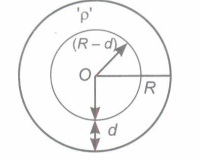
ஃ Mass of earth \(=M=\frac{4}{3} \pi R^{3} \rho\)
and acceleration due to gravity on earth = g
\(\therefore \ g=\frac{G M}{R^{2}}=\frac{G}{R^{2}} \times \frac{4}{3} \pi R^{3} \rho\)
\(\therefore \ g=G \cdot \frac{4}{3} \pi R \rho\) ............(i)
At a depth d, the gravitational force is due to the mass distributed in the sphere of radius (R - d).
ஃ The acceleration due to gravity at the depth d
\(g^{\prime}=\frac{G M^{\prime}}{(R-d)^{2}}=G \frac{4}{3} \frac{\pi(R-d)^{3} \rho}{(R-d)^{2}}\)
\(g^{\prime}=G \frac{4}{3} \pi(R-d)\) .............(ii)
Dividing g' by g, we get
\(\frac{g^{\prime}}{g}=\frac{R-d}{R}=1-\frac{d}{R}\)
\(\therefore \ g^{\prime}=g \frac{(R-d)}{R}=g\left(1-\frac{d}{R}\right)\)
ஃ g reduces as we move from surface to inwards and is zero at the centre.
2.
Escape Speed: It is defined as the minimum speed with which the body has to be projected vertically upwards from the surface of earth (or any other planet) so that it just crosses the gravitational field of earth (or of that planet) and never returns on its own.
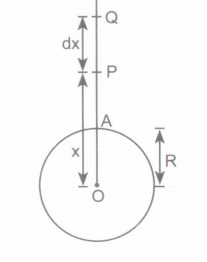
Let earth be a perfect sphere of mass M, radius R with centre at O. Let a body of mass m to be projected from a point A on the surface of earth, as shown in figure.
Join OA and produce it further.
P and Q are at a distance x and (x + dx) from the centre of the earth.
Gravitational force of attraction on the body at P is \(F=\frac{G M m}{x^{2}}\)
This much force has to be applied on the body to take the body in the upward direction. Work done in taking the body against gravitational attraction from P to Q is
\(d W=F d x=\frac{G M m}{x^{2}} d x\)
Total work done in taking the body against gravitational attraction from surface of earth (i.e. x = R) to a region beyond the gravitational field of earth (i.e. x = ∞) can be calculated by interchanging the above expression within the limits x = R to x = ∞. Thus, total work done is
\(W=\int_{R}^{\infty} \frac{G M m}{x^{2}} d x=G M m \int_{R}^{\infty} x^{-2} d x\)
\(=G M m\left[\frac{x^{-2+1}}{-2+1}\right]_{R}^{\infty}=-G M m\left[\frac{1}{x}\right]_{R}^{\infty}\)
\(=-G M m\left[\frac{1}{\infty}-\frac{1}{R}\right]=\frac{G M m}{R}\)
This work done is at the cost of kinetic energy given to the body at the surface of the earth.
K.E. of the body \(=\frac{1}{2} m v_{e}^{2}, v_{e}\) = escape speed of the body
\(\therefore \ \frac{1}{2} m v_{e}^{2}=\frac{G M m}{R}\)
or \(v_{e}^{2}=\frac{2 G M}{R} \text { or } v_{e}=\sqrt{\frac{2 G M}{R}}\)
or \(v_{e}=\sqrt{2 g R} \text { . }\)
3.
(i) Consider an object moving in a straight line with uniform acceleration' a', let at any instant of time 't', dx be the displacement of the objects.
\(\therefore\) instantaneous velocity \(v=\frac{d x}{d t} \text { or } d x=v \mathrm{dt}\)
dx = (u + at) dt (∵ v = u + at)
let x0 and x be the displacements of the object at time 'zero' and 't'.
\(\int_{x_{0}}^{x} d x=\int_{0}^{t}(u+a t) d t=u \int_{0}^{t} d t+a \int_{0}^{t} t d t\)
\((x)_{x_{0}}^{x}=u(t)_{0}^{t}+a\left(\frac{t^{2}}{2}\right)_{0}^{t}\)
If x = x0 = s (distance) covered by the object.
\(s=u t+\frac{1}{2} a t^{2}\)
(ii) Consider a particle moving in a straight line with initial velocity 'v' and acceleration 'a'
Then, \(a=\frac{d v}{d t}=\frac{d v}{d x} \times \frac{d x}{d t}=\frac{d v}{d x} \times v\)
adx = vdv
Integrating, \(\int_{x_{0}}^{x} a d x=\int_{u}^{V} v d v\)
\(\Rightarrow \quad a|x| x_{0}^{x}=\left.\frac{v^{2}}{2}\right|_{u} ^{V}\)
\(a\left(x-x_{0}\right)=\frac{v^{2}}{2}-\frac{u^{2}}{2}\)
v2 - u 2 = 2a(x -x0 )
v 2 - u 2 = 2as
4.
Period of a revolution of a satellite is the time taken by the satellite to complete one revolution round the earth. It is denoted by T.
\(\therefore T=\frac { Circumference\ of\ circular\ orbit }{ Orbital\ velocity } \)
or \(T=\frac { 2\pi r }{ { v }_{ o } } \)
or \(T=\frac { 2\pi (R+h) }{ { v }_{ o } } \quad \quad \quad \quad \quad [\therefore r=R+H]\)
or \(T=2\pi (R+h)\sqrt { \frac { R+h }{ GM } } \left[ \because \quad { v }_{ o }=\sqrt { \frac { GM }{ R+h } } \right] \)
or \(T=2\pi \sqrt { \frac { (R+h)^{ 2 } }{ GM } } \)
Also, \(T=2\pi \sqrt { \frac { (R+h)^{ 2 }(R+h) }{ GM } } \)
or \(T=2\pi \sqrt { \frac { (R+h)^{ 3 } }{ gR^{ 2 } } } \)
\(\because \quad \quad g{ R }^{ 2 }=GM\)
\(\therefore T=2\pi \sqrt { \frac { (R+h)^{ 2 } }{ gR^{ 2 } } } \)
5.
Given \(V={ 2t }^{ 2 }-3t-10m/s\)
\({ a }_{ in }=\frac { dv }{ dt } =4t-3m/{ s }^{ 2 }\)
If t = 5 \({ a }_{ in }=5\times 4-3=17m/{ s }^{ 2 }\)
6.
The dimensions of LHS
= [M][LT-2] = [ML2T-2]
The dimensions of RHS = [M][LT-1] = [ML2T-2]
The dimensions of LHS and RHS are same and hence the consistency is verified.
7.
The number of significant figures in the given quantities are given below.
(i) In 0.007, the number of significant figures is 1 because in a number less than 1, the zero's on the right of the decimal point but to the left of the first non-zero digit are not significant.
(ii) In 2.64 × 1024 kg, the number of significant figures is 3 because all non-zero digits are significant, power of 10 are not taken in significant figure.
(iii) In 0.2370, the number of significant figures is 4, as all non-zero digits left to decimal and trailing zero are significant.
(iv) In 6.320, the number of significant figures is 4, as all non-zero digits left to decimal and trailing zero are significant.
(v) In 6.032, the number of significant figures is 4, as all non-zero digits left to decimal and trailing zero are significant.
(vi) In 0.0006032, the number of significant figures is 4, because in a number less than 1, the zero's on the right of the decimal point but to the left of the first non-zero digit are not significant.
8.
As, \(x=\frac { { a }^{ 3 }{ b }^{ 3 } }{ c\sqrt { d } } \)
\(\therefore \quad\frac { \triangle x }{ x } =\pm \left[ 2\frac { \triangle a }{ a } +3\frac { \triangle b }{ b } +\frac { \triangle c }{ c } +\frac { 1 }{ 2 } \frac { \triangle d }{ d } \right] \)
Percentage error in x is given by
\(\frac { \triangle x }{ x } \times 100\) = \(\pm\) \([2\times 2\)% + \(3\times 1\)% +3% + \(\frac { 1 }{ 2 } \times 4\)%\(]\)
\(=\pm 12\)%
9.
\(g^{\prime}=g\left(1-\frac{d}{R}\right)\)
\(=9.8\left(1-\frac{30 \times 1000}{6.3 \times(1000)^{2}}\right)\)
\(=9.8\left(1-\frac{1}{210}\right)\)
\(=9.8\left(\frac{209}{210}\right)=9.75 \mathrm{~ms}^{-2}\)
10.
(i) The planets including earth, go around the sun in elliptical orbits.
(ii) The line joining the Sun and the planet sweeps equal areas in equal intervals of time.
(iii) The square of the time period of revolution is directly proportional to the cube of the semi-major axis of the elliptical orbit.
Since \(T^{2} \propto r^{3}\) we have,
\(\left(\frac{2 \pi r}{v}\right)^{2} \propto r^{3}\)
\(v^{2}=4 \pi^{2} \frac{r^{2}}{r^{3}}=\frac{4 \pi^{2}}{r}\)
\(\frac{m v^{2}}{r}=\frac{4 m \pi^{2}}{r^{2}}\)
The centripetal force \(\frac{m v^{2}}{r}\) is caused by M - earth on the planet of mass m.
Thus \(\mathrm{F} \propto \frac{\mathrm{Mm}}{r^{2}}\)
It is the Newton's Universal Law of Gravitation.
11.
Velocity after 6 seconds = 10 + 2 x 6 = 22 ms-1 .
12.
Length of actual path covered between the initial and final points is distance while the length of the shortest path between initial and final points is displacement. The magnitude of displacement can be both positive and negative while distance is always positive.
13.
\(KE=\frac { 1 }{ 2 } mv^{ 2 }\text{ i.e.,dimensional formula of KE is} [ML^{ 2 }T^{ -2 }]\)
\(Pressure=\frac { Force }{ Area } =\frac { [MLT^{ -2 }] }{ [L^{ 2 }] } =[ML^{ -1 }T^{ -2 }]\)
14.
0.001293 g/cc
15.
During acceleration,
vm = 0 + 5 x ta
\(\Rightarrow \quad t_{a}=\frac{v_{m}}{5}\)
\(v_{m}^{2}=0+2 \times 5 \times s_{a}\)
\(\Rightarrow \quad s_{a}=\frac{v_{m}^{2}}{10}\)
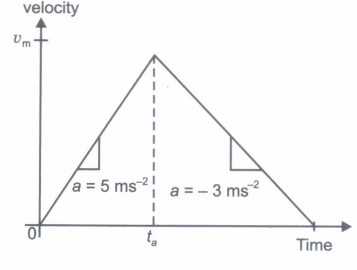
During deceleration,
\(0=v_{m}-3 t_{d} \Rightarrow t_{d}=\frac{v_{m}}{3}\)
\(0=v_{m}^{2}-2 \times 3 \times s_{d} \Rightarrow s_{d}=\frac{v_{m}^{2}}{6}\)
Total time = 6 = ta + td.
\(\therefore \quad v_{\mathrm{m}}=\frac{6 \times 5 \times 3}{8}=11.25 \mathrm{~ms}^{-1}\)
Total length covered \(=s_{a}+s_{d}=v_{m}^{2}\left(\frac{1}{10}+\frac{1}{6}\right)\)
\(=(11.25)^{2} \frac{16}{60}=33.75 \mathrm{~m}\)
16.
(i) Velocity attained by a particle after time t:
Let dt: be the change in velocity of the particle in time dt. Therefore, the acceleration of the particle is given by
\(a=\frac{dv}{dt} \ or \ dv=a \ dt\)
By integrating both sides, we get
\(\int{dv}= \int{a dt}\)
or \(\int{dv}= a \int{ dt}\)
or v = at + k --- (i)
where k is constant of integration.
when t = 0, v = u
Putting these values in equation (i), we get
k = u
Now putting the value of k in equation (i), we get
v = u + at
(ii) Displacement of the particle after time t:
Let dx be the displacement of the particle in time dt. Therefore, the velocity of the particle is given by
\(v=\frac{dx}{dt}\ or \ dx=vdt\)
Since v =u + at
∴ dx=(u+at)dt
Integrating both sides, we get
\(\int{dx}=\int{(u+at)}dt\)
or \(\int{dx}=\int{u}dt+\int{at \ dt}\)
\(x= u\int{dt}+a \int{t\ dt}\) [∵ u and a are constants]
or \(x=ut+a \frac{t^{2}}{2}+k\)
where k is constant of proportionality
where t = 0, x = x0
∴ from equation (ii), we get
\(x=x_{0}+ut+\frac{1}{2}at^{2}\)
or \(x-x_{0}=ut+\frac{1}{2}at^{2}\)
since x-x0= S, displacement of the particle in the time interval t.
S = \(ut+\frac{1}{2}at^{2}\)
(iii) Velocity attained by a particle after travelling a distance S:
We know, \(v=\frac{dx}{dt}\)
Multiplying and dividing R.H.S. by dv, we get
\(v=\frac{dx}{dt}.\frac{dv}{dv}=\frac{dx}{dv}.\frac{dv}{dt}\)
As \(\frac{dv}{dt}=a (acceleration)\)
∴ v = a\(\frac { dx }{ dv } \) or v dv=a dx
Integrating both sides, we get \(\int { v\ dv=\int { a\ dx=a\int { dx } } } \)
or = \(\frac { v^{ 2 } }{ 2 } \)ax+k
when x = 0,v = u
Then,from eqn.(i),k = \(\frac { u^{ 2 } }{ 2 } \)
Putting the value of k in eqn. (i), we get
\(\frac { v^{ 2 } }{ 2 } \)-ax+\(\frac { u^{ 2 } }{ 2 } \)
or \(\frac { v^{ 2 } }{ 2 } -\frac { u^{ 2 } }{ 2 } =ax\)
or v2-u2= 2ax
x = s, then
v2-u2 = 2 aS.
17.
For Kepler's laws of planetary motion, please see facts that matter.
The body will become weightless if the gravitational force mg on it is entirely used up in providing the centripetal acceleration for the rotation of the earth,
Then \(mg=\frac{m\theta^2}{R}=m\omega^2R\)
\(\omega^2=\frac{g}{R}=\frac{9.8}{6400\times10^3}\)
ω =1.237 x 10⁻³ rad s-1
If the earth rotates at this speed, the bodies on the equator will have no weight. At a latitude ф the apparent weight WA is given by
\(W_A=mg(1-\frac{\omega^2R}{g}cos^2\phi)\)
Here, however, g = ω2R
Therefore, WA= mg(1-cos2 ф )
When ф = 600,cos ф = \(\frac{1}{2}\)
\(W_A=mg(1-\frac{1}{4})=\frac{3}{4}\times true\ weight\)
At poles, \(\phi=\frac{\pi}{2}\)
WA mg = true weight
Thus, a body situated on the poles remains unaffected, whatever the speed of rotation of the earth.
18.
\(2.7972\times { 10 }^{ -7 }N\)
19.
Let the frequency of vibration of the string be given by
\(\nu =Kl^{ a }m^{ b }T^{ c }\) ......(i)
where K = a dimensionless constant
Dimensions of the various quantities are
\(\nu =\left[ T^{ -1 } \right] ,l=\left[ L \right] ,T=\left[ T \right] \)
Force =\(\left[ MLT^{ -2 } \right] \)
and \(m=\frac { mass }{ length } =\left[ ML^{ -1 } \right] \)
Substituting these dimensions in equation(i), we get
\(\left[ T^{ -1 } \right] ={ \left[ L \right] }^{ a }\left[ ML^{ -1 } \right] ^{ b }\left[ MLT^{ -2 } \right] ^{ c }\)
or \(\left[ M^{ 0 }L^{ 0 }T^{ -1 } \right] =\left[ { M }^{ b+c }{ L }^{ a-b+c }{ T }^{ -2c } \right] \)
Equating the dimensions of M,L and T, we get
b + c = 0, a - b + c=0 and - 2c = - 1
on solving,\(a=-1,b=-\frac { 1 }{ 2 } and\quad c=\frac { 1 }{ 2 } \)
\(\therefore \quad \left( \nu \right) =Kl^{ -1 }m^{ { -1 }/{ 2 } }T^{ { 1 }/{ 2 } }\quad or\quad \left( \nu \right) =\frac { K }{ l } \sqrt { \frac { T }{ m } } \)
20.
According to Newton's law gravitation, the force F, between two masses m1 and m2 separated by distance r can be given as
\(F=G\frac { { m }_{ 1 }{ m }_{ 2 } }{ { r }^{ 2 } } \)
\(\\ Where,\ G=universal\ gravitational\ constant\)
\(G=\frac { Fr^{ 2 } }{ { m }_{ 1 }{ m }_{ 2 } } \)
\(\\ G=\frac { Newton\times (metre)^{ 2 } }{ (kg)^{ 2 } } \)
\(\\ G=\frac { (mass\times acceleration)\times (metre)^{ 2 } }{ (mass)^{ 2 } } \)
\(\\ =\frac { 1 }{ mass } \left( \frac { Change\quad in\quad velocity }{ Time } \right) \times (Length)^{ 2 }\)
\(\\ G=\frac { (Length)^{ 2 } }{ Mass\times Time } \times \frac { Distance }{ Time } \)
\(\\ G=\frac { [L]^{ 2 } }{ [M]\times [T] } \times \frac { [T] }{ [T] } =[{ M }^{ -1 }{ l }^{ 3 }{ T }^{ -2 }]\)
21.
(a)
(0.25 ± 0.08) m
22.
(a)
N-1m-2C2
23.
(c)
lT-2 ; L; T
24.
(c)
8 km/ sec
25.
(d)
15m
26.
(c)
4√2 kms-1
27.
(c)
is reduced to a quarter
28.
(c)
50kmph
29.
(c)
2v1v2/v1+v2
30.
(a)
48 Kmph
31.
(a)
\(\pi:2\)
32.
(a)
SI
33.
D) If the assertion and reason both are false.
34.
A) If both assertion and reason are true and the reason is the correct explanation of the assertion.
Unit of quantity (L/R) is Henry/ohm. As Henry = ohm ´ sec, hence unit of L/R is sec i.e. [L/R] = [T]. Similarly, unit of product CR is farad ´ ohm or, \(\frac{\text { Coulomb }}{\text { Volt }} \times \frac{\text { Volt }}{A m p} \mid \text { or, } \frac{S e c \times A m p}{A m p} \mid \text {, }\) or, sec i.e. [CR] = [T] therefore [L/R] and [CR] both have the same dimension.
35.
(b) Assertion is correct, reason is correct; reason is not a correct explanation for assertion
36.
D) If the assertion and reason both are false.
Light year measures distance and year measures time. One light year is the distance traveled by light in one year.
37.
38.

11th Standard CBSE Syllabus & Materials
11th Standard CBSE
CBSE 11th Business Studies Forms of Business Organisation Sample Question Papers Study Material - QB365 Set A
NEW11th Standard CBSE
CBSE 11th Business Studies Business, Trade and Commerce Sample Question Papers Study Material - QB365 Set A
NEW11th Standard CBSE
CBSE 11th Physics Waves Sample Question Papers Study Material - QB365 Set A
NEW11th Standard CBSE
CBSE 11th Physics Kinetic Theory Sample Question Papers Study Material - QB365 Set A



NCERT Books

Syllabus

Exam Pattern

Sample Question Papers

Previous year Question Papers

Important Notes

MCQ Practice test

NCERT Exemplers

Case study Questions

Image Based Questions

Passage based Questions

HOT Questions

Value Based Questions

Model Questions Papers
NCERT ( Book Back ) Questions

Assertion and Reason
Important Questions And Answers

CBSE 11th Standard CBSE Subjects
CBSE Standards







