
 100% FREE ACCESS
11th Standard CBSE Syllabus & Materials
11th Standard CBSE
CBSE 11th Economics PART-A - Presentation of Data - New Sample Question Papers Study Material - QB365 Set A
NEW11th Standard CBSE
CBSE 11th Economics PART-A - Organisation of Data - New Sample Question Papers Study Material - QB365 Set A
NEW11th Standard CBSE
CBSE 11th Economics PART-A - Collection of Data - New Sample Question Papers Study Material - QB365 Set A
NEW11th Standard CBSE
CBSE 11th Economics PART-A - Introduction to Economics and Statistics - New Sample Question Papers Study Material - QB365 Set A
NEW11th Standard CBSE
CBSE 11th Business Studies International Trade Sample Question Papers Study Material - QB365 Set A
NEW11th Standard CBSE
CBSE 11th Business Studies Evolution and Fundamentals of Business Sample Question Papers Study Material - QB365 Set A

Published on: 21/10/2025
Download CBSE Class 11th Standard CBSE Physics question papers, sample papers, important questions, and previous year solved papers in PDF format. Get free study materials, NCERT solutions, and exam preparation resources for Class 11th Standard CBSE Physics
Questions + Answers key
Take MCQ Physics Test
1.
Equal masses (m each) are attached at the two ends of a string passing over two pulleys. Another mass is attached at the centre of the string. In order that there is no sag in the string, this mass should be
m
m/2
2 m
Zero
2.
A body is moving unidirectionally under the influence of a source of constant power. Its displacement in time t is proportional to
t1/2
t
t3/2
t2
3.
A body moves a distance 10 m along a straight line under a force 5 N. If the Work done is 25 J, the angle which the force makes with the direction of motion is
0o
30o
60o
90o
4.
KE of a body of mass 1 kg is 18 J. Its momentum is
9 kgm/s
16 kgm/s
6 kgm/s
None
5.
When the speed of a moving object is doubled
Its momentum become four times
Its acceleration is doubled
Its KE is increased to four times
Its potential is doubled
6.
A body whose momentum is constant must always
Be accelerated
Be retarded
Be moving in a circle
Have a constant velocity
7.
State and explain Work-Energy theorem.
8.
Prove that the total mechanical energy remains constant for a ball of mass m dropped from a tower of height h.
9.
Draw a graph showing variation of potential energy, kinetic energy and the total energy of a body freely falling on Earth from a height h.
10.
Two springs have force constants K1 and K2 (K1 > K2). On which spring is more work done when they are stretched by the same force?
11.
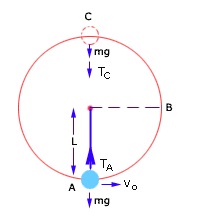
A bob of mass m is suspended by a light string of length L . It is imparted a horizontal velocity vo at the lowest point A such that it completes a semi-circular trajectory in the vertical plane with the string becoming slack only on reaching the topmost point, C. This is shown in Fig. Obtain an expression for (i) vo ; (ii) the speeds at points B and C; (iii) the ratio of the kinetic energies (KB /KC ) at B and C. Comment on the nature of the trajectory of the bob after it reaches the point C.
12.
Work is said to be done by a force acting on a body, provided the body is displaced actually in any direction except in a direction perpendicular to the direction of the force-mathematically, \(W=\bar{F} \cdot \bar{s}=F s \cos \theta\) whereas energy is the capacity of a body to do the work and Power is the rate at which the body do the work.
\(P=\frac{\mathrm{W}}{t}=\frac{\overline{\mathrm{F}} \cdot \bar{s}}{t}=\overline{\mathrm{F}} \cdot \bar{v}\)
Both, work and energy are measured in Joule while power is measured in watt.
(i) A box is pushed through 4.0 m across a floor offering 100 N resistance. Determine the work done by the applied force.
(ii) In the above question, determine the work done by the resistive force and by the gravity.
(iii) A truck draws a tractor of mass 1000 kg at a steady rate of 20 ms-1 on a level road. The tension in the coupling is 2000 N. What is the power spent on the tractor?
(iv) Determine the work done on the tractor in one minute?
13.
Assertion : A person working on a horizontal road with a load on his head does no work.
Reason : No work is said to be done, if directions of force and displacement of load are perpendicular to each other.
Codes:
A) If both assertion and reason are true and the reason is the correct explanation of the assertion.
B) If both assertion and reason are true but reason is not the correct explanation of the assertion.
C) If assertion is true but reason is false.
D) If the assertion and reason both are false.
E) If assertion is false but reason is true.
14.
Assertion: The work done in moving a body over a closed loop is zero for every force in nature.
Reason: Work done depends on nature of force.
Codes:
(a) Assertion is correct, reason is correct; reason is a correct explanation for assertion.
(b) Assertion is correct, reason is correct; reason is not a correct explanation for assertion
(c) Assertion is correct, reason is incorrect
(d) Assertion is incorrect, reason is correct.
15.
Assertion: A spring has potential energy, both when it is compressed or stretched.
Reason: In compressing or stretching, work is done on the spring against the restoring force.
Codes:
(a) Assertion is correct, reason is correct; reason is a correct explanation for assertion.
(b) Assertion is correct, reason is correct; reason is not a correct explanation for assertion
(c) Assertion is correct, reason is incorrect
(d) Assertion is incorrect, reason is correct.
1.
(d)
Zero
2.
(b)
t
3.
(c)
60o
4.
(c)
6 kgm/s
5.
(c)
Its KE is increased to four times
6.
(d)
Have a constant velocity
7.
Work done on a body is reflected as change in kinetic energy, according to Work-Energy theorem.
\(\mathrm{W}=\int \mathrm{F} d x=\int m \frac{d v}{d f} d x\)
\(=\int m v d v=\left|\frac{1}{2} m v^{2}\right|_{v i}^{v_{f}}\)
Work done \(=\frac{1}{2} m\left(v_{f}^{2}-v_{i}^{2}\right)\)
\(=\frac{1}{2} m v_{f}^{2}-\frac{1}{2} m v_{i}^{2}\)
Work done = Change in kinetic energy.
8.
At A
P.E. mgh K.E. = 0
Total energy = mgh
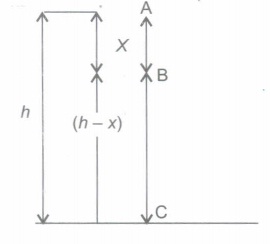
At B
\(\text { Velocity, },=\sqrt{2 g h}\)
\(\mathrm{K.E.}=\frac{1}{2} m v^{2}=\frac{1}{2} m \cdot 2 g x=m g x\)
P.E. = mg (h -x)
Total energy = mgh.
At C
\(\text { Velocity, },=\sqrt{2 g h}\)
\(\mathrm{K.E.}=\frac{1}{2} m v^{2}=\frac{1}{2} m \cdot 2 g h=m g h\)
P.E. = 0
ஃ total energy = mgh.
Total mechanical energy is therefore mgh at all states as a body is dropped.
9.
Graphs depicting variation of (i) gravitational potential energy (P.E.), (ii) kinetic energy (K.E.),and (iii) the total sum of potential and kinetic energies for a freely falling body are as shown in adjoining Fig. From the graphs, it is clear that:
(a) Gravitational potential energy decreases as the body falls downwards and is zero at the Earth.
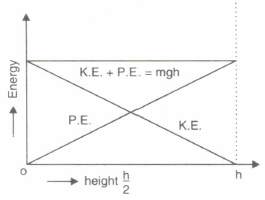
(b) Kinetic energy increases as the body falls downwards and is maximum when the body just strikes the ground.
(c) The sum of kinetic and potential energies remains constant at all points during its free fall.
10.
\({ K }_{ 1 }=\frac { F }{ { x }_{ 1 } } and\ { K }_{ 2 }=\frac { F }{ { x }_{ 2 } } \)
Since K1 > K2
\(\therefore\) x1 < x2
\({ W }_{ 1 }=\frac { 1 }{ 2 } { K }_{ 1 }{ x }_{ 1 }^{ 2 }\) and \({ W }_{ 2 }=\frac { 1 }{ 2 } { K }_{ 2 }{ x }_{ 2 }^{ 2 }\)
\(\frac { { W }_{ 1 } }{ { W }_{ 2 } } =\frac { \frac { 1 }{ 2 } { K }_{ 1 }{ x }_{ 1 }^{ 2 } }{ \frac { 1 }{ 2 } { K }_{ 2 }{ x }_{ 2 }^{ 2 } } =\frac { \left( \frac { F }{ { x }_{ 1 } } \right) \times { x }_{ 1 }^{ 2 } }{ \left( \frac { F }{ { x }_{ 2 } } \right) \times { x }_{ 2 }^{ 2 } } =\frac { { x }_{ 1 } }{ { x }_{ 2 } } \)
As x1 < x2
\(\therefore\) W1 < W2 or W2 > W1
11.
(i) There are two external forces on the bob : gravity and the tension (T ) in the string. The latter does no work since the displacement of the bob is always normal to the string. The potential energy of the bob is thus associated with the gravitational force only. The total mechanical energy E of the system is conserved. We take the potential energy of the system to be zero at the lowest point A. Thus, at A :
\(E=\frac{1}{2} m v_{0}^{2}\) ...(i)
\(T_{A}-m g=\frac{m w_{0}^{2}}{L}\) [Newton’s Second Law]
where TAis the tension in the string at A. At the highest point C, the string slackens, as the tension in the string (TC ) becomes zero.
Thus, at C
\(E=\frac{1}{2} m v_{c}^{2}+2 m g L\) .....(ii)
\(m g=\frac{m v_{c}^{2}}{L}\) [Newton’s Second Law] .....(iii)
where vC is the speed at C. From Eqs.(ii) and (iii)
\(E=\frac{5}{2} m g L\)
Equating this to the energy at A
\(\frac{5}{2} m g L=\frac{m}{2} v_{o}^{2}\)
or \(v_{o}=\sqrt{5 g L}\)
(ii) It is clear from Eq (iii)
\(v_{C}=\sqrt{g L}\)
At B, the energy is
\(E=\frac{1}{2} m v_{B}^{2}+m g L\)
Equating this to the energy at A and employing the result from (i), namely \(v_{o}^{2}=5 g L\)
\(\frac{1}{2} m v_{B}^{2}+m g L=\frac{1}{2} m w_{o}^{2}\)
\(=\frac{5}{2} m g L\)
\(\therefore v_{B}=\sqrt{3 g L}\)
(iii) The ratio of the kinetic energies at B and C is :
\(\frac{K_{B}}{K_{C}}=\frac{\frac{1}{2} m v_{B}^{2}}{\frac{1}{2} m v_{C}^{2}}=\frac{3}{1}\)
At point C, the string becomes slack and the velocity of the bob is horizontal and to the left. If the connecting string is cut at this instant, the bob will execute a projectile motion with horizontal projection akin to a rock kicked horizontally from the edge of a cliff. Otherwise the bob will continue on its circular path and complete the revolution.
12.
(i) W = Fs cos \(\theta\) = 100 x 4 cos 0° = 400 J
(ii) Resistive force opposes the applied force. Box moves at 180o to the resistive force.
Therefore W = Fs .cos 180 = -400 J. Since motion is along horizontal and gravity is along the vertical, therefore workdone by gravity is
W = Fs cos 90 = zero.
(iii) Force applied = tension in coupling = 2000 N
As P = Fv cos\(\theta\) = 2000 x 20 cos 0 o = 40000W = 40 kW
(iv) Work done = Power x time = 40 kW x 60 s = 2400 kJ
13.
A) If both assertion and reason are true and the reason is the correct explanation of the assertion.
The work done, \(W=\vec{F} \cdot \vec{s}=F s \cos \theta\), when a person walk on a horizontal road with load on his head then θ = 90∘. Hence W = Fscos90∘= 0 Thus no work is done by the person.
14.
(b) Assertion is correct, reason is correct; reason is not a correct explanation for assertion
In close loop, s = 0, and so W = Fs = 0.
15.
(a) Assertion is correct, reason is correct; reason is a correct explanation for assertion.

11th Standard CBSE Syllabus & Materials
11th Standard CBSE
CBSE 11th Business Studies Forms of Business Organisation Sample Question Papers Study Material - QB365 Set A
NEW11th Standard CBSE
CBSE 11th Business Studies Business, Trade and Commerce Sample Question Papers Study Material - QB365 Set A
NEW11th Standard CBSE
CBSE 11th Physics Waves Sample Question Papers Study Material - QB365 Set A
NEW11th Standard CBSE
CBSE 11th Physics Kinetic Theory Sample Question Papers Study Material - QB365 Set A



NCERT Books

Syllabus

Exam Pattern

Sample Question Papers

Previous year Question Papers

Important Notes

MCQ Practice test

NCERT Exemplers

Case study Questions

Image Based Questions

Passage based Questions

HOT Questions

Value Based Questions

Model Questions Papers
NCERT ( Book Back ) Questions

Assertion and Reason
Important Questions And Answers

CBSE 11th Standard CBSE Subjects
CBSE Standards







