
 100% FREE ACCESS
11th Standard Syllabus & Materials
11th Standard
TN 11th Tamil இயற்கை வேளாண்மை,சுற்றுச்சூழல் -செய்யுள் - மனோன்மணீயம் Important Questions And Answers Study Material - QB365 Set A
NEW11th Standard
TN 11th Tamil என்னுயிர் என்பேன் -துணைப்பாடம் - இசைத்தமிழர் இருவர் Important Questions And Answers Study Material - QB365 Set A
NEW11th Standard
TN 11th Tamil மொழி கலை -செய்யுள் - ஒவ்வொரு புல்லையும் Important Questions And Answers Study Material - QB365 Set A
NEW11th Standard
TN 11th Tamil பீடு பெற நில் - இலக்கணம் - பகுபத உறுப்புகள் Important Questions And Answers Study Material - QB365 Set A
NEW11th Standard
TN 11th Tamil பீடு பெற நில் - துணைப்பாடம் - வாடிவாசல் Important Questions And Answers Study Material - QB365 Set A
NEW11th Standard
TN 11th Tamil பீடு பெற நில் - செய்யுள் - குறுந்தொகை Important Questions And Answers Study Material - QB365 Set A

Published on: 19/09/2019
Work, Energy and Power
Download Tamil Nadu 11th Standard Physics question papers, model tests, one-mark questions, important questions, and public exam papers in PDF format. Free study materials and answer keys for TN State Board students.
Questions + Answers key
Take MCQ Physics Test1.
A light body and a heavy body have the same linear momentum. Which one has greater K.E?
2.
A variable force F = kx2 acts on a particle which is initially at rest. Calculate the work done by the force during the displacement of the particle from x = 0 m to x = 4 m. (Assume the constant k = 1 N m-2)
3.
Express a unit of electrical energy in terms of joule.
4.
Which physical quantities is / are conserved during elastic and inelastic collision?
5.
What are non-conservative forces?
6.
What is the work done by the force of tension in the string of simple pendulum?
7.
What is the work done by the person in holding 15 kg suitcase while waiting for a bus for 15 minutes?
8.
If energy is neither created nor destroyed, what happens to the so much energy spent against friction?
9.
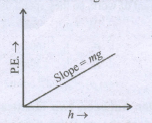
Draw a graph showing the variation of potential energy of an object thrown vertically upward by a boy with respect to its height.
10.
Why should the object be moved at constant velocity when we define potential energy?
11.
How can an object move with zero acceleration (constant velocity) when the external force is acting on the object?
12.
An object of mass m is projected from the ground with initial speed v0. Find the speed at height h.
13.
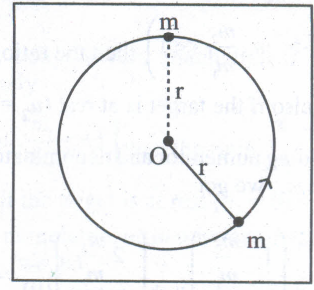
A bob of mass m is attached to one end of the rod of negligible mass and length r, the other end of which is pivoted freely at a fixed center O as shown in the figure. What initial speed must be given to the object to reach the top of the circle? (Hint: Use law of conservation of energy). Is this speed less or greater than speed obtained in the section 4.2.9?
14.
Define the following
a) Coefficient of restitution
15.
Write the differences between conservative and Non-conservative forces. Give two examples each.
1.
The lighter body has more K.E. as K.E. = \(\frac { { p }^{ 2 } }{ 2m } \) and for constant p, K.E.\(\propto \frac { 1 }{ m } \) .
2.
Work done, \(W-\int^{x_f}_{x_i}F(x)dx=k\int_0^4x^2 dx={64\over 3}Nm\)
3.
1 electrical unit = 1 kWh = 1\(\times\)(103 W)\(\times\)(3600 s)
1 electrical unit = 3600\(\times\)103 W s
1 electrical unit = 3.6\(\times\)106 J
1 kWh = 3.6\(\times\)106 J
4.
Linear momentum.
5.
A force is said to be non-conservative if the work done by or against the force in moving a body depends upon the path between the initial and final positions. This means that the value of work done is different in different paths.
6.
Tension in the string is always 90° to the displacement. So, work done by the tension is zero.
7.
Here, s=0
ஃ W = Fs cosθ = 0
8.
The energy is dissipated in the form of heat. The heat energy so produced is not available for work.
9.
As P.E. = mgh \(\Rightarrow\) P.E., \(\infty\) h. So the graph of P.E. verses height is a straight line as shown.
10.
(i) If the object does not move at constant velocity, then it will have different velocities at the initial and final locations.
(ii) According to work-kinetic energy theorem, the external force will impart some extra kinetic energy.
(iii) But we associate potential energy to the forces like gravitational force, spring force and coulomb force.
(iv) So the external agency should not impart any kinetic energy when the object is taken from initial to final location.
11.
(i) It is possible when there is another force which acts exactly opposite to the external applied force.
(ii) They both cancel each other and the resulting net force becomes zero, hence the object moves with zero acceleration.
12.
Since the gravitational force is conservative; the total energy is conserved throughout the motion.
| Initial | Final | |
|---|---|---|
| Kinetic energy | \(\frac { 1 }{ 2 } { mv }_{ 0 }^{ 2 }\) | \(\frac { 1 }{ 2 } { mv }^{ 2 }\) |
| Potential energy | 0 | mgh |
| Total energy | \(\frac { 1 }{ 2 } { mv }_{ 0 }^{ 2 }+0=\frac { 1 }{ 2 } { mv }_{ 0 }^{ 2 }\) | \(\frac { 1 }{ 2 } { mv }^{ 2 }+mgh\) |
Final values of potential energy, kinetic energy and total energy are measured at the height h.
By law of conservation of energy, the initial and final total energies are the same.
\(\frac { 1 }{ 2 } { mv }_{ 0 }^{ 2 }=\frac { 1 }{ 2 } { mv }^{ 2 }+mgh\)
\({ v }_{ 0 }^{ 2 }={ v }^{ 2 }+2gh\)
\(v=\sqrt { { v }_{ 0 }^{ 2 }-2gh } \)
13.
Mass of a bob = m
Length of the rod = r
From the law of conservation of energy,
\(\frac{1}{2} m v_{1}^{2} =2 m g r+\frac{1}{2} m v_{2}^{2}
\)
\(\therefore \frac{1}{2} m\left(v_{1}^{2}-v_{2}^{2}\right) =2 m g r
\)
\(\therefore v_{1}^{2}-v_{2}^{2} =4 g r
\)
\(\text { If } v_{2} =0 \text { then }
\)
\(v_{1}^{2} =4 g r
\)
\(\therefore v_{1} =\sqrt{4 g r} m s^{-1}\)
14.
(a) Coefficient of restitution
It is defined as the ratio of velocity of separation (relative velocity) after collision to the velocity of approach (relative velocity) before collision.
\(e=\frac{v_2-v_1}{u_1-u_2}\)
15.
| S.No. | Conservative forces | Non-Conservative forces |
| 1 | Work done is independent of the path | Work done depends upon the path |
| 2 | Work done in a round trip is zero | Work done in a round trip is not zero. |
| 3 | Total energy remains constant | Energy is dissipated as heat energy |
| 4 | Work done is completely recoverable | Work done is not completely recoverable |
| 5 | Force is the negative gradient of potential energy | No such relation exists |
| 6 | Examples: Elastic spring force, electrostatic force, magnetic force, gravitational force, etc. | Eg: Frictional forces, viscous force |

11th Standard Syllabus & Materials
11th Standard
TN 11th Tamil பீடு பெற நில் - செய்யுள் - காவடிச்சிந்து Important Questions And Answers Study Material - QB365 Set A
NEW11th Standard
TN 11th Tamil பீடு பெற நில் - உரைநடை - மலை இடப்பெயர்கள் : ஓர் ஆய்வு Important Questions And Answers Study Material - QB365 Set A
NEW11th Standard
TN 11th Tamil மாமழை போற்றுதும் - துணைப்பாடம் - யானை டாக்டர் Important Questions And Answers Study Material - QB365 Set A
NEW11th Standard
TN 11th Tamil மாமழை போற்றுதும் - செய்யுள் - ஐங்குறுநூறு Important Questions And Answers Study Material - QB365 Set A



Tamilnadu Stateboard 11th Standard Subjects

Maths

Commerce

Economics

Biology

Business Maths and Statistics

Accountancy

Computer Science
Physics

Chemistry
Maths
Biology
Economics
Physics
Chemistry

History
Business Maths and Statistics

Computer Science
Accountancy

Computer Applications
History
Computer Technology
Commerce
Computer Applications
Computer Technology

Tamil

English

French
Tamilnadu Stateboard Standards

