
 100% FREE ACCESS
11th Standard CBSE Syllabus & Materials
11th Standard CBSE
CBSE 11th Economics PART-A - Presentation of Data - New Sample Question Papers Study Material - QB365 Set A
NEW11th Standard CBSE
CBSE 11th Economics PART-A - Organisation of Data - New Sample Question Papers Study Material - QB365 Set A
NEW11th Standard CBSE
CBSE 11th Economics PART-A - Collection of Data - New Sample Question Papers Study Material - QB365 Set A
NEW11th Standard CBSE
CBSE 11th Economics PART-A - Introduction to Economics and Statistics - New Sample Question Papers Study Material - QB365 Set A
NEW11th Standard CBSE
CBSE 11th Business Studies International Trade Sample Question Papers Study Material - QB365 Set A
NEW11th Standard CBSE
CBSE 11th Business Studies Evolution and Fundamentals of Business Sample Question Papers Study Material - QB365 Set A

Published on: 30/07/2018
Based on the Work, Energy and Power, some of the important questions are covered in this question paper. The questions are prepared from the book back and the creative question
Teacher please subscribes and gets the plenty of question paper based on chapter wise and also predefined blueprint. For subscription, please Click Here.
Download CBSE Class 11th Standard CBSE Physics question papers, sample papers, important questions, and previous year solved papers in PDF format. Get free study materials, NCERT solutions, and exam preparation resources for Class 11th Standard CBSE Physics
Questions + Answers key
Take MCQ Physics Test
1.
The bob A of a pendulum released from 30° to the vertical hits another bob B of the same mass at rest on a table as shown in figure.
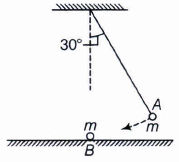
How high does the bob A rise after the collision? Neglect the size of the bobs and assume the collision to be elastic.
2.
A body constrained to move along the z-axis of a coordinate system is subject to a constant force F given by F =\((-\hat{i}+\hat{2j}+\hat{3k})\) N, Where \(\hat{i}\), \( \hat{j} \)and \(\hat{k}\) are unit vectors along the x-, y- and z-axis of the system respectively. What is the work done by this force in moving the body a distance of 4 m along the z-axis ?
3.
In a game of tug of war , one team is slowly giving way to the other.Which team is doing positive work and which team nagative?
4.
Is work done a scalar or a vector?
5.
What happen when two identical objects moving mutually opposite directions suffer elastic collision?
6.
A bolt of mass 0.3 kg falls from the ceiling of an elevator moving down with a uniform speed of 7ms-1 .It hits the floor of the elevator (length of the elevator = 3m) and does not rebound. What is the heat produced by the impact? Would your answer be different if the elevator were stationary?
7.
A spring is cut into two equal halves. How is the spring constant of each half affected?
8.
A molecule in a gas container hits a horizontal wall with speed 200 m s–1 and angle 30° with the normal, and rebounds with the same speed. Is momentum conserved in the collision ? Is the collision elastic or inelastic ?
9.
What is the loss in kinetic energy after collision, if the target body is initially at rest?
10.
Which physical terms remain conserved in an inelastic collision?
11.
If the momentum and total energy is conserved, then define the collision is occurred?
12.
Friction is a non-conservative force. Why?
13.
How much work is done by mass M moving once around a horizontal circle of radius r?
14.
Abody of mass of 2 kg initially at rest moves under the action of an applied horizontally force of 7 N on a table with coefficient of kinetic friction =0.1. Compute the
(i) work done by the applied force in 10 s,
(ii) work done by friction in 10 s,
(iii) work done by the net force on the body in 10 s,
15.
A rain drop of radius 2 mm falls from a height of 500 m above the ground. It falls with decreasing acceleration (due to viscous resistance of the air) until at half its original height, it attains its maximum (terminal) speed, and moves with uniform speed thereafter. What is the work done by the gravitational force on the drop in the first and second half of its journey ? What is the work done by the resistive force in the entire journey if its speed on reaching the ground is 10 m s–1 ?
16.
What is the amount of work done by (i) a weight - lifter in holding a weight of 120 kg on his shoulder for 30 s?
(ii) a locomotive against gravity , if it is travelling on a level plane?
17.
A pump on the ground floor of a building can pump up water to fill a tank of volume 30 m3 in 15 min. If the tank is 40 m above the ground, and the efficiency of the pump is 30%, how much electric power is consumed by the pump ?
18.
Mohan was always jealous of Ravi as Ravi was bette In studies for which everybody praised him.One day, Mohan challenged Ravi to defeat t~In in the race-uphill. They were both good runners but running uphill was difficult. Mohan ran very fast and was ahead of Ravi. After sometime, Mohan became breathless and started coughing. Ravi who was following him saw his condition and went to help him forgetting their challenge. Then, Mohan realised why everyone praised Ravi and they became
friends forever.
(i) What values of Ravi do you appreciate?
(ii) If the mass of bag is 0.3 kg and is taken up on an inclined plane of length 10 m and height 5 m, then allowed to slide down to bottom. The coefficient of friction between the body and plane is 0.15, what is the; (a) work doneby gravitational force over the round trip? (b) work done by applied force on upward journey?
(iii) What do you mean by positive work and negative work?
19.
Answer the following :
(a) The casing of a rocket in flight burns up due to friction. At whose expense is the heat energy required for burning obtained? The rocket or the atmosphere?
(b) Comets move around the sun in highly elliptical orbits. The gravitational force on the comet due to the sun is not normal to the comet’s velocity in general. Yet the work done by the gravitational force over every complete orbit of the comet is zero. Why
(c) An artificial satellite orbiting the earth in very thin atmosphere loses its energy gradually due to dissipation against atmospheric resistance, however small. Why then does its speed increase progressively as it comes closer and closer to the earth ?
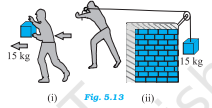
(d) In Fig. 5.(i) the man walks 2 m carrying a mass of 15 kg on his hands. In Fig. (ii), he walks the same distance pulling the rope behind him. The rope goes over a pulley, and a mass of 15 kg hangs at its other end. In which case is the work done greater ?
20.
A particle of mass moving with an initial velocity u collides inelastically with a particle of mass M initially at rest. if the collision is completely inelastic, then find expressions for
final velocity of combined entity and
1.
When the pendulum bob A reaches the position B, its velocity is horizontal and it strikes the mass m placed at B. Since, the collision is one-dimensional and elastic, the bob exchange their velocities being of the same mass.
The bob A does not rise at all and the bob B begins to move with the velocity of A.
2.
Here, F = \((-\hat{i}+\hat{2j}+\hat{3k})\) N and s = \((\hat{4k})\) m
W = F.s = Fz.Sz
= 3 \(\times\) 4
= 12N - m
= 12 J
3.
The winning team ( i.e the team which is pulling the other team towards itself ) is doing positive work and the losing team ( i.e. the team slowly giving way to the other ) is doing negative work. )
4.
Work done by a force for a certain dislacement is a scalar quantity.
5.
When two identical objects moving in mutually opposite direction suffer an elastic collusion. their velocity gets interchanged. If the masses of both objects are same then their velocities will get interchanged and they will move in opposite directions away from each other.
6.
Given, mass of bolt, m = 0.3 kg. height through which bolt falls h=3m.
When the bolt falls on floor of elevator and does no rebound, it suffers a loss of potential energy
\(\Delta\)U = mgh = 0.3 \(\times\)9.8\(\times\) 3 =8.28 J
\(\therefore\) Amount of heat produced = Loss of potential energy = 8.82 J. because is no gain in KE at all.
The answer is true when either the elevator is at rest or in state of uniform motion because potential energy of bolt has no connection with velocity if elevator
7.
Spring constant of each half becomes twice the spring constant of the original spring.
8.
Let us consider the mass of the molecule be m and that of wall be M. The wall remains at rest due to its large mass. Resolving momentum of the molecule along x-axis and y-axis, we get
The x-component of momentum of molecule
= mu cos \(\theta\) = - m 200 cos 30° = -100\(\sqrt { 3 } \)m
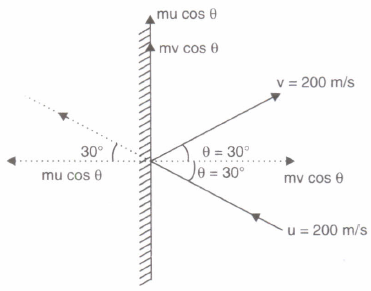
y-component of the molecule
= mu sin \(\theta\) = m \(\times\) 200 \(\times\) sin 30° = 100 m
Before collision: x-component of total momentum (wall + molecule)
= 0 + (-100\(\sqrt { 3 } \) m) = -100 \(\sqrt { 3 } \) m
y- component of momentum (wall + molecule) = 0 + 100 m = 100 m
After collision: x-component of the momentum (wall + molecule)
= 0 + m 200 cos 30° = 100 \(\sqrt { 3 } \) m
and y-component = 0 + m 100 sin 30° = 100 m
We find that momentum of the (molecule + wall) system is conserved. The wall has a recoil momentum such that momentum of the wall + momentum of outgoing molecule equals the momentum of the incoming molecule.
Initial kinetic energy \(\left( \frac { 1 }{ 2 } { mu }^{ 2 } \right) \) is the same as final K.E. \(\left( \frac { 1 }{ 2 } { mv }^{ 2 } \right) \)of the molecule as u = v = 200 m/s i.e., thus, the collision is elastic collision.
9.
Loss in kinetic energy on collision is \(\frac{1}{2}\left(\frac{m_1m_2}{m_1+m_2} \right)\mu^2\)
10.
In an inelastic collision, total momentum as well as total energy remain conserved.
11.
Collision in which momentum and total energy remained onserved and total kinetic energy of the colliding particles remain constant both before and after the collision, is clled elastic collision.
12.
Friction is a good example of a nonconservative force. Work done against friction depends on the length of the path between the starting and ending points. Because of this dependence on path, there is no potential energy associated with nonconservative forces.
13.
In physics, circular motion is a movement of an object along the circumference of a circle or rotation along a circular path. It can be uniform, with constant angular rate of rotation and constant speed, or non-uniform with a changing rate of rotation. The rotation around a fixed axis of a three-dimensional body involves circular motion of its parts. The equations of motion describe the movement of the center of mass of a body.
14.
Here, applied force F= 7N
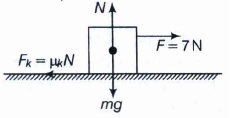
and opposing friction force,\(f={ \mu }_{ k }.N={ \mu }_{ k }.mg\)
\(=0.1\times 2\times 9.8=1.96N\)
\(\because \) Net accelerating force = F-f = 7 - 1.96 = 5.04 N
\(\therefore\) Acceleration, a= \(\frac { force }{ mass } =\frac { 5.04N }{ 2kg } \)
= 2.52 ms-2
(i) Distance covered in 10 s (assuming u = 0)
s = \(0+\frac { 1 }{ 2 } a{ t }^{ 2 }=\frac { 1 }{ 2 } \times 2.52\times { (10) }^{ 2 }\)= 126 m
\(\therefore\) Work done by the applied force W = Fs = \(7\times 126=+882\)J
(ii) Work done by friction in 10 s
\({ W }\prime =fs\cos { 180° } =-1.96\times 126=-247\)J
(iii) Work done by net force in 10s = W - W' =882 - 247
= + 635J
15.
If r be the radius of the drop and \(\rho \quad \)the density of water then the mass of the drop is
\(m=\frac { 4 }{ 3 } { \pi r }^{ 2 }\rho =\frac { 4 }{ 3 } \times (2\times { 10 }^{ -3 }m{ ) }^{ 3 }\times { 10 }^{ 3 }kg{ m }^{ -3 }\)
\(=3.35\times { 10 }^{ -5 }kg\)
The weight of the drop is
mg = (3.35 \(\times \) 10-5 kg) \(\times \) 9.8 ms-2 = 3.283 \(\times \)10-4 J
The wor done by the force in each half journey
\(W=mgh=(3.283\times { 10 }^{ -4 }\quad N)\times 250\quad m=0.082\quad J\)
The work done by the resistive force in the entire journey is equal to loss in energy of drop. If there were no resistive force, energy of drop on reaching the ground is equal to work on the drop by gravity force
\({ E }_{ 1 }=mgh=3.35\times { 10 }^{ -5 }\times 9.8\times 500\quad J=0.164\quad J\)
But the actual energy of drop is its kinetic energy
\({ E }_{ 2 }=\frac { 1 }{ 2 } { mv }^{ 2 }=\frac { 1 }{ 2 } \times 3.35\times { 10 }^{ -5 }\times { (10) }^{ 2 }=1.675\times { 10 }^{ -3 }\quad J\)
Work done by resistive force.
= E1 - E2 = 0164\(\times \)10-3 = 0.163 J
16.
(a) In the first case, a weight lifter has been given to be holding a weight of 120 kg on his shoulder for 30 s. The displacement of the weight for the duration of 30 s is practically zero. So, even if it seems like a tough job, there is no work done on the weight for the 30 s duration.
Therefore, the work done is zero in this case as s is zero.
(b) In calculation of the work done by a locomotive in carrying the weight over a plane road we have to take into account the direction of force and direction of displacement. The force here is the force of gravity acting downwards and as the locomotive is travelling on a plane path, the displacement vector happens to be in a direction which is perpendicular to the direction of force. As we know
W=\(\vec{F}\) .\(\vec{s}\) =Fscosθ
and as
W=Fscos90∘=0
Therefore, in this case too, work done is zero.
Additional information:
There is an important concept of conservative force that determines the nature of work done. If a force is conservative, then the amount of work done depends on the endpoints only and not on the path travelled.
The force of gravity is a conservative force. Therefore as we lift a mass at some height for 30 s when the amount of work done will be the difference in potential energy at t = 30 and t = 0 time. In between, anything could have happened; it will not affect our answer. The point here is before and after 30 seconds the mass stays at the same height so no work is done.
17.
Here,volume of water lifted V = volume of tank = 30 m, time t = 15 min = 900s,
Height of tank, h = 40 m and efficiency of motor, n = 30%
= mgh = Vpgh
\(\therefore \text{Output power}=\frac { Vpgh }{ t } =\frac { 30\times { 10 }^{ 3 }\times 9.8\times 40 }{ 900 } \)
\(=1.307\times { 10 }^{ 4 }W\)
\(\text{ Input power }=\ \frac { Output\ power }{ n } =+\frac { 1.307\times{ 10 }^{ 4 } }{ \frac { 30 }{ 100 } }\)
\( =\frac { 1.307\times{ 10 }^{ 4 }\times100 }{ 30 } =4.357\times{ 10 }^{ 4 }\quad W\)
\( =43.54 \ kW\ [1kW=1000W]\)
18.
(i) Ravi is intelligent and helpful to all. For him, helping someone in need is more important than winning.
(ii) (a) Since in a round trip, displacement is zero, so work done by gravitational force is zero.
(b) Work done in moving down the inclined plane
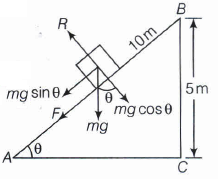
\(W=\left( mg\sin { \theta } +F \right) \times s\)
\(\\ W=\left( mg\sin { \theta } +\mu R \right) \times s\)
\(\\ W=\left( mg\sin { \theta } +\mu mg\cos { \theta } \right) .s\)
\(\\ W=0.3\times 10(\sin { 30° } +0.15\cos { 30° } )\times 10\)
W = 18.9J
(iii) Positive work means transfer of energy to the system.Negative work means transfer of energy from the system.
19.
(i) Heat energy required for burning of casing of rocket comes from the rocket itself. As a result of work done against friction the kinetic energy of rocket continuously decreases and this work against friction reappears as heat energy.
(ii) The gravitational force is a conservative force, hence, work done by the gravitational force over one complete (closed) orbit of comet is zero.
(iii) As an artificial satellite gradually loses its energy due to dissipation against atmospheric resistance, its potential energy decreases rapidly. As a result, kinetic energy of satellite slightly increases i.e. its speed increases progressively.
(iv) In figure, the man carries the mass of 15 kg on his hands and walks 2m. In this case, he is actually doing work against the friction force. Friction force contribution by mass
\(f=\mu N=\mu mg\times 15\times 9.8N\)
and work done against friction
\({ W }_{ 1 }={ f }_{ S }=\mu \times 15\times 9.8\)= 294 \(\mu \)J
In figure (ii) the tension in string, T = mg =15 \(\times \) 9.8 N
Hence, force applied by man for pulling the rope F =T =15\(\times \) 9.8N
\(\therefore \) Work done by man, Wz = Fs =15\(\times \) 9.8\(\times \) 2 = 294 J and additional work has to be done against friction also.
Thus, it is clear that W2 > W1.
20.
Let a particle of mass m moving with an initial velocity u collides inelastically with another particle of mass M initially at rest. Let after collision the combined entity moves with a velocity v. Then, from the conservation of linear momentum, we have \(m\mu +0=(m+M)v\Rightarrow v=\frac { mu }{ m+M } \)

11th Standard CBSE Syllabus & Materials
11th Standard CBSE
CBSE 11th Business Studies Forms of Business Organisation Sample Question Papers Study Material - QB365 Set A
NEW11th Standard CBSE
CBSE 11th Business Studies Business, Trade and Commerce Sample Question Papers Study Material - QB365 Set A
NEW11th Standard CBSE
CBSE 11th Physics Waves Sample Question Papers Study Material - QB365 Set A
NEW11th Standard CBSE
CBSE 11th Physics Kinetic Theory Sample Question Papers Study Material - QB365 Set A



CBSE 11th Standard CBSE Subjects
CBSE Standards









