
 100% FREE ACCESS
11th Standard CBSE Syllabus & Materials
11th Standard CBSE
CBSE 11th Economics PART-A - Presentation of Data - New Sample Question Papers Study Material - QB365 Set A
NEW11th Standard CBSE
CBSE 11th Economics PART-A - Organisation of Data - New Sample Question Papers Study Material - QB365 Set A
NEW11th Standard CBSE
CBSE 11th Economics PART-A - Collection of Data - New Sample Question Papers Study Material - QB365 Set A
NEW11th Standard CBSE
CBSE 11th Economics PART-A - Introduction to Economics and Statistics - New Sample Question Papers Study Material - QB365 Set A
NEW11th Standard CBSE
CBSE 11th Business Studies International Trade Sample Question Papers Study Material - QB365 Set A
NEW11th Standard CBSE
CBSE 11th Business Studies Evolution and Fundamentals of Business Sample Question Papers Study Material - QB365 Set A

Published on: 31/07/2018
From the chapter Mechanical Properties of Solids, some of the important questions are covered in this question paper. The questions are covers from the book back and the previous year questions.
Teachers can examine their student’s knowledge. They can prepare plenty of question paper with answer key. For subscription, please Click Here.
Download CBSE Class 11th Standard CBSE Physics question papers, sample papers, important questions, and previous year solved papers in PDF format. Get free study materials, NCERT solutions, and exam preparation resources for Class 11th Standard CBSE Physics
Questions + Answers key
Take MCQ Physics Test
1.
The stress-strain graphs for materials A and B are shown in Fig. (a) and Fig. (b).
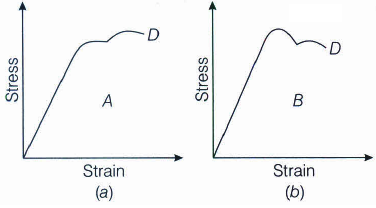
The graphs are drawn to the same scale.
(a) Which of the materials has the greater Young’s modulus?
(b) Which of the two is the stronger material?
2.
Determine the fractional change in volume as the pressure of the atmosphere 1.0 x 10⁵ Pa around a metal block is reduced to zero by placing the block in vacuum. The Bulk modulus for the block is 1.25 x 10¹¹ Nm-2
3.
A uniform pressure p is exerted on all sides of a solid cube at temperature t0C.By what amount should the temperature of the cube raised in order to bring its volume back to the volume it had before the pressure was applied, if the Bulk modulus and coefficient of volume expansion of the material B are \(\gamma \) and respectively.
4.
A solid sphere of radius R made of a material of Bulk modulus B is surrounded by a liquid in a cylindrical container. A massless piston of area A flots on the surface of the liquid. When a mass M is placed on the piston to compress the liquid, find fractional change in the redius of the sphere.
5.
The star Sirius has a mass of 7 x 1030 kg, its distance from the earth is 8x10¹⁶m and the mass of the earth is 6 x 1024kg. Calculate the cross-section of a steel cable that can withstand the gravitational pull between the Sirius and the earth. Given G = 6.67 x 10⁻¹¹Nm2kg-2 and breaking stress = 1010 Nm-2
6.
A solid sphere of radius R made of a material of bulk modulus B is surrounded by a liqiud in a cylindrical container. A massless piston of area A floats on the surface of the liqiud. When a mass M is placed on the piston on the piston to compress the liqiud, find fractiional change in the radius of the sphere?
7.
What is Bulk modulud for a perfectly rigid body?
8.
What is the Young's modulus for a perfect rigid body?
9.
Two wires made of same material are subjected to forces in the ratio 1 : 4. Their lengths are in the ratio 2 : 1 and diameters in the ratio 1 : 3. What is the ratio of their extensions ?
10.
Find the change in volume which 1cc of water at the surface will undergo, when it is taken to the bottom of the lake 100m deep, given that volume elasticity is 22000 atmospheres.
11.
A steel cable with a radius of 1.5 cm supports a chairlift at a ski area. If the maximum stress is not to exceed 108 N m–2, what is the maximum load the cable can support ?
12.
What does the slope of stress versus strain graph indicate ?
13.
Which type of strain is there, when a spiral spring is stretched by a force ?
14.
A thick wire is suspended from a rigid support, but no load is attached to its free end. Is this wire under stress ?
15.
Is stress a vector quantity ?
16.
Two identical solid balls, one of ivory and the other of wet-clay, are dropped from the same height on the floor. Which will rise to a greater height after striking the floor and why ?
17.
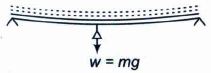
A mild steel wire of length 1m and cross-sectional area 0.5 x 10⁻² cm2 is stretched, well within its elastic limit, horizontally between two pillars. Amass of 100 g is suspended from the mid-point of the wire. Calculate the depression at the mid-point. Given Young's modulus for steel (Ys) = 2\(\times \) 1011 Pa
18.
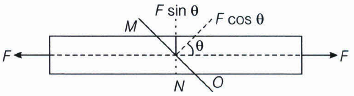
A bar of cross-section A is subjected to equal and opposite tensile forces at its ends. Consider a plane section of the bar whose normal makes an angle 8 with the axis of the bar.
(i) What is the tensile stress on this plane?
(ii) What is the shearing stress on this plane?
(iii) For what value of 8 is the tensile stress maximum?
(iv) For what value of e is the shearing stress maximum?
19.
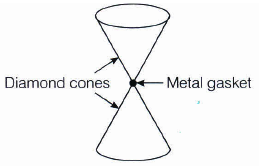
Anvils made of single crystals of diamond, with the shape as shown in figure are used to investigate the behaviour of materials under very high pressure. Flat faces at the narrow end of the anvil have a diameter of 0.50 mm and the wide en are subjected to a compressional force of 50000 N. What is the pressure at the tip of the anvil?
20.
Identical springs of steel and copper are equally stretched.On which, more work will have to be done?
21.
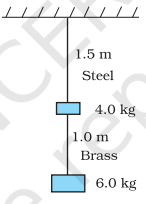
Two wires of diameter 0.25 cm, one made of steel and the other made of brass are loaded as shown in Fig.. The unloaded length of steel wire is 1.5 m and that of brass wire is 1.0 m. Compute the elongations of the steel and the brass wires.
22.
The edge of an aluminium cube is 10 cm long. One face of the cube is firmly fixed to a vertical wall. A mass of 100 kg is then attached to the opposite face of the cube. The shear modulus of aluminium is 25 GPa. What is the vertical deflection of this face?
23.
What is the length of a wire that breaks under its own weight when suspended vertically? Breaking stress = 5 x 10⁷ Nm-2 and density of the material of the wire = 3 x 10³ kg/m3
1.
(i) In the two graphs, the slope of graph in Fig. (a) is greater than the slope of graph in Fig. (b), so material A has greater Young's modulus.
(ii) Material A is stronger than material B because it can withstand more load without breaking. For material A, the break even point (D) is higher.
2.
8 x 10⁻⁷
3.
[(\(\frac{p}{γB}\))]
4.
\((\frac{△R}{R}=\frac{Mg}{3AB})\)
5.
44m2
6.
When mass M is placed on the piston, the excess pressure, p=Mg/A. As the pressure is equally applicable from all the direction on the sphere, hence there will be decrease in volume due to decrease in raius sphere. Volume of the sphere, \(V=\frac { 3 }{ 4 } \pi { R }^{ 3 }\)
Differentiating it , we get,
\(\Delta V=\frac { 4 }{ 3 } \pi (3{ R }^{ 2 })\Delta R=4\pi { R }^{ 2 }\Delta R\)
\(\\ \frac { \Delta V }{ V } =\frac { 4\pi { R }^{ 2 }\Delta R }{ \frac { 4 }{ 3 } \pi { R }^{ 3 } } =\frac { 3\Delta R }{ R } \)
We know that, \(B=\frac { P }{ dV/V } =\frac { Mg }{ A } \diagup \frac { 3\Delta R }{ R } \)
\(or\ \frac { \Delta R }{ R } =\frac { Mg }{ 3BA } \)
7.
Bulk modulus \((B)=\frac { p }{ \Delta V/V } =\frac { pV }{ \Delta V } \)
For perfectly rigid body, change in volume Δ V=0
\(B=\frac { pV }{ 0 } =\infty \)
Therefore, Bulk modulus for a perfectly rigd body is \(\infty \)
8.
Young's modulus \(Y=\frac{F}{A} \times \frac{l}{\Delta l}\)
For a perfectly rigid body, change in length Δl=0
\(Y=\frac{F}{A} \times \frac{l}{0}=\infty\)
Therefore, Young's modulus for a perfectly rigid bosy is ∞.
9.
According to Hooke's law,
Modulus of elasticity, E = \(\frac { F }{ \pi { r }^{ 2 } } \times \frac { l }{ \Delta l } \)
or \(\Delta l=\frac { Fl }{ \pi { r }^{ 2 }E } \)
or \(\Delta l\propto \frac { Fl }{ { r }^{ 2 } } \) [ \(\because\) E is same for two wires]
\(\therefore\) \(\frac { \Delta { l }_{ 1 } }{ \Delta { l }_{ 2 } } =\frac { { F }_{ 1 } }{ { F }_{ 2 } } \times \frac { { l }_{ 1 } }{ { l }_{ 2 } } \times \frac { { r }_{ 2 }^{ 2 } }{ { r }_{ 1 }^{ 2 } } \)
= \(\frac { 1 }{ 4 } \times \frac { 2 }{ 1 } \times \left( \frac { 3 }{ 1 } \right) ^{ 2 }=\frac { 9 }{ 2 } \)
So, \(\Delta { l }_{ 1 }\quad :\Delta { l }_{ 2 }\)
= 9 : 2
10.
\( \mathrm{p}=100 \mathrm{~m} \text { of water column }=(100 \times 100) \times 1 \times 980 \text { dyne } / \text { sq. } \mathrm{cm} \mathrm{V}=1 \mathrm{c} . \mathrm{c} \text {., } \)
\( \Delta V=?, B=22000 \mathrm{~atm} .=22000 \times 76 \times 13.6 \times 980 \text { dyne } / \mathrm{sq} . \mathrm{cm} . \)
\( \text { Now, } \Delta V=\frac{p V}{B}=\frac{100 \times 100 \times 980 \times 1}{22000 \times 76 \times 13.6 \times 980} \)
\(\text { 0.00044c.c. }
\)
11.
Given, radius of steel cable (r) = 1.5 cm = 1.5 x 10⁻²m
Maximum stress = 108 N/m2
Area of cross-section of steel cable (A) = \(\pi { r }^{ 2 }\)
= 3.14 x (1.5 x 10-2)2 m2
= 3.14 x 2.25 x 10-4 m2
Maximum stress = \(\frac { Maximum\ force }{ Area\ of\ cross-section } \)
or Maximum force = Maximum stress x Area of cross-section
= 108 x (3.14 x 2.25 x 10-4 ) N
= 7.065 x 10⁴ N
= 7.1 x 10⁴ N
12.
The slope of stress (on y-axis) and strain (on x-acis) gives modulus of elasticity.
The Slope of stress (on x-axis) and strain (on y-axis) gives the reciprocal of modulus of elasticity.
13.
Longitudinal strain and shear strain.
14.
Yes, the wire is under stress due to its own weight.
15.
No, because stress is a scalar quantity, not a vector quantity.
Stress = Magnitude of internal reaction force/Area of cross−section
16.
The ball of ivory will rise to a greater height bacause, ivory is more elastic than wet-clay.
17.
Given, length (l) = 1m
Area of cross-section (A) = 0.5\(\times \) 10-2 cm2
= 0.5 \(\times \)10-6 m2
Mass (m) = 100 g = 0.1 kg
\(\therefore \) Load (w) = mg = 0.1\(\times \) 9.8N = 0.98 N
Young's modulus for steel (Y) = 2 \(\times \)1011 Pa
Area (A) = \(\pi \)r2
or r2 = \(\frac { A }{ \pi } =\frac { 0.5\times { 10 }^{ -6 } }{ \pi } \)
Depression in a wire when a load is suspended at its centre
\( \delta =\frac { w{ l }^{ 3 } }{ 12\pi { r }^{ 4 }Y } =\frac { 0.98\times { (1) }^{ 3 } }{ 12\pi \times { \left( \frac { 0.5\times { 10 }^{ -6 } }{ \pi } \right) }^{ 2 }\times 2\times { 10 }^{ 11 } } \)
\(\delta =\frac { 0.98\times \pi }{ 12\times 0.25\times 2\times { 10 }^{ -1 } } \)
= 5.12 m
18.
(i) The resolved part of F along the normal is the tensile force on this plane and the resolved part parallel to the plane is the shearing force on the plane.
Area of MO plane section = A \(\sec { \theta } \)
Tensile stress =\(\frac { Force }{ Area } \)= \(\frac { F\cos { \theta } }{ F\sec { \theta } } \)
=\(\frac { F }{ A } \cos ^{ 2 }{ \theta } \) \(\left[ \because \quad \sec { \theta } =\frac { 1 }{ \cos { \theta } } \right] \quad \)
(ii) Shearing stress applied on the top face
So, F = \(F\sin { \theta } \)
Shearing stress =\(\frac { Force }{ Area } \)=\(\frac { F\sin { \theta } }{ A\sec { \theta } } \)
= \(\frac { F }{ A } \sin { \theta } \cos { \theta } \)
= \(\frac { F }{ 2A } \sin { 2\theta } \) \(\left[ \because \quad \sin { 2\theta } =2\sin { \theta } \cos { \theta } \right] \)
(iii) Tensile stress will be maximum when \(\cos ^{ 2 }{ \theta } \)i is maximum i.e. \(\cos { \theta } \) = 1 or \( \theta\) = 0°.
(iv) Shearing stress will be maximum when \(sin 2 \theta\) is maximum i.e. \(sin 2 \theta\) = 1 or \(2\theta\) = 90° or \( \theta\) = 45°.
19.
Given, compressional force, F = 50000 N
Diameter, D = 0.5 mm = 5\(\times \)10-4 m
Radius, r = \(\frac { D }{ 2 } \) = 2.5 \(\times \)10-4m
Pressure at the tip of the anvil (p) = \(\frac { Force }{ Area } \)
\( p=\frac { F }{ \pi { r }^{ 2 } } =\frac { 50000 }{ { \left( 2.5\times { 10 }^{ -4 } \right) }^{ 2 } } \)
= 2.5 \(\times \)1011 Pa.
20.
\(Work\ done\ in\ strtching\ a\ wire\ is\ given\ by\)
\(\\ W=\frac { 1 }{ 2 } F\times \triangle l\)
\(\\ As\ springs\ of\ steel\ and\ copper\ are\ equally\ streched.Therefore,for\ same\ force(F).\)
\(\\ W\propto \triangle l\)
\(\\ Young's\ modulus\ (Y)=\frac { F }{ A } \times \frac { l }{ \triangle l } \)
\(\\ or\ \triangle l=\frac { F }{ A } \times \frac { l }{ Y } \)
\(\\ As\ both\ springs\ are\ identical\)
\( \triangle l\propto \frac { 1 }{ Y } \)
\(\\ From \ Eqs.(i) \ and \ (ii),\ we \ get \ W\propto \frac { 1 }{ Y }\)
\( \\ \therefore \frac { { W }_{ steel } }{ { W }_{ copper } } =\frac { { Y }_{ copper } }{ { Y }_{ steel } } <1\ [as\ { Y }_{ steel }>{ Y }_{ copper }]\)
\(\\ or\ { W }_{ steel }\ <\ { W }_{ copper }\)
\(\\ Therefore,\ more\ work\ will\ be\ done\ for\ stretching\ copper\ spring.\)
21.
Given, diameter of wires (2r) = 0.25 cm
\(\therefore \) r = 0.125 cm
= 1.25 \(\times\) 10-3 m
For steel wire,
Load (F1) = (4 + 6) kgf
= 10 \(\times\) 9.8N = 98N
Length of steel wire (l1) = 1.5 m
Young's modulus (Y1 ) = 2.0 \(\times\) 1011 Pa
Young's modulus (Y) = \(\frac { { F }_{ 1 }\times { l }_{ 1 } }{ { A }_{ 1 }\times { \Delta l }_{ 1 } } \)
\(\therefore \) Change in length (\({ \Delta l }_{ 1 }\)) = \(\frac { { F }_{ 1 }\times { l }_{ 1 } }{ { A }_{ 1 }\times { Y }_{ 1 } } =\frac { { F }_{ 1 }\times { l }_{ 1 } }{ { \pi }{ r }_{ 1 }^{ 2 }\times { Y }_{ 1 } } \)
= \(\frac { 98\times 1.5 }{ 3.14\times { \left( 1.25\times { 10 }^{ -3 } \right) }^{ 2 }\times 2.0\times { 10 }^{ 11 } } \)
= 1.5\(\times\)10-4 m
For brass wire,
Load (F2) = 6 kgf = 6\(\times\) 9.8N = 58.8 N
Length of brass wire ( l2) = 1.0m
Young's modulus (Y2) = 0.91 \(\times\) 1011Pa
Change in length(\({ \Delta l }_{ 2 }\)) = \(\frac { { F }_{ 2 }\times { l }_{ 2 } }{ { \pi }{ r }_{ 2 }^{ 2 }\times { Y }_{ 2 } } \)
= \(\frac { 58.8\times 1.0 }{ 3.14\times { \left( 1.25\times { 10 }^{ -3 } \right) }^{ 2 }\times 0.91\times { 10 }^{ 11 } } \)
= 1.3\(\times\)10-4 m
22.
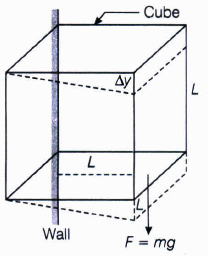
Given, side of a cube (l) = 10 cm = 0.1 m
Area of its each face (A) = l2 = (0.1)2 = 0.01 m2
Load(m) = 100 kg
Tangential force acting on one face of the cube, F = mg = 100\(\times \) 9.8 =980 N
Shear stress acting on this face = \(\frac { F }{ A } \) = \(\frac { 980 }{ 0.01 } \) N/m2
= 9.8 \(\times \)104 N/m2
Shear modulus of aluminium (\(\eta \)) = 25 GPa
= 25\(\times \) 109 N/m2
Shear modulus (\(\eta \))=\(\frac { Shearing\ stress }{ Shearing\ strain } \)
or shearing strain \(\left( \frac { \Delta L }{ L } \right) \) = \(\frac { Shearing\ stress }{ Shear\ modulus } \)
or \(\Delta L\) = \(\frac { Shearing\ stress }{ Shear\ modulus } \) \(\times \) L = \(\frac { 9.8\times { 10 }^{ 4 } }{ 25\times { 10 }^{ 9 } } \)\(\times \) 0.1
= 0.0392 \(\times \)10-5m
= 3.92 \(\times \) 10-7m
23.
1.67 km

11th Standard CBSE Syllabus & Materials
11th Standard CBSE
CBSE 11th Business Studies Forms of Business Organisation Sample Question Papers Study Material - QB365 Set A
NEW11th Standard CBSE
CBSE 11th Business Studies Business, Trade and Commerce Sample Question Papers Study Material - QB365 Set A
NEW11th Standard CBSE
CBSE 11th Physics Waves Sample Question Papers Study Material - QB365 Set A
NEW11th Standard CBSE
CBSE 11th Physics Kinetic Theory Sample Question Papers Study Material - QB365 Set A



CBSE 11th Standard CBSE Subjects
CBSE Standards









