
 100% FREE ACCESS
11th Standard CBSE Syllabus & Materials
11th Standard CBSE
CBSE 11th Economics PART-A - Presentation of Data - New Sample Question Papers Study Material - QB365 Set A
NEW11th Standard CBSE
CBSE 11th Economics PART-A - Organisation of Data - New Sample Question Papers Study Material - QB365 Set A
NEW11th Standard CBSE
CBSE 11th Economics PART-A - Collection of Data - New Sample Question Papers Study Material - QB365 Set A
NEW11th Standard CBSE
CBSE 11th Economics PART-A - Introduction to Economics and Statistics - New Sample Question Papers Study Material - QB365 Set A
NEW11th Standard CBSE
CBSE 11th Business Studies International Trade Sample Question Papers Study Material - QB365 Set A
NEW11th Standard CBSE
CBSE 11th Business Studies Evolution and Fundamentals of Business Sample Question Papers Study Material - QB365 Set A

Published on: 01/12/2018
From the chapter Oscillation, some of the important questions are covered in this question paper.
Questions are covered from the creative and previous year questions.
Download CBSE Class 11th Standard CBSE Physics question papers, sample papers, important questions, and previous year solved papers in PDF format. Get free study materials, NCERT solutions, and exam preparation resources for Class 11th Standard CBSE Physics
Questions + Answers key
Take MCQ Physics Test
1.
What is the total energy of a simple harmonic oscillator?
2.
Every SHM is periodic motion, but every periodic motion need not to be a simple harmonic motion. Do you agree? Give an example to justify your statement.
3.
Which of the following examples represent periodic motion?
(i) A freely suspended bar magnet displaced from its N-S direction and released.
(ii) A hydrogen molecule rotating about its centre of mass.
(iii) An arrow released from a bow.
4.
State the condition when motion of a particle can be an SHM.
5.
If the length of a simple pendulum is increased by 25% then what is the change in its time period?
6.
What is the force equation of a SHM?
7.
A body executes SHM with aperiod of 11/7 s and an amplitude of 0.025 m. What is the maximum value of acceleration?
8.
A simple harmonic motion given by \(x=6.0\quad cos\left( 100t+\frac { \pi }{ 4 } \right) \) where x is in cm and t in second. What is the (i) displacement amplitude, (ii) frequency?
9.
A uniform spring whose unstretched length is I has a force constant k. The spring is cut into two pieces of unstretched lengths. l1and l2, where l1= nl2 and n is an integer. What are the corresponding force constants k1 and k2 in terms of n and k?
10.
Two linear simple harmonic motions of equal amplitudes and frequencies ω and 2ω are impressed on a particle along the axes of X and Y respective/yo If the initial phase difference between them is π/2 find the resultant path followed by the particle.
11.
Figure (a) shows a spring of force constant k clamped rigidly at one-end and a mass m attached to its free end. A force F applied at the free end stretches the spring. Figure (b) shows the same spring with both ends free and attached to a mass m at either end. Each end of the spring in Figure (b) is stretched by the same force F.
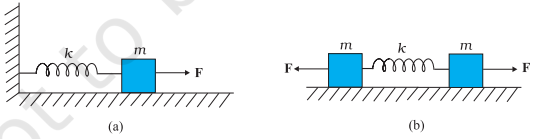
(a) What is the maximum extension of the spring in the two cases?
(b) If the mass in Fig. (a) and the two masses in Fig. (b) are released free, what is the period of oscillation in each case?
12.
A simple harmonic motion is represented by \(x=12\sin { \left( 10t+0.6 \right) } \) Find out the amplitude, angular frequency, frequency, time period and initial phase if displacement is measured in metre and time in seconds.
13.
Samar invited his friends for a party at his house. His friends were enjoying the party and jumping on the sofa. They started the competition of high jump on the sofa.Samar's father warned them that the springs of sofa could be broken and they could get hurt and explained them the working of spring. Children promised that they would never jump on the furniture.
(i) What values of the boys do you appreciate?
(ii) A spring compressed by 0.2 m develops a restoring force of 20 N. A body of mass 4 kg is placed on it. Deduce (a) the force constant of spring (b) depression of the spring under the weight of the body.
(iii) Give two examples of objects which work using springs.
14.
A horizontal platform with an object placed on it is executing SHM in the vertical direction. The amplitude of oscillation is 2.5 cm. What must be the least period of these oscillations so that the object is not detached from the platform? Take g = 10 ms-2?
15.
A block with a mass of 3.0 kg is suspended from an ideal spring having negligible mass and stretches the spring by 0.2 m.
(a) What is the force constant of the spring?
(b) What is the period of oscillation of the block if it is pulled down and released?
16.
A simple pendulum of length l and having a bob of mass M is suspended in a car. The car is moving on a circular track of radius R with a uniform speed v. If the pendulum makes small oscillations in a radial direction about its equilibrium position, what will be its time period ?
17.
The length of a second pendulum on the surface of earth is 1m. What will be the length of a second pendulum on the moon?
1.
\(\frac{1}{2}\)mω2r2 where r = amplitude, ω = angular frequency, m = mass of the oscillator.
2.
Yes, every periodic motion need to be SHM. e.g. the motion of the earth round the sun is a periodic motion, but not simple harmonic motion as the back and forth motion is not taking place.
3.
(i) The motion is repeated after a certain interval of time, hence periodic. In fact, the bar magnet oscillates about its mean position with a definite period of time.
(ii) Rorarary motion is periodic as repeating after fixed time-interval.
(iii) There is no repetition, hence not periodic.
4.
For SHM, the restoring force on the particle must be proportional to its displacement and directed towards mean position.
5.
Time period, \(T=2 \pi \sqrt{\frac{l}{g}}\) or \(T \alpha \sqrt{l}\)
% increase in time period
\(\frac{\Delta T}{T} \times 100=\frac{1}{2} . \frac{\Delta l}{l} \times 100=\frac{1}{2} \times 25=12.5 \%\)
6.
According to force equation of SHM, F = - kx, where k is a constant known as force constant.
7.
−0.4 m/s2
8.
(i) - 6.0cm
(ii) 16 Hz
9.
Here I = l1 + l2 ...(i)
and l1 = nl2
We know \(k=\frac { Mg }{ l } ...(iii)\)
\(k_{ 1 }=\frac { Mg }{ l_{ 1 } } ...(iv)\)
and \(k_{ 2 }=\frac { Mg }{ l_{ 2 } } ...(v)\)
Dividing equation (iv) by equation (iii) we find
\(\frac { { k }_{ 1 } }{ k } =\frac { l }{ { l }_{ 1 } } =\frac { { l }_{ 1 }+{ l }_{ 2 } }{ { l }_{ 1 } } =1+\frac { { l }_{ 2 } }{ { l }_{ 1 } } \)
From equation (ii), we find \(\frac { { l }_{ 1 } }{ { l }_{ 2 } } =n\)
\(\frac { { k }_{ 1 } }{ k } =1+\frac { 1 }{ n } or{ k }_{ 1 }=\left( \frac { n+1 }{ n } \right) k\)
From equation (v) and (iii), we find:
\(\frac { { k }_{21 } }{ k } =\frac { l }{ { l }_{ 2 } } =\frac { { l }_{ 1 }+{ l }_{ 2 } }{ { l }_{ 1 } } =\frac { { l }_{1 } }{ { l }_{ 2 } }+1 \)
From equation (ii) we have \(\frac { { l }_{ 1 } }{ { l }_{ 2 } } =n\)
\(\frac { { k }_{ 2 } }{ k } =(n+1)\quad \therefore { k }_{ 2 }=k(n+1)\)
10.
Two simple harmonic motions of equal amplitudes (A) and frequencies ω and 2ω and initial phase difference of π/2 are represented by
x = A sin ωt ...(i)
\(y=A\ sin\left({2ω+{\pi\over 2}}\right)=A\ cos\ 2 \omega t\) ...(ii)
Since cos 2 ωt (1 - 2 sin2 ωt)
∴ y = A[1 - 2 sin2 ωt] ...(iii)
From eqn. (i)
\(sin^2\ ωt={x^2\over A^2}\)
\(∴\ \ y=A\left[1-{2x^2\over A^2}\right]=A-{2x^2\over A}\)
\(⇒\ \ {2x^2\over A}+y-A=0\)
or \(x^2+{Ay\over 2P}-{A^2\over 2}=0\)
which is the equation of a parabola. Hence the resultant path followed by the particle is parabolic.
11.
(a) Let y be the maximum extension produced in the spring in Fig. (a)
Then F = ky (in magnitude) ∴ y = \(\frac{F}{k}\)
If fig. (b), the force on one mass acts as the force of reaction due to the force on the other mass. Therefore, each mass behaves as if it is fixed with respect to the other.
Therefore, F = ky ⇒ y= \(\frac{F}{k}\)
(b) In fig. (a), F = -ky
⇒ ma = -ky ⇒ a = - \(\frac{k}{m}y\) ∴ω2= \(\frac{k}{m}\) i.e.,ω =\(\sqrt{\frac{k}{m}}\)
Therefore, period \(T=\frac { 2\pi }{ \omega } =2\pi \sqrt { \frac { m }{ k } } \)
In fig. (b), we may consider that the centre of the system is 0 and there are two springs each of length \(\frac{l}{2}\) attached to the two masses, each m, so that k' is the spring factor of each of the springs.
Then, K' = 2k
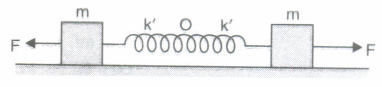
∴ \(T=2\pi \sqrt { \frac { m }{ k' } } \)
\(T=2\pi \sqrt { \frac { m }{ 2k } } \)
12.
Given equation, \(x=12\sin { \left( 10t+0.6 \right) } \)
On comparing with \(x\left( t \right) =A\sin { \left( \omega t+\phi \right) } \)
We have,
(i) Amplitude, A = 12 m
(ii) Angular frequency,\(\omega =10rad/s\)
(iii) Frequency, \(v=\frac { \omega }{ 2\pi } =\frac { 10 }{ 2\pi } =1.59Hz\)
(iv) Time period, \(T=\frac { 2\pi }{ \omega } =\frac { 1 }{ 1.59 } =0.628s\)
(v) Initial phase, \(\omega t+{ \phi }|_{ t=0 }={ 10t+0.6 }|_{ t=0 }\)
\(=0.6rad\).
13.
(i) Boys were sensible and were true to their words.
(ii) \(F=20\ N,\ \Delta l=0.2m,\ m\ =\ 4kg\)
\( (a)\ k=\frac { F }{ \Delta l } =\frac { 20 }{ 0.2 } =100{ Nm }^{ -1 }\)
\( (b)\ y=\frac { mg }{ k } =\frac { 4\times 10 }{ 100 } =0.4\ m\)
(iii) Watch, winding keys of toys.
14.
The object will not detach from the platform, if the angular frequency ω is such that, during the downward motion, the maximum acceleration equals the acceleration due to gravity, i.e
\(ω_{max}^2A=g\)
or \(ω_{max}=\sqrt{g\over A}\)
or \(T_{min}={2\pi\over ω_{max}}=2\pi\sqrt{A\over g}\)
Now A 2.5 cm = 2.5 x 10⁻² m and g = 10 ms=-2.
Substituting these values we get
\(T_{min}={\pi\over 10}=0.314s\)
15.
(a) Force constant \(k=\frac { F }{ l } =\frac { mg }{ l } \)
Here m = 3.0 kg and elongation in length of spring l = 0.2 m
∴ Force constant k = \(\frac{3.0\times 9.8}{0.2}=174Nm^{-1}\)
(b) Period of oscillation \(T=2\pi \sqrt { \frac { m }{ k } } =2\times 3.14\times \sqrt { \frac { 3 }{ 147 } } =0.9s\)
16.
In this case, the bob of the pendulum is under the action of two accelerations.
(i) Acceleration due to gravity 'g' acting vertically downwards.
(ii) Centripetal acceleration ac= \(\frac{v^2}{R}\) acting along the horizontal direction.
∴ Effective acceleration, g'= \(\sqrt { { g }^{ 2 }+{ a }_{ c }^{ 2 } } \)
\(or \ g'=\sqrt { { g }^{ 2 }+\frac { { v }^{ 4 } }{ { R }^{ 2 } } } \)
Now time period,\(T'=2\pi \sqrt { \frac { 1 }{ g } } =2\pi \sqrt { \frac { 1 }{ \sqrt { { g }^{ 2 }+\frac { { v }^{ 4 } }{ { R }^{ 2 } } } } } \)
17.
A second pendulum means a simple pendulum having time period T = 2s
For a simple pendulum T\(=2\pi \sqrt { \frac { l }{ g } } \)
where, l = length of the pendulum and g= acceleratin due to gravity On surface of the earth.
\({ T }_{ s }=2\pi \sqrt { \frac { l_{ e } }{ { g }_{ e } } } \)
On the surface of the moon,
\({ T }_{ n }=2\pi \sqrt { \frac { l_{ m } }{ { g }_{ m } } } \)
Dividing Eq(i) by Eq(ii) we get
\(\frac { { T }_{ s } }{ { T }_{ m } } =\frac { 2\pi }{ 2\pi } \sqrt { \frac { l_{ e } }{ { g }_{ e } } } \times \sqrt { \frac { l_{ m } }{ { g }_{ m } } } \)
Ts = Tm to maintain the second pendulum time period.
\(1=\sqrt { \frac { l_{ e } }{ { g }_{ e } } \times \frac { l_{ m } }{ { g }_{ m } } } \)
But the acceleration due to gravity at moon is 1/6 of the acceleration due to gravity at earth i.e.\({ g }_{ m }=\frac { { g }_{ e } }{ 6 } \)
Squaring Eq (iii) and putting this value
\( 1=\frac { { l }_{ e } }{ { l }_{ m } } \times \frac { { g }_{ e }/6 }{ { g }_{ e } } =\frac { { l }_{ e } }{ { l }_{ m } } \times \frac { 1 }{ 6 } \)
\(\\ \Rightarrow \frac { { l }_{ e } }{ { 6l }_{ m } } =1\)
\(or { l }_{ m }=\frac { 1 }{ 6 } { l }_{ e }=\frac { 1 }{ 6 } \times 1=\frac { 1 }{ 6 } m\)

11th Standard CBSE Syllabus & Materials
11th Standard CBSE
CBSE 11th Business Studies Forms of Business Organisation Sample Question Papers Study Material - QB365 Set A
NEW11th Standard CBSE
CBSE 11th Business Studies Business, Trade and Commerce Sample Question Papers Study Material - QB365 Set A
NEW11th Standard CBSE
CBSE 11th Physics Waves Sample Question Papers Study Material - QB365 Set A
NEW11th Standard CBSE
CBSE 11th Physics Kinetic Theory Sample Question Papers Study Material - QB365 Set A



CBSE 11th Standard CBSE Subjects
CBSE Standards









