
 100% FREE ACCESS
11th Standard CBSE Syllabus & Materials
11th Standard CBSE
CBSE 11th Economics PART-A - Presentation of Data - New Sample Question Papers Study Material - QB365 Set A
NEW11th Standard CBSE
CBSE 11th Economics PART-A - Organisation of Data - New Sample Question Papers Study Material - QB365 Set A
NEW11th Standard CBSE
CBSE 11th Economics PART-A - Collection of Data - New Sample Question Papers Study Material - QB365 Set A
NEW11th Standard CBSE
CBSE 11th Economics PART-A - Introduction to Economics and Statistics - New Sample Question Papers Study Material - QB365 Set A
NEW11th Standard CBSE
CBSE 11th Business Studies International Trade Sample Question Papers Study Material - QB365 Set A
NEW11th Standard CBSE
CBSE 11th Business Studies Evolution and Fundamentals of Business Sample Question Papers Study Material - QB365 Set A

Published on: 29/11/2018
In this question paper, the questions are covered from the creative and previous year question paper.
Questions are created from entire syllabus.
A teacher can subscribe and get plenty of question paper with answer key.
Download CBSE Class 11th Standard CBSE Physics question papers, sample papers, important questions, and previous year solved papers in PDF format. Get free study materials, NCERT solutions, and exam preparation resources for Class 11th Standard CBSE Physics
Questions + Answers key
Take MCQ Physics Test
1.
Why do we call Physics an exact Science?
2.
The parallactic angle subtended by a distant star is 0.76 on the earth's orbital diameter (1.5 x 10¹¹ m). Calculate the distance of the star from the earth.
3.
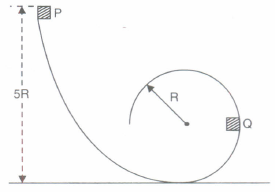
A small block of mass m slides along the frictionless loop-to-loop track shown in the Figure. (a) If it starts from rest at P what is the resultant force acting on it at Q? (b) At what height above the bottom of loop should the block be released so that the force it exerts against the track at the top of the loop equals its weight?
4.
The amplitude of a wave disturbed propagating in the positive x direction is given by \(y=\frac{1}{1+x^{2}}\) at t = 0 and \(y=\frac{1}{[1+(x-1)^{2}]}\) at t=2s where x and y in metre. The shape of disturbance does not change during the propagation. What is the velocity of the wave?
5.
For the harmonic travelling wave \(y=2\cos { 2\pi } \left( 10t-0.0080x+3.5 \right) \) , where, x and y are in cm and t is in second. What is the phase difference between the oscillatory motion at two points separated by a distance of \(\frac { \lambda }{2 } \).
6.
Explain why an optical pyrometer (for measuring high temperature) calibrated for an ideal black body radiation gives too low a value for the temperature of a red hot iron piece in the open, but gives a correct value for the temperature when the same piece is in the furnace.
7.
Heat Flow through a Glass
Calculate the rate of loss of heat through a glass window of area 1000 cm2 and thickness 0.4 cm. When temperature inside is 370 c and outside is -50 C. Coefficient of thermal conductivity of glass is 2.2 x 10⁻³ cal s-1 cm-1K-1.
8.
Consider a spring having spring constant of 81.75 N/m of pressure measuring device.A force acting on the piston compresses the spring downward and the area of the piston is 3 m2. Find out the compression in the spring , if the upthrust force exerted by the fluid on the piston is 12 N.
9.
The motion of a particle of mass m is described by y = ut + \(\frac { 1 }{ 2 } \) gt2. Find the force acting on the particle.
10.
Consider a simple pendulum, having a bob attached to a string, that oscillates under the action of the force of gravity. Suppose that the period of oscillation of the simple pendulum depends on its length (l), mass of the bob (m) and acceleration due to gravity (g). Derive the expression for its time period using method of dimensions.
11.
One mole of an ideal gas at standard temperature and pressure occupies 22.4 L (molar volume). What is the ratio of molar volume to the atomic volume of a mole of hydrogen ? (Take the size of hydrogen molecule to be about 1 Å). Why is this ratio so large ?
12.
Does the moment of inertia of a rigid body change with the speed of rotation?
13.
Can the relative velocity of two bodies be greater than the absolute velocity of either?
14.
The mass of a body is measured by two persons is 0.2 kg and 10.23 kg.Which one is more accurate and why?
15.
Find y for polyatomic gas and hence determine its value for a triatomic gas in which the molecules are linearly arranged.
16.
What causes variation in velocity of a particle?
17.
Two strings of the same material and length under the same tension may vibrate with different fundamental frequency. Why?
18.
Two planets have masses in the ratio 1: 10 and radii in the ratio 2: 5. Compare
(a) their densities
(b) the acceleration due to gravity on their surface
(c) escape velocities from their surfaces, and
(d) the periods of revolutions: of satellites near to their surfaces.
19.
A stone dropped from the top of a tower of height 300 m splashes into the water of a pond near the base of the tower. When is the splash heard at the top given that the speed of sound in air is 340 m s–1 ? (g = 9.8 m s–2)
20.
At what temperature, if any, do the following pairs of scales gives the same reading?
Fahrenheit and Kelvin.
21.
If the earth is 1/4 of its present distance from the sun, then what is the duration of he year?
22.
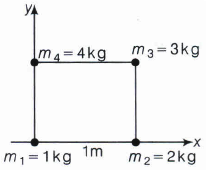
If four particles of mass 1kg, 2kg, 3kg and 4kg are placed at the four vertices A, B, Cand D of square of side lm. Find the position of the centre of mass of the particle.
23.
In which of the following examples of motion, can be the body be considered approximately a point object?
(i) A railway carriage moving without jerks between two stations.
(ii) A monkey sitting on the top of a man cycling smoothly on a circular track.
(iii) A spinning cricket ball that turns sharply on hitting the ground.
(iv) a tumbling beaker that has slipped off the edge of a table.
1.
()
Most of measurement in physics are made with high precise and accuracy, so it is called exact Science.
2.
The parallactic angle, \(\phi =0.76=\frac { 0.76\times \pi }{ 180\times 60\times 60 } \)radians
=\(\frac { 19\pi }{ 1.62\times { 10 }^{ 7 } } \)radians
The orbital diameter, say D = 1.5 x 10¹¹m
\(\therefore\) The required diameter, say d=\(\frac { D }{ \phi } \)
\(=\frac { 1.5\times { 10 }^{ 11 }\times 1.62\times { 10 }^{ 7 } }{ 19\pi } \\ =\frac { 2.43\times { 10 }^{ 18 } }{ 19\times 3.14 } m\\ =\frac { 243\times { 10 }^{ 18 } }{ 19\times 3.14 } m\\ =4.073\times { 10 }^{ 16 }m\)
Since , 1 Light year=9.5\(\times\)1015
\(=\frac { 4.073\times { 10 }^{ 16 } }{ 9.5\times { 10 }^{ 15 } } \) light year
=4.29 light year.
3.
(a) Point Q is at a height R above the ground. Thus, the difference in height between points P and Q is 4R. Hence, the difference in gravitational potential energy of the block between these points = 4 mgR. Since the block starts from rest at P its kinetic energy at Q is equal to its change in potential energy. By the conservation of energy.
\(\therefore \quad \frac { 1 }{ 2 } { mv }^{ 2 }=4mgR\)
v2 = 8gR
At Q, the only forces acting on the block are its weight mg acting downward and the force N of the track on block acting in radial direction. Since the block is moving in a circular path, the normal reaction provides the centripetal force for circular motion.
\(N=\frac { { mv }^{ 2 } }{ R } =\frac { m\times 8gR }{ R } =8\ mg\)
The loop must exert a force on the block equal to eight times the block's weight.
(b) For the block to exert a force equal to its weight against the track at the top of the loop,
\(\frac { { mv }^{ '2 } }{ R } =2mg\)
or v2 = 2gR
\(\therefore \quad mgh=\frac { 1 }{ 2 } { mv }^{ '2 }\)
\(h=\frac { { v }^{ '2 } }{ 2g } =\frac { 2gR }{ 2g } =R\)
The block must be released at a height 3R above the bottom of the loop.
4.
At t = 0, \(y=\frac{1}{1+x^{2}}\)
∴ \(1+x^{2}=\frac{1}{y}\)
\(x^{2}=\frac{1}{y}-1=\frac{1-y}{y} x= (\frac{1-y}{y})^{\frac{1}{2}}\)
At t = 2s, \(y=\frac{1}{[1+(x+1)^{2}]}\)
\(1+(x-1)^{2} =\frac{1}{y}\)
\((x-1)^{2} = \frac{1}{y}-1 = \frac{1-y}{y}\)
\((x-1)=(\frac{1-y}{y})^{\frac{1}{2}}\)
⇒ \(x=1+(\frac{1-y}{y})^{\frac{1}{2}}\)
Since, \(v=\frac{x_2-x_1}{t_2-t_1}\)
∴ \(v=\frac{1}{2-0}=0.5 ms^{-1}\)
5.
Given equation is \(y=2\cos { 2\pi } \left( 10t-0.0080x+3.5 \right) \)
Comparing with standard equation,
\(y=2\cos { 2\pi } \left( 10t-0.0080x+3.5 \right) \)
\(\\ y=a\cos { \left( \omega t-kx+\phi \right) } \)
\(a=2cm,\omega =\frac { 2\pi }{ T } =20\pi ,\ T=0.1s\)
\(k=\frac { 2\pi }{ \lambda } =0.008\times 2\pi \Rightarrow \lambda =\frac { 2\pi }{ 2\pi \times 0.008 } =1.25m\)
\(\\ \phi =2\pi \times 3.5=7\pi rad\)
When x = \(\frac { \lambda }{2 } \)
\({ \phi }_{ 3 }=\frac { 2\pi }{ \lambda } \times \lambda /2=\pi rad\).
6.
Let T be the temperature of the hot iron in the furnace. Heat radiated per second per unit area, E = \(\sigma \)T4 . When the body is placed in the open at temperature T0 , the heat radiated/Second/unit area,
E' = \(\sigma \)(T4-T04)
Clearly, E' < E. So, the optical pyrometer gives too low a value for the temperature in the open.
7.
Given, A = 1000 cm2 , L = 0.4 cm
\(\Delta T=T_{ 1 }-T_{ 2 }=37-(-5)=42^{ 0 }C\)
\(\\ K=2.2\times 10^{ -3 }cal\ s^{ -1 }cm^{ -1 }K^{ -1 }\)
Rate of loss heat,
\(\\ H=\frac { Q }{ T } =\frac { KA(T_{ 1 }-T_{ 2 }) }{ L } =\frac { 2.2\times 10^{ -3 }\times 1000\times 42 }{ 0.4 } \)
\(\\ H=231\ cal\ s^{ -1 }\)
8.
As the force acting on the piston compresses the spring .This force will be balanced by the force acting upward by the fluid known as upthrust force.
\(p=\frac { F }{ A } =\frac { kx }{ A } \)
Given, F = 12 N, A = 3m2 and k = 81.75 N/m
From F= kx
\(\Rightarrow \quad x=\frac { F }{ k } =\frac { 12 }{ 81.75 } \)
Hence, compression in the spring is x = 14.6 cm
9.
We know, y = ut + \(\frac { 1 }{ 2 } \) gt2
Now, v = \(\frac { dy }{ dt } \) = u + gt
acceleration, a = \(\frac { dv }{ dt } \) = g
Then, the force is given by
F = ma = mg
Thus, the given equation describes the motion of a particle under acceleration due to gravity and y is the position coordinate in the direction of g.
10.
The dependence of time period T on the quantities l, g and m as a product may be written as :
\(T=k{ m }^{ x }{ l }^{ y }{ g }^{ z }\)
where k is dimensionless constant and x, y and z are the exponents.
By considering dimensions on both sides, we have
\(\left[\mathrm{L}^0 \mathrm{M}^0 \mathrm{~T}^1\right]=\left[\mathrm{L}^1\right]^x\left[\mathrm{~L}^1 \mathrm{~T}^{-2}\right]^y\left[\mathrm{M}^1\right]^z\) = Lx+y T–2y Mz
On equating the dimensions on both sides,
we have x + y = 0; –2y = 1; and z = 0
So, that x =\(\frac { 1 }{ 2 } \), y =\(-\frac { 1 }{ 2 } \), z = 0
Then \( T=km^{ 0 }l^{ { 1 }/{ 2 } }g^{ { -1 }/{ 2 } }\) or, \(T =k\sqrt { \frac { l }{ g } } \)
Note that value of constant k can not be obtained by the method of dimensions. Here it does not matter if some number multiplies the right side of this formula, because that does not affect its dimensions.
Actually, k = 2π so tha \(T=2\pi \sqrt { \frac { l }{ g } } \)
11.
Given, molar volume of one mole of hydrogen
= 22.4 L = \(22.4\times { 10 }^{ -3 }{ m }^{ 3 }\)
Diameter of hydrogen molecules (d) = 1\(\mathring{A}\) = 10-10m
\(\therefore \) Radius of hydrogen molecule (r) = \(\frac { d }{ 2 } =\frac { { 10 }^{ -10 } }{ 2 } \)
\(=0.5\times { 10 }^{ -10 }m\)
Volume of one molecule of hydrogen = \(\frac { 4 }{ 3 } \pi { r }^{ 3 }\)
\(=\frac { 4 }{ 3 } \times 3.14\times (0.5\times { 10 }^{ -10 })\)
\(=5.234\times { 10 }^{ -31 }{ m }^{ 3 }\)
Number of molecules in one mole hydrogen = Avogadro's number (N) = \(6.023\times { 10 }^{ 23 }\)
\(\therefore \) Atomic volume of one mole of hydrogen = Number of molecules in one mole of hydrogen \(\times \) Volume of one molecule of hydrogen
\(=6.023\times { 10 }^{ 23 }\times 5.234\times { 10 }^{ -31 }\)
\(\\ =3.152\times { 10 }^{ -7 }{ m }^{ 3 }\)
\(\therefore \ \frac { Molar \ Volume }{ Atomic \ Volume } =\frac { 22.4\times { 10 }^{ -3 } }{ 3.152\times { 10 }^{ -7 } } = 7.1\times { 10 }^{ 4 }\)
This ratio is very large, which shows that the intermolecular separation in a gas is much larger than the size of a molecule.
12.
No. because the moment of inertia depends upon the axis of rotation and distribution of mass.
13.
Yes, when two bodies move in opposite direction then relative velocity of each is greater than the individual velocities.
14.
The value m = 10.23kg is more accurate, being correct upto 2nd place of decimal.
15.
The energy of a polyatomic gas having In' degrees of freedom is given by
E = n x \(\frac { 1 }{ 2 } \) KT x N = \(\frac { n }{ 2 } \) RT
\(\therefore\) Cv = \(\frac { dE }{ dT } =\frac { n }{ 2 } R\)
\(\therefore\) Cp = Cv + R = \(\frac { n }{ 2 } R\)+R
= \(\left( \frac { n }{ 2 } +1 \right) R\)
\(\therefore\) \(\gamma\) = \(\frac { { c }_{ p } }{ { C }_{ v } } =\frac { n/2+1 }{ n/2 } =1+\frac { 2 }{ n } \)
In case of a triatomic gas n = 7
\(\therefore\) \(\gamma\) = 1 + \(1+\frac { 2 }{ 7 } =\frac { 9 }{ 7 } \)
16.
The velocity of a particle changes due to either of the following three causes:
(i) Change in magnitude of velocity,
(ii) Change in direction of motion only, and
(iii) Change in magnitude as well as direction of the motion.
17.
The frequency of vibration of string is
given by \(n=\frac{1}{2l}\sqrt{\frac{T}{m}}\)
m (mass per unit length) = \(\frac{mass}{length}\)
=\(\frac{volume \times density}{l} = \frac{\pi r^{2}l \times \rho}{l}=\pi r^{2} \rho\)
= \(\pi (\frac{D}{2})^{2} \ \ \rho=\frac{\pi D^{2}}{4} \rho\)
n =\(\frac{1}{2l}\sqrt{\frac{4T}{\pi D^{2} \rho}}=\frac{1}{Dl}\sqrt{\frac{T}{\pi \rho}}\)
∴ \(n \propto \frac{1}{D}\) (when l,T,ρ are same)
or nD = constant or n2D1 = n1D2.
Hence the two strings may vibrate with different frequencies when they have different diameters.
18.
Let M1, M2 by the masses and R1, R2 be, the radii of the planets.
\(\Rightarrow\frac{M_1}{M_2}=\frac{1}{10}\ and\ \frac{R_1}{R_2}=\frac{2}{5}\)
(a) Ratio of densities \(=\frac{d_1}{d_2}\ or\ \frac{d_1}{d_2}=[\frac{M_1}{\frac{4}{3}\pi R_1^3}][\frac{\frac{4}{3}\pi R_2^3}{M_2}]\)
or, \(\frac{d_1}{d_2}=\frac{M_1}{M_2}[\frac{R_2}{R_1}]^3\Rightarrow \frac{d_1}{d_2}=[\frac{1}{10}][\frac{5}{2}]^3=\frac{25}{16}\)
(b) Acceleration due to gravity at the surface \(=g=\frac{GM}{R^2}\)
\(\therefore\frac{g_1}{g_2}=\frac{M_1}{M_2}[\frac{R_2}{R_1}]^2\)
\(=\frac{1}{10}[\frac{5}{2}]^2=\frac{5}{8}\)
(c) Escape velocity \(=\sqrt {\frac{2GM}{R}}\)
\(=\frac{v_1}{v_2}=\sqrt {\frac{M_1}{M_2}}\sqrt {\frac{R_2}{R_1}}=\sqrt {\frac{1}{10}\times \frac{5}{2}}=\frac{1}{2}\)
(d) Time period of a satellite near the surface (orbit radius = R) \(=\frac{2\pi}{\sqrt {GM}}R\sqrt R\)
\(\Rightarrow \frac{T_1}{T_2}=\sqrt {\frac{M_2}{M_1}}[\frac{R_1}{R_2}][\sqrt {\frac{R_1}{R_2}}]\)
\(=\sqrt {\frac{10}{1}}[\frac{2}{5}][\sqrt {\frac{2}{5}}]=\frac{4}{5}\)
19.
Given, h = 300m, g = 9.8m/s2 , v = 340ms-1
t1 = time taken by stone to strike the water surface
\(t_{ 1 }=\sqrt { \frac { 2h }{ g } } =\sqrt { \frac { 300 }{ 49 } } =7.82s\left( as\quad h=0+\frac { 1 }{ 2 } gt^{ 2 }_{ 1 } \right) \)
t2 = time taken by the splash's sound to reach top of the tower
\(t_{ 2 }=\frac { h }{ v } =\frac { 300 }{ 340 } =0.882\quad \left[ v=\frac { h }{ t_{ 2 } } \right] \)
Total time, t = time to hear splash of sound
= t1 + t2 =7.82 + 0.882
= 8.702
20.
574.6o
21.
One-eighth the present year
Since \(T^2 \propto r^3 \therefore\left(\frac{T}{T}\right)^2=\left(\frac{1}{4}\right)^3 \Rightarrow T^{\prime}=\frac{1}{8} T\)
22.
Observing the figure,
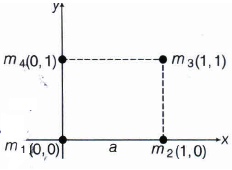
Coordinates of ml, x1 = 0, y1 = 0
Coordinates ofmz' x2 =1, y2 =0
Coordinates of m3, x3 =1, y3 =1
Coordinates of m4, x4 =0, y4 =1
\(\therefore \quad x_{\mathrm{CM}}=\frac{m_{1} x_{1}+m_{2} x_{2}+m_{3} x_{3}+m_{4} x_{4}}{m_{1}+m_{2}+m_{3}+m_{4}}\)
\(=\frac{(1)(0)+(2)(1)+(3)(1)+(4)(0)}{1+2+3+4}\)
\(=\frac{5}{10}=0.5\)
Now, \(y_{\mathrm{CM}}=\frac{m_{1} y_{1}+m_{2} y_{2}+m_{3} y_{3}+m_{4} y_{4}}{m_{1}+m_{2}+m_{3}+m_{4}}\)
\(=\frac{(1)(0)+(2)(0)+(3)(1)+(4)(1)}{1+2+3+4}\)
\(=\frac{7}{10}=0.7 \mathrm{~m}\)
Thus, centre of mass is located at (0.5m, 0.7m).
23.
Any object can be considered as a point object if the distance travelled by it is very large in comparison to its dimensions.
(i) A railway carriage is moving without jerks between two stations, it means stations are at large distance, therefore railway carriage can be taken as a point object.
(ii) Man along with monkey is cycling smoothly which indicates that the distance travelled by the man is very large, therefore monkey can be taken as a point object.
(iii) The distance travelled by the ball is not so large therefore, spinning cricket ball cannot be taken as a point object.
(iv) Again a tumbling beaker slipped off the edge of a table cannot be considered as a point object because distance covered is not much larger.

11th Standard CBSE Syllabus & Materials
11th Standard CBSE
CBSE 11th Business Studies Forms of Business Organisation Sample Question Papers Study Material - QB365 Set A
NEW11th Standard CBSE
CBSE 11th Business Studies Business, Trade and Commerce Sample Question Papers Study Material - QB365 Set A
NEW11th Standard CBSE
CBSE 11th Physics Waves Sample Question Papers Study Material - QB365 Set A
NEW11th Standard CBSE
CBSE 11th Physics Kinetic Theory Sample Question Papers Study Material - QB365 Set A



CBSE 11th Standard CBSE Subjects
CBSE Standards









