
 100% FREE ACCESS
11th Standard CBSE Syllabus & Materials
11th Standard CBSE
CBSE 11th Economics PART-A - Presentation of Data - New Sample Question Papers Study Material - QB365 Set A
NEW11th Standard CBSE
CBSE 11th Economics PART-A - Organisation of Data - New Sample Question Papers Study Material - QB365 Set A
NEW11th Standard CBSE
CBSE 11th Economics PART-A - Collection of Data - New Sample Question Papers Study Material - QB365 Set A
NEW11th Standard CBSE
CBSE 11th Economics PART-A - Introduction to Economics and Statistics - New Sample Question Papers Study Material - QB365 Set A
NEW11th Standard CBSE
CBSE 11th Business Studies International Trade Sample Question Papers Study Material - QB365 Set A
NEW11th Standard CBSE
CBSE 11th Business Studies Evolution and Fundamentals of Business Sample Question Papers Study Material - QB365 Set A

Published on: 05/03/2020
11th Standard Accountancy Board Exam Sample Question 2020
Download CBSE Class 11th Standard CBSE Accountancy question papers, sample papers, important questions, and previous year solved papers in PDF format. Get free study materials, NCERT solutions, and exam preparation resources for Class 11th Standard CBSE Accountancy
Questions + Answers key
Take MCQ Accountancy Test
1.
How will you show closing stock in final accounts?
2.
What is the difference between trade discount and cash discount.
3.
What is Accounting Information System?
4.
State the three parties involved in a Bill of Exchange.
5.
Distinguish between Capital Expenditure and Revenue Expenditure?
6.
In the following Bank Reconciliation Statement, determine the missing amounts:
| Particulars | Amount (Rs) | Amount (Rs) | |
|---|---|---|---|
| Balance as per Cash Book (Dr.) | |||
| (i) | Cheques issued but not yet presented for payment amounting Rs 15,600 | .... | .... |
| (ii) | Interest credited by Bank not recorded in Cash Book Rs 200 | .... | .... |
| (iii) | Cheques deposited but not yet cleared amounting Rs 4000 | .... | .... |
| (iv) | Bank charges debited by bank but not recorded in Cash Book | (100) | ..... |
| Balance as per Bank Statement (Cr.) | 23,700 |
7.
What is Amortisation?
8.
Describe the role of accounting in the modern world.
9.
Distinguish between Capital Expenditure & Revenue Expenditure.
10.
Explain the accounting principle of verifiability and objectivity of evidence.
11.
State the three objectives of Trial Balance.
12.
List any three source documents.
13.
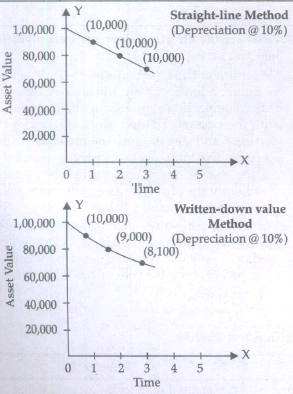
Basaria Confectioner bought a cold storage plant on July 01, 2014 for Rs 1,00,000.
Compare the amount of depreciation charged for first three years using:
1. Rate of depreciation @ 10% on original cost basis;
2. Rate of depreciation @ on written down value basis;
3. Also, plot the computed amount of depreciation on a graph.
14.
Following are the extracts from the Trial Balance of a firm as on 31st March, 2014 :
| Particulars | Debit (Rs) | Credit (Rs) |
|---|---|---|
| Sundry Debtors | 2,05,000 | - |
| Provision for Doubtful Debts | - | 10,000 |
| Provision for Discount on Debtors | - | 1,800 |
| Bad Debts | 3,000 | - |
| Discount | 1,000 | - |
Additional Information:
(i) Additional Bad Debts Rs 4,000.
(ii) Additional Discount allowed to Debtors Rs 1,000.
(iii) Maintain a provision for bad debts @ 10% on debtors.
(iv) Maintain a provision for discount @ 2% on debtors.
Pass the necessary journal entries and show the relevant accounts (including final accounts).
15.
Determine the missing information in the following Rectifying Journal Entries:
| Date | Particulars | L.F. | Debit Amount (Rs.) |
Credit Amount (Rs.) |
|
|---|---|---|---|---|---|
| (i) | ... | Dr. | ... | ||
| To Suspense A/c (Being the wages paid Rs. 10,000 debited in Wages Account as Rs. 1,000,now rectified) |
... | ||||
| (ii) | Suspense A/c | Dr. | ... | ||
| To Mohan (Being the Sales Return of Rs. 5,000 debited to Mohan, who returned the goods, now rectified) |
... | ||||
| (iii) | ... | Dr. | 1,200 | ||
| To ... (Being the Sales Book overcasted, now rectified) |
1,200 | ||||
| (iv) | ... | Dr. | ... | ||
| ... | Dr. | ... | |||
| To Suspense A/c (Being the goods returned to Rohan for Rs. 6,000 wrongly credited to Naveen as Rs. 2,000, now rectified) |
8,000 | ||||
| (v) | Amit | Dr. | ... | ||
| To... (Being the goods sold to Amit for Rs. 12,000 credited to him as Rs. 2,000, now rectified) |
... | ||||
| (vi) | ... | Dr. | 18,000 | ||
| To ... | ... | ||||
| To Mohan (Being the goods returned by Kamal for Rs. 6,000 wrongly debited to Mohan as Rs. 12,000, now rectified) |
... |
16.
Following balance is extracted from the books of a trader. Ascertain Gross Profit, Operating Profit and Net Profit for the year ended March 31, 2014 :
| Particulars | Amount (Rs.) |
|---|---|
| Sales | 75,250 |
| Purchases | 32,250 |
| Opening stock | 7,600 |
| Sales returns | 1,250 |
| Purchases returns | 250 |
| Rent | 300 |
| Stationery and printing | 250 |
| Salaries | 3,000 |
| Misc. expenses | 200 |
| Travelling expenses | 500 |
| Advertisement | 1,800 |
| Commission paid | 150 |
| Office expenses | 1,600 |
| Wages | 2,600 |
| Profit on sale of investment | 500 |
| Depreciation | 800 |
| Dividend on investment | 2,500 |
| Loss on sale of old furniture | 300 |
Closing stock (March 31, 2014) valued at Rs. 8,000.
17.
What is cash book? Explain the types of cash books.
18.
Determine the missing information in the following books of Drawer and Drawee:
| Date | Particulars | L.F. | Debit Amount (Rs) | Credit Amount (Rs) | |
|---|---|---|---|---|---|
| 2017 Jan 1 | ... | Dr. | ... | ||
| To ... | ... | ||||
| (Being the goods sold to Bon credit for Rs 10,000) | |||||
| Jan 1 | ... | Dr. | ... | ||
| To ... | ... | ||||
| (Being the acceptance of the bill received from B for three months) | |||||
| March 4 | ... | Dr. | ... | ||
| ... | Dr. | ... | |||
| To ... | ... | ||||
| (Being the amount received on bill and rebate allowed @ 6% p.a.) |
| Date | Particulars | L.F. | Debit Amount (Rs) | Credit Amount (Rs) | |
|---|---|---|---|---|---|
| 2017 Jan 1 | ... | Dr. | ... | ||
| To ... | ... | ||||
| (Being the purchases of goods on credit) | |||||
| Jan 1 | ... | Dr. | ... | ||
| To ... | ... | ||||
| (Being the acceptance of the bill given to A for three months) | |||||
| March 4 | ... | Dr. | ... | ||
| To ... | ... | ||||
| To ... | ... | ||||
| (Being the acceptance retired under rebate @ 6% p.a.) |
19.
What is meant by Electronic Spreadsheet?
20.
On the basis of the narrations, fill in the missing values:
| Date | Particulars | L.F | Amount Dr(Rs) |
Amount Cr(Rs) |
|
|---|---|---|---|---|---|
| (i) | - | Dr | - | ||
| - | Dr | - | |||
| To ........ | 6,00,000 | ||||
| (Being the capital introduced in cash Rs.1,00,000 and balance by cheque) | |||||
| (ii) | - | Dr | - | ||
| To ........ | 15,000 | ||||
| (Being the goods purchased in cash) | |||||
| (iii) | - | Dr | - | ||
| To ..... | - | ||||
| (Being the land purchased for Rs.2,50,000, payment by cheque) | |||||
| (iv) | - | Dr | - | ||
| To ..... | 1,00,000 | ||||
| (Being the goods purchased from Hari) | |||||
| (v) | - | Dr | 20,000 | ||
| To ... | 20,000 | ||||
| (Being the goods sold) | |||||
| (vi) | - | Dr | 50,000 | ||
| To .... | 50,000 | ||||
| (Being the goods sold to Rajan) | |||||
| (vii) | - | Dr | 5,000 | ||
| To ....... | 5,000 | ||||
| (Being the goods returned by Rajan) | |||||
| (viii) | - | Dr | 4,000 | ||
| To ..... | 4,000 | ||||
| (Being the goods returned to Hari) | |||||
| (ix) | - | Dr | 11,000 | ||
| To ..... | 11,000 | ||||
| (Being the insurance premium of personal car paid) | |||||
| (x) | - | Dr | 250 | ||
| To ..... | 250 | ||||
| (Being the newspaper bill for the month) |
21.
What is matching concept? Why should a business concern follow this concept?
22.
Chhabra & Sons find that overdraft shown by their Cash Book on 31st March 2013 is 30,500 but the Pass Book shows a difference due to the following reasons.
(i) A cheque for 6,000 drawn in favour of Shyam has not been presented for payment.
(ii) A post-dated cheque for 1,000 has been debited in the Bank column of the Cash Book but it could not have been presented in Bank.
(ii) Cheque totalling 12,000 deposited with the bank. have not yet been collected.
(iv) A bill for 5,000 was retired by the bank. under a rebate of 120 but the full amount of the bill was credited in the bank. column of the Cash Book. Prepare a Bank. reconciliation statement and find out the balance as per pass book.
23.
Prepare accounting equation on the basis of the following:
| Particulars | Rs | |
|---|---|---|
| (i) | Business Started with cash | 1,75,000 |
| (ii) | Purchased goods from Rohit | 50,000 |
| (iii) | Sold Goods On credit to Manish (Costing Rs.17,500/-) | 20,000 |
| (iv) | Purchase Furniture for office us | 10,000 |
| (v) | Cash paid to Rohit in full settlements | 48,500 |
| (vi) | Cash received from Manish | 20,000 |
| (vii) | Rent paid | 1,000 |
| (viii) | Cash withdrew for personal use | 3,000 |
24.
What are the practical difficulties that are encountered by a trader due to incompleteness of accounting records?
25.
Opening Capital Rs. 60,000, Drawings Rs.5,000, Capital added during the year Rs. 10,000, Closing Capital Rs. 90,000. Calculate profit or loss.
26.
Raghav & Co. have two bank accounts: Account No. I and Account No. II. From the following particulars relating to Account No. I, find out the balance on the account on December 31,2014 according to the cash book of the firm
(i) Cheque paid into bank prior to December 31, 2005 but not credited until after that date for Rs 10,000
(ii) Transfer of funds from account No. II to account No. I recorded by the bank on December 31, 2005 but entered in the cash book after that date for Rs 8,000.
(iii) Cheques issued prior to December 31, 2014 but not presented until after that date for Rs 7,429.
(iv) Bank charges debited by bank not entered in the cash book for Rs 200.
(v) Interest debited by bank not entered in the cash book Rs 580.
(vi) Overdraft as per Pass Book Rs 18,990.
27.
On April 1,2011 X Ltd. Purchased Machinery for Rs.1,00,000with CGST and SGST @ 6%each. The accounting year of the Company ends on 31st Dec. every year. Depreciation @ 10%p.a. on the initial cost is charged to P & L Account and credited to a separate account known as 'provision for depreciation' account. On 1st July 2013,the machine purchased on 1st April 2011was sold for Rs. 60,000.You are required to prepare machinery Account and Provision for Depreciation Account upto 2013.
28.
Prepare a Cash Book with Cash and Bank Columns from the following transaction:
| 2017 | Particulars | Rs |
|---|---|---|
| Jan. 1 | Cash in hand Rs 5,000, Bank overdraft Rs 1,000 | |
| Jan. 2 | Deposited into bank | 1,000 |
| Jan. 3 | General Expenses paid | 600 |
| Jan. 7 | Purchased goods from Mudit on credit | 2,000 |
| Jan. 10 | Drew from bank for personal use | 1,200 |
| Jan. 12 | Paid to Mudit in full settlement | 1,800 |
| Jan. 15 | Recovered from Sunny, who owe Rs 3,000 | 1,500 |
29.
Explain the following terms:
(i) Account
(ii) Sales
(iii) Goods
(iv) Vouchers.
30.
Explain any two accounting Concepts/Principles :
(i) Dual Aspect, (ii) Accrual, (iii)Conservatism
31.
Explain the following terms regarding Bills of Exchange:
(i) Endorsement
(ii) Paying Bill of Exchange before maturity date.
32.
What is a Suspense Account? Give one example with entries of suspense account.
33.
If the rent received in advance Rs 2,000. The adjustment entry will be :
Debit profit and loss account and Credit rent account
Debit rent account Credit rent received in advance account
Debit rent received in advance account and Credit rent account
None of these.
34.
If the rent of one month is still to be paid the adjustment entry will be
Debit outstanding rent account and Credit rent account
Debit profit and loss account and Credit rent account
Debit rent account and Credit profit and loss account
Debit rent account and Credit outstanding rent account.
35.
While calculating operating profit, the following are not taken into account.
Normal transactions
Abnormal items
Expenses of a purely financial nature
(ii)& (iii)
(i)& (ill)
36.
Choose the correct chronological order of ascertainment of the following profits from the profit and loss account:
Operating Profit, Net Profit, Gross Profit
Operating Profit, Gross Profit, Net Profit
Gross Profit, Operating Profit, Net Profit
Gross Profit, Net Profit, Operating Profit
37.
Credit balance of bank account in cash book shows:
Overdraft
Cash deposited in our bank
Cash withdrawn from bank
None of these
38.
When a firm maintains a cash book, it need not maintain:
Journal Proper
Purchases (journal) book
Bank and cash account in the ledger
39.
Voucher is prepared for
Cash received and paid
Cash/Credit sales
Cash/Credit purchase
All of the above
40.
If wages paid for installation of new machinery is debited to wages Account, it is:
An error of commission
An error of principle
A compensating error
An error of omission
41.
Which of the following is not an error of principle:
Purchase of furniture debited to purchases account
Repairs on the overhauling of second hand machinery purchased debited to repairs account.
Cash received from Manoj posted to Saroj
Sale of old car credited to sales account.
42.
The journal entry to record purchase of equipment for Rs.2,00,000 cash and a balance of Rs. 8,00,000 due in 30 days include
Debit equipment for Rs.2,00,000 and Credit cash 2,00,000
Debit equipment for Rs.10,00,000 and Credit Rs.2,00,000 and creditors Rs.8,00,00.
Debit equipment Rs.2,00,000 and Credit debtors Rs.8,00,000
Debit equipment Rs.10,00,000 and Credit cash Rs.10,00,000
43.
A bank reconciliation statement is mainly prepared for:
Reconcile the cash balance of the cash book
Reconcile the difference between the bank balance shown
Both a and b
None of these
44.
Favourable bank balance means:
Credit balance in the cash book
Credit balance in passbook
Debit balance in the cash book
Both band c
45.
Use of common unit of measurement and common format of reporting promotes;
Comparability
Understandability
Relevance
Reliability
46.
Which of the following is not a business transaction?
Bought furniture of Rs 10,000 for business
Paid for salaries of employees Rs 5,000
Paid sons fees from her personal bank account Rs 20,000
Paid sons fees from the business Rs 2,000
1.
Closing stock is shown in final accounts as follows:
(i) On the credit side of the Trading A/c
(ii) On the assets side of Balance Sheet
2.
| Trade Discount | Cash Discount | |
|---|---|---|
| (i) | It is allowed on acertain quantity being purchase | It is allowed on payment being made before a certain date. |
| (ii) | Trade discount is not entered in the ledger accounts | A ledger account has to be maintained for cash discount in the ledger. |
| (iii) | The amount of trade discount is deducted from the invoices. | It is not deducted from the invoice. |
3.
Accounting information when contained in a computerized environment is called accounting information system. It is a system that performs the enterprises accounting applications by processing high volume of data. It is widely used in profit as well as non-profit organizations because the accounting information that it provides is used not only by the accounts department but also by other departments, like production department, human resource department, market department, manufacturing department etc. Accounting information system gathers data describing the organizations activities, maintains a detailed financial record of the organizations operations, transforms the data into information and makes the information available to users both inside and outside the organization. Accounting information system processes the data of the enterprise. It collects the data, transforms the dat into information and makes the information available to the user.
An Accounting Information System is a system of collecting, processing, summarizing and reporting information about a business organization in monetary items.
4.
Three parties involved in a bill of exchange:
(i) The drawer: The party which makes the order is known as the drawer.
(ii) The acceptor: The party which accepts the order is known as the acceptor.
(iii) The payee: The party to whom the amount has to paid is known as payee. The drawer and the payee may be the same person.
5.
Distinction between Capital Expenditure and Revenue Expenditure
| Basis of Difference | Capital Expenditure | Revenue Expenditure |
| (i) Objective | It is incurred for the purchase of tangible and intangible fixed assets. | It is incurred for the conduct of day-to- day business activities. |
| (ii) Period | Capital expenditure benefits the firm for long period, usually more than one year. | The benefits of revenue expenditure are derived immediately or within one year. |
| (iii) Earning | Capital expenditure increase the earning capacity of the business. | It does not increase the earning capacity. It is incurred for generating revenue and maintaining the fixed assets. |
| (iv)Accounting | Capital expenditure is shown as an asset in the Balance Sheet. | Revenue expenditure is shown on the debit side of Trading and Profit & Loss A/c. |
| (v)Depreciation | Depreciation is charged on capital expenditure. | No depreciation is charged on revenue expenditure as it is fully written off in the year of occurrence. |
6.
| Particulars | Amount (Rs) | Amount (Rs) | |
|---|---|---|---|
| Balance as per Cash Book (Dr.) | 12,000 | ||
| (i) | Cheques issued but not yet presented for payment amounting Rs 15,600 | 15,600 | |
| (ii) | Interest credited by Bank not recorded in Cash Book Rs 200 | 200 | 15,800 |
| 27,800 | |||
| (iii) | Cheques deposited but not yet cleared amounting Rs 4000 | (4000) | |
| (iv) | Bank charges debited by bank but not recorded in Cash Book | (100) | (4,100) |
| Balance as per Bank Statement (Cr.) | 23,700 |
7.
Amortisation refers to writing-off the cost of intangible assets like patents, copyright, trademarks, franchises, leasehold, mines which are entitlements to use for a specific period of time. The procedure for amortisation or periodic write-off of a portion of the cost of intangible assets, is the same as that for the depreciation of fixed assets.
For example: if a business firm buys a patent for Rs. 10,00,000 and estimates that its useful life will be 10 years, then the business firm must write-off Rs. 10,00,000 over 10 years. The amount so written-off is technically referred to as amortisation.
8.
The role of accounting has been changing over the period of time. In the modern world, the role of accounting is not only limited to recording financial transactions but also to provide a basic framework for various decision-making, providing relevant information to various users and assist in both short-run and long-run planning. The role of accounting in the modem world is given below:
(i) Assisting management : Management uses accounting information for short-term and long term planning of business activities to predict the future conditions, prepare budgets and various control measures.
(ii) Comparative study : In the modern world, accounting information helps us to know the performance of the business by comparing current year's profit with that of the previous years and also with other firms in the same industry.
(iii) Substitute of memory: In the modern world, every business incurs large number of transactions and it is beyond human capability to memorise each and every transaction. Hence, it is very necessary to record transactions in the books of accounts.
(iv) Information to end user : Accounting plays an important role in recording, summarising and providing relevant and reliable information to its users, in form of financial data that helps in decision-making.
9.
Difference between Capital Expenditure and Revenue Expenditure
| Basis of Difference | Capital Expenditure | Revenue Expenditure |
|---|---|---|
| (i) Timings | It is charged to expense gradually via depreciation and over a long period of time. | It is charged to expense in the current period, or shortly thereafter. |
| (ii) Consumptions | It is assumed to be consumed over the useful life of the related fixed asset. | It is assumed to be consumed within a very short period of time |
| (iii) Size | It tends to involve larger monetary amounts than revenue expenditures. This is because an expenditure is only classified as a capital expenditure if it exceeds a certain threshold value; if not, it is automatically designated as a revenue expenditure. | Quite large expenditures can still be classified as revenue expenditures, as long they are directly associated with sale transactions or are period costs. |
10.
(i) According to this principle the accounting data should be verifiable and bias-free. Thus, only those transactions should be recorded in the accounting books, which are evidenced and supported by business documents.
(ii) Normally, we follow historical cost accounting, in which accounting books are based on original documents, such asvouchers, cash memos, invoices receipts, etc. As these transactions are based on documentary evidences, they are therefore, verifiable.
(iii) Books of accounts based on evidences are considered bias-free as the users of financial statements feel that data supported by documents are reliable and are not subject to the bias of either accountants or management.
If this principle is not followed, there may be dispute with regard to value to be shown in accounting books because of different valuations of items by different valuers. Although, historical cost accounting is also not free from shortcomings and limitations.
11.
The objectives of Trial Balance are as follows: (i) Ascertaining arithmetical accuracy: Trial balance act as a device to check the arithmetical accuracy of the accounting process culminating in the ledger accounts. If the Trial Balance agrees, it may be taken that arithmetical errors do not exist, even though this cannot be conclusively stated.
(ii) Summarize: To afford a summarised version of the position of each account and accounts in general. Scanning the Trial Balance enables one to know the assets that one possesses, the amounts that are owed to others and the amounts due from others, etc.
(iii) Facilitates preparation of financial statements: To act as a starting point for the preparation of the final accounts, viz., the Profit & Loss Account and the Balance Sheet. The final accounts are made on the basis of the trial balance. The various adjustments that are to be made can be made only after the Trial Balance is ready.
12.
The following are the most common source documents:
(i) Voucher
(ii) Cheque
(iii) Pay-in-slip
(iv) Debit note
(v) Receipt
(vi) Invoice or Bill
(vii) Cash memo
(viii) Credit note.
13.
| Year | Amount of Depreciation @ 10% SLM |
Amount of Depreciation @ 10% WDV |
Difference in Amount |
Marks |
|---|---|---|---|---|
| First year | 10,000 | 10,000 | NIL | No Difference |
| Second year | 10,000 | 9,000 | 1,000 | Rs 1,000 of depreciation more in SLM |
| Third year | 10,000 | 8,100 | 1,900 | 1,900 more depreciate 1 on in SLM |
| Total | 30,000 | 27,100 | 2,900 | There in difference of Rs 2,900 in three years |
14.
| Date | Particulars | L.F. | Debit Amount (Rs) | Credit Amount (Rs) |
|---|---|---|---|---|
| Bad Debts A/c Dr. | 4,000 | |||
| Discount on Debtors A/c Dr. | 1,000 | |||
| To Sundry Debtors A/c | ||||
| (Being the additional bad debts and additional discount on debtors recorded) | ||||
| Provision for Doubtful Debts A/c Dr. | 7,000 | |||
| To Bad Debts A/c | 7,000 | |||
| (Being the bad debts transferred to Provision for Doubtful Debts A/c) | ||||
| Provision for Discount on Debtors A/c Dr. | 2,000 | |||
| To Discount A/c | 2,000 | |||
| (Being the discount on debtors transferred to Provision for Discount on Debtors A/c) | ||||
| Profit and Loss A/c Dr. | 17,000 | |||
| To Provision for doubtful Debts A/c | 17,000 | |||
| (Being the amount charged from Profit & Loss Account to maintain a provision for doubtful debts on debtors 10% i.e., 10% of Rs 2,00,000 (Rs 2,05,000 - Rs 5,000)- (10,000 - 7,000)] | ||||
| Profit and Loss A/c Dr. | 3,800 | |||
| To Provision for Discount on Debtors A/c | 3,800 | |||
| (Being the amount charged from P & L A/c to maintain a provision for discount @ 2% on good debtors i.e., [2% of Rs 1,80,000 (Rs 2,05,000-Rs 5,000-Rs 20,000) + (2,000 - 1,800)] |
| Particulars | Amount (Rs) | Particulars | Amount (Rs) |
|---|---|---|---|
| To Balance b/d | 2,05,000 | By Bad Debts A/c | 4,000 |
| By Discount Allowed A/c | 1,000 | ||
| By Balance c/d | 2,00,000 | ||
| 2,05,000 | 2,05,000 |
| Particulars | Amount (Rs) | Particulars | Amount (rs) |
|---|---|---|---|
| To Balance b/d | 3,000 | By Provision for Doubtful Debts A/c | 7,000 |
| To Sundry Debtors | 4,000 | ||
| 7,000 | 7,000 |
| Particulars | Amount (rs) | Particulars | Amount (rs) |
|---|---|---|---|
| To Bad Debts A/c | 7,000 | By Balance b/d | 10,000 |
| To balance c/d | 20,000 | By Profit & Loss A/c (b/f) | 17,000 |
| [10% of Rs 2,05,000-Rs 5,000] | |||
| 27,000 | 27,000 |
| Particulars | Amount (Rs) | Particulars | Amount (Rs) |
|---|---|---|---|
| To Balance b/d | 1,000 | By Provision for Discount on Debtors A/c | 2,000 |
| To Sundry Debtors A/c | 1,000 | ||
| 2,000 | 2,000 |
| Particulars | Amount (Rs) | Particulars | Amount (Rs) |
|---|---|---|---|
| To Provision for Doubtful Debts | 17,000 | ||
| To Provision for Discount | 3,800 |
| Liabilities | Amount (Rs) | Assets | Amount (Rs) | |
|---|---|---|---|---|
| Current Assets : | ||||
| Sundry Debtors | 2,05,000 | |||
| Less : Additional bad debts and discount | 5,000 | |||
| 2,00,000 | ||||
| Less : Provision for Doubtful debts 10% | 20,000 | |||
| 1,80,000 | ||||
| Less : Provision for Discount @ 2% | 3,600 | 1,76,400 | ||
15.
| Date | Particulars | L.F. | Debit Amount (Rs.) |
Credit Amount (Rs.) |
|
|---|---|---|---|---|---|
| (i) | Wages A/c | Dr. | 9,000 | ||
| To Suspense A/c (Being the wages paid Rs. 10,000 debited in Wages Account as Rs. 1,000, now rectified) |
9,000 | ||||
| (ii) | Suspense A/c | Dr. | 10,000 | ||
| To Mohan (Being the Sales Return of Rs. 5,000 debited to Mohan, who returned the goods, now rectified) |
10,000 | ||||
| (iii) | Sales A/c | Dr. | 1,200 | ||
| To Suspense A/c (Being the Sales Book overcasted, now rectified) |
1,200 | ||||
| (iv) | Rohan | Dr. | 6,000 | ||
| Naveen | Dr. | 2,000 | |||
| To Suspense A/c (Being the goods returned to Rohan for Rs. 6,000 wrongly credited to Naveen as Rs. 2,000, now rectified) |
8,000 | ||||
| (v) | Amit | Dr. | 14,000 | ||
| To Suspense A/c (Being the goods sold to Amit for Rs. 12,000 credited to him as Rs. 2,000, now rectified) |
14,000 | ||||
| (vi) | Suspense A/c | Dr. | 18,000 | ||
| To Kamal | 6,000 | ||||
| To Mohan (Being the goods returned by Kamal for Rs. 6,000 wrongly debited to Mohan as Rs. 12,000, now rectified) |
12,000 |
16.
| Particulars | Amount (Rs.) | Particulars | Amount (Rs.) | ||
|---|---|---|---|---|---|
| To Opening Stock | 7600 | By Sales | 75250 | ||
| To Purchases | 32250 | Less: Sales returns | 1250 | 74000 | |
| Less: Pur. returns | 250 | 32000 | By Closing Stock | 8000 | |
| To Wages | 2600 | ||||
| To Gross Profit c/d | 39800 | ||||
| 82000 | 82000 | ||||
| To Rent | 300 | By Gross Profit b/d | 39800 | ||
| To Stationery and Printing | 250 | ||||
| To Salaries | 3000 | ||||
| To Misc. expenses | 200 | ||||
| To Travelling expenses | 500 | ||||
| To Advertisement expenses | 1,800 | ||||
| To Commission paid | 150 | ||||
| To Office expenses | 1,600 | ||||
| To Depreciation | 800 | ||||
| To Operating Profit c/d | 31,200 | ||||
| 39,800 | 39,800 | ||||
| To Loss on sale of old furniture | 300 | By Operating profit bid | 31,200 | ||
| To Net Profit (transferred to capital account) | 33,900 | By Profit on sale of Investment | 500 | ||
| By Dividend on Investment | 2,500 | ||||
| 34,200 | 34,200 | ||||
17.
Cash book is a book in which all transaction-relating to cash receipt' and cash payments are recorded. It starts the cash or bank balances at the beginning of the period. Generally, it is made on monthly basis. It serves the purpose of both journal as well as the ledger (cash) amount since, transactions are recorded for the first time in the cash book, it is also called the book of original entry. When a cash book is maintained, transactions of cash are not recorded in the journal, and no separate account for cash or bank is maintained.
Types of Cash Book
There are there types of Cash Book.
(i) One column Cash Book /Simple Cash Book- Their is ordinary cash book having one column of Amount on each side of book for cash. It records only cash transactions.
(ii) Two column Cash Book- Their cash book contains two columns of amount on each side of book for cash and Bank. It records all cash bank transactions in a single book.
(iii) Petty Cash Book-It in collaborated cash book to annuitants record of petty cash expense like conveyance, cartage, stationery etc.
18.
| Date | Particulars | L.F. | Debit Amount (Rs) | Credit Amount (Rs) | |
|---|---|---|---|---|---|
| 2017 Jan 1 | B | dr. | 10,000 | ||
| To Sales A/c | 10,000 | ||||
| (Being the goods sold to Bon credit for Rs 10,000) | |||||
| Jan 1 | Bills Receivable A/c | Dr. | 10,000 | ||
| To B | 10,000 | ||||
| (Being the acceptance of the bill received from B for three months) | |||||
| March 4 | Cash/Bank | Dr. | 9,950 | ||
| Rebate A/c | Dr. | 50 | |||
| To Bills Receivable A/c | 10,000 | ||||
| (Being the amount received on bill and rebate allowed @ 6% p.a.) |
| Date | Particulars | L.F. | Debit Amount (Rs) | Credit Amount (Rs) | |
|---|---|---|---|---|---|
| 2017 Jan 1 | Purchases A/c | Dr. | 10,000 | ||
| To A | 10,000 | ||||
| (Being the purchases of goods on credit) | |||||
| Jan 1 | A | Dr. | 10,000 | ||
| To Bills Payable A/c | 10,000 | ||||
| (Being the acceptance of the bill given to A for three months) | |||||
| March 4 | Bills Payables A/c | Dr. | 10,000 | ||
| To Cash/Bank A/c | 9,950 | ||||
| To Rebate A/c | 50 | ||||
| (Being the acceptance retired under rebate @ 6% p.a.) |
19.
Electronic Spreadsheet is a specially designed programme for the business firms. Electronic Spreadsheet is an interactive computer application for organization, analysis and storage of data in tabular form. Spreadsheets are developed as computerized simulations of paper accounting worksheets. The program operates on data entered in cells of a table.
20.
| Date | Particulars | L.F | Amount Dr(Rs) | Amount Cr(Rs) | |
|---|---|---|---|---|---|
| (i) | Cash A/c | Dr | 1,00,000 | ||
| Bank A/c | Dr | 5,00,000 | |||
| To Capital A/c | 6,00,000 | ||||
| (Being the capital introduced in cash Rs.1,00,000 and balance by cheque) | |||||
| (ii) | Purchases A/c | Dr | 15,000 | ||
| To Cash A/c | 15,000 | ||||
| (Being the goods purchased in cash) | |||||
| (iii) | Land A/c | Dr | 2,50,000 | ||
| To Bank A/c | 2,50,000 | ||||
| (Being the land purchased for Rs.2,50,000, payment by cheque) | |||||
| (iv) | Purchases A/c | Dr | 1,00,000 | ||
| To Hari | 1,00,000 | ||||
| (Being the goods purchased from Hari) | |||||
| (v) | Cash A/c | Dr | 20,000 | ||
| To Sales A/c | 20,000 | ||||
| (Being the goods sold) | |||||
| (vi) | Rajan | Dr | 50,000 | ||
| To Sales A/c | 50,000 | ||||
| (Being the goods sold to Rajan) | |||||
| (vii) | Sales Return A/c | Dr | 5,000 | ||
| To Rajan | 5,000 | ||||
| (Being the goods returned by Rajan) | |||||
| (viii) | Hari | Dr | 4,000 | ||
| To Purchases Return A/c | 4,000 | ||||
| (Being the goods returned to Hari) | |||||
| (ix) | Drawings A/c | Dr | 11,000 | ||
| To Bank A/c | 11,000 | ||||
| (Being the insurance premium of personal car paid) | |||||
| (x) | Miscellaneous Expenses A/c | Dr | 250 | ||
| To Cash A/c | 250 | ||||
| (Being the newspaper bill for the month) |
21.
The process of ascertaining the amount of profit earned or the loss incurred during a particular period it involves deduction of related expenses from the revenue earned during that period. The matching concept emphasises exactly on this aspect. It States that expenses incurred in an accounting period should be matched with revenues during that period. It follows that the revenues and expenses incurred to earn these revenues must belong to the same accounting period. Revenue is recognised when a sale is complete or services is rendered rather when cash is received. Similarly an expense is recognised not only when cash is paid but when an asset or services has been used to generate revenue. For example, expenses such as salaries, rent, insurance are recognised on the basis of period to which they relate and not when these are paid. Similarly, costs like depreciation of fixed asset is divided over the periods during which the assets is used.
The matching concept, thus, implies that all revenues earned during an accounting year, whether received during that year, or not and all costs incurred, whether paid during the year, or not should be taken into account while ascertaining profit or loss for that year.
22.
| Particular | (+) items | (-) items |
|---|---|---|
| Overdraft as per Cash Book | 30,500 | |
| Add: Cheque issued but not presented | 6,000 | |
| Less: Cheques recorded in Cash Book but not banked | 1000 | |
| Less Cheque deposited but not collected | 12,000 | |
| Add: Rebate amount not considered on retirement of bill | 120 | |
| Overdraft as per pass book | 37,380 | |
| 43,500 | 43,500 |
23.
| Trans. No. | Assets | Liabilities Creditors | + | Capital | ||||||||||
| Cash | + | Stock | + | Debtors | + | Furniture | ||||||||
| (i) | 1,75,000 | = | + | 1,75,000 | ||||||||||
| (ii) | + | 50,000 | = | + 50,000 | ||||||||||
| (iii) | (17,500) | + | 20,000 | = | + | 2,500 | ||||||||
| (iv) | (10,000) | + | 10,000 | = | ||||||||||
| (v) | (48,500) | = | (50,000) | + | 1,500 | |||||||||
| (vi) | + 20,000 | (20,000) | = | |||||||||||
| (vii) | (1,000) | = | (1,000) | |||||||||||
| (viii) | (3,000) | |||||||||||||
| Total | 1,32,500 | + | 32,500 | + | 10,000 | = | 0 | + | 1,75,000 | |||||
| 1,75,000 | = | 0 | + | 1,75,000 | ||||||||||
24.
The following are the practical difficulties that are encountered by a trader due to incompleteness of accounting records:
(i) Unscientific: Absence of systematic recording of both aspects of a transaction under this, makes it unscientific.
(ii) No trial balance for arithmetical accuracy of accounts : Dual aspects of a transaction is not recorded under this system. As a result, trial balance cannot be prepared from the accounting records maintained. Hence, arithmetical accuracy of accounting records cannot be checked
(iii)True Profits cannot be known: Nominal accounts are not maintained and therefore, it is not possible to prepare trading and profit and loss account to calculate gross profit and net profit respectively. Although the amount of net profit is determinable but the absence of details of revenue, other income, expenses and losses affect sound decision making.
(iv) True financial position cannot be determined: As all the assets and liabilities and depreciation are not recorded, the Balance Sheet cannot be prepared and as a result the true financial position cannot be ascertained.
(v)Difficulty in planning and decision making : In the absence of reliable information about nominal and real accounts, effective planning and control over expenses, assets, etc. is not possible
(vi) Not recognised by tax-authorities : Accounts maintained based on this system are not accepted by sales-tax and income-tax authorities.
(vii) Inter firm comparison not possible : Due to the variation in accounting procedure and rules, comparison of two or more business is not possible
25.
Profit = Closing Capital + Drawings - Additional Capital - Opening Capital.
= Rs. 90,000 + Rs. 5,000 - Rs. 10,000 - Rs. 60,000.
= Rs. 25,000.
26.
| Particulars | Amount (Rs) |
Amount (Rs) |
|
|---|---|---|---|
| Add: | Overdraft as per Pass Book | 18,990 | |
| (ii) Transfer of Funds from Account no II to account no I not entered in cash book |
8,000 | ||
| (iii) Cheque issued but not presented | 7,429 | 15,429 | |
| Less: | 34,419 | ||
| (i) Cheque paid into bank, but not credited | 10,000 | ||
| (vi) Bank charges debited by bank not entered in cash book | 200 | ||
| (v) Interest debited by bank, not entered in cash book | 580 | (10,780) | |
| Overdraft as per Cash Book | 23,639 |
27.
| Date | Particulars | J.F | Amount(Rs.) | Date | Particulars | J.F | Amount(Rs) |
|---|---|---|---|---|---|---|---|
| 2011 | 2011 | ||||||
| Apr.1 | To Bank A/c | 1,00,000 | Dec. 31 | By Balance c/d | 1,00,000 | ||
| 1,00,000 | 1,00,000 | ||||||
| 2012 | 2012 | ||||||
| Jan 1 | To Balance b/d | 1,00,000 | Dec 31 | By Balance c/d | 1,00,000 | ||
| 1,00,000 | 1,00,000 | ||||||
| 2013 | 2013 | ||||||
| Jan 1 | To Balance b/d | 1,00,000 | July 1 | To Bank A/c | 60,000 | ||
| July 1 | By Prov.for Dep.A/c | 22,500 | |||||
| July 1 | By Loss on Sale | 17,500 | |||||
| 1,00,000 | 1,00,000 |
| Date | Particulars | J.F | Amount(Rs.) | Date | Particulars | J.F | Amount(Rs) |
|---|---|---|---|---|---|---|---|
| 2011 | 2011 | ||||||
| Dec 31 | To Balance c/d | 7,500 | Dec 31 | By Depreciation A/c | 7,500 | ||
| 7,500 | 7,500 | ||||||
| 2012 | 2012 | ||||||
| Dec 31 | To Balance b/d | 17,500 | Jan 1 | By Balance b/d | 7,500 | ||
| Dec 31 | By Depreciation A/c | 10,000 | |||||
| 17,500 | 17,500 | ||||||
| 2013 | 2013 | ||||||
| Dec 31 | To Balance c/d | 22,500 | Jan 1 | By Balance b/d | 17,000 | ||
| Jan 1 | By Depreciation A/c | 5,000 | |||||
| 22,500 | 22,500 |
28.
| Date | Particular | L.F. | Cash Rs | Bank Rs | Date | Paticular | L.F | Cash Rs | Bank Rs |
|---|---|---|---|---|---|---|---|---|---|
| 2017 | 2017 | ||||||||
| Jan. 1 | To Bal. b/d | 5,000 | - | Jan. 1 | By Bal. b/d | - | 1,000 | ||
| Jan. 2 | To Cash A/c | (C) | - | 1,000 | Jan. 2 | By Bank A/c | (C) | 1,000 | - |
| Jan. 15 | To Bad debts | - | - | Jan. 3 | By Gen. Exp. | 600 | - | ||
| recovered | 1,500 | - | Jan. 10 | By Drawings | - | 1,200 | |||
| Jan.31 | To Bal. c/d | - | 1,200 | Jan. 12 | By Mudit | 1,800 | - | ||
| Jan.31 | By Bal. c/d | 3,100 | - | ||||||
| 6,500 | 2,200 | 6,500 | 2,200 |
29.
(i) Account: An account is a basic way of recording/ posting business transactions in terms of 'Debit' and 'Credit'.
(ii) Sales : The term 'Sales' is used only for the sale of goods which are purchased with the purpose of resale. The term 'sales' includes both cash sales and credit sales. In accounting terminology, sale of assets are not sales. Sales should be a regular feature.
(iii) Goods: Articles purchased for sale or for use in the manufacturing of other products as raw material are known as 'Goods'. For example: furniture will be the goods for the firm dealing in furniture but it will be an asset for the firm dealing in stationery.
(iv) Voucher: A voucher is an evidence, in writing, of a transaction that has taken place.
30.
(i) Dual Aspect: According to Dual Aspect principle every business transaction has two aspects, i.e., debit and credit with same amount. e.g., Rent paid Rs 1,000. So this transaction has two aspect one is debit as rent and other is cash which will be credit. Trial Balance is also prepared as per the Dual Aspect principle.
(ii) Accrual: According to this principle, all anticipated losses and expenses should be recorded in the books of accounts, but all anticipated gains should be ignored.
(iii)Conservatism: It is also called Prudence Principle. Conservatism principle says that provide for all possible anticipated losses but not for profits. But the biggest drawback of this principle is creation of secret reserve. For example: Creation of Provision for doubtful debts.
31.
(i) Endorsement:
Endorsement is a process by which an instrument such as bill of exchange is made payable to any third person. For example: Mohit draws a bill on Nitin. The amount of bill is generally payable to Mohit. Suppose Mohit wants to give this bill to his creditor Aman, Mohit will endorse this bill in favour of Aman. As a result, Nitin will make payment to Aman.
(ii) Paying Bill of Exchange before maturity date:
A bill of exchange is payable generally on the maturity date. But an acceptor of bill may pay bill of exchange before maturity date. In this case, payee allows a discount known as rebate.
The purpose and benefits of retiring a bill of exchange to the debtor is that he is entitled to a rebate or discount on such an early payment. A debtor earns a rebate which is again to him. The purpose and benefit of retiring a bill of exchange to the creditor is to ensure the payment before maturity.
32.
Suspense Account may be defined as a temporary account to which the difference in trial balance has been put till the errors are located and rectified. For example: A payment received from an unidentified party is recorded as:
Bank A/c Dr.
To Suspense A/c
While preparing Trial Balance, if an accountant is unable to detect the difference in the totals of the Trial Balance, he can put the difference in suspense account. If the debit side is short, the suspense account shall be debited by the amount of difference. If the credit side is short, then the difference shall be credited to the suspense account. Thus, with the help of the suspense account the trial balance will get balanced. As soon as the errors are detected, these are rectified by passing Journal entries. When all the errors leading to difference in the trial balance are located and rectified, the suspense account shall be closed automatically.
33.
(b)
Debit rent account Credit rent received in advance account
34.
(d)
Debit rent account and Credit outstanding rent account.
35.
(c)
Expenses of a purely financial nature
36.
(c)
Gross Profit, Operating Profit, Net Profit
37.
(b)
Cash deposited in our bank
38.
(c)
Bank and cash account in the ledger
39.
(d)
All of the above
40.
(b)
An error of principle
41.
42.
(b)
Debit equipment for Rs.10,00,000 and Credit Rs.2,00,000 and creditors Rs.8,00,00.
43.
(b)
Reconcile the difference between the bank balance shown
44.
(c)
Debit balance in the cash book
45.
(a)
Comparability
46.
(c)
Paid sons fees from her personal bank account Rs 20,000

11th Standard CBSE Syllabus & Materials
11th Standard CBSE
CBSE 11th Business Studies Forms of Business Organisation Sample Question Papers Study Material - QB365 Set A
NEW11th Standard CBSE
CBSE 11th Business Studies Business, Trade and Commerce Sample Question Papers Study Material - QB365 Set A
NEW11th Standard CBSE
CBSE 11th Physics Waves Sample Question Papers Study Material - QB365 Set A
NEW11th Standard CBSE
CBSE 11th Physics Kinetic Theory Sample Question Papers Study Material - QB365 Set A



CBSE 11th Standard CBSE Subjects
CBSE Standards









