
 100% FREE ACCESS
11th Standard Syllabus & Materials
11th Standard
TN 11th Tamil இயற்கை வேளாண்மை,சுற்றுச்சூழல் -செய்யுள் - மனோன்மணீயம் Important Questions And Answers Study Material - QB365 Set A
NEW11th Standard
TN 11th Tamil என்னுயிர் என்பேன் -துணைப்பாடம் - இசைத்தமிழர் இருவர் Important Questions And Answers Study Material - QB365 Set A
NEW11th Standard
TN 11th Tamil மொழி கலை -செய்யுள் - ஒவ்வொரு புல்லையும் Important Questions And Answers Study Material - QB365 Set A
NEW11th Standard
TN 11th Tamil பீடு பெற நில் - இலக்கணம் - பகுபத உறுப்புகள் Important Questions And Answers Study Material - QB365 Set A
NEW11th Standard
TN 11th Tamil பீடு பெற நில் - துணைப்பாடம் - வாடிவாசல் Important Questions And Answers Study Material - QB365 Set A
NEW11th Standard
TN 11th Tamil பீடு பெற நில் - செய்யுள் - குறுந்தொகை Important Questions And Answers Study Material - QB365 Set A

Published on: 14/03/2020
11th Standard Business Mathematics English Medium All Chapter Book Back and Creative Three Marks Questions 2020
Download Tamil Nadu 11th Standard Business Maths and Statistics question papers, model tests, one-mark questions, important questions, and public exam papers in PDF format. Free study materials and answer keys for TN State Board students.
Questions + Answers key
Take MCQ Business Maths and Statistics Test
1.
Differentiate the following with respect to x.
(i) xx
(ii) (log x)cos x
2.
Evaluate: \(\underset { x\rightarrow a }{ lim } \frac { { x }^{ \frac { 3 }{ 5 } }-{ a }^{ \frac { 3 }{ 5 } } }{ { x }^{ \frac { 1 }{ 5 } }-{ a }^{ \frac { 1 }{ 5 } } } \)
3.
4.
If \(A=\left[ \begin{matrix} 2 & 4 \\ -3 & 2 \end{matrix} \right] \)then, find A -1.
5.
For the production function P= 5(L)0.7(K)0.3.Find the marginal productivities of Labour (L) and Capital (K) when L = 10, K = 3 [Use (0.3)0·3 = 0.6968; (3.33)0·7 = 2.2322]
6.
Find the co-variance and co-efficient of correlation for the following data:
n=10, \(\sum\)x=50, \(\sum\)y=-30, \(\sum\)x2=290, \(\sum\)y2=300 and \(\sum\)xy=-115.
7.
Calculate the harmonic mean for the following data:
| Size of items | 50-60 | 60-70 | 70-80 | 80-90 | 90-100 |
| No.of items | 12 | 15 | 22 | 18 | 10 |
8.
A card from pack 52 cards is lost. From the remaining cards of the pack, two cards are drawn and are found to be hearts. Find the probability of the missing card to be a heart?
9.
Separate the intervals in which the function x3 + 8x2 + 5x - 2 is increasing or decreasing.
10.
Construct the network for the projects consisting of various activities and their precedence relationships are as given below:
| Immediate Predecessor | A | B | C | D | E | F | G | H | I |
| Activity | B | C | D,E,F | G | I | H | J | K | L |
11.
Solve the following LPP graphically. Maximize \(Z={ x }_{ 1 }+{ x }_{ 2 }\)
Subject to the constraints \({ x }_{ 1 }-{ x }_{ 2 }\le -1,{ -x }_{ 1 }+{ x }_{ 2 }\le 0\quad and\quad { x }_{ 1 }+{ x }_{ 2 }\ge 0\)
12.
Ram bought at 9% stock for Rs.5400 at a discount of 11%. If the paid 1% brokerage, find the percentage of his income.
13.
If I deposit Rs.500 every year for a period of 10 years in a bank which gives C.I. 5% per year, find out the amount I will receive at the end of 10 years.
14.
prove that the correlation co-efficient is the geometric mean of regression co-efficients.
15.
Which is better investment: 12% Rs. 20 shares at Rs. 16 (or) 15% Rs. 20 shares at Rs. 24.
16.
Find the annual rate of interest, to get a perpetuity of Rs. 675 for every half yearly from the present value of Rs. 30,000
17.
Calculate the Harmonic Mean of the following values:
1, 0.5, 10, 45.0, 175.0, 0.01, 4.0, 11.2
18.
There are two series of index numbers P for price index and S for stock of the commodity. The mean and standard deviation of P are 100 and 8 and of S are 103 and 4 respectively. The correlation coefficient between the two series is 0.4. With these data obtain the regression lines of P on S and S on P.
19.
Calculate the value of Q1, Q3, D6 and P50 from the following data
| Roll No | 1 | 2 | 3 | 4 | 5 | 6 | 7 |
| Marks | 20 | 28 | 40 | 12 | 30 | 15 | 50 |
20.
Calculate the correlation co-efficient for the following data.
| X | 5 | 10 | 5 | 11 | 12 | 4 | 3 | 2 | 7 | 1 |
| Y | 1 | 6 | 2 | 8 | 5 | 1 | 4 | 6 | 5 | 2 |
21.
A firm manufactures two products A and B on which the profits earned per unit are Rs. 3 and Rs. 4 respectively. Each product is processed on two machines M1 and M2. Product A requires one minute of processing time on M1 and two minutes on M2, While B requires one minute on M1 and one minute on M2. Machine M1 is available for not more than 7 hrs 30 minutes while M2 is available for 10 hrs during any working day. Formulate this problem as a linear programming problem to maximize the profit.
22.
The average cost function associated with producing and marketing x units of an item is given by AC = 2x - 11+\(\frac { 50 }{ x } \). Find the range of values of the output x, for which AC is increasing.
23.
A company is producing three products P1, P2 and P3, with profit contribution of Rs.20, Rs.25 and Rs.15 per unit respectively. The resource requirements per unit of each of the products and total availability are given below.
| Product | P1 | P2 | P3 | Total availability |
| Man hours/unit | 6 | 3 | 12 | 200 |
| Machine hours/unit | 2 | 5 | 4 | 350 |
| Material/unit | 1kg | 2kg | 1kg | 100kg |
Formulate the above as a linear programming model.
24.
25.
If \(\sin { A } =\frac { 12 }{ 13 } \), find sin 3A
26.
Prove that\(\left\{1+\cot x-\sec\left(\frac{\pi}{2}+x\right)\right\}\left\{1+\cot x+\sec\left(\frac{\pi}{2}+x\right)\right\}=2\cot x\)
27.
Find all other trigonometrical ratios if \(\sin x=\frac{-2\sqrt6}{5}\) and x lies in III quadrant?
28.
Differentiate: \(\sin ^{ -1 }{ \left( \sqrt { \cos { x } } \right) } \)
29.
Prove that the lines (b - c) x + (c - a) y + (a - b) = 0, (c - a) x + (a - b) y + (b - c) = 0, and (a - b) x + (b - c) y+c-a=0 are concurrent.
30.
A point moves such that its distance from the point (4, 0) is half that of its distance from the line x = 16, find its locus.
31.
If \(y=\sqrt { x } +\frac { 1 }{ \sqrt { x } } \) show that \(2x\frac { dy }{ dx } +y=2\sqrt { x } \).
32.
Let p(n) be the statement "n2 + n is even". If p(k) is true, then show that P(k+1) is true.
33.
In an examination, Yamini has to select 4 questions from each part. There are 6, 7 and 8 questions in Part I, Parts II and Part III respectively. What is the number of possible combinations in which she can choose the questions?
34.
Find the vertex, focus, axis, directrix and the length of latus rectum of the parabola y2 - 8y - 8x + 24 = 0
35.
Prove that \(\sec { \left( \frac { 3\pi }{ 2 } -\theta \right) } \sec { \left( \theta -\frac { 5\pi }{ 2 } \right) } +\tan { \left( \frac { 5\pi }{ 2 } +\theta \right) } \tan { \left( \theta -\frac { 5\pi }{ 2 } \right) } =-1\)
36.
Using the properties of determinants, show that \(\left| \begin{matrix} 2 & 7 & 65 \\ 3 & 8 & 75 \\ 5 & 9 & 86 \end{matrix} \right| \) = 0
37.
Show that \(\begin{vmatrix}x+a &b&c \\a &x+b&c\\a&b&x+c \end{vmatrix}=x^2(x+a+b+c)\)
38.
Resolve into Partial Fractions : \(\frac { 5x+7 }{ (x+1)(x+3) } \)
39.
How many numbers lesser than 1000 can be formed using the digits 5, 6, 7, 8 and 9 if no digit is repeated?
40.
Evaluate: \(\begin{bmatrix} 3&-2&4\\2&0&1\\1&2&3 \end{bmatrix}\)
1.
(i) Let y = xx
Taking logarithm on both sides logy = x log x
Differentiating with respect to x,
\(\cfrac { 1 }{ y } .\cfrac { dy }{ dx } =x.\cfrac { 1 }{ x } +logx.1\)
\(\cfrac { dy }{ dx } =y\left[ 1+logx \right] \)
\( \therefore \cfrac { dy }{ dx } ={ x }^{ x }\left[ 1+logx \right] \)
(ii) Let y = (logx)cosx
Taking logarithm on both sides log y = cos x log(logx)
Differentiating with respect to x,
\(\cfrac { 1 }{ y } .\cfrac { dy }{ dx } =cosx\cfrac { 1 }{ logx } .\cfrac { 1 }{ x } +\left[ log\left( logx \right) \right] \left( -sinx \right) \)
\(\cfrac { dy }{ dx } =y\left[ \cfrac { cosx }{ xlogx } -sinxlog\left( logx \right) \right] \)
\(=\left( logx \right) ^{ cosx }\left[ \cfrac { cosx }{ xlogx } -sinxlog\left( logx \right) \right] \)
2.
\(\underset { x\rightarrow a }{ lim } \cfrac { { x }^{ \frac { 3 }{ 5 } }-{ a }^{ \frac { 3 }{ 5 } } }{ { x }^{ \frac { 1 }{ 5 } }-{ a }^{ \frac { 1 }{ 5 } } } =\underset { x\rightarrow a }{ lim } \cfrac { { x }^{ \frac { 3 }{ 5 } }-{ a }^{ \frac { 3 }{ 5 } } }{ \frac { { x }^{ \frac { 4 }{ 5 } }-{ a }^{ \frac { 1 }{ 5 } } }{ x-a } } \)
= \(\cfrac { \frac { 3 }{ 5 } \left( a \right) ^{ -\frac { 2 }{ 5 } } }{ \frac { 1 }{ 5 } \left( a \right) ^{ -\frac { 4 }{ 5 } } } =3{ a }^{ \frac { -2 }{ 5 } +\frac { 4 }{ 5 } }=3a^{ \frac { 2 }{ 5 } }\)
3.
4.
\(A=\left[ \begin{matrix} 2 & 4 \\ -3 & 2 \end{matrix} \right] \)
\(|A|=\left[ \begin{matrix} 2 & 4 \\ -3 & 2 \end{matrix} \right] \)
=16 ≠ 0
Since A is a nonsingular matrix, A -1 exists
Now adj \(A=\left[ \begin{matrix} 2 & -4 \\3 & 2 \end{matrix} \right] \)
\({ A }^{ -1 }=\frac { 1 }{ \left| A \right| } adjA\)
\(=\frac { 1 }{ 16 } \left[ \begin{matrix} 2 & -4 \\ 3 & 2 \end{matrix} \right] \)
5.
Given P= 5(L)0.7(K)0.3
Marginal Productivity of Labour (L) is
\({∂P\over ∂L}=5(0.7)(L)^{0.7-1} (K)^{0.3 }= 3.5(L)^{-o·3} (K)^{0.3} = 3.5\left(K\over L\right)^{0.3}\)
When L = 10 and K = 3,
\(\frac { \partial P }{ \partial L } =3.5\left( \frac { 3 }{ 10 } \right) ^{ 0.3 }=3.5(0.3)^{ 0.3 }=3.5\times 0.6968\)
= 2.438 = 2.44
\({∂P\over ∂L}=5(L)^{0.7} (0.3)(K)^{0.3-1 }= 1.5(L)^{0.7}(K)^-{0.7} = 1.5\left(L\over K\right)^{0.7}\)
When L= 10 and K=3,
\({∂P\over ∂L}=1.5\left(10\over3\right)^{0.7}=1.5(3.33)^{0.7} = 1.5(2.2322) = 3.481 = 3.48\)
6.
cov(x, y)=\(\frac { n\sum { xy } -(\sum { x } )(\sum { y } ) }{ { n }^{ 2 } } =\frac { 10(-115)-50(-30) }{ { 10 }^{ 2 } } \)
=\(\frac { -1150+1500 }{ 100 } =\frac { 350 }{ 100 } \)=3.5
Again, co-efficient correlation
r(x,y)=\(\frac { n\sum { xy } -(\sum { x } )(\sum { y } ) }{ \sqrt { n{ \sum { x } }^{ 2 }-{ (\sum { x } ) }^{ 2 } } \sqrt { n{ \sum { y } }^{ 2 }-{ (\sum { y } ) }^{ 2 } } } \)
=\(\frac { 10(-115)-50(-30) }{ \sqrt { 10(290)-{ (50) }^{ 2 } } .\sqrt { 10(300)-{ (-30) }^{ 2 } } } \)
=\(\frac { -1150+1500 }{ \sqrt { 2900-2500 } .\sqrt { 3000-900 } } =\frac { 350 }{ 20\times 10\sqrt { 21 } } \)=0.3819
∴ r(x,y)=0.3819
7.
| Size x | No. of items f | Mid Value x | f/x |
|---|---|---|---|
| 50-60 | 12 | 55 | 0.2182 |
| 60-70 | 15 | 65 | 0.2308 |
| 70-80 | 22 | 75 | 0.2933 |
| 80-90 | 18 | 85 | 0.2118 |
| 90-100 | 10 | 95 | 0.1053 |
| N=77 | \(\sum { f/x=1.0594 } \) |
\(\therefore\) Harmonic mean = \(\frac { N }{ \sum { \left( \frac { f }{ x } \right) } } =\frac { 77 }{ 1.0594 } =72.683\)
\(\therefore\) HM = 72.683
8.
Let E1 = missing card is a heart card
E2 = missing card is a spade card
E3 = missing card is a club card
E4 = missing card is a diamond card
and A = drawing 2 heart cards from the remaining cards.
\(\therefore\) P(E1) = P(E2) = P(E3) = P(E4)
\(=\frac { 13 }{ 52 } =\frac { 1 }{ 4 } \)
P(A/E1) = P(two heart cards given that one heart card is missing)
\(=\frac { 12{ C }_{ 2 } }{ 51{ C }_{ 2 } } =\frac { \frac { 12\times 11 }{ 2\times 1 } }{ \frac { 51\times 50 }{ 2\times 1 } } =\frac { 66 }{ 1275 } \)
P(A/E2) = P(2 heart cards given that one spade card is missing)
\(=\frac { 13{ C }_{ 2 } }{ 51{ C }_{ 2 } } =\frac { \frac { 13\times 12 }{ 2 } }{ \frac { 51\times 50 }{ 2\times 1 } } =\frac { 78 }{ 1275 } \)
Similarly, P(A/E3) = \(\frac { 13{ C }_{ 2 } }{ 51{ C }_{ 2 } } =\frac { 78 }{ 1275 } \)
and P(A/E4) = \(\frac { 13{ C }_{ 2 } }{ 51{ C }_{ 2 } } =\frac { 78 }{ 1275 } \)
\(\therefore\) By Baye's theorem,
\(P({ E }_{ 1 }/A)=\frac { P({ E }_{ 1 }).P\left( A/{ E }_{ 1 } \right) }{ P({ E }_{ 1 }).P\left( A/{ E }_{ 1 } \right) +P({ E }_{ 2 }).P\left( A/{ E }_{ 2 } \right) +P({ E }_{ 3 }).P(A/{ E }_{ 3 }) } \)
\(=\frac { \frac { 1 }{ 4 } \times \frac { 66 }{ 1275 } }{ \frac { 1 }{ 4 } \times \frac { 66 }{ 1275 } +\frac { 1 }{ 4 } \times \frac { 78 }{ 1275 } +\frac { 1 }{ 4 } \times \frac { 78 }{ 1275 } +\frac { 1 }{ 4 } \times \frac { 78 }{ 1275 } } \)
\(=\frac { \frac { 1 }{ 4 } \times \frac { 66 }{ 1275 } }{ \frac { 1 }{ 4 } \left[ \frac { 66 }{ 1275 } +\frac { 78 }{ 1275 } +\frac { 78 }{ 1275 } +\frac { 78 }{ 1275 } \right] } \)
\(=\frac { 66 }{ 1275 } \times \frac { 1275 }{ 66+78+78+78 } \)
\(=\frac { 66 }{ 300 } =\frac { 11 }{ 50 } \)
9.
Let y = x3+8x2+5x-2
Differentiating w.r.t. 'x' we get
\({dy\over dx}=3x^2+16x+5\)
\({dy\over dx}=0⇒3x^2 + 16x + 5=0\)
⇒ (x+5)(3x+1)=0
⇒ x = - 5, -1/3

The possible intervals are (-∞, - 5), (-5, -1/3) and (-1/3, ∞)
| Intervals | Sign of \(dy\over dx\) | Nature of Function |
|---|---|---|
| (-∞, - 5) say x = - 6 | 3(-6)2 + 16(-6) + 5 = 17 (Positive) | Increasing Function |
| (-5, -1/3) say x = -1 | 3(-1)2 + 16(-1) + 5 = - 8 (Negative) | Decreasing Function |
| (-1/3, ∞) say x = 0 | 3(0)2 + 16(0) + 5 = 5 (Positive) | Increasing Function |
Hence the given function is increasing in the intervals (-∞, - 5), (-1/3, ∞) and decreasing in (-5, -1/3).
10.
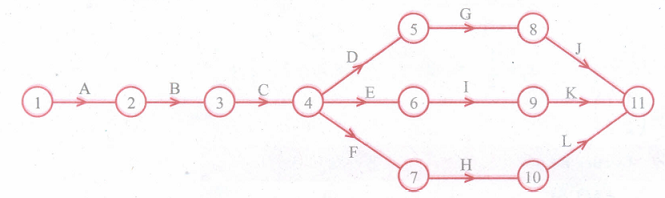
11.
Since the decision variables are non-negative, the solution lies in the I quadrant of the plane.
Consider the equations
\({ x }_{ 1 }-{ x }_{ 2 }=-1\)
| \({ x }_{ 1 }\) | 0 | 1 |
| \({ x }_{ 2 }\) | 1 | 2 |
\({ -x }_{ 1 }+{ x }_{ 2 }=0\)
| \({ x }_{ 1 }\) | 2 | 1 |
| \({ x }_{ 2 }\) | 2 | 1 |
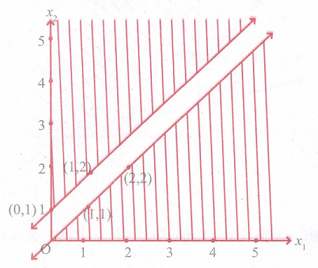
The feasible region is not common. Thus, there is no maximum value of Z.
12.
Given FV =Rs.100
Market value = 100-11+1 = Rs.90
Income=\(=\frac { \text {Investment }}{\text { MV } }\times {\text { Divicend Rate}}=\frac { 5400 }{ 90 } \times 9=Rs.540\)
\(\therefore\) Percentage of his income \(=\frac { \text {Income }}{\text { vestment } } \times 100=\frac { 540 }{ 5400 } \times 100=10\%\)
13.
Given a = Rs.500,i = 5% = 0.05,n =10
A =\(\cfrac { a }{ i } \left( 1+i \right) \left[ \left( 1+i \right) ^{ n }-1 \right] \)
\(=\frac { 500 }{ 0.05 } (1.05)\left[ (1.05)^{ 10 }-1 \right] \)
\(=10,500[1.629-1]\)
\(=10,500(0.629)\)
\(\therefore\) = Rs. 6604.50
At the end of 10 years, I will receive Rs. 6604.50.
\((1.05)^{ 10 }=10log(1.05)\)
\(=0.2120\)
Antilog of 0.2120 is 1.629
14.
The regression co-efficient are given by
bxy= \(r.\frac { { \sigma }_{ x } }{ { \sigma }_{ y } } \)and byx=\(r.\frac { { \sigma }_{ y } }{ { \sigma }_{ x } } \)
where r is the co-efficient of correlation.
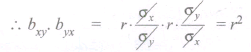
\(r=\sqrt { { b }_{ xy }.{ b }_{ yx } } \)
15.
Let the investment in each case be Rs. (16× 24)
Step 1: Income on 12% shares:
Income from 12 % Rs. 20 shares at Rs. 16
= \(\frac{12}{16}\times (16\times 24)\) = Rs. 288
Step 2: Income on 15% shares:
Income from 15% Rs. 20 Shares at Rs. 24
= \(\frac{15}{24}\times (16\times 24)\) = Rs. 240
Hence, the first investment is better.
16.
Here P = 30,000 ; a = 675 ; k = 2, i = ?
P = \({\frac{a}{{i}/k}} \)
30,000 = \(\frac{675}{\frac{i}{2}}\)
= \(\frac{1350}{i}\)
⇒ i = \(\frac{1350}{30,000}\) = \(\frac{135}{3000}\) = 0.045
Rate of interest (i) = 0.045 × 100% = 4.5%
17.
| X | \(\frac{1}{X}\) |
| 1 | 1.0000 |
| 0.5 | 2.0000 |
| 10 | 0.1000 |
| 45 | 0.0222 |
| 175 | 0.0057 |
| 0.01 | 100.0000 |
| 4.0 | 0.2500 |
| 11.2 | 0.0893 |
| \(\sum { \left( \frac { 1 }{ X } \right) } \) = 103.4672 |
n = 8
\(HM=\frac { n }{ \sum { \left( \frac { 1 }{ X } \right) } } =\frac { 8 }{ 103.467 } =0.077\)
18.
Let us consider X for price P and Y for stock S. Then the mean and SD for P is considered as \(\bar { X } \) = 100 and σx = 8 respectively and the mean and SD of S is considered as \(\bar { Y } \) = 103 and σy = 4. The correlation coefficient between the series is r(X, Y) = 0.4
Let the regression line X on Y be
\(X-\bar { X } =r\frac { { \sigma }_{ x } }{ { \sigma }_{ y } } (Y-\bar { Y } )\)
X-100 = (0.4)\(\frac{8}{4}\)(Y-103)
X–100 = 0.8(Y–103 )
X–0.8Y–17.6 = 0 (or) X = 0.8Y+17.6
The regression line Y on X be \(Y-\bar { Y } =r\frac { { \sigma }_{ y } }{ { \sigma }_{ x } } (X-\bar { X } )\)
Y-103 = (0.4)\(\frac{4}{8}\)(X-100)
Y–103 = 0.2 (X–100 )
Y–103 = 0.2 X–20
Y = 0.2 X + 83 (or) 0.2 X–Y + 83 = 0
19.
Marks are arranged in ascending order
12 15 20 28 30 40 50
n = number of observations = 7
Q1 = Size of \(\left( \frac { n+1 }{ 4 } \right) ^{th}\) value
= Size of \(\left( \frac { 7+1 }{ 4 } \right) ^{th}\) value
= Size of 2nd value = 15
Q3 = Size of \(\left( \frac { 3(n+1) }{ 4 } \right) ^{th}\) value
= Size of \(\\ \left( \frac { 3\times 8 }{ 4 } \right) ^{th}\) value
= Size of 6th value = 40
D6 = Size of \(\left( \frac { 6(n+1) }{ 10 } \right) \)th value
= Size of \(\\ \left( \frac { 6\times 8 }{ 10 } \right) ^{th}\) value
= Size of 4.8th value
= Size of 5th value = 30
P50 = Size of \(\left( \frac {50(n+1) }{ 100 } \right) ^{th}\) value
= Size of 4th value = 28
Hence Q1 = 15, Q3 = 40, D6 = 30 and P50 = 28
20.
| x | y | x2 | y2 | xy |
| 5 | 1 | 25 | 1 | 5 |
| 10 | 6 | 100 | 36 | 60 |
| 5 | 2 | 25 | 4 | 10 |
| 11 | 8 | 121 | 64 | 88 |
| 12 | 5 | 144 | 25 | 60 |
| 4 | 1 | 16 | 1 | 4 |
| 3 | 4 | 9 | 16 | 12 |
| 2 | 6 | 4 | 36 | 12 |
| 7 | 5 | 49 | 25 | 35 |
| 1 | 2 | 1 | 4 | 2 |
| \(\sum\)x = 60 | \(\sum\)y = 40 | \(\Sigma X^2=\) 494 | \(\Sigma Y^2=\) 212 | \(\Sigma XY=\) 288 |
Correlation Co-efficient r =\(\frac { N\sum { xy-(\sum { x)(\sum { y) } } } }{ \sqrt { N\sum { { x }^{ 2 }-({ \sum { x) } }^{ 2 }\times \sqrt { N{ \sum { y } }^{ 2 }-\left( { \sum { y } }^{ 2 } \right) } } } } \)
= \(\frac { 10(288)-(60)(40) }{ \sqrt { 10(494)-{ (60) }^{ 2 }\sqrt { 10(211)-{ (40) }^{ 2 } } } } \)
= \(\frac { 2880-2400 }{ \sqrt { 1340 } .\sqrt { 520 } } \)
= \(\frac { 480 }{ (36.61)(22.80) } =\frac { 480 }{ 834.71 } \)
r = 0.575
21.
i) variables:
Let x1 and x2 denote the product A and B respectively.
ii) Objective function:
Profit on x1 of the product A = 3x1
Profit on x2 of the product B = 4x2
Total profit = 3x1 + 4x2
Let Z = 3x1 + 4x2, which is the objective function. Since the total profit is to be maximized, we have to maximize Z = 3x1 + 4x2.
(iii) Constraints:
We make the following table from the given data
| Title | Requirement for A | Requirement for B | (min) Available time |
| (min) M1 | 1 min | 2 min | 7 x 60 + 30 = 450 |
| (min) M2 | 1 min | 1 min | 10 x 60 = 600 |
x1 + x2 \(\le \) 450 [\(\because\) Machine M1 is available for not more than 7 hrs 30 minutes]
2x1 + x2 \(\le \) 600 [\(\because\) Machine M2 is available for 10 hrs during any working day]
(iv) Non-negative restrictions:
Since the product A and product B are non-negative, we have x1, x2\(\ge \) 0.
Thus, we have the following linear programming model.
Maximize \(Z=3{ x }_{ 1 }+{ 4x }_{ 2 }\)
subject to the constraints
\(x_{ 1 }+{ x }_{ 2 }\le 450\)
\(2x_{ 1 }+{ x }_{ 2 }\le 600\)
\(x_1,x_2\ge0\)
22.
\(A C =2 x-11+\frac{50}{x} \)
\(\frac{d(A C)}{d x} =2-\frac{50}{x^2} \)
\(\frac{d(A C)}{d x} =0 \Rightarrow 2-\frac{50}{x^2}=0 \Rightarrow 2=\frac{50}{x^2} \)
\(x^2 =25 \Rightarrow x=\pm 5\)
The real line is divided into 2 intervals namely ( \(-\infty \), -5) (-5, 5) and (5, \(\infty \))
| Interval | Sign of \(\frac { d\left( AC \right) }{ dx } \) | Nature of function |
|---|---|---|
| (-5, 5) | -ve | Decreasing function |
| (5, \(\infty \)) | + ve | Increasing function |
| ( \(-\infty \), -5) | -ve | Decreasing function |
Average cost is increasing at x > 5
23.
(i) Variables: Let x1, x2 and x3 be the number of units of products P1, P2 and P3 to be produced.
(ii) Objective function: Profit on x1 units of the product P1 = 20 x1
Profit on x2 units of the product P2 = 25 x2
Profit on x3 units of the product P3 = 15 x3
Total profit = 20 x1 + 25 x2 + 15 x3
Since the total profit is to be maximized, we have to maximize Z = 20 x1 + 25 x2 + 15 x3
Constraints: 6x1 + 3x2 + 12x3 ≤ 200
2x1 + 5x2 + 4x3 ≤ 350
x1 + 2x2 + x3 ≤ 100
Non-negative restrictions: Since the number of units of the products A, B and C cannot be negative, we have x1, x2, x3 ≥ 0
Thus, we have the following linear programming model.
Maximize Z = 20 x1 + 25 x2 + 15 x3
Subject to 6 x1 + 3 x2 + 12 x3 ≤ 200
2x1 + 5x2 + 4x3 ≤ 350
x1 + 2x2 + x3 ≤ 100
x1, x2, x3 ≥ 0
24.
25.
\(\sin A=\frac{12}{13}\)
\(\sin 3 A=3 \sin A-4 \sin ^3 A\)
\(=3\left(\frac{12}{13}\right)-4\left(\frac{12}{13}\right)^3\)
\(=\frac{36}{13}-\frac{6912}{2197}=\frac{-828}{2197}\)
26.
LHS\(=\left\{1+\cot x-\sec\left(\frac{\pi}{2}+x\right)\right\}\left\{1+\cot x+\sec\left(\frac{\pi}{2}+x\right)\right\}\)
=(1 + cot x + cosec x) (1 + cot x - cosec x)
(1 + cot x)2 - (cosec2x) [\(\therefore\)(a + b) (a - b) = a2 - b2]
1 + cot2x + 2 cot x - cosec2x
= cosec2x + 2 cot x - cosec2x [\(\therefore\) 1 + cot2x = cosec2x]
= 2 cot x = RHS. Hence proved.
27.
We know that \(\cos^2x+\sin^2x=1\)
\(\Rightarrow\cos x=\pm\sqrt{1-\sin^2x}\)
In the III quadrant, cos x is negative
\(\therefore\cos x=-\sqrt{1-\sin^2x}=-\sqrt{1-\frac{24}{25}}=-\frac15\left[\because\sin^2x=\frac{4(6)}{25}=\frac{24}{25}\right]\)
In the III quadrant, tan x is positive
\(\therefore\tan x=\frac{\sin x}{\cos x}=\frac{-2\sqrt6}{5}\times\frac{-5}{1}=2\sqrt{6}\)
\(cosec x=\frac{1}{\sin x}=\frac{-5}{2\sqrt6}\)
\(\sec x=\frac{1}{\cos x}=-5\) and
\(\cot x=\frac{1}{\tan x}=\frac{1}{2\sqrt6}\)
28.
\(y=\sin ^{ -1 }{ \left( \sqrt { \cos { x } } \right) } \)
Differentiating with respect to 'x' we have
\(\frac { dy }{ dx } =\frac { d }{ dx } .\sin ^{ -1 }{ { \left( \cos { x } \right) }^{ \frac { 1 }{ 2 } } } =\frac { 1 }{ \sqrt { 1-{ \left( \sqrt { \cos { x } } \right) }^{ 2 } } } .\frac { d }{ dx } { \left( \cos { x } \right) }^{ \frac { 1 }{ 2 } }\)
\(=\frac { 1 }{ \sqrt { 1-\cos { x } } } .\frac { 1 }{ 2\sqrt { 1-\cos { x } } } .\frac { d }{ dx } \left( \cos { x } \right) \)
\(=\frac { 1 }{ 2\sqrt { \cos { x } } .\sqrt { 1-\cos { x } } } \left( -\sin { x } \right) =\frac { -\sin { x } }{ 2\sqrt { \cos { x } } .\sqrt { 1-\cos { x } } } \)
29.
Given lines are (b - c) x + (c - a) y + (a - b) = 0
(c - a) x + (a - b) y + (b - c) = 0
(a - b) x + (b - c) y + (c - a) = 0.
The condition for the given lines to be concurrent is
\(\left| \begin{matrix} b-c & c-a & a-b \\ c-a & a-b & b-c \\ a-b & b-c & c-a \end{matrix} \right| =0\)
Applying the elementary row transformation C1⟶C1+C2+C3
We get \(\left| \begin{matrix} 0 & c-a & a-b \\ 0 & a-b & b-c \\ 0 & b-c & c-a \end{matrix} \right| =0\)
Expanding along C1 we get
\(\left| \begin{matrix} 0 & c-a & a-b \\ 0 & a-b & b-c \\ 0 & b-c & c-a \end{matrix} \right| =0\)
Hence the given lines are Concurrent
30.
let p(x1,y1) be any point on the locus \(\therefore\) \(\sqrt { { \left( { x }_{ 1 }-4 \right) }^{ 2 }+{ \left( { y }_{ 1 }-0 \right) }^{ 2 } } =\frac { 1 }{ 2 } \left| \frac { { x }_{ 1 }-16 }{ \sqrt { { 1 }^{ 2 }+{ 0 }^{ 2 } } } \right| \)
\(\Rightarrow\)\(\sqrt { { \left( { x }_{ 1 }-4 \right) }^{ 2 }+{ y }_{ 1 }^{ 2 } } =\frac { 1 }{ 2 } \left| \frac { { x }_{ 1 }-16 }{ \sqrt { { 1 }^{ 2 }+{ 0 }^{ 2 } } } \right| \)
Squaring both sides, (x1 - 4)2 + y12 = \(\frac{1}{4}\)(x1 - 16)2
⇒ 4[x12 + 16 - 8 x1 + y12] = x12 - 32x1 + 256
⇒ 3x12 + 4y12 - 192 = 0
Locus of (x1, y1) is 3x2 + 4y2 = 192
31.
Given \(y=\sqrt { x } +\frac { 1 }{ \sqrt { x } } .\Rightarrow y=\frac { x+1 }{ \sqrt { x } } \) ......(1)
Differentiating with respect to 'x' we get,
\(\frac { dy }{ dx } =\frac { \sqrt { x } .\frac { d }{ dx } (x+1)-(x+1).\frac { d }{ dx } (\sqrt { x } ) }{ { (\sqrt { x } })^{ 2 } } \)
\(=\frac { \sqrt { x } (1)-(x+1).\frac { 1 }{ 2\sqrt { x } } }{ x } =\frac { \frac { 2x-(x+1) }{ 2\sqrt { x } } }{ x } \)
\(\frac { dy }{ dx } =\frac { 2x-x-1 }{ 2x.\sqrt { x } } =\frac { x-1 }{ 2x\sqrt { x } } \)...(2)
LHS=\(2x\left( \frac { dy }{ dx } \right) +y\)
\(=2x\left( \frac { x-1 }{ 2x\sqrt { x } } \right) +\frac { x+1 }{ \sqrt { x } }\)
[From (1) and (2)]
\(=\frac { x-1 }{ \sqrt { x } } +\frac { x+1 }{ \sqrt { x } } =\frac { x-1+x+1 }{ \sqrt { x } } =\frac { 2x }{ \sqrt { x } } =\frac { 2\sqrt { x } .\sqrt { x } }{ \sqrt { x } } =2\sqrt { x } \) = RHS.
Hence proved
32.
P(n): "n2 + n is even"
Given that P(k) is true.
\(\Rightarrow \) k2 + k is even
\(\Rightarrow \) k2 + k = 2\(\lambda \) for some \(\lambda \) ....(1)
To prove that P (k + 1) is true.
P (k + 1) : (k + 1)2+ (k + 1) is even
Consider (k + 1)2 + (k + 1)
= k2+2k+ 1 +k+ 1
= k2+2k+ 1 +k+ 1
= (k2+ k) + (2 k + 2)
= 2\(\lambda \) + 2 (k + 1) [from (1)]
= even + even
= Sum of two even numbers is always an even number .
∴ P (k + 1) is true.
33.
No. of ways of selecting 4 questions out of 6 questions (Part - I) = 6C4 = 6C2 =\(\frac { 6\times 5 }{ 1\times 2 } =15\)
No. of ways of selecting 4 questions out of 7 questions (Part - II) = 7C4 = 7C3 =\(\frac { 7\times 6\times 5 }{ 3\times 2\times 1 } =35\)
No. of ways of selecting 4 questions out of 8 questions (Part - III) = 8 C4 =\(\frac { 8\times 7\times 6\times 5 }{ 4\times 3\times 2\times 1 } =70\)
∴ Total number of choices = 15 x 35 x 70 = 36750
34.
Given equation of the parabola is
\({ y }^{ 2 }-8y-8x+24=0\)
\(\Rightarrow\) \({ y }^{ 2 }-8y=8x-24=0\)
\(\Rightarrow\)\({ y }^{ 2 }-8y+16=8x-24+16\) [Adding 16 both sides]
\(\Rightarrow { \left( y-4 \right) }^{ 2 }=8x-8\)
\(\Rightarrow { \left( y-4 \right) }^{ 2 }=8(x-1)\)
X = x - 1 and Y = y - 4, 4a = 8 \(\Rightarrow\) a = 2
\(\Rightarrow\) \(y^{ 2 }=8X\)
y2 = 8X with y2 = 4(2)X
| Referred to (x, y) | Referred to (x, y) x = x + 1, y = y + 4a | ||
|---|---|---|---|
| (i) | Vertex | (0, 0) | (1, 4) |
| (ii) | Focus | (a, 0),(2, 0) | (3, 4) |
| (iii) | Axis | Y = 0 | y = 4 |
| (iv) | Directrix | X = -a; X = -2 | x = -1; x + 1 = 0 |
| (v) | Length of latus rectum | 4a | 8 units |
35.
\(\sec \left(\frac{3 \pi}{2}-\theta\right) \sec \left(\theta-\frac{5 \pi}{2}\right) +\tan \left(\frac{5 \pi}{2}+\theta\right) \tan \left(\theta-\frac{5 \pi}{2}\right)=-1 \)
\(\operatorname{LHS}= \sec \left(\frac{3 \pi}{2}-\theta\right) \sec \left(\theta-\frac{5 \pi}{2}\right) +\tan \left(\frac{5 \pi}{2}+\theta\right) \tan \left(\theta-\frac{5 \pi}{2}\right) \)
\(= \sec \left(270^{\circ}-\theta\right) \sec \left(450^{\circ}-\theta\right) +\tan \left(450^{\circ}+\theta\right)\left(-\tan \left(450^{\circ}-\theta\right)\right) \)
\(=-\operatorname{cosec} \theta \sec \left(360^{\circ}+90^{\circ}-\theta\right) -\tan \left(360^{\circ}+90^{\circ}+\theta\right) \tan \left(360^{\circ}+90^{\circ}-\theta\right) \)
\(=-\operatorname{cosec} \theta \sec \left(90^{\circ}-\theta\right) -\tan \left(90^{\circ}+\theta\right) \tan \left(90^{\circ}-\theta\right) \)
\(=-\operatorname{cosec} \theta \operatorname{cosec} \theta+\cot \theta \cot \theta \)
\(=-\left(\operatorname{cosec}{ }^2 \theta-\cot { }^2 \theta\right)=-1 = \text { RHS } \)
Hence proved.
36.
Let A = \(\left| \begin{matrix} 2 & 7 & 65 \\ 3 & 8 & 75 \\ 5 & 9 & 86 \end{matrix} \right| \)
Applying C1➝C1+9C2 we get
A = \(\left| \begin{matrix} 2+63 & 7 & 65 \\ 3+72 & 7 & 65 \\ 5+81 & 9 & 86 \end{matrix} \right| =\left| \begin{matrix} 65 & 7 & 65 \\ 75 & 8 & 75 \\ 86 & 9 & 86 \end{matrix} \right| =0[ \because {C}_{1}\equiv{C}_{3}]\)
37.
LHS = \(\begin{vmatrix}x+a &b&c \\a &x+b&c\\a&b&x+c \end{vmatrix}\)
Applying C1 \(\rightarrow\) C1 + C2 + C3 we get,
LHS = \(\begin{vmatrix}x+a+b+c &b&c \\x+a+b+c &x+b&c\\x+a+b+c&b&x+c \end{vmatrix}\)
Taking (x + a + b + c) common from C1 we get,
= (x + a + b + c) \(\begin{vmatrix}1 &b&c \\1 &x+b&c\\1&b&x+c \end{vmatrix}\)
Applying R2 \(\rightarrow\) R2 - R1 and R3 \(\rightarrow\) R1 we get,
= \((x+a+b+c)\begin{vmatrix}1 &b&c \\0&x&0\\0&0&x\end{vmatrix}\)
Expanding along C1 we get,
\(=(x+a+b+c)\begin{bmatrix} 1\begin{bmatrix} x & 0 \\ 0 & x\end{bmatrix} +0+0\end{bmatrix}\)
= (x + a + b + C)(x2) = RHS
Hence proved.
38.
\(\frac{5 x+7}{(x-1)(x+3)}=\frac{A}{x-1}+\frac{B}{x+3}\)
\(\frac{5 x+7}{(x-1)(x+3)}=\frac{A(x+3)+B(x-1)}{(x-1)(x+3)}\)
\(\text {If } x=1 \Rightarrow 12=A(4)\)
\(\dot{A}=\frac{12}{4}=3\)
\(\text {If } x=-3\)
\(-15+7=B(-3-1)\)
\(-8=-4 B \Rightarrow B=\frac{8}{4}=2\)
\(\frac{5 x+7}{(x-1)(x+3)}=\frac{3}{x-1}+\frac{2}{x+3}\)
39.
(i) Number of one-digit numbers using 5, 6, 7, 8 and 9 is 5
(ii) Number of two-digit numbers using 5, 6, 7, 8 and 9 is 5 \(\times\) 4 = 20
(iii) Number of three-digit numbers using 5, 6, 7, 8 and 9 is 5 \(\times\) 4 \(\times\) 3 = 60
(iv) By addition principle of counting total number of numbers = 5 + 20 + 60 = 85
40.
\(\left|\begin{array}{ccc} 3 & -2 & 4 \\ 2 & 0 & 1 \\ 1 & 2 & 3 \end{array}\right|=3[0-2]+2[6-1]+4[4-0]\)
\(=-6+10+16=20\)

11th Standard Syllabus & Materials
11th Standard
TN 11th Tamil பீடு பெற நில் - செய்யுள் - காவடிச்சிந்து Important Questions And Answers Study Material - QB365 Set A
NEW11th Standard
TN 11th Tamil பீடு பெற நில் - உரைநடை - மலை இடப்பெயர்கள் : ஓர் ஆய்வு Important Questions And Answers Study Material - QB365 Set A
NEW11th Standard
TN 11th Tamil மாமழை போற்றுதும் - துணைப்பாடம் - யானை டாக்டர் Important Questions And Answers Study Material - QB365 Set A
NEW11th Standard
TN 11th Tamil மாமழை போற்றுதும் - செய்யுள் - ஐங்குறுநூறு Important Questions And Answers Study Material - QB365 Set A



Tamilnadu Stateboard 11th Standard Subjects

Maths

Commerce

Economics

Biology
Business Maths and Statistics

Accountancy

Computer Science

Physics

Chemistry
Maths
Biology
Economics
Physics
Chemistry

History
Business Maths and Statistics

Computer Science
Accountancy

Computer Applications
History
Computer Technology
Commerce
Computer Applications
Computer Technology

Tamil

English

French
Tamilnadu Stateboard Standards
