
 100% FREE ACCESS
11th Standard CBSE Syllabus & Materials
11th Standard CBSE
CBSE 11th Economics PART-A - Presentation of Data - New Sample Question Papers Study Material - QB365 Set A
NEW11th Standard CBSE
CBSE 11th Economics PART-A - Organisation of Data - New Sample Question Papers Study Material - QB365 Set A
NEW11th Standard CBSE
CBSE 11th Economics PART-A - Collection of Data - New Sample Question Papers Study Material - QB365 Set A
NEW11th Standard CBSE
CBSE 11th Economics PART-A - Introduction to Economics and Statistics - New Sample Question Papers Study Material - QB365 Set A
NEW11th Standard CBSE
CBSE 11th Business Studies International Trade Sample Question Papers Study Material - QB365 Set A
NEW11th Standard CBSE
CBSE 11th Business Studies Evolution and Fundamentals of Business Sample Question Papers Study Material - QB365 Set A

Published on: 08/10/2019
Applications of Computers in Accounting
Download CBSE Class 11th Standard CBSE Accountancy question papers, sample papers, important questions, and previous year solved papers in PDF format. Get free study materials, NCERT solutions, and exam preparation resources for Class 11th Standard CBSE Accountancy
Questions + Answers key
Take MCQ Accountancy Test
1.
An accounting report is essential a report which must be able to fulfill certain basic criteria. Explain List the various types of accounting reports?
2.
Explain using examples, the relationship between the organizational MIS and the other functional information system in an organization. Describe how AIS receives and provides information to other functional MIS.
3.
Between Manual and Computerised Accounting system.
4.
Distinguish between Computerized Accounting and Manual Accounting.
5.
Explain Generation of reports through computerised system of accounting.
6.
What is normalization? Define first normal form.
7.
What is the need for normalization? Define third normal form.
8.
How does a Laser Printer works?
9.
What are the advantages of customized software?
10.
What are the main disadvantages of computerized accounting?
1.
Data means facts, which may be numeric, textual pictorial or vocal. On the other hand, Information refers to processed data placed in a meaningful context for the uses. Processing converts data into information. When all related information is summarized to meet a particular need, it is called as report.
The context and design of the report varies according to the level it is submitted and the type of decision to made on the basis of the report. A report must be efficient, effective, accurate and relevant. It should be helpful in taking decisions. An accounting report: is essential a report which must be able to fulfil certain basic criteria, which are following:
(i) Relevance
(ii) Completeness
(iii) Accuracy
(iv) Timeliness
(vi) Summarization.
(i) Relevance: To be useful, report must be relevant to the decision-making needs of user. Report has the quality of relevance when it influences the economic decisions of the user by helping them to evaluate past, present, or future events or confirming or correcting their past evaluation.
(ii) Completeness: To be reliable, a report must be complete within the bounds of materiality and cost. An omission can cause report to be false or
misleading and thus, unreliable and deficient in terms of its relevance.
(iii) Accuracy: To be reliable and useful in decision making process, a report must be accurate i.e. it is free from error or bias or subjectivity. It must be represent true and fair description neutrally.
(iv) Timeliness: Reports must be timely to have any usefulness for decision make t If there is undue delay in reporting, it may lose its relevance. To provide report on timely basis, it may often be necessary to report before all aspects of transaction or other executes are known.
(v) Summarization: Report must be brief and comprehensive so that user can use its information timely for decision-making purpose. The following four steps are taken in designing the accounting report:
(i) Defining Objectives: The objectives of the report must be defined clearly. It must specify, who are the user and the decision to be based on the report.
(ii) Structure of the Report: The report should be complete and must be presented in a clear style.
(iii) Querying with the database: The report must specify the various information queries which are helpful in interacting with the database.
(iv) Finalizing the Report: It must have complete ending with proper suggestions of its study.
Various types of accounting Reports: The report may be routine report or specific report. For example, ledger is a routine report whereas a report generated to show the accounts of particular customer is a specific reports. Different reports serve different purposes.
(i) Demand Reports: Report generated on the demand of the management. For example, Stock Valuation Report, Bad debts reports for a given period etc.
(ii) Supplier Reports: Report generated as per the need of the management Presenting various aspects of the supplier. For example, Purchase analysis, Vendor analysis report etc.
(iii) Customer Reports: Reports generated as per need of the management depicting the top customer, list of faulty customer, list of bulk customer etc.
(iv) Exception Reports: Reports generated for some specific condition o exceptions. For example, Stock Status Report, Over Stocked Status etc.
(v) Responsibility Reports: The various reports prepared by managers responsible. For example, report regarding different aspects of sales to be submitted by the Sales manager.
(vi) Summary Reports: It is a summarized report of all the activities of are organization. For example, Balance sheet, Trail Balance etc.
2.
A management information system is an information system that generates, accurate, timely and organized information to help manager's to make decision, control process, solves problems, supervise activities and track progress. It provides information necessary to take decision and manage an organization effectively.
Managemnt information system has a link with all the functional information system in an organization, like Accounting Information System, Manufacturing Information System, Human Resource Information System, Financial Information System, Marketing Information System etc.
All the functional information system in an organization that provides the information regarding their departments to management information system and receives the orders and instructions about the decision taken by the management. The following diagram shows the relationship between organizational MIS and the other functional information system in an organization.
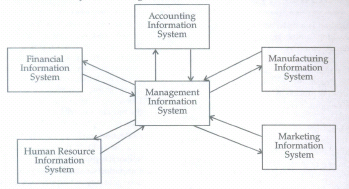
The diagram shown above entails the five widely recognized functional areas of management of an ogranisation. An organization operates in a given environment surrounded by the Government, society, suppliers and customer. The informational needs emerges from the business processes stratified into functional areas. MIS receives and provide information to the various sub-system of the ogranisation.
Accounting information system is an important sub-system of the MIS. It provides and receives information to the other functional MIS. Following examples illustrate the relationship and data interface between AlS and various sub-components of MIS :
I. Relationship between AIS, Manufacturing Information System and Human Resource Information System:
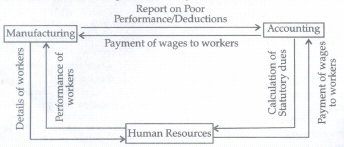
The above diagram depicts how these departments are related to each other. The human resource department sends a list and details of workers to the accounts and manufacturing departments. The manufacturing department send a report of level of production achieved by each worker and other deductions to be made from their wages to the account department as well as human resource department. The accounts department on receiving such reports make its own calculations and make the payment to the worker. It also sends the report of same to both the department i.e. HR department and manufacturing departments to monitor the performance of the worker.
II. Relationship between AIS and Marketing Information System: Market and Sales department performs following activities:
(i) Inquiry Process
(ii) Creating Contacts
(iii) Order Taking
(iv) Dispatching Goods
(v) Billing
Accounting sub-system transaction cycle includes:
(i) Processing of sales order
(ii) Credit Authorization
(iii) Keeping custody of goods
(iv) Stock position
(v) Dispatch Details
(vi) Account Receivable, etc.
III. Relationship between AIS and Manufacturing Information System- Production department perform following activities:
(i) Preparing plans, schedules
(ii) Issue of material requisition forms
(iii) Issue of job cards
(iv) Issue of stock
(v) Handling of vendor invoices
(vi) Payment to vendor/suppliers
Accounting sub-system transaction cycle includes:
(i) Processing purchases order.
(ii) Advance payment
(iii) Stock updation
(iv) Accounts payable, etc.
3.
The differences between Computerized accounting and Manual accounting are as follows:
(i) Manual accounting consists of journalizing and then posting of the same to ledgers whereas in computerized accounting system the journal entries are passed only and posting happens automatically.
(ii) Computerized accounting is subject to lesser possibility of errors as compared to manual errors.
(iii) Trial balance is required to be prepared in manual accounting to determine the arithmetical accuracy of the books of accounts whereas in computerized accounting the trial balance is automatically prepared.
(iv) Final accounts can be immediately prepared in computerized accounting at any point of time whereas in manual accounting final accounts can be prepared only after the period ends, which requires time as well.
4.
The differences between Computerized accounting and Manual accounting are as follows:
(i) Manual accounting consists of journalizing and then posting of the same to ledgers whereas in computerized accounting system the journal entries are passed only and posting happens automatically.
(ii) Computerized accounting is subject to lesser possibility of errors as compared to manual errors.
(iii) Trial balance is required to be prepared in manual accounting to determine the arithmetical accuracy of the books of accounts whereas in computerized accounting the trial balance is automatically prepared.
(iv) Final accounts can be immediately prepared in computerized accounting at any point of time whereas in manual accounting final accounts can be prepared only after the period ends, which requires time as well.
5.
After recording all the transaction in to a computerised programme for accounting, following reports can be generated quickly:
Trial Balance: After recording entries into computerised programme for accounting and posting entries into the ledger, a statement is generated by the programme showing the abstract of the balances (debit or credit) of various accounts in the ledger. This statement is known as Trial Balance.
Profit and Loss Account: Profit and Loss Account is that account which is prepared to determine the income of the enterprise for a particular accounting period. All expenses and losses (indirect expenses) are recorded in the debit side and all incomes and gains are recorded in the credit side of this account to find out the net profit or loss during the year.
Balance Sheet: Computerised programme helps in generating Balance Sheet at the end of the accounting process which shows the financial position of the business. It may be defined as a statement depicting the exact financial position of business on any date.
6.
Normalization is the process of refining the data model built by the Entity-Relationship diagram. It logically groups the data over a number of tables, which are independent and contain no unnecessary data. A table is said to be in first normal form, when it contains no repeating groups. The repeating columns or fields in an unnormalized table are removed from table and put into tables of their own. Such a table becomes dependent on the parent table from which it is derived.
7.
Normalization is defined as :
(i) Refinement of E-RModel.
(ii) Segregation of data over many entities or tables.
(iii)Normalized model converted to physical database tables.
Normalization is needed to:
(i) Improve database design.
(ii) Ensure minimum redundancy of data.
(iii) Reduce need to reorganize data when design is modified.
(iv)Removes anomalies for database activities.
A relation is said to be in third normal form if and only if it is in 2NF and if all the non-key fields of the table are independent of all other non-key fields of the same table.
8.
Laser printers are a popular type of non-impact printers, which use laser and heating technologies to print. The main advantage of laser printers is speed. Laser printers have maximum speed of printing along with maximum resolutions. So, if you want high-speed printing with very high-quality output, then you should go for laser printers.
In laser printers, a head fires a laser on the drum, to draw an inverted image of the output. The drum is charged with a negative charge on this portion. The dry positively charged ink immediately sticks on the portion of the drum, where the output was drawn. The drum rotates and transfers the image on the paper. After this, paper is passed through a heater which fixes the powdered ink on the paper. A coloured laser printer contains four toners of cyan, magenta, yellow and black (CMYK).Mixing the different amounts of these colours creates different colours. The above-stated procedure of drawing laser on the drum and coating colour is repeated with all the four colours to create the desired colour.
Due to the use of optical technology i.e. lasers, these printers achieve highest resolutions with highest speeds of printing. The speed of laser printers ranges from 12-25 pages per minute and the resolution may range from 600 dpi to 2400 dpi or more. These are of a very high cost to balance the above qualities.
Although laser printers are of a very high cost, they have least cost per print with quality. Inkjets have low costs but high maintenance as liquid inks are consumed at a faster rate. The cartridge of inkjet provides few hundred prints depending upon the type of prints, whereas lasers can produce thousands of prints from a toner of dry ink.
9.
Following are the main advantages of customized software:
(i) Easy to Operate: Customized software satisfies each and every need of the company. It leads to complete satisfaction of accounting professionals and leads to overall performance increment.
(ii) User-Friendly Environment: Customized software offers user-friendly interface, user-friendly reports and it is completely compatible with existing hardware.
(iii) Easy to Expand: Customized software is developed by keeping in view the future requirements of company. Due to this reason, it is easy to expand the software in future.
10.
Following are the main disadvantages or limitations of computerized accounting:
(i) High Cost: The computerized accounting system is a very costly system. It includes the cost of computers, peripherals and network devices. It also includes the cost of software that is to be used to automate the system. Computerized accounting also includes the cost of media that has to be used to take regular backups of data. For example, tape drives and compact disks are generally used for backup purpose.
(ii) Problem of Obsolescence: Obsolescence is the major problem of computerized accounting. The hardware and software industry is continuously growing at a rapid rate. It has been found that the size of an average hardware chip reduces to its half after every 18 months, that too without compromising on its processing power. Due to such high speed developments, new hardware devices replace the older ones. The software industry is also growing at a similar rate and newer versions of software are being introduced on routine basis. Newer versions of software require newer hardware devices to run. Therefore, the organization has to spend a considerable amount of money to purchase new hardware and software.
(iii) Dependence on Computer Accountant: Computerized accountancy requires computer accountants to record and analyse the transactions. These are the people who have complete knowledge of accounts and computers. In a computerized accounting system, a computer illiterate person cannot do anything in the system. The company is completely dependent on computer accountant for all their accounting needs. In few companies, the managers also have the knowledge of computerized accounting but most of the companies depend on computer accountants.
(iv) Problem of Security and Secrecy: The computers are not faithful machines. They just obey the commands of the person who is sitting in front of it. If a person manages to get access to the computer, he or she may harm the information stored in the computer. Several types of other problems like virus or failures may lead to data loss. Computer networks also cause security problems as the information of one computer can be accessed from the other. Very strict and careful handling of the
information is needed in computerized accounting system. This security can be implemented by using separate cabins and lock and key mechanisms or by using password mechanisms.
(v)Training Requirements: The computerized accounting system requires the training of accountants as per the software that has been installed to automate the accounting system. The duration and cost of this training varies with the type of accounting software. The customized accounting softwares are generally easy to use and require less training. In most of the cases, the training is provided by the software vendors.

11th Standard CBSE Syllabus & Materials
11th Standard CBSE
CBSE 11th Business Studies Forms of Business Organisation Sample Question Papers Study Material - QB365 Set A
NEW11th Standard CBSE
CBSE 11th Business Studies Business, Trade and Commerce Sample Question Papers Study Material - QB365 Set A
NEW11th Standard CBSE
CBSE 11th Physics Waves Sample Question Papers Study Material - QB365 Set A
NEW11th Standard CBSE
CBSE 11th Physics Kinetic Theory Sample Question Papers Study Material - QB365 Set A



CBSE 11th Standard CBSE Subjects
CBSE Standards









