
 100% FREE ACCESS
11th Standard CBSE Syllabus & Materials
11th Standard CBSE
CBSE 11th Economics PART-A - Presentation of Data - New Sample Question Papers Study Material - QB365 Set A
NEW11th Standard CBSE
CBSE 11th Economics PART-A - Organisation of Data - New Sample Question Papers Study Material - QB365 Set A
NEW11th Standard CBSE
CBSE 11th Economics PART-A - Collection of Data - New Sample Question Papers Study Material - QB365 Set A
NEW11th Standard CBSE
CBSE 11th Economics PART-A - Introduction to Economics and Statistics - New Sample Question Papers Study Material - QB365 Set A
NEW11th Standard CBSE
CBSE 11th Business Studies International Trade Sample Question Papers Study Material - QB365 Set A
NEW11th Standard CBSE
CBSE 11th Business Studies Evolution and Fundamentals of Business Sample Question Papers Study Material - QB365 Set A

Published on: 24/09/2019
Applications of Computers in Accounting
Download CBSE Class 11th Standard CBSE Accountancy question papers, sample papers, important questions, and previous year solved papers in PDF format. Get free study materials, NCERT solutions, and exam preparation resources for Class 11th Standard CBSE Accountancy
Questions + Answers key
Take MCQ Accountancy Test
1.
Give example of the relationship between a Human Resource Information System and MIS.
2.
Name three components of a Transaction Processing System.
3.
State the various essential features of an accounting report.
4.
What is Accounting Information System?
5.
Give three examples of a transaction processing system.
6.
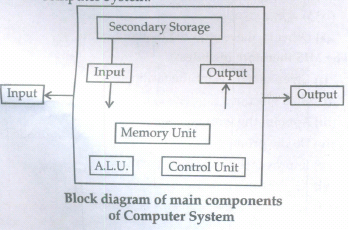
Draw block diagram showing the main components of a Computer.
7.
Lists the distinctive advantages of a computer system over a manual system.
8.
What do you mean by single-tasking and multi-tasking operating system?
9.
Explain the structure and working of CPU.
10.
Explain the Tailor-made software.
1.
MIS: Management Information System
MIS is system that provides the information necessary to take decision and manage or control an organization effectively.This system can be used at many levels by management i.e. Operational, Tacticaland Strategic, It has many other sub-system, like Accounting Information System, Human Resource Information System, Manufacturing Information System etc.
Human Resource Information System: People are the most valuable assets and resources of the organization. Human Resource Information System keeps the records of the man power that works for the organization. It keeps the full and complete records of all from owner to worker of the organization.
Relationship between a Human Resource Information System and MIS: The business process in the Human Resource department involve the following activities:
(i) Details of the worker
(ii) No. of days they work.
(iii) How long they work.
(iv) Number of workers required.
(v) Number of workers for promotion.
(vi) Any difficulties in working conditions.
(vii) Particular problem of any worker.
(viii) Training of worker
(ix) Wages to worker
(x) Other facilities required by workers etc.
The MIS therefore includes:
(i) Given sanctions for the facilities.
(ii) Give sanctions for the wage payment.
(iii) Appoint the workers required.
(iv) Do the promotion.
(v) Improves the working conditions.
(vi) Arrange the training.
(vii) Try to solve the problems of worker.
2.
Transaction Processing System (TPS) serve the organization at the operational level to perform and record the daily routine transaction which are very important to conduct business. Every transaction processing system has three components.
(i) Input
(ii) Processing
(iii) Output.

(i) Input includes the data collection and data entry.
(ii) Processing includes data editing, data validation, data manipulation and data storage.
(iii)Output includes information and reporting. Information Technology or Computer System works on principle GIGO i.e. Garbage In Garbage Out, so it is necessary that the input is accurate, complete and authorised. This can be done by automating the input.
3.
Data when processed becomes information i.e firstly data is collected from various sources and then manipulated in such a way as to provide certain information. When the related information is summarized to meet particular need, it is called as a report.
The essential features of an accounting report are following:
(i) Relevance:
To be useful, must be relevant to the decision making needs of user. Report has the quality of relevance. When it influences the economic decision of the user by helping them to evaluate past, present or future events or confirming or correcting their past evaluation.
(ii) Timeliness:
Reports must be timely to have any usefulness for decision making. If there is undue delay in reporting, it may lose its relevance. To provide report on timely basis, it may often be necessary to report before all aspects of transactionor other events are known.
(iii) Accuracy:
To be reliable and useful in decision making process a report must be accurate i.e. it is free from error or bias or subjectivity. It must represent true and fair description neutrally,
(iv) Completeness:
To be reliable, a report must be complete within the bounds of materiality and cost. An omission can cause report to be false or misleading and thus, unreliable and deficient in terms of its relevance.
(v) Summarisation:
Report must be brief and comprehensive, so that user can use its information timely for decision-making purpose.
4.
Accounting information when contained in a computerized environment is called accounting information system. It is a system that performs the enterprises accounting applications by processing high volume of data. It is widely used in profit as well as non-profit organizations because the accounting information that it provides is used not only by the accounts department but also by other departments, like production department, human resource department, market department, manufacturing department etc. Accounting information system gathers data describing the organizations activities, maintains a detailed financial record of the organizations operations, transforms the data into information and makes the information available to users both inside and outside the organization. Accounting information system processes the data of the enterprise. It collects the data, transforms the dat into information and makes the information available to the user.
An Accounting Information System is a system of collecting, processing, summarizing and reporting information about a business organization in monetary items.
5.
Transaction processing system serves the organization at the operational level for which it records the daily routine transactions which are very important to conduct business.
Examples of Transaction Processing System.
(i) Payroll Application:
Earlier they were used to run on a computer system with punched card using batch processing. Nowadays, they are running using terminals and online processing.
(ii) ATM's:
Automatic Teller Machines use a number of specialized computer programs to handle bank transactions.
(iii) Order processing:
It collects and process order from customer through mail or telephone or staff. Once order taken invoicing, Nc receivable and stock control processing applications are started.
6.
The main components of a Computer System are :
(i) Input Unit
(ii) Central Processing System
(iii) Output Unit
These are the essential building blocks of a Computer System.
7.
Advantages of Computer System over a Manual System:
(i) Speed: It refers to the amount of time taken for accomplishing a task. Computer requires far less time than human beings in performing a task. Human beings takes second or minute as unit of time whereas computer has such a fast speed that the relevant unit of time is fraction of a second.
(ii) Accuracy: Manual system can never be perfect, it can make some mistakes always but the computers are extremely accurate. This operations are error free. Most of the errors in computer system occur because of bad programming erroneous data and deviation from procedures. These errors are caused by manual system and not by computer system.
(iii) Reliability: A man may fell mental and physical fatigue after long working hours but a computer never get tired like a human being. It can work continuously and does not suffer from lack of concentration and can perform the joys of repetitive nature any number of times, in exactly the same way.
(iv) Versatility: Manual system also has the versatile nature but in comparison with computer it is very less. Computer is capable of performing a wide variety of tasks of different nature, at the same time. It can be used in business, industry, scientific, statistical technological, communication and so on. Human being can do only limited no. of tasks.
(v) Storage or Memory: It comparison of manual system, computer system has large memory, it can store any volume of information or data for being processed. It can be stored in it on permanent basis. The information stored in it can also be recalled at any time when required.
(vi) Scientific System A Computer operates scientifically and never gets emotional while solving the problems like human beings. Thus, it is clear form the above discussion that computer systems outperform the manual system.
8.
Single-tasking operating systems are those operating systems that can process one application at one time whereas, multi-tasking or multiprogramming
operating systems are those operating systems that can process more than one application at one time.
9.
The microprocessor or CPU may be considered as the brain of a computer as it performs all the processing. The CPU is mounted on "Main board" or "Mother board", which is the main circuit of computer. The CPU performs arithmetical, logical and control functions. It is connected with input! output devices, primary and secondary memories through electrical lines, known as buses.
Structure of CPU: A CPU consists of an Arithmetic and Logic Unit (ALU), Control Unit (CU) and a Memory Unit. All the arithmetic and logical operations are performed by ALU. Arithmetical operations include addition, subtraction, multiplication, division, etc. and logical operations include comparisons using various operators like greater than, less than, equals to or not equal to.
the control unit (CU) supervises and controls the working of ALU. It ensures that all the processing is occurring as per the desired schedule and in case of multiple processes, no one process is having the possession of CPU for a long time duration.
10.
Tailor-made software: Software which are developed after the discussion between the user and the developers. These software are used for special purpose. For example, software for security of data, etc.
Advantages of Tailor-made softwares:
(i) Suitable for large business houses.
(ii) Level of secrecy and authenticity is reliable.
(iii) Special training and knowledge is provided to the users.
(iv) Transactions are recorded properly with accuracy.
Limitations of Tailor-Made Softwares:
(i) Very Costly (high cost of installation and training).
(ii) Only large business houses can afford, small business houses cannot afford these software.

11th Standard CBSE Syllabus & Materials
11th Standard CBSE
CBSE 11th Business Studies Forms of Business Organisation Sample Question Papers Study Material - QB365 Set A
NEW11th Standard CBSE
CBSE 11th Business Studies Business, Trade and Commerce Sample Question Papers Study Material - QB365 Set A
NEW11th Standard CBSE
CBSE 11th Physics Waves Sample Question Papers Study Material - QB365 Set A
NEW11th Standard CBSE
CBSE 11th Physics Kinetic Theory Sample Question Papers Study Material - QB365 Set A



CBSE 11th Standard CBSE Subjects
CBSE Standards









