
 100% FREE ACCESS
11th Standard CBSE Syllabus & Materials
11th Standard CBSE
CBSE 11th Economics PART-A - Presentation of Data - New Sample Question Papers Study Material - QB365 Set A
NEW11th Standard CBSE
CBSE 11th Economics PART-A - Organisation of Data - New Sample Question Papers Study Material - QB365 Set A
NEW11th Standard CBSE
CBSE 11th Economics PART-A - Collection of Data - New Sample Question Papers Study Material - QB365 Set A
NEW11th Standard CBSE
CBSE 11th Economics PART-A - Introduction to Economics and Statistics - New Sample Question Papers Study Material - QB365 Set A
NEW11th Standard CBSE
CBSE 11th Business Studies International Trade Sample Question Papers Study Material - QB365 Set A
NEW11th Standard CBSE
CBSE 11th Business Studies Evolution and Fundamentals of Business Sample Question Papers Study Material - QB365 Set A

Published on: 24/09/2019
Anatomy of Flowering Plants
Download CBSE Class 11th Standard CBSE Biology question papers, sample papers, important questions, and previous year solved papers in PDF format. Get free study materials, NCERT solutions, and exam preparation resources for Class 11th Standard CBSE Biology
Questions + Answers key
Take MCQ Biology Test
1.
Describe in brief, structure of androecium.
2.
What changes in histology makes a stem to produce flowers?
3.
What is the difference between simple leaf and compound leaf?
4.
What is the difference and similarity between prop root and stilt root?
5.
What is the role of veins and veinlets in leaves?
6.
Define cymose inflorescence.
7.
How do the various leaf modifications help plants?
8.
Draw a labelled diagram of the following:
(a) Gram Seed
(b) V.S. of Maize Seed
9.
What is the difference between lenticels and stomata?
10.
List out the differences between intrafascicular cambium and interfascicular cambium.
11.
Distinguish between sapwood and heartwood .
12.
Explain the formation of vascular cambium.
13.
While eating peach or pear, it is usually seen that some stone-like structures get entangled in the teeth. What are these stone-like structures called?
14.
What are the charecteristic difference found in vascular tissu of gymnosperms and angiosperms?
15.
Write the characteristics of heartwood and sapwood.
1.
Androecium is composed of stamens. Each stamen which represents the male reproductive organ consists of a stalk or a filament and an anther. Each anther is usually bilobed and each lobe has two chambers, the pollen-sacs. The pollen grains are produced in pollen-sacs.
2.
The shoot apical meristem changes into floral meristem. This finally results in development of flower. Internodes do not elongate and the axis gets condensed. Nodes, in stead of producing leaves, produce different floral parts.
3.
In simple leaf lamina is usually entire and when the lamina is showing incision, the incision do not touch the midrib.
In compound leaf, the incision on lamina reach up to the midrib, which results in number of leaflets. Presence or absence of axillary bud also shows the difference between leaf and leaflets
4.
Difference. Prop roots come out of branches of the main stem and they come from greater heights. Stilt roots come out from the main stem and they come out from just above the ground.
Similarity. Both prop roots and stilt roots give additional mechanical support to the plant.
5.
Veins and veinlets are like supply channels in leaves. They transport water to leaves and take back products of photosynthesis to different parts of plants.
6.
In cymose type of inflorescence the main axis terminates in a flower, hence is limited in growth. The flowers are borne in a basipetal order. In basipetal succession older flowers are at the apex and younger flowers are near the base.
7.
Modifications of Leaves
Leaves are often modified to perform functions other than photosynthesis. Tendrils. They are converted into tendrils for climbing as in peas or into spines for defence as in cacti.
Bulb.
The fleshy leaves of onion and garlic store food.
In some plants such as Australian acacia, the leaves are small and short-lived.The petioles in these plants expand, become green and synthesise food. Leaves of certain insectivorous plants such as pitcher plant, venus-fly trap are also modified leaves.
8.
(a)
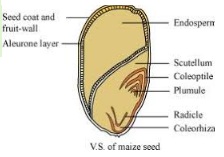
(b)
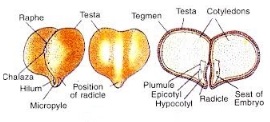
9.
Difference between lenticels and stomata are
| Lenticles | Stomata |
| These are present in old stems and roots. | they are found in young stems and leaves. |
| These are found in cork tissues. | Stomata are found in the epidermis. |
| These contain a number of complementary cells. | A stomata has two guard cells. |
| They remain open permanently. | They open and close in response to turgidity to their guard cells. |
10.
Differences between intrafascicular cambium and interfascicular cambium are
| Intra fascicular Cambium | Interfascicular Cambium |
| It is a primary meristerm. | It is secondary meristerm. |
| It is present even in the primary stem. | It develops only when secondary growth is to occur. |
| vascular cambium lies inside the vascular bundle of the stem. | Intervascular cambium is formed in between the vascular bundles. |
| It is derived from procambium of stem apical meristem. | It develops from permanent cells of medullary rays through the process of dedifferentiation. |
11.
Differences between sapwood and heartwood are
| Sapwood | Heartwood |
| It is the outer region of xylem of an old stem. | It is the central part of secondary xylem of an old stem. |
| It is light or pale coloured. | It is dark brown in colour. |
|
It conatins living xylem parenchyma |
Parenchyma has died down. |
| Tyloses areb absent . | Tyloses (sing . tylosis) which are intrusions of parenchyma cells into tracheary elements are present. |
| It is light in weight. | It is heavier. |
| It is prone to attack of insects and pathogens. | It is resistant to attack of pathogens and insects. |
12.
The portion of conjunctive parenchyma or tissue present below the phloem bundles dedifferentiates to form brick shaped cells of vascular cambium.
The process of dedifferentiation of conjuctive parenchyma spreads laterally between xylem and phloem bundles.The portion of the pericycle in contact with protoxylem also becomes meristematic.It produces a complete continuous wavy ring of vascular cambium that passes from below bundles to above the xylem bundles.
13.
Sclereids, a type of sclerenchyma.
14.
In gymnosperms , Vessel elements are not present in xylem, whereas , these are main constituents in angiosperms . In the phloem of gymnosperms, companion cells are not associated with the sieve elements . In angiosperms , companion cells are associated with the sieve elements of phloem.
15.
Heartwood It is seconadry xylem with highly lignified walls.In old trees, considerableregion of secondary xylem is dark brown due to accumulation of tanini, resins, oils, gums and other organic materials .The substances make is heart and resistant to microbes and insects.
Sapwood Sapwood is the peripheral region of secondary which is lighter in colour and involved in conduction of water and minerals from root to leaf

11th Standard CBSE Syllabus & Materials
11th Standard CBSE
CBSE 11th Business Studies Forms of Business Organisation Sample Question Papers Study Material - QB365 Set A
NEW11th Standard CBSE
CBSE 11th Business Studies Business, Trade and Commerce Sample Question Papers Study Material - QB365 Set A
NEW11th Standard CBSE
CBSE 11th Physics Waves Sample Question Papers Study Material - QB365 Set A
NEW11th Standard CBSE
CBSE 11th Physics Kinetic Theory Sample Question Papers Study Material - QB365 Set A



CBSE 11th Standard CBSE Subjects
CBSE Standards









