
 100% FREE ACCESS
11th Standard CBSE Syllabus & Materials
11th Standard CBSE
CBSE 11th Economics PART-A - Presentation of Data - New Sample Question Papers Study Material - QB365 Set A
NEW11th Standard CBSE
CBSE 11th Economics PART-A - Organisation of Data - New Sample Question Papers Study Material - QB365 Set A
NEW11th Standard CBSE
CBSE 11th Economics PART-A - Collection of Data - New Sample Question Papers Study Material - QB365 Set A
NEW11th Standard CBSE
CBSE 11th Economics PART-A - Introduction to Economics and Statistics - New Sample Question Papers Study Material - QB365 Set A
NEW11th Standard CBSE
CBSE 11th Business Studies International Trade Sample Question Papers Study Material - QB365 Set A
NEW11th Standard CBSE
CBSE 11th Business Studies Evolution and Fundamentals of Business Sample Question Papers Study Material - QB365 Set A

Published on: 09/10/2019
Animal Kingdom
Download CBSE Class 11th Standard CBSE Biology question papers, sample papers, important questions, and previous year solved papers in PDF format. Get free study materials, NCERT solutions, and exam preparation resources for Class 11th Standard CBSE Biology
Questions + Answers key
Take MCQ Biology Test
1.
Describe key features of class Mammalia. Discuss how these features enable them to be at the top of the evolutionary pyramid.
2.
Amphibians are supposed to be the linking point between aquatic and terrestrial life. Explain
3.
Discuss key difference between Animal and Plant Kingdom. Why animals can be termed advanced in terms of evolution?
4.
Describe economic importance of the largest phylum.
5.
Describe phylum Coelenterata. Give suitable examples.
6.
What are the key features of phylum Porifera? Write in detail.
7.
Give a diagrammatic representation of the Animal Kingdom based on broad features.
8.
Write short notes on following:
(a) Diploblastic and Triploblastic Organization
(b) Different types of coelom
(c) Segmentation
(d) Notochord
9.
What are the symmetries based on which animals can be classified? Describe with appropriate diagram.
10.
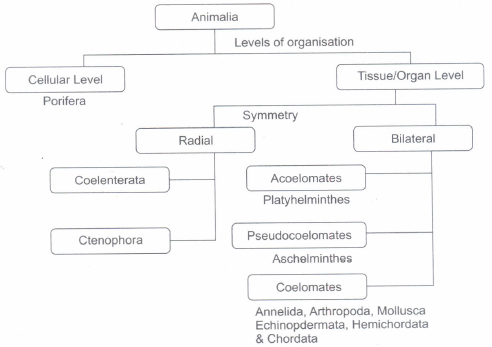
What are basis of classification of Animal Kingdom? Give detail on levels of organisation.
2
3
4
5
1.
Key Features of Mammalia
Unique Characters. The most unique mammalian characteristic is the presence of milk producing glands (mammary glands) by which the young ones are nourished. They have two pairs of limbs, adapted for walking, running, climbing, burrowing, swimming or flying. The skin of mammals is unique in possessing hair. External ears or pinnae are present. Different types of teeth are present in the jaw.
Circulatory System. The heart is four-chambered. They are homoiothermous. Respiration is by lungs.
Reproduction. Sexes are separate and fertilization is internal. They are viviparous with few exceptions and development is direct.
Mammary glands enable animals of this class in nurturing the progeny for a longer duration. This helps in preparing them in a better way in the ways and means of survival. In other words they get trained in getting food and selecting partners for reproduction.
In higher mammals forelimbs are utilized for grabbing things which enables them in handling objects. Especially in human the opposite orientation of thumb compared to other fingers help them in manipulating tools.
Larger mammals can see up to a great distance because their limbs enable them to hold their eyes on a higher plane. This helps them in sensing danger and opportunity from a greater distance so that they can react accordingly.
Presence of hair on body gives better insulation against temperature. So, most of the mammals can survive in variety of environmental conditions.
Majority of them are viviparous. This means there is lesser strain on body of the female and a longer life span for her. Moreover, this also ensures that the offspring can be of very large size.
Heart is four chambered, so there is complete segregation of oxygenated and deoxygenated blood. This is a more efficient mode of exchange of gases. This
enables mammals to do more vigorous physical activities.
Presence of teeth enables mammals to ingest more variety of food. So, mammals can be herbivorous, carnivorous and omnivorous. This enables mammals to utilize
more natural resources compared to other animals.
Presence of external ear helps them in catching sound waves from a longer distance. Once again the advantage is of sensing opportunity and danger from a larger distance. This gives ample of reaction time to mammals.
They are homoiothermous which means they can control their body temperature and don't have to depend on external environment for that. No matter what is the environmental condition.
2.
Amphibians are adapted to survive in both aquatic as well as terrestrial life. As research has proved that the life started in water and finally moved to land and air. Aquatic life has its own limitations. The area is limited and there is less variety in primary producers which limits the type of food available to the animals living in water. Specially in deep sea limited reach of sunlight doesn't permit variations of certain kind. Following paragraphs highlights certain features which amphibians developed to adapt in a terrestrial environment.
Emergence of lungs enabled frogs to breathe in air. When they are in water they breathe through skin. Some aquatic mammals, like whale need to come on surface, frequently, to breathe in oxygen which limits the time they can chase a prey underwater. So frogs are having a better mechanism to do so.
Emergence of four limbs meant frogs can travel larger distances. Their webbed fingers enable them to swim, while the stronger hind legs are used for better jump. Ease of mobility is helpful from two perspectives. One is in getting food and another is in saving from predators.
Frogs are ammonotelic which is more suitable for aquatic life. But later animals have switched over to ureotelic and urecotelic mode of excretion.
The feeding habit of frogs enables them to survive both on land as well as on water. While on land they eat small insects.
Presence of nictitating membrane over eyes allows them to swim under water. In higher animals, like mammals nictitating membrane becomes a vestigial organ showing their relationship with the aquatic life.
3.
Difference between Animals and Plants
| Animal Kingdom | Plant Kingdom |
|---|---|
| 1. Animals are heterotrophic and saprophytic mode of nutrition. | 1. Majority of plants are autotrophic, |
| 2. Animals can be primary or secondary consumers. | 2. Plants are mainly producers, except some insectivorous plants. |
| 3. Majority of animals are motile. | 3. Plants are sessile, i.e. fixed to substratum. |
| 4. Animal cells do not have cell wall. | 4. Plant cells have cell walls. |
| 5: Animal cells have smaller vacuoles. | 5. Plant cells have larger vacuoles. |
| 6. Animal cells do not have chloroplasts. | 6. Plant cells have chloroplasts. |
Evolutionary Steps
A heterotrophic lifestyle gives more choice of food to animals giving them better abilities to survive.
The motility in animals gives them an ability to spread in larger geographical area in search of better food.
For sexual reproduction animals are not dependent on other agents, while plants depend on agents for cross pollination. Reduced dependency means more opportunities to gain variations, which is important from evolutionary perspective.
Presence of cell walls in plant cells give structural rigidity but prevents exchange of many substances. In animals lack of cell walls means that cell membrane can be utilized for exchange of materials.
So, it can be easily said that from evolutionary perspective animals are more advanced.
4.
The largest phylum is Arthropoda and its economic importance is as follows:
They are major agents for cross pollination. Insects, like butterflies and honey bee facilitate cross pollination.
Honey is an important food for human.
Many crustaceans, like lobsters and prawns are part of cuisine around the world.
The red dye cochineal, produced from a Central American species of insect, was economically important to the Aztecs and Mayans.
The blood of horseshoe crabs contains a clotting agent Limulus Amebocyte Lysate which is now used to test that antibiotics and kidney machines are free of dangerous bacteria, and to detect spinal meningitis and some cancers.
Maggots of housefly are used to treat those wounds which take time to heal because of absence of blood supply.
The relative simplicity of the arthropods' body plan, allowing them to move on a variety of surfaces both on land and in water, have made them useful as models for robotics.
They are carriers of many human parasite causing diseases like malaria, filaria and sleeping sickness.
Cockroaches are one of the major nuisance as they contaminate food in kitchens.
Termites are major causes of playing havoc with wooden furnitures.
Scorpions are known for their deadly sting, which can kill human and livestock.
5.
Phylum - Coelenterata (Cnidaria)
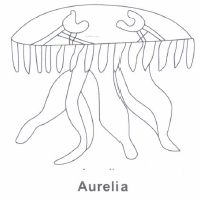
Habit and Habitat. They are aquatic, mostly marine, sessile or free-swimming, radially symmetrical animals. The name cnidaria is derived from the cnidoblasts or cnidocytes (which contain the stinging capsules or nematocytes) present on the tentacles and the body. Cnidoblasts are used for anchorage, defense and for the capture of prey.
Key Structural Features. Cnidarians exhibit tissue level of organisation and are diploblastic. They have a central gastro-vascular cavity with a single opening, hypostome. Digestion is extracellular and intracellular. Some of the cnidarians, e.g., corals have a skeleton composed of calcium carbonate.
Basic Body Forms. Cnidarians exhibit two basic body forms called polyp and medusa. Polyp is a sessile and cylindrical form like Hydra, Adamsia, etc. whereas,
medussa is umbrella-shaped and free-swimming like Aurelia or jelly fish. Those cnidarians which exist in both forms exhibit alternation of generation
(Metagenesis), i.e., polyps produce medusae asexually and medusae form the polyps sexually (e.g., Obelia).
Examples: Physalia (Portuguese man-of-war), Adamsia (Sea anemone), Pennatula (Sea-pen), Gorgonia (Sea-fan) and Meandrina (Brain coral).
6.
Phylum - Porifera
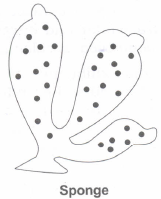
Habit and Habitat. Members of this phylum are commonly known as sponges. They are generally marine and mostly asymmetrical animals. These are primitive
multicellular animals and have cellular level of organization.
Water Transport System in Sponges. Sponges have a water transport or canal system. Water enters through minute pores (ostia) in the body wall into a central
cavity (spongocoel) from where it goes out through the osculum. This pathway of water transport is helpful in food gathering, respiratory exchange and removal of
waste. Choanocytes or collar cells line the spongocoel and the canals. Digestion is intracellular. The body is supported by a skeleton made up of spicules or
sponging fibres.
Reproduction. Sponges are hermaphrodite animals. Sexes are not separate, i.e., eggs and sperms are produced by the same individual. Sponges reproduce asexually by fragmentation and sexually by formation of gametes. Fertilization is internal and development is indirect having a larval stage which is morphologically distinct
from the adult.
Examples: Sycon, Spongilla, Euspongia.
7.
8.
(a) Diploblastic and Triploblastic Organization
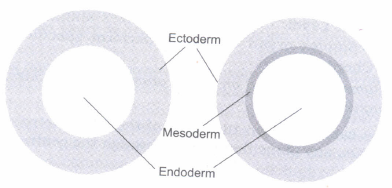
Diploblastic Organization. Animals in which the cells are arranged in two embryonic layers, an external ectoderm and an internal endoderm, are called diploblastic animals, e.g., coelenterates. An undifferentiated layer, mesoglea,
is present in between the ectoderm and the endoderm.
Triploblastic Organization. Those animals in which the developing embryo has a third germinal layer, mesoderm, in between the ectoderm and endoderm, are called triploblastic animals. Example: platyhelminthes to chordates.
(b) Coelom
Presence or absence of a cavity between the body wall and the gut wall is very important in classification. The body cavity, which is lined by mesoderm is called coelom.
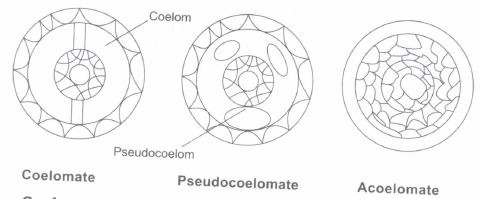
Coelomates. Animals possessing coelom are called coelomates, e.g., annelids, molluscs, arthropods, echinoderms, hemichordates and chordates.
Pseudocoelomates. In some animals, the body cavity is not lined by mesoderm, instead, the mesoderm is present as scattered pouches in between the ectoderm and endoderm. Such a body cavity is called pseudocoelom and the animals possessing them are called pseudocoelomates, e.g., aschelminthes.
Acoelomates. The animals in which the body cavity is absent are called acoelomates, e.g., platyhelminthes.
(c) Segmentation
In some animals, the body is externally and internally divided into segments with a serial repetition of at least some organs. For example, in earthworm, the body shows this pattern called metameric segmentation and the phenomenon is known as metamerism.
(d) Notochord
Notochord is a mesodermally derived rod-like structure formed on the dorsal side during embryonic development in some animals. Animals with notochord are called chordates and those animals which do not form this structure are called non-chordates, e.g., porifera to echinoderms.
9.
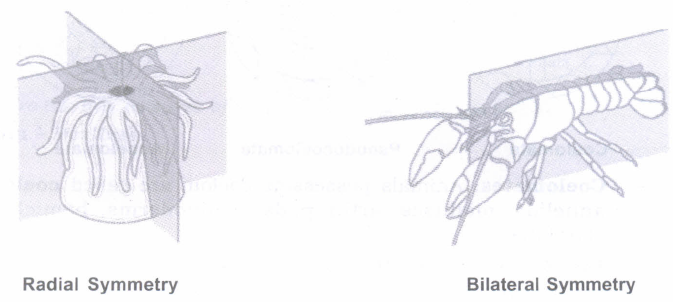
Animals can be categorized on the basis of their symmetry. Sponges are mostly asymmetrical, i.e., any plane that passes through the centre does not divide them into equal halves.
Radial Symmetry. When any plane passing through the central axis of the body divides the organism into two identical halves, it is called radial symmetry. Coelenterates, ctenophores and echinoderms have this kind of body plan.
Bilateral Symmetry. In certain animals the body can be divided into identical left and right halves in only one plane and this type of symmetry is called bilateral symmetry. Examples: Annelids, Arthropods, Mammals
10.
Basis of Classification is as follows:
Level of Organisation
Symmetry
Layers of Cells
Presence or Absence of Coelom
Segmentation
Presence or Absence of Notochord
Levels of Organisation
Cellular Level : In some multicellular animals, the cell is responsible for all the metabolic activities in the animal body. This type of organisation of function is termed as cellular level of organisation.
Tissue Level : In certain animals cells performing the same function are arranged in a group. Example: Coelenterates.
Organ Level : Some animals form specialized organs for specific functions. Example: Platyhelminthes.
Organ System Level : In higher and complex animals various organs group to form a complex organ system to perform specific function. Example: Molluscs, Chordata

11th Standard CBSE Syllabus & Materials
11th Standard CBSE
CBSE 11th Business Studies Forms of Business Organisation Sample Question Papers Study Material - QB365 Set A
NEW11th Standard CBSE
CBSE 11th Business Studies Business, Trade and Commerce Sample Question Papers Study Material - QB365 Set A
NEW11th Standard CBSE
CBSE 11th Physics Waves Sample Question Papers Study Material - QB365 Set A
NEW11th Standard CBSE
CBSE 11th Physics Kinetic Theory Sample Question Papers Study Material - QB365 Set A



CBSE 11th Standard CBSE Subjects
CBSE Standards









