
 100% FREE ACCESS
11th Standard CBSE Syllabus & Materials
11th Standard CBSE
CBSE 11th Economics PART-A - Presentation of Data - New Sample Question Papers Study Material - QB365 Set A
NEW11th Standard CBSE
CBSE 11th Economics PART-A - Organisation of Data - New Sample Question Papers Study Material - QB365 Set A
NEW11th Standard CBSE
CBSE 11th Economics PART-A - Collection of Data - New Sample Question Papers Study Material - QB365 Set A
NEW11th Standard CBSE
CBSE 11th Economics PART-A - Introduction to Economics and Statistics - New Sample Question Papers Study Material - QB365 Set A
NEW11th Standard CBSE
CBSE 11th Business Studies International Trade Sample Question Papers Study Material - QB365 Set A
NEW11th Standard CBSE
CBSE 11th Business Studies Evolution and Fundamentals of Business Sample Question Papers Study Material - QB365 Set A

Published on: 21/09/2019
Animal Kingdom
Download CBSE Class 11th Standard CBSE Biology question papers, sample papers, important questions, and previous year solved papers in PDF format. Get free study materials, NCERT solutions, and exam preparation resources for Class 11th Standard CBSE Biology
Questions + Answers key
Take MCQ Biology Test
1.
Give a schematic diagram showing basic architecture of a chordate.
2.
What do you understand by direct and indirect development?
3.
Which is the first phylum showing a closed circulatory system? What are the advantages of a closed circulatory system over open circulatory system?
4.
What are the differences between incomplete digestive system and complete digestive system?
5.
On the basis of which characters you can say that Aschelminthes are more advanced compared to Platyhelminthes?
6.
Give a description of the water vascular system in Echinodermata.
7.
Draw a diagram showing coelomate, acoelomate and pseudocoelomate in transverse section.
8.
What flight adaptations are present in birds?
9.
What are the sense organs present in class-Mollusca? How do respiration and excretion occurs in these?
10.
List out any six general features of cartilaginous fishes
11.
Differentiate between notochord and nerve cord
12.
What are the difficulties that you would face in classification of animals, if common fundamental features are not taken into account?
13.
How useful is the study of the nature of body cavity and coelom in the classification of animals?
14.
Organ system in different groups of animals exhibits various patterns of complexities. Explain
15.
Could the number of eggs or young ones produced by an oviparous and viviparous mother be equal? Why?
1.
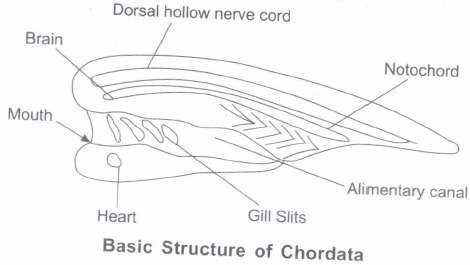
2.
In direct development the embryo directly develops into an adult, while in indirect development there is an intermediate larval stage. Certain members of Arthropods show larval stage of development.
3.
Annelida is the first phylum showing a closed circulatory system. In open circulatory system blood is directly supplied to tissues. In closed circulatory system special tubes are in place to circulate blood. This is more efficient in circulating blood in larger and complex organisms. So all higher organisms have closed circulatory system.
4.
(a) In incomplete digestive system there is single opening for ingestion of food and for expulsion of waste products, while in complete digestive system there are separate openings for ingestion of food and expulsion of waste products.
(b) Animals with incomplete digestive system cannot segregate food from waste materials, while there is complete segregation of them in complete digestive system.
5.
(a) Platyhelminthes are acoelomate, while Aschelminthes are pseudocoelomates. This indicates development of mesoderm.
(b) In Platyhelminthes both sexes are on the same animal, while in Aschelminthes there is segregation of sexes. This shows another point of evolution.
6.
Water Vascular System of Echinodermata. The water vascular system is a hydraulic system used by echinoderms, such as starfish and sea urchins, for locomotion, food and waste transportation, and respiration. The system is composed of canals connecting numerous tube feet. Echinoderms move by alternately contracting muscles that force water into the tube feet, causing them to extend and push against the ground, then relaxing to allow the feet to retract.
7.
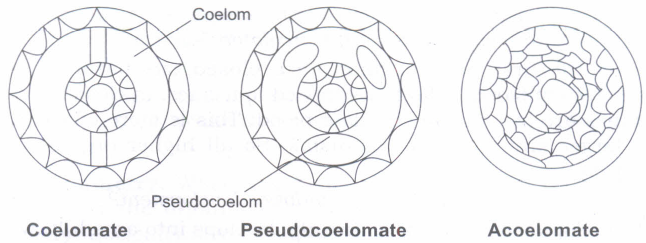
8.
Flight adaptations found in birds
(i) Body is streamlined to reduce air resistance during flight
(ii) Forelimbs are modified into wings
(iii) Wings have long quill feathers to increase the efficiency of beating of wings
(iv) Pneumatic bones are present to reduce the body weight
(v) High metabolic rate to provide energy for flight
(vI) Air sacs present in lungs help in double respiration
9.
Members of class-Mollusca have eyes, statocyst, tentacles for equilibrium and receptors for touch, smell and taste. Respiration occurs through lungs and feather like gills, while excretion occurs by a pair of metanephridia or organs of Bojanus or Keber's organs.
10.
Features of cartilaginous fishes
(i) Cartilaginous endoskeleton is present
(ii) These are mostly marine, poikilothermic animals
(iii) Notochord is persistent throughout the life
(iv) Placoid scales are present
(v) Heart is two-chambered with one auricle and ventrical
(vi) Tail fin is always heterocercal
11.
Difference between notochord and nerve cord are as follows
| Notochord | Nerve cord |
| It is a solid ensheathed dorsal rod of large cartilaginous tissue | It is a bundle of nerve fibres with chains of ganglia, generally running ventrally |
| It occurs in chordates | It occurs in invertebrates |
| It provides support and point of attachment to muscles | It gives rise to peripheral nerves |
| In vertebrates, it forms the axial skeleton | It forms a major part of nervous system. |
12.
The difficulties that will be faced if common fundamental features are not taken into account are as follows
(i) The interrelationship among different animals cannot be traced.
(ii) The picture of all animals at a glance cannot be projected
(iii) The development of other animal species cannot be made.
(iv) There are numerous animal species which show great variety of life. The various common fundamental characters are taken into account for the classification of these animals. If this has not been separately at individual level. Therefore, a classification has to be based on the common fundamental characters for the sake of study of diversity in living forms.
13.
Presence or absence of a cavity between the body wall and the gut wall is very important in classification. The body cavity which is lined by mesoderm is called coelom.
(i) Animals possessing coleom are called coelmate , e.g annelids, molluscs , arthropods, echinoderms, hemichordates and chordates.
(ii) In some, animals, the body cavity id not mesoderm, instead the mesoderm is present as scattered pouchesin between the ectoderm and endoderm. Such a body possessing them are called pseudocoelomates, e.g aschelminthes .
(iii) The animals in which the body cavity is absent are known as acoelomates, e.g plathyhelminthes . This helps, in assigning the excat taxonomic position of the animal on the basis of its presence or absence in the animal's body
14.
In animals like annelids, arthropods, molluses, echinoderms and chordates, organs have associated to form functional systems , where each system is concerned with a specific physiological function. This pattern is called organ system level of organisation. Organ systems in different groups of animlas exhibit various patterns of complexities.
For example the digestive system in Platyhelminthes has only a single opening to the outside of the body that serves as both both mouth and anus and is hence called incomplete. A complete digestive system has two separate opening , mouth and anus
15.
Viviparous animals: Viviparous animals are those animals in which both the fertilization (i.e. the fusion of male and female gametes) of egg that results in zygote and development of embryo take place inside the body of the female in the mother's womb.
These animals give birth to young ones directly.
Examples – mammals such as cows, goats, dogs, humans, etc.
Oviparous animals: Oviparous animals are those animals in which both the process of development of embryos take place outside the body of the female.
a) In oviparous animals fertilization can occur inside the mother’s body or outside the mother’s body.
b) Oviparous animals lay eggs outside their body. Example – birds, hen, frogs, etc.
Number of eggs or young ones produced by the oviparous and viviparous can be equal or not:
a) No, the number of eggs or young ones produced by an oviparous and viviparous mother cannot be equal.
b) The number of eggs laid by the oviparous animals are always more in number than the young ones produced by viviparous animals.
c) This is because the events of fertilization or development of embryos takes place outside the mother’s body so there are more chances that the eggs will get damaged prior to fertilization or development. So, to ensure the complete development of at least one embryo, oviparous animals lay more numbers of eggs than viviparous animals.
d) On the other hand in viviparous animals fertilization and development of embryos both occur inside the body of the female so there are 100% of its development.

11th Standard CBSE Syllabus & Materials
11th Standard CBSE
CBSE 11th Business Studies Forms of Business Organisation Sample Question Papers Study Material - QB365 Set A
NEW11th Standard CBSE
CBSE 11th Business Studies Business, Trade and Commerce Sample Question Papers Study Material - QB365 Set A
NEW11th Standard CBSE
CBSE 11th Physics Waves Sample Question Papers Study Material - QB365 Set A
NEW11th Standard CBSE
CBSE 11th Physics Kinetic Theory Sample Question Papers Study Material - QB365 Set A



CBSE 11th Standard CBSE Subjects
CBSE Standards









