
 100% FREE ACCESS
11th Standard CBSE Syllabus & Materials
11th Standard CBSE
CBSE 11th Economics PART-A - Presentation of Data - New Sample Question Papers Study Material - QB365 Set A
NEW11th Standard CBSE
CBSE 11th Economics PART-A - Organisation of Data - New Sample Question Papers Study Material - QB365 Set A
NEW11th Standard CBSE
CBSE 11th Economics PART-A - Collection of Data - New Sample Question Papers Study Material - QB365 Set A
NEW11th Standard CBSE
CBSE 11th Economics PART-A - Introduction to Economics and Statistics - New Sample Question Papers Study Material - QB365 Set A
NEW11th Standard CBSE
CBSE 11th Business Studies International Trade Sample Question Papers Study Material - QB365 Set A
NEW11th Standard CBSE
CBSE 11th Business Studies Evolution and Fundamentals of Business Sample Question Papers Study Material - QB365 Set A

Published on: 13/08/2019
Bio-molecules
Download CBSE Class 11th Standard CBSE Biology question papers, sample papers, important questions, and previous year solved papers in PDF format. Get free study materials, NCERT solutions, and exam preparation resources for Class 11th Standard CBSE Biology
Questions + Answers key
Take MCQ Biology Test
1.
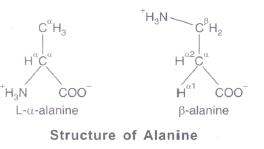
Draw the structure of the amino acid, alanine.
2.
Why is living state a non-equilibrium steady-state?
3.
Account for the following. Phospholipids form a thin layer on the surface of an aqueous medium.
4.
Give any two examples of derived lipids.
5.
Give the basic representation\(\frac { dP }{ dt } \) of rate of a chemical reaction.Also define the same
6.
Oil does not dissolve in water.Give scientific explanation.
7.
Why does starch turn blue black with iodine?
8.
The macromolecules that form the hereditary determinants of the living organism. Name it.
9.
Name of any two aromatic amino acids.
10.
Mention four essential major elements of life.
11.
What is the term to ribonucleic acid with catalytic power?
12.
Describe the mechanism of enzymatic action.
13.
What are factors which affect action of enzyme? What is lock and key model and induced fit model?
14.
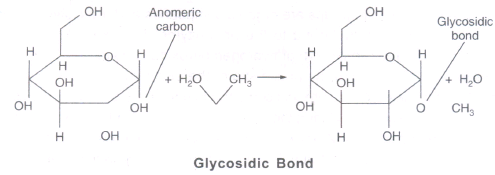
Illustratea glycosidic, peptide and a phosphodiester bond.
15.
(i) Identify the structure shown in figure.
(ii) Write the measurement (distance) of the parts marked (A), (B), (C).
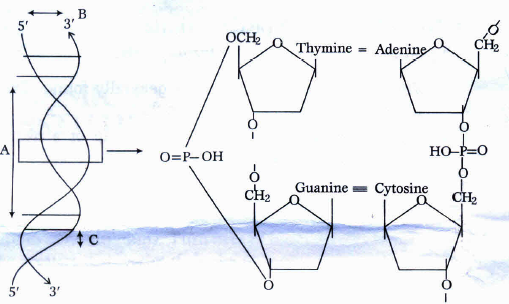
(iii) How many H-bonds are there at the place marked as(6)?
(iv) Which form of DNA is shown in the figure?
(v) Whether B type DNA has left-handed spiral structure or right-handed?
16.
Which of the following is not a macromolecule?
Protein
Polysachharide
Lipid
DNA
17.
Which of the following defines the living state?
Non-equilbriurn steady state
Equilibrium steady state
Non-equilibrium non-steady state
Equilibrium non-steady state
18.
The fact that all biomolecules undergo turnover is known as _____.
Catabolism
Anabolism
Metabolism
All of the above
19.
Primary metabolites are always found in animal cells. Which of the following is not an example of primary metabolite?
Amino acids
Sugar
Carbohydrate
Alkaloids
20.
Which is the first step in analysis of biomolecules?
Precipitation
Extraction
Staining
Reagent Reaction
21.
Explain classification of enzymes.
22.
Define living state.
23.
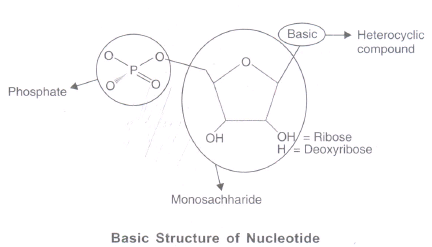
Explain the basic structure of a nucleotide.
1.
2.
A system at equilibrium cannot work. But, living organisms have to work continuously and cannot afford to reach equilibrium, so living state is a non-equilibrium steady-state.
3.
The hydrocarbon chains of the two fatty acid function as hydrophobic non-polar tails of the phospholipid molecule. The phosphate and the additional group behave as hydrophilic polar head of the molecule. In the aqueous medium, the phospholipid molecules arrange themselves to form a thin double layer. The polar hydrophilic heads of the molecules form the two surfaces which are in contact with water. The hydrophobic or non-polar tails of the phospholipid molecules are towards the centre of the bilayer.
4.
Terpenes, steroids and carotenoids are examples of derived lipids.
5.
Rate of a chemical reaction refers to the amount of product formed per unit time
It is represented as Rate =\(\frac { dP }{ dt } \)
6.
Oil is non-polar and is not attracted to water.so oil is not soluble in water
7.
Appearance of blue colour with the addition of iodine is due to its reaction with amylose of starch.
8.
Nucleic acid : All the hereditary information is stored in the DNA.
9.
Tyrosine and tryptophan are the two aromatic amino acids.
10.
Oxygen, carbon, hydrogen and nitrogen are the four basic essential elements of life.
11.
These are called ribozymes. Ribozymes are molecules of ribonucleic acid with catalytic activity.
12.
Mechanisms of Enzymatic Actions
i) Lowering the activation energy by creating an environment in which the transition state is stabilized (e.g. straining the shape of a substrate by binding the transition-state conformation of the substrate/product molecules, the enzyme distorts the bound substrate(s) into their transition state form, thereby reducing the amount of energy required to complete the transition).
ii) Lowering the energy of the transition state, but without distorting the substrate, by creating an environment with the opposite charge distribution to that of the transition state.
iii) Providing an alternative pathway: For example, temporarily reacting with the substrate to form an intermediate ES complex, which would be impossible in the absence of the enzyme.
iv) Reducing the reaction entropy change by bringing substrates together in the correct orientation to react. Considering \({ \Delta H }_{ \div }^{ \div }\) alone overlooks this effect.
v) Increases in temperatures speed up reactions. Thus, temperature increases help the enzyme function and develop the end product even faster. However, if heated too much, the enzyme's shape deteriorates and only when the temperature comes back to normal does the enzyme regain its shape. Some enzymes like thermolabile enzymes work best at low temperatures.
The catalytic cycle of an enzyme action can be described in the following steps:
1. First, the substrate binds to the active site of the enzyme, fitting into the active site.
2. The binding of the substrate induces the enzyme to alter its shape, fitting more tightly around the substrate.
3. The active site of the enzyme, now in close proximity of the substrate breaks the chemical bonds of the substrate and the new enzyme- product complex is formed.
4. The enzyme releases the products of the reaction and the free enzyme is ready to bind to another molecule of the substrate and run through the catalytic cycle once again.
13.
Factors Affecting Enzymatic Action
Temperature and pH.
Enzymes generally function in a narrow range of temperature and pH. Each enzyme shows its highest activity at a particular temperature and pH called the optimum temperature and optimum pH. Activity declines both below and above the optimum value. Low temperature preserves the enzyme in a temporarily inactive state whereas high temperature destroys enzymatic activity because proteins are denatured by heat.
Concentration of Substrate.
With the increase in substrate concentration, the velocity of the enzymatic reaction rises at first. The reaction ultimately reaches a maximum velocity (Vmax) which is not exceeded by any further rise in concentration of the substrate. This is because the enzyme molecules are fewer than the substrate molecules and after saturation of these molecules, there are no free enzyme molec.ules to bind with the additional substrate molecules.
Effect of Inhibitor.
The activity of an enzyme is also sensitive to the presence of specific chemicals that bind to the enzyme. When the binding of the chemical shuts off enzyme activity, the process is called inhibition and the chemical is called an inhibitor. When the inhibitor closely resembles the substrate in its molecular structure and inhibits the activity of the enzyme, it is known as competitive inhibitor. Due to its close structural similarity with the substrate, the inhibitor competes with the substrate for the substrate binding site of the enzyme. Consequently, the substrate cannot bind and as a result, the enzyme action declines, e.g., inhibition of succinic dehydrogenase by malonate which closely resembles the substrate succinate in structure. Such competitive inhibitors are often used in the control of bacterial pathogens.
"Lockand Key" Model:
Enzymes are very specific, and it was suggested by Emil Fischer in 1894 that this was because both the enzyme and the substrate possess specific complementary geometric shapes that fit exactly into one another. This is often referred to as "the lock and key" model. However, while this model explains enzyme specificity, it fails to explain the stabilization of the transition state that enzymes achieve. The "lock and key" model has proven inaccurate, and the induced fit model is the most currently accepted enzyme-substrate-coenzyme figure.
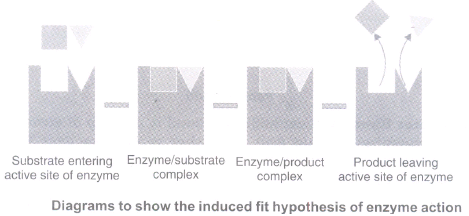
Induced Fit Model
In 1958, Daniel Koshland suggested a modification to the lock and key model: since enzymes are rather flexible structures, the active site is continually reshaped by interactions with the substrate as the substrate interacts with the enzyme. As a result, the substrate does not simply bind to a rigid active site; the amino acid side chains which make up the active site are molded into the precise positions that enable the enzyme to perform its catalytic function. In some cases, such as glycosidases, the substrate molecule also changes shape slightly as it enters the active site. The active site continues to change until the substrate is completely bound, at which point the final shape and charge is determined.
14.
A glycosidic bond is a certain type of functional group that joins a carbohydrate (sugar) molecule to another group, which mayor may not be another carbohydrate.
A peptide bond (amide bond) is a chemical bond formed between two molecules when the carboxyl group of one molecule reacts with the amine group of the other molecule, thereby releasing a molecule of water (H2O). This is a dehydration 'synthesis reaction (also known as a condensation reaction) and usually occurs between amino acids. The resulting CO-NH bond is called a peptide bond, and the resulting molecule is an amide. The four-atom functional group -C(=O) NH-is called an amide group or (in the context of proteins) a peptide group. Polypeptides and proteins are chains of amino acids held together by peptide bonds, as is the backbone of PNA. Polyamides, such as nylons and aramids, are synthetic molecules (polymers) that possess peptide bonds.
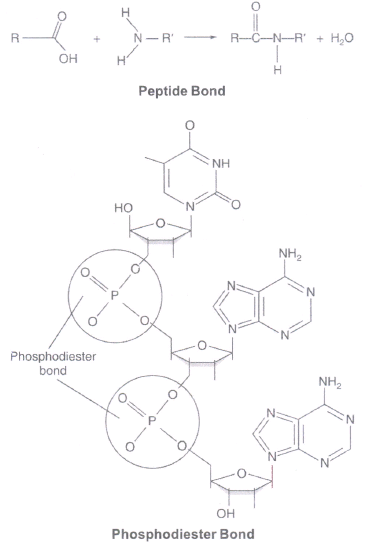
A phosphodiester bond is a group of strong covalent bonds between a phosphate group and two other molecules over two ester bonds. Phosphodiester bonds are central to all life on Earth, as they make up the backbone of the strands of DNA. In DNA and RNA, the phosphodiester bond is the linkage between the 3' carbon atom of one sugar molecule and the 5' carbon of another, deoxyribose in DNAand ribose in RNA.
15.
(i) Double helix model of DNA (Waston-Crick model of DNA).
(ii) (A) 2 nm
(B) 3.4 nm
(C) 0.34 nm.
(iii) The bonds between C and G are three.
(iv) This is B-form of DNA.
(v) B-DNA is right - handed spiral structure.
16.
(c)
Lipid
17.
(a)
Non-equilbriurn steady state
18.
(c)
Metabolism
19.
(d)
Alkaloids
20.
(b)
Extraction
21.
Classification and Nomenclature of Enzymes
Thousands of enzymes have been discovered, isolated and studied. Most of these enzymes have been classified into different groups based on the type of reactions they catalyse. Enzymes are divided into 6 classes each with 4 -13 subclasses and named accordingly by a four-digit number.
Oxidoreductases/ dehydrogenases.
Enzymes which catalyse oxidoreduction between two substrates S and S'.
Transferases.
Enzymes catalysing a transfer of a group, G (other than hydrogen) between a pair of substrate Sand S'.
Hydrolases.
Enzymes catalysing hydrolysis of ester, ether, peptide, glycosidic, C-C, C-halide or P-N bonds.
Lyases.
Enzymes that catalyse removal of groups from substrates by mechanisms other than hydrolysis leaving double bonds.
Isomerases.
Includes all enzymes catalysing inter-conversion of optical, geometric or positional isomers.
Ligases.
Enzymes catalysing the linking together of 2 compounds, e.g., enzymes which catalyse the joining of C-O, C-S, C-N, P-O etc. bonds.
22.
The most important fact of biological systems is that all living organisms exist in a steady-state characterised by concentrations of each of these biomolecules. These biomolecules are in a metabolic flux. Any chemical or physical process moves spontaneously to equilibrium. The steady state is a non-equilibrium state. As living organisms work continuously, they cannot afford to reach equilibrium. Hence the living state is a non-equilibrium steady-state to be able to perform work; living process is a constant effort to prevent falling into equilibrium. This is achieved by energy input. Metabolism provides a mechanism for the production of energy. Hence the living state and metabolism are synonymous. Without metabolism, there cannot be a living state.
23.
A nucleotide is a building block of nucleic acids. A nucleotide has following components:
(a) A heterocyclic compound (base)
(b) A monosaccharide, and
(c) A phosphoric acid or a phosphate.

11th Standard CBSE Syllabus & Materials
11th Standard CBSE
CBSE 11th Business Studies Forms of Business Organisation Sample Question Papers Study Material - QB365 Set A
NEW11th Standard CBSE
CBSE 11th Business Studies Business, Trade and Commerce Sample Question Papers Study Material - QB365 Set A
NEW11th Standard CBSE
CBSE 11th Physics Waves Sample Question Papers Study Material - QB365 Set A
NEW11th Standard CBSE
CBSE 11th Physics Kinetic Theory Sample Question Papers Study Material - QB365 Set A



CBSE 11th Standard CBSE Subjects
CBSE Standards









