
 100% FREE ACCESS
11th Standard CBSE Syllabus & Materials
11th Standard CBSE
CBSE 11th Economics PART-A - Presentation of Data - New Sample Question Papers Study Material - QB365 Set A
NEW11th Standard CBSE
CBSE 11th Economics PART-A - Organisation of Data - New Sample Question Papers Study Material - QB365 Set A
NEW11th Standard CBSE
CBSE 11th Economics PART-A - Collection of Data - New Sample Question Papers Study Material - QB365 Set A
NEW11th Standard CBSE
CBSE 11th Economics PART-A - Introduction to Economics and Statistics - New Sample Question Papers Study Material - QB365 Set A
NEW11th Standard CBSE
CBSE 11th Business Studies International Trade Sample Question Papers Study Material - QB365 Set A
NEW11th Standard CBSE
CBSE 11th Business Studies Evolution and Fundamentals of Business Sample Question Papers Study Material - QB365 Set A

Published on: 30/09/2019
Biological Classification
Download CBSE Class 11th Standard CBSE Biology question papers, sample papers, important questions, and previous year solved papers in PDF format. Get free study materials, NCERT solutions, and exam preparation resources for Class 11th Standard CBSE Biology
Questions + Answers key
Take MCQ Biology Test
1.
Give a brief account of reproduction in fungi
2.
Describe various classes of fungi.Give details of their key characteristics.
3.
What are the benefits of a five kingdom classification over a two kingdom classification?
4.
Briefly describe the components of a typical bacteria cell
5.
How do viruses resemble non - living things?
6.
Give a brief account of viruses with respect to their structure and nature of genetic materials. Also, name four common viral diseases.
7.
Write difference between ascocarp and basidiocarp
8.
Describe the cell structure of fungus in details
9.
What is three domain system? Who introduced it? Name these domains and their salient features.
10.
Biological classification is a dynamic and ever-evolving phenomenon which keeps changing with our understanding of life forms. Justify the statements by taking any two examples.
1.
Reproduction in Fungi. Reproduction in fungi can be vegetative, asexual or sexual.
(a) Vegetative Reproduction. Reproduction in fungi can take place by vegetative means - fragmentation, fission and budding.
(b) Asexual Reproduction.Asexual reproduction is by spores called conidia or sporangiospores or zoospores.
(c) Sexual Reproduction. Sexual reproduction is by oospores, ascospores and basidiospores. The various spores are produced in distinct structures called fruiting bodies.
The sexual cycle involves the following three steps:
(i) Plasmogamy. Fusion of protoplasms between two motile or non-motile gametes is called plasmogamy.
(ii) Karyogamy. Fusion of two nuclei is called karyogamy.
(iii) Meiosis in zygote resulting in haploid spores.When a fungus reproduces sexually, two haploid hyphae of compatible mating types come together and fuse. In some fungi the fusion of two haploid cells immediately results in diploid cells (2n).However, in other fungi (ascomycetes and basidiomycetes), an intervening dikaryotic stage (n + n i.e. two nuclei per cell) occurs; such a condition is called a dikaryon and the phase is called dikaryophase of fungus.Later, the parental nuclei fuse and the cells become diploid.The fungi form fruiting bodies in which reduction division occurs, leading to formation of haploid spores.
2.
Division of Kingdom Fungi :
The morphology of the mycelium, mode of spore formation and fruiting bodies form the basis for the division of the kingdom into various classes.
a) Phycomycetes :
Habit and Habitat : Members of phycomycetes are found in aquatic habitats and on decaying wood in moist and damp places or as obligate parasites on plants.
Mycelium : The mycelium is aseptate and coenocytic.
Reproduction : Asexual reproduction takes place by zoospores (motile) or by aplanospores (non-motile).
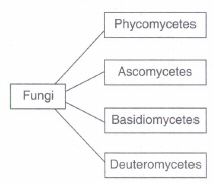
b) Ascomycetes :
Habit and Habitat : Commonly known as sac-fungi,the ascomycetes are unicellular, e.g.yeast (Sacharomyces) or multicellular, e.g.Penicillium.They are saprophytic, decomposers, parasitic or coprophilous (growing on dung).
Mycelium : Mycelium is branched and septate.
Reproduction : The asexual spores are conidia, produced exogenously on the special mycelium called conidiophores.
c) Basidiomycetes :
Habit and Habitat : Commonly known forms of basidiomycetes are mushrooms, bracket fungi or puffballs. They grow in soil, on logs and tree stumps and in living plant bodies as parasites, e.g., rusts and smuts.
Mycelium : The mycelium is branched and septate.
Reproduction : The asexual spores are generally not found, but vegetative reproduction by fragmentation is common.
d) Deuteromycetes :
Habit and Habitat : Some members are saprophytes or parasites while a large number of them are decomposers of litter and help in mineral cycling. Some examples are Alternaria, Colletotrichum and Trichoderma.
Reproduction : The deuteromycetes reproduce only by asexual spores known as conidia. The mycelium is septate and branched.
3.
Two kingdom classification was unable to accommodate certain living beings as they neither had properties of animals nor of plants.Through two kingdom classification it was not possible to include every set of characters in a particular kingdom.
Five kingdom classification could accommodate more set of characters.As a result it was easier to categorize all living beings.
For example bacteria can be autotrophic as well as heterotrophic.It was a difficult question to categorize them either under plant or animal.A separate kingdom was the most logical choice.
Similarly, viruses are a borderline case between living and non-living.When they don,t get host then they behave like a non-living.Once, inside a host they spring to life. Although the five kingdom classification does not have room for virus but it opened the way for a better and more inclusive system of classification.
4.
A bacterial cell consists of following components
Cell envelope : It is the outer covering of protoplasm of bacterial cell. It contains mucilage sheath, cell wall and plasma membrane.
Cytoplasm : It is a crystallo - colloidal complex that forms the protoplasm excluding its nucleoid. Membrane bound cell organelles are absent. Cytoplasm along with nucleoid are together called as protoplasm.
Nucleoid : It represents the genetic material of prokaryotes. Nucleoid consists of a single circular strand of DNA duplex which is super coiled with the help of RNA. No nuclear envelope is present.
Plasmids : these are self-replicating , extrachromosomal segments of double-stranded, circular, naked DNA.
Flagella : These are unstranded, equivalent to a single microtubular fibre. These help in movement and locomotion.
Pili and Fimbriae : Pili are longer, fewer and thicker tubular outgrowths made up of protein pilin. Fimbriae are small bristle-like fibres sprouting from cell surface in large number. Pili are helpful in attaching to recipient cell and forming conjugation tube. Fimbriae cause agglutination of RBC.They also help in mutual clinging of bacteria.
5.
Viruses are intermediate between living and non - living objects.
They resemble non - living objects in
(i) Lacking protoplast.
(ii) Ability to get crystallised.
(iii) High specific gravity which is found only in non - living objects.
(iv) Absence of respiration and energy storing system.
(v) Absence of growth and division.
(vi) Cannot live independent of a living cell.
They resemble living objects in
(i) Presence of genetic material (DNA or RNA).
(ii) Capable of mutation.
(iii) Irritability.
(iv) Can grow and multiply inside the host cell.
6.
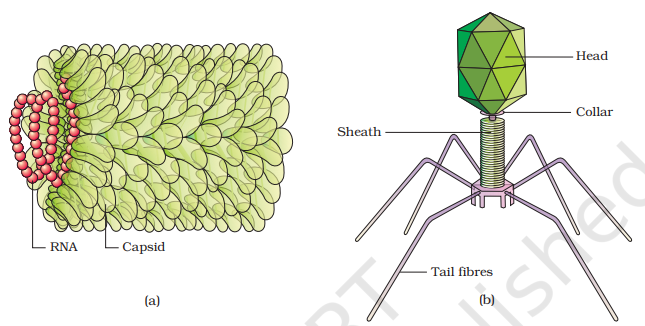
Viruses are sub-microscopic infectious agents that can infect all living organisms. The entire infectious virus particle, called a virion, consists of the nucleic acid and an outer shell of protein. The nucleic acid may be single- or double-stranded and most viruses have either RNA or DNA as their genetic material.
The simplest viruses contain only enough RNA or DNA to encode four proteins.
Now plant infecting viruses, have single stranded RNA as genetic material and viruses infecting animals have single or double stranded RNA or double stranded DNA.
Bacteriophages or viruses infecting bacteria mostly have double stranded DNA. Their protein coat called capsid is made up of capsomere subunits. These capsomeres are arranged in helical or polyhedral geometric forms.
Few examples of viral diseases are
1. A.I.D.S,
2. small pox,
3. mumps and
4. influenza.
7.
Difference between ascocarp and basidiocarp are given below
| Ascpcarp | Basidiocarp |
| It is a fructification found in Ascomycetes. | It is a fructification found in Basidiomycetes. |
| It is simpler in construction. | It is more elaborate in construction. |
| Ascocarp contains numerous asci. | Basidiocarp contains several basidia. |
| Ascus is generally aseptate. | Basidium may be septate or aseptate. |
| An ascus form eight ascocarps. | A basidium, produces four basidiospores. |
| These are formed endogenously. | These are formed exogenously. |
8.
Fungus cells are eukaryotic. These cells contains all the eukaryotic organelles excepts plastids. Some of the organelles are the nucleus, ribosomes, endoplasmic reticulum, mitochondria, Golgi bodies, etc. A fungal cell wall contains mostly chitin. Plasmalemma bears coiled membranous outgrowths called lomasomes. Nuclei are small and connected to endoplasmic reticulum. Nuclear division involves formation of internal spindle. Vacuoles are small. Near the hyphal tips, the cytoplasm contains small vesicles called chitosomes. Food reserve is in the form of glycogen and oil.
9.
Three Domains system or six Kingdom classification is a biological classification system in which living organisms were divided based on cellular characteristics. Carl Woese in 1990 introduced it.
The three domains are
(i) Archaea It contains prokaryotic organisms, which have a monolayer core of lipids in the cell membrane and distinct nucleotides in their 16 RNA.
(ii) Bacteria It contains typical prokaryotes, which lack membrane covered cell organelles but do not have a type of microchambers for separating various activities.
(iii) Eukarya This domain contains eukaryotic organisms, originated by endosymbiotic association between some archaebacteria and eubacteria. It have four kingdoms-Protista, Plantae, and Animalia.
10.
Biological classification keeps with our understanding of life forms, Initially, new characters were taken by Aristotle, Theophrastus, John Ray and Linnaeus. Linnaeus divided plants on the basis of sex organs only.
As more and more knowledge gathered for delimitation of taxa, the ways for natural system of classification became clear.
This can be understood by following examples :
(i) Two kingdom classification was replaced by three kingdom classification when Haeckel (1866) proposed the kingdom of Protista.
(ii) It was converted into four-kingdom classification by Copeland when he proposed the kingdom-Monera.
(iii) Whittaker in 1969 proposed five kingdom classification
(iv) As the information about biochemistry of archaebacteria gathered, Carl Woese in 1990 raised another kingdom - Archaea.

11th Standard CBSE Syllabus & Materials
11th Standard CBSE
CBSE 11th Business Studies Forms of Business Organisation Sample Question Papers Study Material - QB365 Set A
NEW11th Standard CBSE
CBSE 11th Business Studies Business, Trade and Commerce Sample Question Papers Study Material - QB365 Set A
NEW11th Standard CBSE
CBSE 11th Physics Waves Sample Question Papers Study Material - QB365 Set A
NEW11th Standard CBSE
CBSE 11th Physics Kinetic Theory Sample Question Papers Study Material - QB365 Set A



CBSE 11th Standard CBSE Subjects
CBSE Standards









