
 100% FREE ACCESS
11th Standard CBSE Syllabus & Materials
11th Standard CBSE
CBSE 11th Economics PART-A - Presentation of Data - New Sample Question Papers Study Material - QB365 Set A
NEW11th Standard CBSE
CBSE 11th Economics PART-A - Organisation of Data - New Sample Question Papers Study Material - QB365 Set A
NEW11th Standard CBSE
CBSE 11th Economics PART-A - Collection of Data - New Sample Question Papers Study Material - QB365 Set A
NEW11th Standard CBSE
CBSE 11th Economics PART-A - Introduction to Economics and Statistics - New Sample Question Papers Study Material - QB365 Set A
NEW11th Standard CBSE
CBSE 11th Business Studies International Trade Sample Question Papers Study Material - QB365 Set A
NEW11th Standard CBSE
CBSE 11th Business Studies Evolution and Fundamentals of Business Sample Question Papers Study Material - QB365 Set A

Published on: 24/09/2019
Cell Cycle and Cell Division
Download CBSE Class 11th Standard CBSE Biology question papers, sample papers, important questions, and previous year solved papers in PDF format. Get free study materials, NCERT solutions, and exam preparation resources for Class 11th Standard CBSE Biology
Questions + Answers key
Take MCQ Biology Test
1.
How does meiosis facilitate creation of off springs, with distinct characters?
2.
What is the process of cell division in prokaryotes?
3.
Which cell in humans does not have capacity to repair through cell division?
4.
Describe telophase I of meiosis
5.
Give a description of metaphase I of meiosis
6.
Find examples where the four daughter cells from meiosis are equal in size and where they are found unequal in size.
7.
(i) Name the stages and type of cell division represented in A and B, repectively.
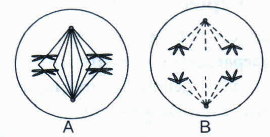
(ii) Also explain any one of them.
8.
Both unicellular and multicellular organisms undergo mitosis. What are the differences if any observed in the process between the two?
9.
Name three phases of interphase. Give one major event of each phase.
10.
Distinguish anaphase of mitosis from anaphase I of meiosis.
1.
Meiosis happens during gametogenesis and as a result gametes have half the number of chromosomes. During fertilization, when gametes fuse together two different sets of chromosomes make a new set. This results in an offspring, who has distinct characters, compared to parents.
2.
Prokaryotes do not have nucleus. So, there is no elaborate karyokinesis, as seen in eukaryotes. In prokaryotes the replication of DNA starts the process of cell division. Once genetic material is replicated, it is followed by division of cytoplasm. The process is known as binary fission
3.
Neuron cells lack a centrosome and hence they do not undergo the process of cell division. Neurons lack mitotic activity. Besides centrosomes, all other cell organelles are present in neurons.
4.
Telophase I:
1. The nuclear membrane and nucleolus reappear, cytokinesis follows and this is called as diad of cells.
2. Although in many cases the chromosomes do undergo some dispersion, they do not reach the extremely extended state of the interphase nucleus.
3. The stage between the two meiotic divisions is called interkinesis and is generally short lived. Interkinesis is followed by prophase II, a much simpler prophase than prophase 1
5.
Meiosis is a multistep process, and one of the phases within this process is called metaphase I. Metaphase I is when homologous chromosomes line up along the equator of the cell. Homologous chromosomes contain the same genes in the same locations and are often distinguishable based on size.
6.
During microsporogenesis in flowering plants, the four daughter cells formed are equal in size. On the other hand, during megasporogenesis the four daughter cells formed are unequal in size. This can be seen in many other organisms also during the formation of male and female gametes. Meiosis usually leads to formation of equal sized male gametes and unequal sized daughter cells while forming female gametes.
7.
(i) Stages and type of cell division are (A) Metaphase -I-meiosis(B) Anaphase-I-meiosis
(ii) For metaphase-I : It is the stage followed by prophase (same as mitosis).
Following changes are observed during this stage
(i) The bivalents during this phase arrange themselves on the two parallel equatorial plates.
(ii) The centromeres project little bit towards periphery.Since, there are two centromeres in each bivalent.Thus, each centromere is joined by chromosomal fibres.
(iii) The fibres of the homologous chromosomes are always in the opposite directions.
8.
Cell division id the first stage of growth in living organisms whereby cells divide to form new cells.
(i) In unicellular organisms, cell division is a process of asexual reproduction. It leads to an increase in the total number individuals.
(ii) In multicellular organism, the division of all cells, other than the reproductive cells is known as mitosis. It is a process of cell division related to growth and is accomplished by the cellular enlargement and differentiation.
9.
Three main events that occur in interphase are
G1-phase (post-mitotic or pre-synthetic phase), S-phase (synthesising phase) and G2-phase (post-synthetic or pre-mitotic phase).
Major events of each phase are
(i) G1-phase is the longest phase during which synthesis of RNA and DNA takes place.
(ii) S-phase is the phase during which chromosomes replicated and prepare themselves for equal distribution.
(iii) G2 -phase, is the phase in which synthesis DNA gets stopped. However, formation of RNA takes place.
10.
Differences between anaphase of mitosis and anaphase-I of meiosis are
| Anaphase of mitosis | Anaphase-I of meiosis |
| Each chromosome arranged at the metaphase plate, splits simultaneously and the two daughter chromatids migrate towards the opposite poles. | The spindle fibres contract and pull the centromeres of homologous chromosome towards the opposite poles. So, each chromosome goes to opposite pole. |
| The centromere of each chromosome is towards the pole with arms of chromosome trailing behind. |
The centromere is not divided, so half set of the chromosomes of parent nucleus go to one pole and the remaining half set in the opposite pole. |
| During this stage (i) Centromeres split and chromatids separate. (ii) Chromatids move to opposite poles |
During this stage (i) Homologous chromosomes separate. (ii) Sister chromatids remain associated at their centromere. |

11th Standard CBSE Syllabus & Materials
11th Standard CBSE
CBSE 11th Business Studies Forms of Business Organisation Sample Question Papers Study Material - QB365 Set A
NEW11th Standard CBSE
CBSE 11th Business Studies Business, Trade and Commerce Sample Question Papers Study Material - QB365 Set A
NEW11th Standard CBSE
CBSE 11th Physics Waves Sample Question Papers Study Material - QB365 Set A
NEW11th Standard CBSE
CBSE 11th Physics Kinetic Theory Sample Question Papers Study Material - QB365 Set A



CBSE 11th Standard CBSE Subjects
CBSE Standards









