
 100% FREE ACCESS
11th Standard CBSE Syllabus & Materials
11th Standard CBSE
CBSE 11th Economics PART-A - Presentation of Data - New Sample Question Papers Study Material - QB365 Set A
NEW11th Standard CBSE
CBSE 11th Economics PART-A - Organisation of Data - New Sample Question Papers Study Material - QB365 Set A
NEW11th Standard CBSE
CBSE 11th Economics PART-A - Collection of Data - New Sample Question Papers Study Material - QB365 Set A
NEW11th Standard CBSE
CBSE 11th Economics PART-A - Introduction to Economics and Statistics - New Sample Question Papers Study Material - QB365 Set A
NEW11th Standard CBSE
CBSE 11th Business Studies International Trade Sample Question Papers Study Material - QB365 Set A
NEW11th Standard CBSE
CBSE 11th Business Studies Evolution and Fundamentals of Business Sample Question Papers Study Material - QB365 Set A

Published on: 05/08/2019
Cell : The Unit of Life
Download CBSE Class 11th Standard CBSE Biology question papers, sample papers, important questions, and previous year solved papers in PDF format. Get free study materials, NCERT solutions, and exam preparation resources for Class 11th Standard CBSE Biology
Questions + Answers key
Take MCQ Biology Test
1.
What is the importance of vacuoles in Amoeba?
2.
What is the advantages of phospholipid bilayers fluidity?
3.
In which cell organelles, you will find permeable biomembrane?
4.
Are the different types of plastids interchangeable? If yes, give examples where they are getting converted from one type to another.
5.
Cell is the basic unit of life. Discuss in brief.
6.
What do you mean by 9 +2 pattern of the organisation?
7.
Which layer of cell envelope is sticky in nature? Also give another name for this layer.
8.
Why are gas vacuoles named so?
9.
Where are extrinsic proteins found in the cell membrane?
10.
What is the basis of classification of chromosomes?
Position of Telomeres
Position of centromere
Size of arms of chromosome
All of the above
11.
A ribosome is 80S. In this statement what does the letter 'S' signify?
Size of ribosome
Density of ribosome
Radius of ribosome
Both (a) and (b)
12.
Which of the following plastids stores proteins?
Amyloplasts
Elaioplasts
Aleuroplasts
Chloroplasts
13.
Protein synthesis takes place in which cell organelle?
Golgi Body
Endoplasmic Reticulum
Ribosomes
Lysosome
14.
Which organelle is not found in plant cells?
Mitochondria
Plastids
Rough ER
Centriole
15.
Which of the following is correct:
Cells of all living organisms have a nucleus
Both animal and plant cells have a well defined cell wall
In prokaryotes, there are no membrane bound organelles
Cells are formed de novo from abiotic materials
16.
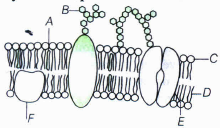
The diagram shows a section of cell membrane.Identify the components labelled A-F.
17.
What are the characteristic of prokaryotic cells?
18.
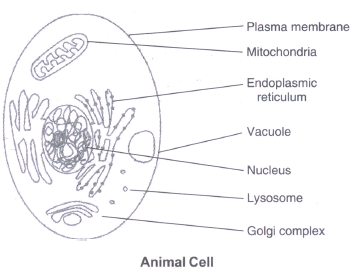
With suitable diagram describe animal cell.
19.
What is a centromere? How does the position of centromere form the basis of classification of chromosomes. Support your answer with a diagram showing the position of centromere on different types of chromosomes.
1.
In amoeba, all functions are carried out by the single cell. Especially when amoeba ingests food through phagocytosis or pinocytosis then it makes a vacuole around the food particle. The vacuole in amoeba is contractile in nature. This contractility is important to accommodate food of various sizes and to have enough digestive enzymes. Moreover, amoeba being an aquatic animal the contractile vacuole helps in maintaining the tonocity of the cell as well.
2.
Interaction of molecules within the membrane, intercellular functions, secretion, endocytosis are the advantages of lipid bilayer fluidity.
3.
Endoplasmic reticulum, Golgi apparatus are the organelles with permeable biomembrane.
4.
The different types of plastids leucoplasts chromoplasts chloroplasts such as are interchangeable. The transformation from chloroplasts is observed during ripening of fruits (e.g Tomato, Chilli) when they change their color from green to reddish orange. It takes place through loss of chlorophylls and degeneration of lamellae. The most common carotenoid of the fruit is lycopene. Petals of Calendula develop orange yellow color due to the formation of chromoplasts from proplastids.
Carrot root develops it characteristic color because of the conversion of leucoplasts into chromoplasts.It is rich in carotene.
5.
All organisms begin their life as a single cell. Certain organisms are made up of single cell only. They are called unicellular or acellular organisms, e.g., Amoebe Chlamydomonas, bacteria and yeast.
In other organisms, single cell undergoes divisions to from multicellular body. Body of human being is made up of trillion of cells. All the cells of an organism carry the same genetic material, developed from same pre-existing cells and possess several organelles to perform various life activities. The cells are therefore, basic unit of life and structural unit of an organism.
6.
It means that 9 microtubule doublets surround two single microtubules.
7.
The sticky layer of cell envelope is called glycocalyx. It is also known as mucilage sheath.
8.
Gas vacuoles are name so, because these are permeable to atmospheric gases and not to water
9.
On the outer and inner surface of phospholipid matrix.
10.
(b)
Position of centromere
11.
(d)
Both (a) and (b)
12.
(c)
Aleuroplasts
13.
(c)
Ribosomes
14.
(d)
Centriole
15.
(a)
Cells of all living organisms have a nucleus
16.
Following are the labelled sections of cell membrane
A - Cholesterol
B - Glycolipid
C - Hydrophilic head of phospholipid
D - Hydrophobic tail of phospholipid
E - Transmembrane protein
F - Intrinsic protein
17.
Characteristics of prokaryotic cells are as follows
(i) A prokaryotic cell, i.e., of bacteria is surrounded by a cell membrane. The cell wall in turn is surrounded by a slimy layer.
(ii) Absence of well-organised chloroplast, mitochondria and nucleus.
(iii) Nucleolus is absent. It is known as nucleoid. The DNA of a prokaryotic cell is circular and not associated with basic proteins.
(iv) The cytoplasm is filled with dense granules. Most of these granules are ribosomes.
(v) A prokaryotic cell possesses single chromosome (not paired) that exists as circular loops of DNA without histone proteins.
18.
An animal cell has following cell structures:
i) Plasma membrane
ii) Endoplasmic reticulum
iii) Mitochondria
iv)Golgibody
v) Lysosomes
vi) Ribosomes
vii) Vacuoles
viii) Nucleus
ix) Centriole
Plasma Membrane.
This is also known as cell membrane. Plasma membrane is made up of lipid and protein. It is semi-permeable in nature. Certain substances are transported through plasma membrane by passive transport. Some substances get transported by osmosis and some by active transport. Active transport involves use of some carrier to facilitate transport. Apart from transport of materials, plasma membrane gives a shape and size to the animal cell.
Endoplasmic Reticulum.
These are networks of fine tubules extending from plasma membrane to nucleus. They work like pipelines and facilitate transport of substances from outside the cell to nucleus and cytoplasm. Depending on presence or absence of ribosomes ER can be either rough or smooth.
Golgi Body.
This is composed of many sack like structures stacked one over another. The function of golgi body is to package different materials, like carbohydrate, protein and lipid.
Lysosome.
Lysosome is small spherical structure filled with digestive enzymes. The digestive enzyme helps in digesting foreign materials and waste products. Sometimes the lysosome digests the contents of cytoplasm which in turn kills the cell itself. That is why lysosome is also known as 'suicide bag of the cell'.
Ribosome.
Ribosomes are small dot like structures. They are made of two subunits. The function of ribosome is to synthesize protein.
Vacuoles.
These are small fluid filled structures. Vacuoles help in maintaining osmotic pressure inside the cell.
Mitochondria.
Mitochondria is double membrane structure. The inner membrane is projected in finger-like structures, called cristae. The presence of cristae helps in increasing the inner surface are of mitochondria. Aerobic respiration takes place in the mitochondria and energy released is stored in the form of ATP (Adenosine triphosphate).
Nucleus.
Nucleus is covered by nuclear membrane. Nucleus contains chromosomes which are genetic materials. Nucleus also controls various functions of the cell.
Centriole.
These are spindle like structures. During cell division they form spindle fibres.
19.
Every chromosome essentially has a primary constriction or the centromere on the sides of which disc-shaped structures called kinetochores are present. Based on the position of the centromere, the chromosomes can be classified into four types.
Metacentric Chromosome : The metacentric chromosome has middle centromere forming two equal arms of the chromosome. Sub-metacentric Chromosome. The sub-metacentric chromosome has centromere nearer to one end of the chromosome resulting into one shorter arm and one longer arm.
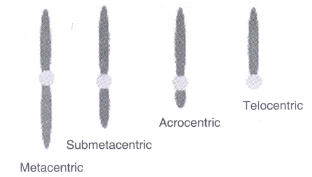
Acrocentric Chromosome : In case of acrocentric chromosome, the centromere is situated close to its end forming one extremely short and one very long arm, Telocentric Chromosome. The telocentric chromosome has a terminal centromere.

11th Standard CBSE Syllabus & Materials
11th Standard CBSE
CBSE 11th Business Studies Forms of Business Organisation Sample Question Papers Study Material - QB365 Set A
NEW11th Standard CBSE
CBSE 11th Business Studies Business, Trade and Commerce Sample Question Papers Study Material - QB365 Set A
NEW11th Standard CBSE
CBSE 11th Physics Waves Sample Question Papers Study Material - QB365 Set A
NEW11th Standard CBSE
CBSE 11th Physics Kinetic Theory Sample Question Papers Study Material - QB365 Set A



CBSE 11th Standard CBSE Subjects
CBSE Standards









