
 100% FREE ACCESS
11th Standard CBSE Syllabus & Materials
11th Standard CBSE
CBSE 11th Economics PART-A - Presentation of Data - New Sample Question Papers Study Material - QB365 Set A
NEW11th Standard CBSE
CBSE 11th Economics PART-A - Organisation of Data - New Sample Question Papers Study Material - QB365 Set A
NEW11th Standard CBSE
CBSE 11th Economics PART-A - Collection of Data - New Sample Question Papers Study Material - QB365 Set A
NEW11th Standard CBSE
CBSE 11th Economics PART-A - Introduction to Economics and Statistics - New Sample Question Papers Study Material - QB365 Set A
NEW11th Standard CBSE
CBSE 11th Business Studies International Trade Sample Question Papers Study Material - QB365 Set A
NEW11th Standard CBSE
CBSE 11th Business Studies Evolution and Fundamentals of Business Sample Question Papers Study Material - QB365 Set A

Published on: 28/09/2019
Chemical Coordination and Integration
Download CBSE Class 11th Standard CBSE Biology question papers, sample papers, important questions, and previous year solved papers in PDF format. Get free study materials, NCERT solutions, and exam preparation resources for Class 11th Standard CBSE Biology
Questions + Answers key
Take MCQ Biology Test
1.
Name the two hormone of hypothalamus that influences’ the middle lobe of pituitary. Mention their functions.
2.
What is acromegaly?
3.
What are secondary sexual characters?
4.
How do fight or flight hormones prepare our body to fight emergency?
5.
How does parathyroid hormone influences calcium uptake in the body?
6.
Explain the function of melanin.
7.
Justify the name endocrine gland.
8.
Give example(s) of:
(a) Hyperglycemic hormone and hypoglycemic hormone
(b) Hypercalcemic hormone
(c) Gonadotrophic hormones
(d) Progestational hormone
(e) Blood Pressure lowering hormone
(f) Androgens and estrogens
9.
Diagrammatically indicate the location of the various endocrine glands in our body.
10.
George comes on a vacation to India from US. The long journey disturbs his biological clock and he suffers from jet lag. What is the cause of his discomfort?
11.
How does progesterone function in a human female?
12.
Fill up the blank spaces (i) - (vi) in the table given below
| Name of Endocrine Gland | Secreted Hormone | Functions of the Hormone |
| Pituitary | (i) | Reabsorption of water and electrolytes in the kidney |
| (ii) .......... | Insulin | (iii) ..... |
| Thymus | Thymosins | (iv) ..... |
| Ovary | (v) .... and | |
| (vi) ..... | Thyroxine | Development of growing ovarian follicles controls the metabolism of proteins, fats and carbohydrates. |
13.
How do you justify the statement that hormones of adrenal medulla are emergency hormones?
14.
What is meant by 'antagonistic effect? Illustrate your answer with an example
15.
Mention the major classes of hormones released in humans. Give the examples of each.
1.
(1) Melanocytes stimulating –release hormone. Stimulate the function of MSH.
(2) Melanocyte stimulating-inhibiting hormone. It inhibits the release of MSH.
2.
Excess secretion of growth hormone in adults, especially in middle age can result in severe disfigurement (especially of the face). This is called acromegaly. This can lead to serious complications and even death; if unchecked. The disease is hard to diagnose in the early stages and is frequently missed for many years, until changes in external features become noticeable
3.
Characters which do not play direct role in sexual reproduction but are basically means of sexual differentiation are called secondary sexual characters. For example, facial hair and deep voice in males and thin voice in females are secondary sexual characters
4.
Adrenaline and noradrenaline are rapidly secreted in response to stress of any kind and during emergency situations and are called emergency hormones or hormones of Fight or Flight. These hormones increase alertness, pupilary dilation, piloerection (raising of hairs), sweating etc. Both the hormones increase the heart beat, the strength of heart contraction and the rate of respiration. Finally the body is ready to counter the emergency situations.
5.
Parathyroid hormone (PTH) increases the Ca2+ levels in the blood. PTH acts on bones and stimulates the process of bone resorption (dissolution/ demineralisation). PTH also stimulates reabsorption of Ca2+ by the renal tubules and increases Ca2+ absorption from the digested food. It is, thus, clear that PTH is a hypercalcemic hormone, i.e., it increases the blood Ca2+ levels. Along with TCT, it plays a significant role in calcium balance in the body
6.
Melanin controls the circadian variations of the body. During 24 hours different organ system of our body works at different pace. During sleep certain body functions slow down. All of this is known as circadian rhythm. Additionally, melanin influences metabolism, pigmentation, menstruation and defence capability
7.
Endocrine glands are tubeless glands and their secretion is directly released on the target site. Because of the absence of tubes the hormone is secreted in the gland itself hence the name endocrine gland is given for them.
8.
(a) Glucagon and insulin,respectively.
(b) Parathyroid hormone.
(c) Follicle stimulating Hormone (FSH) and Luteinizing Hormone (LH).
(d) Progesterone and estrogen
(e) Atrial Natriuretic Factor (FSH).
(f) Androgen are mainly testosterone and oestrogens include oestriol, oestradiol and oestrone.
9.
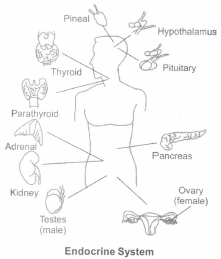
10.
Jet lag is caused by the disruption of the body clock as it is out of synchronisation with the unfamiliar time zone of the two different parts of the world. The body experience different patterns of light and dark than it is normally used to which disrupts the natural sleep - wake cycle.
Melatonin is a hormone that plays a key role in body rhythms and jet lag. After the sun sets, the eyes perceive darkness and alert the hypothalamus to begin releasing melatonin which promotes sleep. Conversely, when the eyes perceive sunlight, they tell the production. It takes several days.
11.
Following are the functions performed by progesterone
(i) Helps in maintaining pregnancy.
(ii) Stimulates the development of secretory alveoli in mammary gland and secretion of milk.
(iii) Its secretion is influenced by luteinising hormone of anterior pituitary.
12.
(i) Vasopressin
(ii) Pancreas
(iii) Reduces blood glucose level
(iv) Differentiation of T-Iymphocytes
(v) Estrogen
(vi) Thyroid.
13.
Hormones of adrenal medulla, adrenaline and noradrenaline are secreted in response to any kind of stress, danger and during emergency situations like fall in blood pressure or sugar, increase respiratory rate and heartbeat. CNS at the time of stress or danger. All these conditions need more energy for their action. Thus, because these hormones prepare the body to face stress or danger hence, are called emergency hormones.
14.
It refers to the effect of a hormone that are countered by an antagonistic (opposing) signal, often another hormone.For example, the sympathetic and parasympathetic nervous system achieve antagonistic effect on heartbeat.
This mechanism involves the use of more than one second messenger. In heart cells cyclic form of adenosine monophosphate (cAMP) servers as a second messenger, showing muscle contraction in response to acetylcholine.
15.
Although hormones are chemically diverse, they generally belong to one of four different chemical groups
(i) Steriod hormones : These hormones are manufactured by endocrine cells form cholesterol, an important type of lipid in the human body. Examples include cortisol, aldosterone, oestrogen, progesterone and testosterone.
(ii) Amino acid derivatives : The thyroid hormones (T3 and T4) are synthesised from the amino acid throsine and iodide, respectively. Adernaline (also known as epinephrine) and noradrenaline (also known as nerephrine) are produced by the medulla of the adernal gland, are also derived from tyrosine. Melatonin is synthesised from the amino acid tryptophan.
(iii) Protein hormones : These hormones are long, folded chains of amino acids. Included among these hormones are insulin , glucagons, parathyroid hormone, growth hormone, prolactin, etc.
(iv) Peptide hormones : Hormones such as oxytocin and antidiuretic hormone re smaller than protein horemone. They are made up of a short chain of amino acids.

11th Standard CBSE Syllabus & Materials
11th Standard CBSE
CBSE 11th Business Studies Forms of Business Organisation Sample Question Papers Study Material - QB365 Set A
NEW11th Standard CBSE
CBSE 11th Business Studies Business, Trade and Commerce Sample Question Papers Study Material - QB365 Set A
NEW11th Standard CBSE
CBSE 11th Physics Waves Sample Question Papers Study Material - QB365 Set A
NEW11th Standard CBSE
CBSE 11th Physics Kinetic Theory Sample Question Papers Study Material - QB365 Set A



CBSE 11th Standard CBSE Subjects
CBSE Standards









