
 100% FREE ACCESS
11th Standard CBSE Syllabus & Materials
11th Standard CBSE
CBSE 11th Economics PART-A - Presentation of Data - New Sample Question Papers Study Material - QB365 Set A
NEW11th Standard CBSE
CBSE 11th Economics PART-A - Organisation of Data - New Sample Question Papers Study Material - QB365 Set A
NEW11th Standard CBSE
CBSE 11th Economics PART-A - Collection of Data - New Sample Question Papers Study Material - QB365 Set A
NEW11th Standard CBSE
CBSE 11th Economics PART-A - Introduction to Economics and Statistics - New Sample Question Papers Study Material - QB365 Set A
NEW11th Standard CBSE
CBSE 11th Business Studies International Trade Sample Question Papers Study Material - QB365 Set A
NEW11th Standard CBSE
CBSE 11th Business Studies Evolution and Fundamentals of Business Sample Question Papers Study Material - QB365 Set A

Published on: 28/09/2019
Locomotion and Movement
Download CBSE Class 11th Standard CBSE Biology question papers, sample papers, important questions, and previous year solved papers in PDF format. Get free study materials, NCERT solutions, and exam preparation resources for Class 11th Standard CBSE Biology
Questions + Answers key
Take MCQ Biology Test
1.
Give a brief explanation of the human skeletal system.
2.
What is osteoporosis? Why are women at a greater risk of suffering from osteoporosis? Suggest some precautionary means to avoid osteoporosis.
3.
Explain the pelvic girdle of human skeleton.
4.
Describe the pectoral girdle of human skeleton.
5.
Give a description of the appendicular skeleton in human.
6.
Describe the structure of the rib cage of human.
7.
Explain the structure of the vertebral column of human.
8.
What are the different types of movements exhibited by the cells of human body?
9.
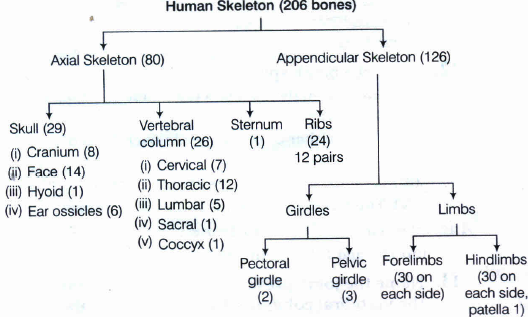
Give the name of the major parts of human skeleton.Also mention the number of bones in each part.
10.
Why are muscles rigidly locked in whatever position they are after death? What is the phenomenon known as?
11.
Describe the important steps in muscle contraction.
12.
Write a few lines about gout
13.
In old age, people often suffer from stiff and inflammed joints. What is this condition called? What are the possible reasons for these symptoms?
14.
How do you distinguish between a skeletal muscle and a cardiac muscle.
1.
Bones and cartilages constitute our skeletal system. The skeletal system is divisible into axial and appendicular. Skull, vertebral column, ribs and sternum constitute the axial skeleton. Limb bones and girdles form the appendicular skeleton. Three types of joints are formed between bones or between bone and cartilage - fibrous, cartilaginous and synovial. Synovial joints allow considerable movements and therefore, playa significant role in locomotion.
2.
Osteoporosis is the condition in which the bone mass is decreased. This leads to general weakening of bones. Even a minor slip can result in fractures if a person is suffering from osteoporosis.
Women are at greater risk of suffering from osteoporosis because of several reasons. During child bearing major part of calcium from their body is utilized in formation of the skeleton of the foetus. Additionally during lactation there is further depletion of the calcium reserve of the body because of milk formation. A calcium rich diet can help prevent the progression of osteoporosis. Milk and eggs are good source of calcium. During pregnancy oral calcium supplement is also given to prevent osteoporosis.
3.
Pelvic Girdle. Pelvic girdle consists of two coxal bones. Each coxal bone is formed by the fusion of three bones - ilium, ischium and pubis. At the point of fusion of the above bones is a cavity called acetabulum to which the thigh bone articulates. The two halves of the pelvic girdle meet ventrally to form the pubic symphysis containing fibrous cartilage.
4.
Pectoral Girdle. Each half of pectoral girdle consists of a clavicle and a scapula. Scapula is a large triangular flat bone situated in the dorsal part of the thorax between the second and the seventh ribs. The dorsal, flat, triangular body of scapula has a slightly elevated ridge called the spine which projects as a flat, expanded process called the acromion. The clavicle articulates with this. Below the acromion is a depression called the glenoid cavity which articulates with the head of the humerus to form the shoulder joint. Each clavicle is a long slender bone with two curvatures. This bone is commonly called the collar bone.
5.
Appendicular Skeleton. The bones of the limbs alongwith their girdles constitute the appendicular skeleton. Each limb is made of 30 bones.
| Bones of Limbs | |
| Fore Limb | Hind Limb |
| Humerus, Radius, Ulna Carpals (8) Metacarpals (5) Phalanges (14) |
Femur, Tibia, Fibula, Tarsals (7) Metatarsals (5) Phalanges (14) Patella |
6.
Rib Cage. There are 12 pairs of ribs. Each rib is a thin flat bone connected dorsally to the vertebral column and ventrally to the sternum. It has two articulation surfaces on its dorsal end and is hence called bicephalic. First seven pairs of ribs are called true ribs. Dorsally, they are attached to the thoracic vertebrae and ventrally connected to the sternum with the help of hyaline cartilage. The 8th, 9th and 10th pairs of ribs do not articulate directly with the sternum but join the seventh rib with the help of hyaline cartilage. These are called vertebrochondral (false) ribs. Last 2 pairs (llth and 12th) of ribs are not connected ventrally and are therefore, called floating ribs. Thoracic vertebrae, ribs and sternum together form the rib cage.
7.
Vertebral Column. Our vertebral column is formed by 26 serially arranged units called vertebrae and is dorsally placed. It extends from the base of the skull and constitutes the main framework of the trunk. Each vertebra has a central hollow portion (neural canal) through which the spinal cord passes. First vertebra is the atlas and it articulates with the occipital condyles. The vertebral column is differentiated into followingregions starting from the skull:
1. cervical (7),
2. thoracic (12),
3. lumbar (5),
4. sacral (I-fused) and
5. coccygeal (I-fused] regions
The number of cervical vertebrae are seven in almost all mammals including human beings. The vertebral column protects the spinal cord, supports the head and serves as the point of attachment for the ribs and musculature of the back. Sternum is a flat bone on the ventral midline of thorax.
8.
Cells of the human body exhibit three main types of movements, namely, amoeboid, ciliary and muscular.
Amoeboid Movement :
Some specialised cells in our body like macrophages and leucocytes in blood exhibit amoeboid movement. It is effected by pseudopodia formed by the streaming of protoplasm (as in Amoeba). Cytoskeletal elements like microfilaments are also involved in amoeboid movement. Ciliary Movement. Ciliary movement occurs in most of our internal tubular organs which are lined by ciliated epithelium. The coordinated movements of cilia in the trachea help us in removing dust particles and some of the foreign substances inhaled alongwith the atmospheric air. Passage of ova through the female reproductive tract is also facilitated by the ciliary movement.
Muscular Movement :
Movement of our limbs, jaws, tongue, etc, require muscular movement. The contractile property of muscles are effectivelyused for locomotion and other movements by human beings and majority of multicellular organisms. Locomotion requires a perfect coordinated activity of muscular, skeletal and neural systems.
9.
10.
Muscles require ATP to relax as well as to contract. On animal's death, its muscles soon exhaust ATP and lose the ability to contract or relax. They become rigidly locked in whatever position they were when ATP gets completely used up. This phenomenon is known as Rigor Mortis. It is used in determining the time of death.
11.
Summary of steps in skeletal muscle contraction
(i) Stimulation :
(a) Nerve impulse arrives at neuromuscular junction and release of acetylcholine takes place.
(b) Spreading of action potential through muscle fibre.
(c) The release of Ca2+ from sarcoplasmic reticulum to cytoplasm of muscle fibre.
(ii) Contraction :
(a) ATP joins to meromyosin head that hydrolyses into ADP and Pi releasing energy, which in turn raises the head to high energy state (the head joins active site on actin, forming cross-bridge).
(b) ADP and Pi are released. And head returns to low energy state.
(c) Actin filament is thus, pulled towards center of sarcomere. And a new ATP joins head, detaching it from actin filament.
(d) Above mentioned steps are thus, repeated many times during one contraction to draw the thin myofilaments further inward.
12.
When metabolic waste like uric and urate crystals are present in excess in blood, they get accumulated in the joints causing gouts or gouty arthritis. It is very painful, particularly at night and makes movement difficult.
13.
This condition is called as arthritis.
The possible reasons can be
(i) inflammation of the synovial membrane,
(ii) progressive erosion of articular cartilage,
(iii) infection by a microorganism,
(iv) due to metabolic defect causing excess of uric acid and urate crystals.
14.
Differences between skeletal muscle and cardiac muscle
| skeletal muscle | cardiac muscle |
| It is found in limbs, tongue, all parts in association with the skeleton of organism | It is found in the walls of heart and large veins. |
| Fibres are unbranched | Fibres are branched |
| It is multinucleate | It is uninucleate |
| No oblique bridge and intercalated discs | Oblique bridge and intercalated discs are present. |
| It gets fatigued soon. | It never gets fatigued |
| It is voluntary in nature. | It is involuntary. |

11th Standard CBSE Syllabus & Materials
11th Standard CBSE
CBSE 11th Business Studies Forms of Business Organisation Sample Question Papers Study Material - QB365 Set A
NEW11th Standard CBSE
CBSE 11th Business Studies Business, Trade and Commerce Sample Question Papers Study Material - QB365 Set A
NEW11th Standard CBSE
CBSE 11th Physics Waves Sample Question Papers Study Material - QB365 Set A
NEW11th Standard CBSE
CBSE 11th Physics Kinetic Theory Sample Question Papers Study Material - QB365 Set A



CBSE 11th Standard CBSE Subjects
CBSE Standards









