
 100% FREE ACCESS
11th Standard CBSE Syllabus & Materials
11th Standard CBSE
CBSE 11th Economics PART-A - Presentation of Data - New Sample Question Papers Study Material - QB365 Set A
NEW11th Standard CBSE
CBSE 11th Economics PART-A - Organisation of Data - New Sample Question Papers Study Material - QB365 Set A
NEW11th Standard CBSE
CBSE 11th Economics PART-A - Collection of Data - New Sample Question Papers Study Material - QB365 Set A
NEW11th Standard CBSE
CBSE 11th Economics PART-A - Introduction to Economics and Statistics - New Sample Question Papers Study Material - QB365 Set A
NEW11th Standard CBSE
CBSE 11th Business Studies International Trade Sample Question Papers Study Material - QB365 Set A
NEW11th Standard CBSE
CBSE 11th Business Studies Evolution and Fundamentals of Business Sample Question Papers Study Material - QB365 Set A

Published on: 09/10/2019
Morphology of Flowering Plants
Download CBSE Class 11th Standard CBSE Biology question papers, sample papers, important questions, and previous year solved papers in PDF format. Get free study materials, NCERT solutions, and exam preparation resources for Class 11th Standard CBSE Biology
Questions + Answers key
Take MCQ Biology Test
1.
With suitable diagram explain the structure of dicot stem. Write main differences between dicot and monocot stems.
2.
Describe the structure of an isobilateral leaf. Differentiate between a moncot and dicot leaf.
3.
With suitable diagrams explain the structures of dicot and monocot root.
4.
What is a tissue? Describe different types of simple tissues in plants.
5.
Explain with suitable examples the different types of phyllotaxy.
6.
How do various leaf modifications help plants?
7.
Write the medicinal value of family -Fabaceae, Solanaceae, and Liliaceae
8.
Compare the androecium of family-Fabaceae, Solanaceae, and Liliaceae.
9.
Describe the modification of stem with suitable examples. "Fleshy stems"
10.
Describe the modification of stem with suitable examples. "Thorns"
1.
Epidermis. The transverse section of a typical young dicotyledonous stem shows that the epidermis is the outermost protective layer of the stem. Covered with a thin layer of cuticle, it may bear trichomes and a few stomata.
Cortex. The cells arranged in multiple layers between epidermis and pericycle constitute the cortex. It consists of three sub-zones. The outer hypodermis, consists of a few layers of collenchymatous cells just below the epidermis, which provide mechanical strength to the young stem. Cortical layers below hypodermis consist of rounded thin-walled parenchymatous cells with conspicuous intercellular spaces. The innermost layer of the cortex is called the endodermis. The cells of the endodermis are rich in starch grains and the layer is also referred to as the starch sheath. Pericycle is present on the inner side of the endodermis and above the phloem in the form of semi-lunar patches of sclerenchyma. In between the vascular bundles, there are a few layers of radially placed parenchymatous cells, which constitute medullary rays
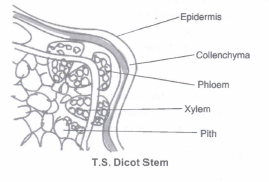
Vascular Bundles. A large number of vascular bundles are arranged in a ring; the 'ring' arrangement of vascular bundles is a characteristic of dicot stem. Each vascular bundle is conjoint, open, and with endarch protoxylem. A large number of rounded, parenchymatous cells with large intercellular spaces which occupy the central portion of the stem constitute the pith.
Differences between dicot and monocot stems
| Dicot Stem | Monocot Stem |
|---|---|
| 1. Vascular bundles are arranged in a ring. | 1. Vascular bundles are scattered. |
| 2. Secondary growth takes place. | 2. Secondary growth does not happen. |
| 3. Wood is formed. | 3. Wood is not formed. |
2.
Isobilateral (Monocotyledonous) Leaf
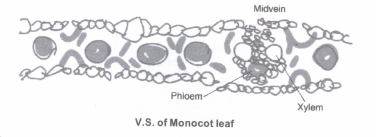
Structure: -
1. Epidermis is composed of single layer of cells.
2. Stomata are present on both surfaces of leaf.
3. Mesophyll is not differentiaited into palisade and spongy parenchyma.
4. In grasses, certain adaxial epidermal cells along the veins modify themselves into large, empty, colourless cells. These are called bulliform cells. When the bulliform cells in the leaves have absorbed water and are turgid, the leaf surface is exposed. When they are flaccid due to water stress, they make the leaves curl inwards to minimise water loss.
5. The parallel venation in monocot leaves is reflected in the near similar sizes of vascular bundles (except in main veins) as seen in vertical sections of the leaves.
Differences between Dicot and Monocot Leaf
| Dicot Leaf | Monocot Leaf |
|---|---|
| 1. Stomata on ventral surface. | 1. Stomata on both surfaces |
| 2. Mesophyll differentiated in Pallisade and spongy parenchyma | 2. Mesophyll is not differentiated |
| 3. Bulliform cells absent. | 3. Bulliform cells present. |
| 4. Vascular bundles are of different sizes. | 4. Vascular bundles are of similar sizes (except in main veins) |
3.
Dicotyledonous Root
Epidermis. The outermost layer is epidermis. Many of the epidermal cells protrude in the form of unicellular root hairs.
Cortex. The cortex consists of several layers of thin-walled parenchyma cells with intercellular spaces.
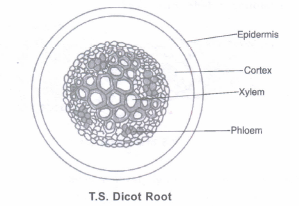
Endodermis. The innermost layer of the cortex is called endodermis. It comprises a single layer of barrel-shaped cells without any intercellular spaces. The tangential, as well as radial walls of the endodermal cells, have a deposition of water impermeable, waxy material suberin in the form of Casparian strips. Next to endodermis lies a few layers of thick-walled parenchymatous cells referred to as pericycle. Initiation of lateral roots and vascular cambium during the secondary growth takes place in these cells. The pith is small or inconspicuous. The parenchymatous cells which lie between the xylem and the phloem are called conjuctive tissue. There are usually two to four xylem and phloem patches. Later, a cambium ring develops between the xylem and phloem. All tissues on the inner side of the endodermis such as pericycle, vascular bundles and pith constitute the stele.
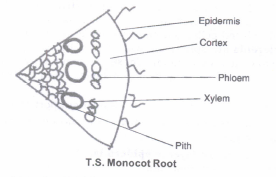
Monocotyledonous Root
The anatomy of the monocot root is similar to the dicot root in many respects. It has epidermis, cortex, endodermis, pericycle, vascular bundles and pith. As compared to the dicot root which have fewer xylem bundles, there are usually more than six (polyarch) xylem bundles in the monocot root. Pith is large and well developed. Monocotyledonous roots do not undergo any secondary growth.
4.
A tissue is a group of cells having a common origin and usually performing a common function.
Simple Tissues. A simple tissue is made of only one type of cells. Simple tissues are of following types:
(a) Parenchyma
(b) Collenchyma
(c) Sclerenchyma
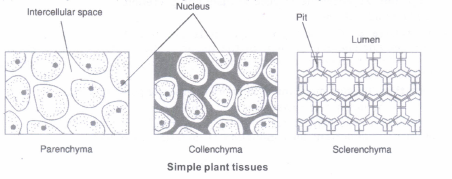
Parenchyma. Parenchyma forms the major component within organs. The cells of the parenchyma are generally isodiametric. They may be spherical, oval, round, polygonal or elongated in shape. Their walls are thin and made up of cellulose. They may either be closely packed or have small intercellular spaces.
Function. The parenchyma performs various functions like photosynthesis, storage, secretion.
Collenchyma. The collenchyma occurs in layers below the epidermis in dicotyledonous plants. It is found either as a homogeneous layer or in patches. It consists of cells which are much thickened at the corners due to a deposition of cellulose, hemicellulose and pectin. Collenchymatous cells may be oval, spherical or polygonal and often contain chloroplasts. These cells assimilate food when they contain chloroplasts. Intercellular spaces are absent.
Function. They provide mechanical support to the growing parts of the plant such as young stem and petiole of a leaf.
Sclerenchyma. Sclerenchyma consists of long, narrow cells with thick and lignified cell walls having a few or numerous pits. They are usually dead and without protoplasts. On the basis of variation in form, structure, origin and development, sclerenchyma may be either fibres or sclereids. The fibres are thick-walled, elongated and pointed cells, generally occurring in groups, in various parts of the plant. The sclereids are spherical, oval or cylindrical, highly thickened dead cells with very narrow cavities (lumen). These are commonly found in the fruit walls of nuts; pulp of fruits like guava, pear and sapota; seed coats of legumes and leaves of tea.
Function. Sclerenchyma provides mechanical support to organs.
5.
The mode of arrangement of leaves on the stem and its branches is called phyllotaxy (Phyllon-leaf; taxis arrangement). They are arranged most systematically, regularly and mathematically, so as to get proper sunlight and avoid overcrowding.
Phyllotaxy in leaves is of following three types.
(i) Alternate: A single leaf arises at a node. e.g, China rose, mango, mustard, sunflower, etc.
(ii) Oppposite: Two leaves arise at a node,opposite to each other e.g, guava, Calotropis tulsi, etc.
(iii) Whorled: More than two leaves arise at each node forming a circle or whorl, e.g, Alstonia Scholaris etc.
6.
Various leaf modifications help plants in the following ways
(i) Leaf tendrils help in climbing up for support.e.g Pea
(ii) Spines provide protection from browsing animals, e.g, Opuntia.
(iii) Leaves modifies into pitcher help in trapping insects e.g., insectivorous plants
(iv) Storage of food materials, e.g., Onion
(v) Petiole expands and carried out photosynthesis, e.g., Australian Acacia.
7.
Economic importance of family Fabaceae, Solanaceae, and Liliaceae.
Solanaceae : Economic Importance : Many plants belonging to this family are source of food (tomato, brinjal, potato ), spice (chilli), medicine (belladonna, ashwagandha), fumigatory (tobacco), omamentals (petunia).
Fabaceae : Food : Humans, cattle, as well as wild animals, all benefit from abundant vegetable protein sources provided by the Fabaceae family plants. Some forage plants or crops are also cultivated as livestock feed. The plants with edible seeds are Chickpea, Garden pea, Peanut, Lentil, etc. Pulses are the main source of food yielded by the Fabaceae family.
Pulses - Gram, Moong, Soya Bean, Sem, Arhar, Lentil, Masur, green gram, pea, chickpea, black gram, and pigeon pea are some of the pulses yielded by the Fabaceae family plants.
Edible Oil - Oil is extracted from soya beans and groundnuts, which are then utilized in cooking.
Agriculture : The Fabaceae family is economically feasible for farmers due to its capacity to fix nitrogen. It ultimately helps in money-saving because of low expenditure on fertilizer purchase.
Liliaceae : 1. Source of Medicine -Aloe vera, Smilax and Colchicine.
2. Ornamental Plants -Lilium, tulips, Gloriosa and Ruscus.
3. Source of food (or) Vegetables-Asparagus.
8.
Floral characters of family Fabaceae, Solanaceae, and Liliaceae
Solanaceae : It is a large family, commonly called as the potato family.
Vegetative Characters : Plants mostly herbs , shrubs and small trees.
Stem : Herbaceous rarely woody, aerial, erect, cylindrical, branched, solid or hollow, hairy or glabrous, underground stem in potato (Solanum tuberosum). Leaves : Alternate, simple, rarely pinnately compound, exstipulate, venation reticulate.
Floral Characters :
Inflorescence : Solitary , axillary or cymose as in solanum.
Flower : Bisexual, actinomorphic.
Calyx : Sepals five, united, persistent, valvate aestivation.
Corolla : Petals five , united , valvate aestivation.
Androecium : Stamens five , epipetalous.
Gynoecium : Bicarpellary, syncarpous, ovary superior, bilocular, placenta swollen with many ovules.
Fruits : Berry or capsule. Seeds : Many endospermous.
Floral Formula :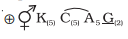
Floral Characters : Fabaceae
Inflorescence: Racemose.
Flower: Complete, bisexual, zygomorphic, hypogynous, bracteate/ ebracteate.
Calyx: Five sepals, gamosepalous; valvate or imbricate aestivation.
Corolla: Five petals, polypetalous, papilionaceous, vexillary aestivation.
Androecium: Ten stamens (9+1), diadelphous, anther dithecous.
Gynoecium: Superior ovary, monocarpellary, unilocular, single, short -style and flat, hairy-stigma.
Fruit: Legume.
Seed: One or more, non-endospermic.
Floral characters Liliaceae :
Inflorescence: Cymose- solitary; umbellate clusters.
Flower: Complete, bisexual, actinomorphic; hypogynous, perianth present.
Perianth: Indistinctive sepal and petal; six tepals (3+3), often united tepals; valvate aestivation.
Androecium: Six stamens in two whorls (3+3).
Gynoecium: Syncarpous, tricarpellary, trilocular, superior ovary with axile placentation.
Fruit: Mostly Capsule and sometimes berry.
Seed: Endospermic seeds.
9.
Fleshy stems In plants in arid regions modify stemsinto flattened or fleshy cylindrical structures. They contain chlorophyll and carry out photosynthesis.
10.
Thorns are woody pointed,straight structures to protect plants from browing animals e.g. Baugainvillea

11th Standard CBSE Syllabus & Materials
11th Standard CBSE
CBSE 11th Business Studies Forms of Business Organisation Sample Question Papers Study Material - QB365 Set A
NEW11th Standard CBSE
CBSE 11th Business Studies Business, Trade and Commerce Sample Question Papers Study Material - QB365 Set A
NEW11th Standard CBSE
CBSE 11th Physics Waves Sample Question Papers Study Material - QB365 Set A
NEW11th Standard CBSE
CBSE 11th Physics Kinetic Theory Sample Question Papers Study Material - QB365 Set A



CBSE 11th Standard CBSE Subjects
CBSE Standards









