
 100% FREE ACCESS
11th Standard CBSE Syllabus & Materials
11th Standard CBSE
CBSE 11th Economics PART-A - Presentation of Data - New Sample Question Papers Study Material - QB365 Set A
NEW11th Standard CBSE
CBSE 11th Economics PART-A - Organisation of Data - New Sample Question Papers Study Material - QB365 Set A
NEW11th Standard CBSE
CBSE 11th Economics PART-A - Collection of Data - New Sample Question Papers Study Material - QB365 Set A
NEW11th Standard CBSE
CBSE 11th Economics PART-A - Introduction to Economics and Statistics - New Sample Question Papers Study Material - QB365 Set A
NEW11th Standard CBSE
CBSE 11th Business Studies International Trade Sample Question Papers Study Material - QB365 Set A
NEW11th Standard CBSE
CBSE 11th Business Studies Evolution and Fundamentals of Business Sample Question Papers Study Material - QB365 Set A

Published on: 18/10/2019
Photosynthesis in Higher Plants
Download CBSE Class 11th Standard CBSE Biology question papers, sample papers, important questions, and previous year solved papers in PDF format. Get free study materials, NCERT solutions, and exam preparation resources for Class 11th Standard CBSE Biology
Questions + Answers key
Take MCQ Biology Test
1.
What are the different steps of C4 pathway?
2.
What is Calvin cycle? What is the importance of Calvin cycle?
3.
Describe plant organelles and their role in photosynthesis.
4.
In the diagram shown below label A, B and C.What type of phosphorylation is possible in this?

5.
Under what condition are C4-plants superior to C3?
6.
What are special anatomical features displayed by leaves of C4 -plants? How do they provide an advantage over the structure of C3 -plants?
7.
Six turns of Calvin cycle are required to generate one mole of glucose. Explain.
8.
Why is RuBisCO enzyme the most abundant enzyme in the world?
9.
Is it correct to say that photosynthesis occurs only in leaves of a plant? Besides leaves, what are the other parts be capable of carrying out photosynthesis?Justify.
10.
Give comparison between the cyclic and non-cyclic photophosphorylation.
1.
Steps of C4 pathway:
(i) The primary CO2 acceptor is a 3-carbon molecule phosphoenol pyruvate (PEP) and is present in the mesophyll cells. The enzyme responsible for this flxation is PEP carboxylase or PEP case. It is important to register that the mesophyll cells lack RuBisCO enzyme. The C4 acid OAA is formed in the mesophyll cells.
(ii) It then forms other 4-carbon compounds like malic acid or aspartic acid in the mesophyll cells itself, which are transported to the bundle sheath cells. In the bundle sheath cells these C4 acids are broken down to release CO2 and a 3-carbon molecule.
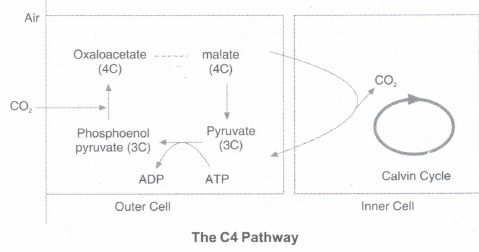
(i) The 3-carbon molecule is transported back to the mesophyll where it is converted to PEP again, thus, completing the cycle.
(ii) The CO2 released in the bundle sheath cells enters the C3 or the Calvin pathway, a pathway common to all plants. The bundle sheath cells are rich in an enzyme Ribulose bisphosphate carboxylase-oxygenase (RuBisCO), but lack PEPcase. Thus, the basic pathway that results in the formation of the sugars, the Calvin pathway, is common to the C3 and C4 plants.
2.
The Calvin Cycle
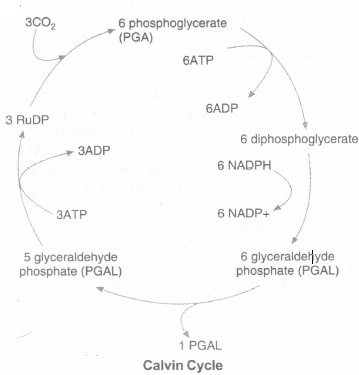
Calvin and his co-workers worked out the whole pathway and showed that the pathway operated in a cyclic manner; the RuBP (Ribulose bisphosphate) was regenerated.
The Calvin cycle can be described under three stages: carboxylation, reduction and regeneration.
1. Carboxylation. Carboxylation is the fixation of CO2 into a stable organic intermediate. Carboxylation is the most crucial step of the Calvin cycle where CO2 is utilised for the carboxylation of RuBP. This reaction is catalysed by the enzyme RuBP carboxylase which results in the formation of two molecules of 3-PGA. Since this enzyme also has an oxygenation activity it would be more correct to call it RuBP carboxylase-oxygenase or RuBisCO.
2. Reduction. These are a series of reactions that lead to the formation of glucose. The steps involve utilisation of 2 molecules of ATP for phosphorylation and two of NADPH for reduction per CO2 molecule fixed. The fixation of six molecules of CO2 and 6 turns of the cycle are required for the removal of one molecule of glucose from the pathway.
3. Regeneration. Regeneration of the CO2 acceptor molecule RuBP is crucial if the cycle is to continue uninterrupted. The regeneration steps require one ATP for phosphorylation to form RuBP.
Hence for every CO2 molecule entering the Calvin cycle, 3 molecules of ATP and 2 of NADPH are required. It is probably to meet this difference in number of ATP and NADPH used in the dark reaction that the cyclic phosphorylation takes place.
To make one molecule of glucose 6 turns of the cycle are required.
The Calvin Cycle
Importance of Calvin Cycle. Calvin cycle is the major step in which carbon fixation takes place. In other words this can be said as the 'moment of truth' in photosynthesis.
3.
Photosynthetic Membranes and organelles:
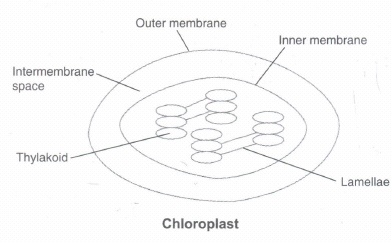
(i) In plants and algae, photosynthesis takes place in organelles called chloroplasts. A typical plant cell contains about 10 to 100 chloroplasts.
(ii) The chloroplast is enclosed by a membrane. This membrane is composed of a phospholipid inner membrane, a phospholipid outer membrane, and an intermembrane space between them.
(iii) Within the membrane is an aqueous fluid called the stroma. The stroma contains stacks (grana) of thylakoids, which are the site of photosynthesis.
(iv) The thylakoids are flattened disks, bounded by a membrane with a lumen or thylakoid space within it.
(v) The site of photosynthesis is the thylakoid membrane, which contains integral and peripheral membrane protein complexes, including the pigments that absorb light energy, which form the photosystems.
Plants absorb light primarily using the pigment chlorophyll, which is the reason that most plants have a green color. Besides chlorophyll, plants also use pigments such as carotenes and xanthophylls. Algae also use chlorophyll, but various other pigments are present as phycocyanin, carotenes, and xanthophylls in green algae, phycoerythrin in red algae (rhodophytes) and fucoxanthol in brown algae and diatoms resulting in a wide variety of colors.
These pigments are embedded in plants and algae in special antenna-proteins. In such proteins all the pigments are ordered to work well together. Such a protein is also called a light-harvesting complex.
Although all cells in the green parts of a plant have chloroplasts, most of the energy is captured in the leaves. The cells in the interior tissues of a leaf, called the mesophyll, can contain between 450,000 and 800,000 chloroplasts for every square millimeter of leaf. The surface of the leaf is uniformly coated with a water-resistant waxy cuticle that protects the leaf from excessive evaporation of water and decreases the absorption of ultraviolet or blue light to reduce heating. The transparent epidermis layer allows light to pass through to the palisade mesophyll cells where most of the photosynthesis takes place.
4.
The diagram is showing cyclic photophosphorylation.Here, A is electron acceptor, B is electron transport system and C is Photo system-I\({ PS }_{ 400 }\)
In cyclic photophosphorylation, only PS-I is functional.The electron is circulated within the photosystem and the phosphorylation occurs due to cyclic flow of electrons.
5.
C4-plants can produce more suger than C3-plants in condition of bright light and high tempertaure.It is because of the following reasons.
i)They have a special type of leaf anatomy
ii)They can tolerate higher temperature.
iii)They show response to high light intensities
iv)They lack a process called photorespiration.
v)They have greater productivity of biomass.
Many important crop plants are C4-plants including maize, sorghum, sugarcane and millet.
6.
The particularly large cells around the vascular bundles of the C4 pathway plants are called bundle sheath cells and the leaves, which have such anatomy are said to have Kranz anatomy.Kranz means wreath and is a reflection of the arrangement of cells.The bundle sheath cells may form several layers around the vascular bundles; they are characterized by having a large number of chloroplasts, thick walls impervious to gaseous exchange and no intercellular spaces.
C4 -plants can produce more sugar than C3-plants in conditions of bright light and high temperature.Many important crop plants are C4-plants, i.e maize, sorghum, sugarcane, and millet.
7.
Calvin cycle is a series of reactions that leads to the formation of glucose. The steps involve utilisation of 2 molecules of ATP for phosphorylation and 2 of NADPH for reduction per CO2 molecule fixed. The fixation of six molecules of CO2 and six turns of the cycle are required for the synthesis of one molecule of glucose through these reactions.
Hence, for every CO2 molecule entering the Calvin cycle, 3 molecules of ATP and 2 of NADPH are required. It is probably to meet this difference in number of ATP and NADPH used in the dark reaction that the cyclic phosphorylation takes place. To make one molecule of glucose six turns of the cycle are required.
8.
The enzyme Ribulose-1, 5-bisphosphate carboxylase/oxygenase, most commonly known by the shorter name RuBisCO is used in the Calvin cycle of photosynthesis to catalyse the first major step of carbon-fixation.
RuBisCO is thought to be the most abundant protein in the world since it is present in every plant that performs photosynthesis. It makes about 20-25% of the soluble protein in the leaves and is made on the earth at the rate of about 1000 Kg/s. It is estimated that every person on Earth is supported by about 44 kg of RuBisCO.
9.
Although all cells in the green part of a plant have chloroplasts, most of the energy is captured in the leaves. The cells in the interior tissues of a leaf, called the mesophyll, can contain between 450000 and 800000 chloroplasts for every square millimetre of leaf (nearly 60-70 chloroplasts/cell).
The surface of the leaf is uniformly coated with a water-resistant waxy cuticle that protects the leaf from excessive evaporation of water and decreases the absorption of ultraviolet or blue light to reduce heating.The transparent epidermal layer allows light to pass through to the palisade mesophyll cells, where most of the photosynthesis takes place.The green stems are also capable of performing photosynthesis.
10.
Comparison between the cyclic and non-cyclic photophosphorylation
| cyclic photophosphorylation | non-cyclic photophosphorylation |
| It occurs in photosystem-I in stromal or i ntergranal lamellae. |
It is carried out by both PS-I and PS-II i n the granal thylakoids. |
| It is not connected to photolysis of water so on oxygen is evolved. |
It is connected with photolysis of water, so oxygen is evolved in it. |
| It is activated by light of 700 nm wavelength | It occurs in 680 nm as well as 700 nm wavelength |
| It generates ATP only, there is no formation of NADPH2 | It produces both ATP as well as NADPH2 |
| Chlorophyll does not receive any electron from donor. | The source of electrons is photolysis of water. |
| The system does not take part in photosynthesis except in bacteria |
This system is connected with CO2, fixation and is dominant in green plants. |

11th Standard CBSE Syllabus & Materials
11th Standard CBSE
CBSE 11th Business Studies Forms of Business Organisation Sample Question Papers Study Material - QB365 Set A
NEW11th Standard CBSE
CBSE 11th Business Studies Business, Trade and Commerce Sample Question Papers Study Material - QB365 Set A
NEW11th Standard CBSE
CBSE 11th Physics Waves Sample Question Papers Study Material - QB365 Set A
NEW11th Standard CBSE
CBSE 11th Physics Kinetic Theory Sample Question Papers Study Material - QB365 Set A



CBSE 11th Standard CBSE Subjects
CBSE Standards









