
 100% FREE ACCESS
11th Standard CBSE Syllabus & Materials
11th Standard CBSE
CBSE 11th Economics PART-A - Presentation of Data - New Sample Question Papers Study Material - QB365 Set A
NEW11th Standard CBSE
CBSE 11th Economics PART-A - Organisation of Data - New Sample Question Papers Study Material - QB365 Set A
NEW11th Standard CBSE
CBSE 11th Economics PART-A - Collection of Data - New Sample Question Papers Study Material - QB365 Set A
NEW11th Standard CBSE
CBSE 11th Economics PART-A - Introduction to Economics and Statistics - New Sample Question Papers Study Material - QB365 Set A
NEW11th Standard CBSE
CBSE 11th Business Studies International Trade Sample Question Papers Study Material - QB365 Set A
NEW11th Standard CBSE
CBSE 11th Business Studies Evolution and Fundamentals of Business Sample Question Papers Study Material - QB365 Set A

Published on: 18/09/2019
Plant Growth and Development
Download CBSE Class 11th Standard CBSE Biology question papers, sample papers, important questions, and previous year solved papers in PDF format. Get free study materials, NCERT solutions, and exam preparation resources for Class 11th Standard CBSE Biology
Questions + Answers key
Take MCQ Biology Test
1.
What is "Bioassay"?
2.
Can you alter the rate of growth in an organism? If yes how?
3.
Which hormone breaks the dormancy of seed to initiate germination?
4.
What do you understand by inherent seed dormancy?
5.
Which is the first step in plant growth?
6.
Define development in living organisms.
7.
In areas requiring high growth which plant growth regulator is found?
8.
Why is abscisic acid also known as stress hormone?
9.
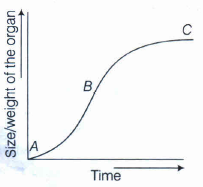
In the figure of sigmoid growth curve below label segments A, B and C.
10.
State the antagonistic effect of cytokinin and ABA
11.
Explain what is meant by the terms auxin precursors, anti-auxins, free auxins and bound auxins
12.
How does spraying of sugarcane plants with gibberellins increase the yield of sugar?
13.
In an experiment, the callus produced from internodal segments did not proliferate until coconut water was added. Given person
14.
In a slide showing different types of cells, can you identify which type of the cell may be meristematic and the one which is incapable of dividing and how?
15.
Explain inhibitory effect of auxins with the help of one example
1.
It is evaluation of the effect of a substance on a living organism under controlled conditions. Two bioassays used to examine auxin activity in plants are:
1. The Avena Curvature Test
2. Root growth inhibition test
2.
Yes, we can alter the rate of growth by making variations in the factors affecting growth, these are light and temperature. A plant grows quicker during the night then during the day. During the night retarding or inhibiting action of light is absent and rate of growth of a plant gradually increases until dawn while during the day the rate of growth gradually decreases until about sunset.
3.
Ethylene.
4.
When seed dormancy is because of internal causes, it is called inherent seed dormancy.
5.
The first step in the process of plant growth is seed germination. The seed germinates when favourable conditions for growth exist in the environment. In absence of such favourable conditions the seeds do not germinate and goes into a period of suspended growth or rest.
6.
Development is a term that includes all changes that an organism goes through during its life cycle from germination of the seed to senescence.
7.
They promote cell division, cell enlargement, flowering, fruiting and seed formation. Examples are auxins, gibberellins and cytokinins.
8.
Abscisic acid is also known as the stress hormone because it is found to induce various types of responses in plants against stress conditions like the closure of the stomata during drought, seed dormancy and it also ensures germination of seed during favorable conditions.
9.
A - Lag phase, B - Log phase and C- Steady phase.
10.
Abscisic acid (ABA) and cytokinin antagonistically regulate many developmental processes and environmental stress responses in plants.
11.
The compound, which can be converted into auxin are called auxin precursors. The compounds, which inhibit the actions of auxins, are termed anti-auxins. The auxins, which can easily be extracted, are called free auxins. And auxins, which are hard to extract and need the use of organic solvents, are reffered to as bound auxins.
12.
Spraying of sugar plants with gibberellin can increases the length of internodes and increased or lengthy internodes will produce more sugar. Thus,gibberelins can increase sugar yield.
13.
Callus (i.e., undifferentiated mass of cells) proliferates only when nutrient medium containing auxin was supplemented with coconut milk because it contains kinetin (a cytokinin) which stimulates growth of plants tissues.
14.
Meristematic cells are actively dividing cells which show mitotic divisions, ie.each chromosome is split lengthwise into two homologous chromatids, which pass equally into daughter cells. These possess thin cell wasll and a dense cytoplasm.
Mature cells are incapable of divisions becauses inthese cells differentiation has take place. Also mature cells do not possess thin cell wall in and a dense cytoplasm.
15.
Higher concentration of auxins inhibit growth of the plants. In normal course in nature, self produced auxin in plants inhibits the growth and development of lateral buds and as a result lateral bud remains dormant.

11th Standard CBSE Syllabus & Materials
11th Standard CBSE
CBSE 11th Business Studies Forms of Business Organisation Sample Question Papers Study Material - QB365 Set A
NEW11th Standard CBSE
CBSE 11th Business Studies Business, Trade and Commerce Sample Question Papers Study Material - QB365 Set A
NEW11th Standard CBSE
CBSE 11th Physics Waves Sample Question Papers Study Material - QB365 Set A
NEW11th Standard CBSE
CBSE 11th Physics Kinetic Theory Sample Question Papers Study Material - QB365 Set A



CBSE 11th Standard CBSE Subjects
CBSE Standards









