
 100% FREE ACCESS
11th Standard CBSE Syllabus & Materials
11th Standard CBSE
CBSE 11th Economics PART-A - Presentation of Data - New Sample Question Papers Study Material - QB365 Set A
NEW11th Standard CBSE
CBSE 11th Economics PART-A - Organisation of Data - New Sample Question Papers Study Material - QB365 Set A
NEW11th Standard CBSE
CBSE 11th Economics PART-A - Collection of Data - New Sample Question Papers Study Material - QB365 Set A
NEW11th Standard CBSE
CBSE 11th Economics PART-A - Introduction to Economics and Statistics - New Sample Question Papers Study Material - QB365 Set A
NEW11th Standard CBSE
CBSE 11th Business Studies International Trade Sample Question Papers Study Material - QB365 Set A
NEW11th Standard CBSE
CBSE 11th Business Studies Evolution and Fundamentals of Business Sample Question Papers Study Material - QB365 Set A

Published on: 24/09/2019
Structural Organisation in Animals
Download CBSE Class 11th Standard CBSE Biology question papers, sample papers, important questions, and previous year solved papers in PDF format. Get free study materials, NCERT solutions, and exam preparation resources for Class 11th Standard CBSE Biology
Questions + Answers key
Take MCQ Biology Test
1.
Write short notes on following:
Glandular Epithelium
2.
What do you understand by special junctions between cells? Which type of special junction are found in epithelial tissues?
3.
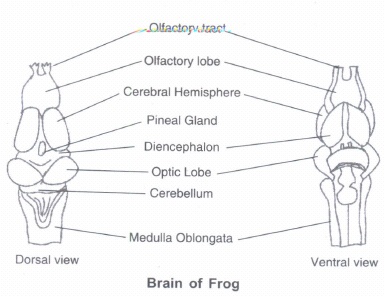
Draw a well lebelled diagram of both ventral and dorsal views of the brain of the frog.
4.
Explain in brief the nervous system of cockroach.
5.
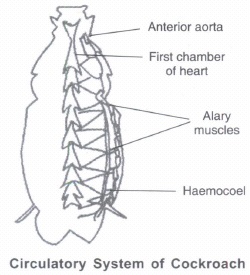
Draw a well labelled diagram of the circulatory system of cockroach.
6.
Explain fertilization and development in pheretima.
7.
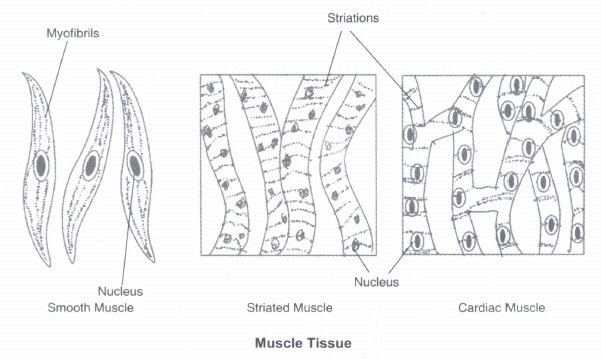
What are the main differences between smooth muscles, skeletal muscles and cardiac muscles?
8.
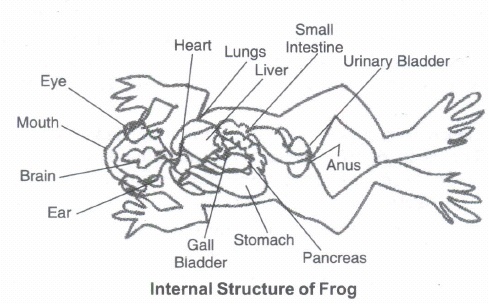
Draw a neat diagram of digestive system of frog.
9.
Mention briefly about the circulatory system of earthworm.
10.
Difference between blood plasma and serum.
11.
Difference between keratinised and non keretinised stratified squamous epitheila
12.
Mention the special features of eye in cockroach.
13.
Mention the similarities between Cardiac and skeletal muscles.
14.
Name the main excretory organs of cockroach. Write the structure of these organs.
15.
Why is the body cavity of cockroach called haemocoel? Name the different layer of body wall in it.
1.
Glandular Epithelium. Some of the columnar or cuboidal cells get specialised for secretion and are called glandular epithelium. They are mainly of two types:
(i) Unicellular, consisting of isolated glandular cells (goblet cells of the alimentary canal),
(ii) Multicellular, consisting of cluster of cells (salivary gland).
On the basis of the mode of pouring of their secretions, glands are divided into two categories namely exocrine and endocrine glands. Exocrine glands secrete mucus, saliva, earwax, oil, milk, digestive enzymes and other cell products. These products are released through ducts or tubes. In contrast, endocrine glands do not have ducts. Their products, called hormones, are secreted directly into the fluid bathing the gland.
2.
All cells are held together with intercellular material. These materials form junctions between cells.
There are three types of cell junctions found in epithelial tissue.
(a) Tight Junctions: These junctions help in stopping leakage of substances across a tissue.
(b) Adhering Junctions: These junctions keep neighbouring cells together.
(c) Gap Junctions: These junctions connect cytoplasm of adhering cells, and facilitate exchange of materials.
3.
4.
Nervous System of Cockroach:
(i) The nervous system of cockroach consists of a series of fused, segmentally arranged ganglia joined by paired longitudinal connectives on the ventral side.
(ii) Three ganglia lie in the thorax, and six in the abdomen. The nervous system of cockroach is spread throughout the body.
(iii) The head holds a bit of a nervous system while the rest is situated along the ventral (belly-side) part of its body.
5.
6.
Fertilization and Development in Pheretima:
(i) A mutual exchange of sperm occurs between two worms during mating. One worm has to find another worm and they mate juxtaposing opposite gonadal openings exchanging packets of sperms called spermatophores.
(ii) Mature sperm and egg cells and nutritive fluid are deposited in cocoons produced by the gland cells of clitellum. Fertilisation and development occur within the cocoons which are deposited in soil.
(iii) The cocoon holds the worm embryos. After about 3 weeks, each cocoon produces two to twenty baby worms with an average of four.
(iv) Earthworms development is direct, i.e., there is no larva formed.
7.
| Smooth Muscle | Skeletal Muscle | Cardiac Muscle |
| Spindle shaped cells | Striated unbranched cells | Striated branched cells |
| Found in muscles of internal organs. |
Found in musculo-skeletal system. |
Found in the heart |
| Control involuntary actions. | Control voluntary actions. | Control heart's pumping which is involuntary. |
8.
9.
Blood Vascular System. Pheretima exhibits a closed type of blood vascular system, consisting of blood vessels, capillaries and heart. Due to closed circulatory system, blood is confined to the heart and blood vessels. Contractions keep blood circulating in one direction. Smaller blood vessels supply the gut, nerve cord, and the body wall. Blood glands are present on the 4th, 5th and 6th segments. They produce blood cells and haemoglobin which is dissolved in blood plasma. Blood cells are phagocytic in nature. Earthworms lack specialised breathing devices. Respiratory exchange occurs through moist body surface into their blood stream.
10.
Difference between blood plasma and serum.
| Blood plasma | Blood serum |
| It is the fluid minus blood corpuscles | It is liquid minus clotting elements and corpuscles |
| It is faint yellow in color | It is pale yellow in color |
| It contains fibrinogen and other clotting factors | it lacks fibrinogen and other clotting factors |
| It takes part in blood clotting | It does not take part in blood clotting |
11.
Difference between keratinised and non keretinised stratified squamous epitheila
| keratinised stratified squamous epitheila | non keretinised stratified squamous epitheila |
| It isfound over the surfaces exposedto drying | It occurs over the surfaces which are not subjected to drying |
| The outr cells are dead | the outer cells are living |
| the outer cells are filled with keratin | keratin is absent |
| it has adhisive lipid layer | Lipid layer is absent |
| The epithelium is imprevious to water | Impermeability to water is low |
12.
In cockroach, there are two types of eyes, i.e., apair of simple eye and a pair of compound eyes. A compound eye has upto 2000 hexagonbal units called ommatidia. These are responsible for producing mosaic vision. The adjacent ommatidia are separated internally by the pigment cells. An ommatidium has two parts
(i) Outer dioptoric or focussing part, which consisits of a corneal lens, two corneagen cells, a crystalline cone and four cone cells or vitrellae.
(ii) Inner receptive part has a spindle-shaped pigment contaning rhadome surrounded by eight retinulae which continue as nerve fibre.
13.
Similarities between cardiac and skeletal muscles The cardiac and skeletal muscles both are made up of elongated fibres, which have numerous myofibrils. The myofibrils of the cardiac muscles have the same structure as those of skeletal muscle and are made up of actin and myosin filaments. The cardiac and skeletal muscles fibres have dark and light bands.
14.
Malphighian tubules are the amin excretory organs of cockroach.
15.
The body cavity of cockroach is filled with haemolymph so, it is called haemocoel. Cuticle, epidermis and basement membrane are layer of body wall in cockroach.

11th Standard CBSE Syllabus & Materials
11th Standard CBSE
CBSE 11th Business Studies Forms of Business Organisation Sample Question Papers Study Material - QB365 Set A
NEW11th Standard CBSE
CBSE 11th Business Studies Business, Trade and Commerce Sample Question Papers Study Material - QB365 Set A
NEW11th Standard CBSE
CBSE 11th Physics Waves Sample Question Papers Study Material - QB365 Set A
NEW11th Standard CBSE
CBSE 11th Physics Kinetic Theory Sample Question Papers Study Material - QB365 Set A



CBSE 11th Standard CBSE Subjects
CBSE Standards









