
 100% FREE ACCESS
11th Standard CBSE Syllabus & Materials
11th Standard CBSE
CBSE 11th Economics PART-A - Presentation of Data - New Sample Question Papers Study Material - QB365 Set A
NEW11th Standard CBSE
CBSE 11th Economics PART-A - Organisation of Data - New Sample Question Papers Study Material - QB365 Set A
NEW11th Standard CBSE
CBSE 11th Economics PART-A - Collection of Data - New Sample Question Papers Study Material - QB365 Set A
NEW11th Standard CBSE
CBSE 11th Economics PART-A - Introduction to Economics and Statistics - New Sample Question Papers Study Material - QB365 Set A
NEW11th Standard CBSE
CBSE 11th Business Studies International Trade Sample Question Papers Study Material - QB365 Set A
NEW11th Standard CBSE
CBSE 11th Business Studies Evolution and Fundamentals of Business Sample Question Papers Study Material - QB365 Set A

Published on: 28/09/2019
Transport in Plants
Download CBSE Class 11th Standard CBSE Biology question papers, sample papers, important questions, and previous year solved papers in PDF format. Get free study materials, NCERT solutions, and exam preparation resources for Class 11th Standard CBSE Biology
Questions + Answers key
Take MCQ Biology Test
1.
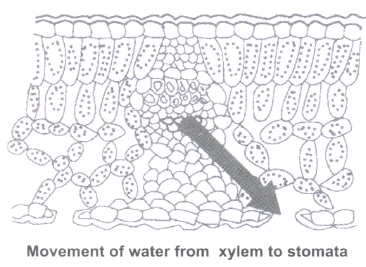
Give a diagram showing movement of water in leaves.
2.
Give a comparison of different transport mechanisms used by plants.
3.
"The movement of water is through transpiration pull. " Discuss if this statement is 100% true. Give explanation for your answer.
4.
What is the role of root pressure in water transport?
5.
Define following: (a) Cohesion, (b) Adhesion and (c) Surface Tension. How do these properties of water help in movement of water in plants?
6.
Describe the movement of water in leaves.
7.
What is the significance of transpiration?
8.
Photosynthesis needs constant supply of water. But transpiration can hamper this supply. How do plants of desert area manage to get sufficient water in spite of faster transpiration?
9.
Define facilitated diffusion.
10.
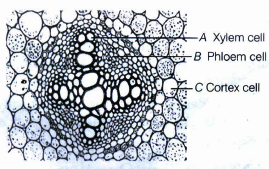
The diagram shows a transverse section of the central portion of a root of a dicotyledonous plant.
(i) Through which tissue are sugars and amino acids transported?
(ii) Why is the movement through phloem bidirectional?
11.
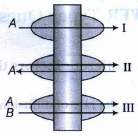
Identify the process occurring in I, II and III.
12.
Under what condition the rate of transpiration will be maximum, when soil is dry and atmosphere is humid or when soil is humid and atmosphere is dry? given reason.
13.
Describe at least three major functions of turgor pressure.
14.
What happens when a pressure greater than the atmospheric pressure is applied to pure water or a solution?
1.
2.
Comparison of different transport mechanisms
| Property | Simple Diffusion | Facilitated Transport | Active Transport |
|---|---|---|---|
| Requires special membrane protein | No | Yes | Yes |
| Highly selective | No | Yes | Yes |
| Transport saturates | No | Yes | Yes |
| Uphill transport | No | No | Yes |
| Requires ATP energy | No | No | Yes |
3.
This statement is partially true. Transpiration pull is the major factor which facilitates movement of water in xylem. But there are other factors at play. The cohesion-adhesion and surface tension gives high capillarity to water molecules which enables it to reach a certain height in plant's xylem. Transpiration pull has an augmentative effect on the surface tension push. So in totality it is cohesion-adhesion-surface tension and transpiration pull which does the whole function of transporting water to greater heights in plants
4.
Root pressure can provide only modest push during water transport in plants. The main role of root pressure is in re-establishing the continuous chain of water molecules in the xylem. The continuous chain often breaks due to enormous tension created by transpiration pull.
5.
(a) Cohesion: Mutual attraction between water molecules is called cohesion.
(b) Adhesion: Attraction of water molecules to polar surfaces is called adhesion.
(c) Surface Tension: Water molecules are attracted to each other in the liquid phase more than to water in the gas phase. This gives a liquid an ability to acquire the least possible area and explains the spherical shape of raindrops.
These properties give water high tensile strength, i.e., an ability to resist a pulling force, and high capillarity, i.e., the ability to rise in thin tubes. In plants capillarity is aided by the small diameter of the tracheary elements - the tracheids and vessel elements.
6.
Evaporation from the leaf sets up a pressure gradient between the outside air and the air spaces of the leaf. The gradient is transmitted into the photosynthetic cells and on the water-filled xylem in the leaf vein. This facilitates movement of water from xylem to the guard cells of stomata
7.
Significance of transpiration:
1.Transpiration pull facilitates movement of water from roots.
2.Transpiration supplies water for photosynthesis
3.It pulls minerals from soil.
4.Helps in cooling of plants.
5.Maintains shape of plant cells
8.
Desert plants have a different mechanism of photosynthesis and it is called C4 pathways. The evolution of the C4 photosynthetic system is probably one of the strategies for maximising the availability of CO2 while minimising water loss. C4 plants are twice as efficient as C3 plants in terms of fixing carbon (making sugar). However, a C4 plant loses only half as much water as a C3 plant for the same amount of CO2 fixed.
9.
Membrane proteins provide sites at which movement of certain molecules takes place. These molecules have hydrophilic moiety and hence it is difficult for themto cross a membrane. They need assistance of membrane proteins to cross the membrane. This is called facilitated diffusion.
10.
(i) Sugars and amino acids are transported by phloem tissue, i.e., ' .part B which are found alternating between the central core of xylem tissue.
(ii) Direction of Transport'.
11.
I - Uniport transport
II - Antiport transport,
III - Symport transport.
12.
The rate of transpiration will be maximum when the soil is humid and atmosphere is dry because of following reasons.
(i) Availability of more water in the soil is necessary for the absorption of water by the roots in order to carry it up to the xylem. Thus, lack of water decrease transpiration and over all health of the plants. Whereas, more water in soil increase transpiration.
(ii) In dry climates, transpiration is increased. Water is forced to diffuse more rapidly in to the air due to the concentration difference between the environment outside the plant. Low humidity creates a vapour gradient between the plant and the air.In dry air, there is lack of water, forcing water to be pulled from the plant to the atmosphere increasing transpiration. Therefore, in humid climates, transpiration is less affected by diffusion.
13.
Turgor pressure maintains rigidity of a plant cell, i.e., it keeps plants upright and stiff.
It also plays an imporant role in plant cell growth whereby the cell wall undergroes irreversible changes in volume and structure.
It also influences the opening and closure of stomata by influencing the turgidity of guard cells.
14.
If a pressure greater than atmospheric pressure is applied to pure water or a solution, its water potential increases. It is equivalent to pumping water from one place to another. Pressure can be built up in a plant system when water Enters a plant cell due to diffusion against the cell wall. It makes the cell turgid, this increases the pressure potential. Pressure potential is usually positive and denoted by \({ \Psi }_{ p }\).

11th Standard CBSE Syllabus & Materials
11th Standard CBSE
CBSE 11th Business Studies Forms of Business Organisation Sample Question Papers Study Material - QB365 Set A
NEW11th Standard CBSE
CBSE 11th Business Studies Business, Trade and Commerce Sample Question Papers Study Material - QB365 Set A
NEW11th Standard CBSE
CBSE 11th Physics Waves Sample Question Papers Study Material - QB365 Set A
NEW11th Standard CBSE
CBSE 11th Physics Kinetic Theory Sample Question Papers Study Material - QB365 Set A



CBSE 11th Standard CBSE Subjects
CBSE Standards









