
 100% FREE ACCESS
11th Standard CBSE Syllabus & Materials
11th Standard CBSE
CBSE 11th Economics PART-A - Presentation of Data - New Sample Question Papers Study Material - QB365 Set A
NEW11th Standard CBSE
CBSE 11th Economics PART-A - Organisation of Data - New Sample Question Papers Study Material - QB365 Set A
NEW11th Standard CBSE
CBSE 11th Economics PART-A - Collection of Data - New Sample Question Papers Study Material - QB365 Set A
NEW11th Standard CBSE
CBSE 11th Economics PART-A - Introduction to Economics and Statistics - New Sample Question Papers Study Material - QB365 Set A
NEW11th Standard CBSE
CBSE 11th Business Studies International Trade Sample Question Papers Study Material - QB365 Set A
NEW11th Standard CBSE
CBSE 11th Business Studies Evolution and Fundamentals of Business Sample Question Papers Study Material - QB365 Set A

Published on: 20/09/2019
The Living World
Download CBSE Class 11th Standard CBSE Biology question papers, sample papers, important questions, and previous year solved papers in PDF format. Get free study materials, NCERT solutions, and exam preparation resources for Class 11th Standard CBSE Biology
Questions + Answers key
Take MCQ Biology Test
1.
Write five characters which make you think that cockroaches and mentis belong to same Phylum.
2.
Find five characteristics each in orange and lemon to establish that they belong to the same family.
3.
Write a brief note on three domains of life.
4.
How is botanical garden useful for scientists?
5.
Write short notes on following: Phylum, Order, Genus and Species.
6.
Write the relation between taxonomic category and taxonomic hierarchy.Fill in the missing category in following hierarchical arrangement in ascending order.
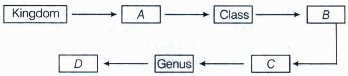
7.
What precautions must you observe while in a zoological museum?
8.
How do you prepare your own herbarium sheets? What are different tools you carry with you while, collecting plants for the preparation of a herbarium? What information should a preserved plant material on the herbarium sheet provide for taxonomic studies?
9.
Amoeba is a living matter and a sand particle is non-living matter.Explain.
10.
Metabolism is a defining feature of all living organisms without exception. Isolated metabolic reactions in vitro are not living things, but surely living reactions.Comment.
11.
In which fields taxonomical aids are helpful? Why taxonomic aids are used in these studies? Which different taxonomical aids are used by the biologists?
12.
What are the obligate categories? How these are different from intermediate categories. List out some intermediate categories.
13.
Define a taxon. Give some examples of taxa at different hierarchical levels.
14.
What different criteria would you choose to classify people that you meet often?
15.
Why are the classification systems changing every now and then?
1.
Similar characters of cockroach and mentis :
(a) Joined appendages.
(b) Body divided into head, thorax and abdomen
(c) Presence of compound eyes
(d) Exoskeleton made of chitin
(e) Wings made of chitin.
2.
Similar characters of orange and lemon :
(a) Shape of fruit.
(b) Similar structure of mesocarp of fruit.
(c) Similar arrangement of seeds indicating similar arrangement of embryo.
(d) Similar venation and structure of leaves.
(e) Presence of thorns on branches.
3.
The three-domain system was first invented in 1990. One main characteristic of the three domain method is the separation of Archaea and bacteria, previously, grouped into the single Kingdom Bacteria (or Monera). The three domains of life are as follows:
(a) Archaea
(b) Bacteria and
(c) Monera.
4.
In a botanical garden, various plant species are reared. Special artificial climate is created for a plant's specific needs. The purpose of botanical garden is to maintain a rich flora of diverse species. Since they are live specimens so they help scientists in studying physiology and anatomy over a long duration. Imagine if Mendel were given a botanical garden full of variety of species. He could have done experiment on so many plants and may have come with more insights.
5.
Phylum:
Phylum comes next to Kingdom in the taxonomical hierarchy. All broad characteristics of an animal or plant are defined in a phylum. For example, all chordates have a notochord and gill at some stage of life cycle. Similarly, all arthopods have jointed legs made of chitin.
Order:
Order further zeroes down on characteristics and includes related genera. For example, humans and monkeys belong to the order Primates. Both humans and monkeys can use their hands to manipulate objects and can walk on their hind legs.
Genus:
Comprises a group of related species which has more characters in common in comparison to species of other genera. We can say that genera are aggregates of closely related species. For example, potato, tomato and brinjal are three different species but all belong to the genus Solanum. Lion (Panthera leo), leopard (P. Pardus) and tiger (P. Tigris) with several common features, are all species of the genus Panthera. This genus differs from another genus Felis which includes cats.
Species:
Taxonomic studies consider a group of individual organisms with fundamental morphological similarities as a species. One should be able to distinguish one species from the other closely related species based on the distinct morphological differences.
6.
The category is a part of overall taxonomic arrangement called taxonomic category. All the categories together constitute the taxonomic hierarchy.
A - Phylum, B - Order, C - Family and D - Species
7.
We must observe following precautions while visiting a museum :
(i) Do not touch or displace any specimen or the container containing it.
(ii) Do not make noise or any kind of disturbance in a museum.
(iii) Carefully examine each specimen and make notes in a notebook.
(iv) Contact the security personnel or any other authority present in case of any problem.
8.
For the preparation of herbarium sheets, a sheet of about 29 x 41 cm is cut from chart paper. Dried specimens are mounted on the sheets with the help of glue or cellotape. A label is pasted on sheets at lower right corner of the sheet.
Tools for collection are
(i) digger
(ii) pruning knife
(iii) scissors
(iv) vasculum
(v) polythene bags
(vi) old newspapers
(vii) blotting papers
(viii) plant press
(ix) field notebook
(x) magnifying glass
Information from herbarium sheets : The label of herbarium sheets has information like scientific name of plant, family, common and English name, local name, collector's name, place, time and date of collection.
9.
Amoeba shows various characteristics such as growth, reproduction, metabolism, etc., that are specific to living organisms. On the other hand, a sand particle does not show any reproduction and metabolism therefore, it is considered as non-living matter. Though, the sand particle shows growth which is also a characteristic of living things, but in this the growth is only external due to aggregation of many sand particles and not internal. Therefore, Amoeba is a living matter while a sand particle is a non-living matter.
10.
The living organisms are made up of molecules. These are of various sizes, classes, functions, etc. They need to change in some other biomolecules. These conversions are chemical reactions or metabolic reactions.
Metabolism is a defining feature of life, as living things depend on various biochemical reactions. These reactions can be demonstrated outside the body in cell-free systems, which are neither living nor non-living nor non-living, Isolated metabolic reactions in vitro are thus, not living things, but surely living reactions.
11.
Taxonomical aids are helpful in various fields such as agriculture, forestry, industry and in knowing our bioresources.
All the above-mentioned studies need correct identification and classification of organisms. Identification of organisms requires intensive laboratory and field studies.
Biologists use herbarium, botanical gardens, museum, zoological parks, and taxonomical keys while doing taxonomical studies.
12.
(i) The taxonomic categories which are always used in hierarchical classification of organisms are called obligate categories.
(ii) The taxonomic categories from species to kingdom are broad categories or obligate categories. However, taxonomists have developed sub-categories in this hierarchy to facilitate more sound and scientific placement of various taxa.
(iii) These are intermediate categories.
(iv) They include subphyla, subclasses, suborders, subfamilies, subgenera, varieties or subspecies.
13.
Each category in taxonomical hierarchy is commonly called taxon.
The different taxonomical categories are-species, genus, family, order, class, phyla/division and kingdom. Some examples of taxa at different hierarchical levels are
(i) Mangifera indica is a taxon and species is its category.
(ii) The taxon of all the bacteria is Monera and the category is kingdom.
(iii) The taxon of fishes is Pisces and the category is class.
14.
Classifying humans:
1. The various criteria that may be chosen to classify people whom we meet often include behaviour, geographical location, morphology, gender, family members etc.
2. Geographical location of the individual defines their ability to adapt to the environment.
3. The morphology or phenotype of the organism and the behavior is responsible for differentiating humans.
4. Gender also helps in the major classification of humans that helps in the population studies.
15.
Now a days, biologists use several principles and criteria to classify the organisms. These are based on morphology, anatomy, cytology, physiology, phylogeny, reproduction, evolution, biochemistry and genetics. Thus, there are several characteristics differences which help in classification. This is the reason of change in classification systems every now and then.

11th Standard CBSE Syllabus & Materials
11th Standard CBSE
CBSE 11th Business Studies Forms of Business Organisation Sample Question Papers Study Material - QB365 Set A
NEW11th Standard CBSE
CBSE 11th Business Studies Business, Trade and Commerce Sample Question Papers Study Material - QB365 Set A
NEW11th Standard CBSE
CBSE 11th Physics Waves Sample Question Papers Study Material - QB365 Set A
NEW11th Standard CBSE
CBSE 11th Physics Kinetic Theory Sample Question Papers Study Material - QB365 Set A



CBSE 11th Standard CBSE Subjects
CBSE Standards









