
 100% FREE ACCESS
11th Standard CBSE Syllabus & Materials
11th Standard CBSE
CBSE 11th Economics PART-A - Presentation of Data - New Sample Question Papers Study Material - QB365 Set A
NEW11th Standard CBSE
CBSE 11th Economics PART-A - Organisation of Data - New Sample Question Papers Study Material - QB365 Set A
NEW11th Standard CBSE
CBSE 11th Economics PART-A - Collection of Data - New Sample Question Papers Study Material - QB365 Set A
NEW11th Standard CBSE
CBSE 11th Economics PART-A - Introduction to Economics and Statistics - New Sample Question Papers Study Material - QB365 Set A
NEW11th Standard CBSE
CBSE 11th Business Studies International Trade Sample Question Papers Study Material - QB365 Set A
NEW11th Standard CBSE
CBSE 11th Business Studies Evolution and Fundamentals of Business Sample Question Papers Study Material - QB365 Set A

Published on: 28/07/2019
Animal Kingdom
Download CBSE Class 11th Standard CBSE Biology question papers, sample papers, important questions, and previous year solved papers in PDF format. Get free study materials, NCERT solutions, and exam preparation resources for Class 11th Standard CBSE Biology
Questions + Answers key
Take MCQ Biology Test
1.
What is a cnidoblast?
2.
What is the name of the opening through which the water moves out of the body of a sponge?
3.
Define notochord
4.
What is the major difference between coelomates and acoelomates?
5.
What is the key feature of Reptilia?
6.
Provide the appropriate technical term for blood-filled cavity in arthropods and lateral appendages in aquatic annelids.
7.
There has been an increase in the number of chambers in heart during evolution of vertebrates.Give the name of the class of vertebrates having two, three or four - chambered heart
8.
What is the difference between direct and indirect development?
9.
Distinguish between intracellular and extracellular digestion?
10.
Difference between the complete and incomplete digestive system.
11.
Segmentation in the body is first observed in
12.
What kind of body scales are present in bony
13.
How important is the presence of air bladder in Pisces?
14.
Name an animal having canal system and spicules.
15.
Pseudometamerism is found in...........
16.
Which is the first phylum showing a closed circulatory system? What are the advantages of a closed circulatory system over open circulatory system?
17.
List out any six general features of cartilaginous fishes
18.
Justify that annelids are evolutionary precursors of molluscs.
19.
Write an account on skeleton of sponges.
20.
What are the different habitats of molluscs? Give with examples.
21.
Describe phylum Coelenterata. Give suitable examples.
22.
Write an account of general features of roundworms.
23.
Urecotelic excretion is found in which of the following pairs of animals?
Frogs and Crows
Lizards and Sparrow
Chimpanzee and Kangaroo
Bats and Crows
24.
Which type of excretion is present in fishes?
Ammonotelic
Ureotelic
Urecotelic
None of these
25.
How many chambers are there in the heart of a crocodile?
2
3
4
5
26.
On the basis of which character it can be said that bats do not belong to Aves?
Ability to fly
Presence of mammary glands
both (a) and (b)
None of the above
27.
Which of the following organisms is having a two-chambered heart?
Frog
Cobra
Shark
Platypus
1.
Cnidoblasts are special structures containing stinging capsules. The poisonous substance from the stinging capsule is used to kill the prey.
2.
Osculum; the water enters through ostia and moves out through osculum.
3.
The notochord is mesodermally derived structure formed on the dorsal side during embryonic development in some animals.
4.
In coelomates the mesoderm is lining the body cavity, while in acoelomates the mesoderm is present in small pouches.
5.
Reptilia are crawling animals and their skin is hard and dry to withstand extreme temperatures.
6.
Blood-filled cavity in arthropods is haemocoel and lateral appendages in aquatic annelids are parapodia.
7.
(i) Two - chambered heart - Pisces
(ii) Three - chambered heart - Amphibians and reptiles except crocodiles
(iii) Four-chambered heart - Crocodiles, aves and Mammalia
8.
Differences between the direct and indirect development are as follows.
Direct development : In case direct development the life cycle of an adult individual lacks any larval stage in its life cycle. The adult give rise to young ones which directly develop into the adult.e.g, mammals
Indirect development : It is present mostly in case of lower animals, the adult individual gives rise to eggs mostly which develop into the adult after being passing through serval larval stages, e.g, echinoderms Ascaris, cockroach have prolonged larval stages in their life cycle.
9.
Differences between intracellular and extracellular digestion are
(i) Intracellular digestion occurs inside the living cells with the help of lysosmal enzymes. Food particle taken in through endocyotosis It forms a phagosome, which fuses with a lysosome. The digested material passes into the cytoplasm. The undigested matter is thrown out by exocytosis. It occurs in Amoeba, Paramecium, etc.
(ii) Extracellur digestion In case of coelenterates, digestion occurs in gastrovascular cavity. This cavity, has gland cells which secrete digestive enzymes ove the food. The partilly digested framented food particles are ingested by nutritive cells. It occurs in Hydra, Aurelia and higher animals, etc.
10.
Digestive system having only a single opening to the outside of the body that serves as both mouth and anus, called incomplete digestive system while a complete digestive system has two separate openings, i.e mouth and anus.
11.
In Platyhelminthes, true segmentation is absent but pseudosegmentation is seen,which is reduced by repeated budding or strobilation.
12.
Most bony fishes have cycloid or ctenoid scales. Both cycloid and ctenoid scales consist of an outer layer of calcium and an inner layer of connective tissue.
13.
Gas bladder or air bladder is a gas-filled sac present in fishes. It helps in maintaining buoyancy. Thus, it helps fishes to ascend or descend and stay in the water current.
14.
Sycon (sponge) possesses canal system and bear spicules.
15.
tapeworms
16.
Annelida is the first phylum showing a closed circulatory system. In open circulatory system blood is directly supplied to tissues. In closed circulatory system special tubes are in place to circulate blood. This is more efficient in circulating blood in larger and complex organisms. So all higher organisms have closed circulatory system.
17.
Features of cartilaginous fishes
(i) Cartilaginous endoskeleton is present
(ii) These are mostly marine, poikilothermic animals
(iii) Notochord is persistent throughout the life
(iv) Placoid scales are present
(v) Heart is two-chambered with one auricle and ventrical
(vi) Tail fin is always heterocercal
18.
Annelids are considered evolutionary precursors of molluscs as they do not have metameric segmentation.However, Neopilina a living fossil shows metameric segmentation.Besides,its trochopore larva, it has structural similarities to annelid trochopore larva.These two evidences suggest that molluscs have descended from annelids.
19.
The body of sponges contains a supporting exoskeleton. It is made up of either spicules or spongin fibres or both. Spongin fibres are protein fibres. They are either highly branched or show anastomosis. Spicules are calcareous or siliceous with hard spine-like structures.
Depending on the branching the spicules are
(i) monoaxons (single axis).
(ii) triaxons (three axis forming six rays of hexactinal spicules).
(iii) tetraxons (four rays or tetra actinal).
(iv) polyaxons (several rays)
20.
Molluscs have diverse habitats
(i) Marine Chiton,Sepia,Octopus
(ii)Fresh water unio and Pila
(iii)Terrestrial Land snails
(iv) Parasites Glochidium larva
21.
Phylum - Coelenterata (Cnidaria)
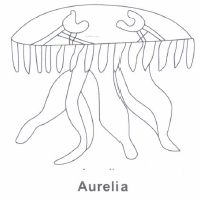
Habit and Habitat. They are aquatic, mostly marine, sessile or free-swimming, radially symmetrical animals. The name cnidaria is derived from the cnidoblasts or cnidocytes (which contain the stinging capsules or nematocytes) present on the tentacles and the body. Cnidoblasts are used for anchorage, defense and for the capture of prey.
Key Structural Features. Cnidarians exhibit tissue level of organisation and are diploblastic. They have a central gastro-vascular cavity with a single opening, hypostome. Digestion is extracellular and intracellular. Some of the cnidarians, e.g., corals have a skeleton composed of calcium carbonate.
Basic Body Forms. Cnidarians exhibit two basic body forms called polyp and medusa. Polyp is a sessile and cylindrical form like Hydra, Adamsia, etc. whereas,
medussa is umbrella-shaped and free-swimming like Aurelia or jelly fish. Those cnidarians which exist in both forms exhibit alternation of generation
(Metagenesis), i.e., polyps produce medusae asexually and medusae form the polyps sexually (e.g., Obelia).
Examples: Physalia (Portuguese man-of-war), Adamsia (Sea anemone), Pennatula (Sea-pen), Gorgonia (Sea-fan) and Meandrina (Brain coral).
22.
General features of roundworms are
(i) The body is cylindrical and tapering at both ends.
(ii) No segmentation.
(iii) Bilateral symmetry
(iv) They have organ system level of organisation
(v) The anterior end does not form a distinct head
(vi) There are no locomotory appendages in roundworms
(vii) The body wall consists of firm, non-living, resistant cuticle, epidermis and muscle layer.
(viii) These are pseudocoelomates.
(ix) Hydroskeleton is present.
(x) Digestive tract is complete.Respiration occurs by body surface.
(xi) Circulatory system is undeveloped.Excretion occurs through gland cells.
(xii) Sexes are separate.Sexual dimorphism is present. Fertilisation is internal.There is no asexual reproduction.
(xiii)Development is direct.
23.
(b)
Lizards and Sparrow
24.
(a)
Ammonotelic
25.
(c)
4
26.
(b)
Presence of mammary glands
27.
(c)
Shark

11th Standard CBSE Syllabus & Materials
11th Standard CBSE
CBSE 11th Business Studies Forms of Business Organisation Sample Question Papers Study Material - QB365 Set A
NEW11th Standard CBSE
CBSE 11th Business Studies Business, Trade and Commerce Sample Question Papers Study Material - QB365 Set A
NEW11th Standard CBSE
CBSE 11th Physics Waves Sample Question Papers Study Material - QB365 Set A
NEW11th Standard CBSE
CBSE 11th Physics Kinetic Theory Sample Question Papers Study Material - QB365 Set A



CBSE 11th Standard CBSE Subjects
CBSE Standards









