
 100% FREE ACCESS
11th Standard CBSE Syllabus & Materials
11th Standard CBSE
CBSE 11th Economics PART-A - Presentation of Data - New Sample Question Papers Study Material - QB365 Set A
NEW11th Standard CBSE
CBSE 11th Economics PART-A - Organisation of Data - New Sample Question Papers Study Material - QB365 Set A
NEW11th Standard CBSE
CBSE 11th Economics PART-A - Collection of Data - New Sample Question Papers Study Material - QB365 Set A
NEW11th Standard CBSE
CBSE 11th Economics PART-A - Introduction to Economics and Statistics - New Sample Question Papers Study Material - QB365 Set A
NEW11th Standard CBSE
CBSE 11th Business Studies International Trade Sample Question Papers Study Material - QB365 Set A
NEW11th Standard CBSE
CBSE 11th Business Studies Evolution and Fundamentals of Business Sample Question Papers Study Material - QB365 Set A

Published on: 04/09/2019
Morphology of Flowering Plants
Download CBSE Class 11th Standard CBSE Biology question papers, sample papers, important questions, and previous year solved papers in PDF format. Get free study materials, NCERT solutions, and exam preparation resources for Class 11th Standard CBSE Biology
Questions + Answers key
Take MCQ Biology Test
1.
Write the description of gynoecium in various plants.
2.
Name of the ornamental plants of lily family
3.
Describe the modification of stem with suitable examples. "Fleshy stems"
4.
What is root cap? Which any two variations are found in this?
5.
Write a short note on two main types of roots.
6.
Differentiate between reticulate venation and paralleel venation.
7.
Write the floral formula of family-Fabaceae and give its two examples.
8.
What are the two layers of seed coat?
9.
A maize grain is not a seed.Explain
10.
Why are velamen tissues present in epiphytic roots?
11.
The scutellum obeserved in a grain of wheat or maize is comparable to which part of the seed in other monocots.
12.
Name the components of the formed elements in the blood and mention one major function of each of them.
13.
What is periderm? How does periderm formation take place in the dicot stems?
14.
How is the study of plant anatomy useful to us?
15.
What is stomatal apparatus? Explain the structure of stomata with a labelled diagram.
16.
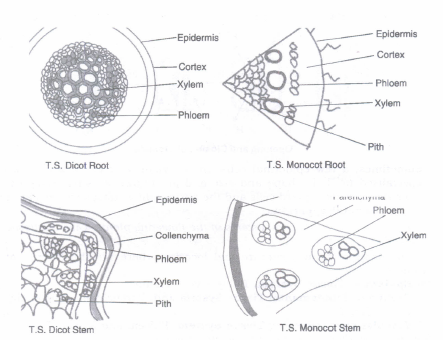
Draw illustrations to bring out the anatomical difference between
(a) Monocot root and Dicot root
(b) Monocot stem and Dicot stem
17.
Cork cambium forms tissues that form the cork. Do you agree with this statement? Explain.
18.
Name some taxonomic characters to be described.
19.
Justify the following statements on the basis of external features.
(a) Underground parts of a plant are not always roots.
(b) Flower is a modified shoot.
1.
The description of gynoecium in various plants.
(i) Carples Monocarpellary /bi carpellary/ tricarpellary/tetracarpellary /multi-capillary
(ii) Cohestion Apocarpous/Syncarpous
(iii) Overy Superior/semi-inferior/inferior.
(iv) Placentation Marginal/axile/parietal/basal/free-central/superficial.
(v) Style Terminal/lateral/gynobasic/stylopodium
(vi) Stigma number,shape-simpe,lobed,capitate,branched.
2.
Asparagus, Ruscus, Yucca, Aloe, Gloriosa, Smilax, TULIPS, LILIES, ETC.
3.
Fleshy stems In plants in arid regions modify stemsinto flattened or fleshy cylindrical structures. They contain chlorophyll and carry out photosynthesis.
4.
The apex of each root is covered by a cushion of thin-walled cells known as root cap.
Variations :
(i) Multiple root cap is present in Pandanus (screw pine).
(ii) In aquatic plants, the root apex is enclosed within a sac-like structure called root packet.
e.g.Pisitia, Eichhornia, etc
5.
Two main type of roots is tap root and adventitious root.Taproot develops from radicle of the embryo,e.g., pea,gram, etc. Adventitious root develops from ant part of the plant other than the radicle.,e.g., wheat,rice,etc.
6.
Differentiate between reticulate venation and paralleel venation are
| Reticulate Venation | Parallel Venation |
| Veins are not oriented parallel to one another | Veins are oriented parallel to one another. |
| Smaller veins produce a network or reticulum. | A reticulum is not produced |
| It is the charactersitic feature of dictyledons. | It is the characterstic feature of monocotyledons. |
7.
Arachis Hypogea (groundnut) and Glycine max (soyabean)
8.
Testa is the outer hard layer of the seed coat, while tegmen is an nner thin layer of seed coat.
9.
A maize grain is a single-seeded fruit called caryopsis or grain in which the pericarp (fruit wall) is inseparably fused with testa.
10.
The velamens atre spongy tissues, which help epiuphytic roots in absording atmospheric water vapours.
11.
The scutellum observed in a grain of wheat or maize is comparable to the cotyledon part of the seed in other monocotyledons.
12.
Formed Elements in Blood And Their Functions:
Erythrocytes or red blood cells (RBC).These molecules play a significant role in transport of respiratory gases.
Leucocytes or white blood cells (WBC).They are of two types, viz. granulocytes and agranulocytes. Neutrophils, eosinophils and basophils are different types of granulocytes, while lymphocytes and monocytes are the agranulocytes. Neutrophils and monocytes (6-8 per cent) are phagocytic cells which destroy foreign organisms entering the body. Basophils secrete histamine, serotonin, heparin, etc., and are, involved in inflammatory reactions. Eosinophils (2-3 per cent) resist infections and are also associated with allergic reactions. Lymphocytes (20-25 per cent) are of two major types - '8' and 'T' forms. Both B and T lymphocytes are responsible for immune responses of the body.
Platelets or thrombocytes. Platelets can release a variety of substances most of which are involved in the coagulation or clotting of blood.
13.
As the stem continues to increase in girth due to the activity of vascular cambium, the outer cortical and epidermis layers get broken and need to be replaced to provide new protective cell layers. Hence, sooner or later, another meristematic tissue called cork cambium or phellogen develops, usually in the cortex region. Phellogen is a couple of layers thick. It is made of narrow, thin-walled and nearly rectangular cells. Phellogen cuts off cells on both sides. The outer cells differentiate into cork or phellem while the inner cells differentiate into secondary cortex or phelloderm. The cork is impervious to water due to suberin deposition in the cell wall. The cells of secondary cortex are parenchymatous. Phellogen, phellem, and phelloderm are collectively known as periderm. Due to activity of the cork cambium, pressure builds up on the remaining layers peripheral to phellogen and ultimately these layers die and slough off.
14.
The study of plant anatomy is useful in many ways. First of all the study helps us understand the way a plant functions carrying out its routine activities like transpiration, photosynthesis and growth and repair. Second, it helps botanists and agriculture scientists to understand the disease and cure for plants. Plants are important to maintain the ecological balance of the earth, so understanding plants anatomy is a way to understand the larger system of the ecology on this planet.
15.
Stomata are structures present in the epidermis of leaves. Stomata regulate the process of transpiration and gaseous exchange. Each stoma is composed of two beanshaped cells known as guard cells. In grasses, the guard cells are dumbbell shaped. The outer walls of guard cells (away from the stomatal pore) are thin and the inner walls (towards the stomatal pore) are highly thickened. The guard cells possess chloroplasts and regulate the opening and closing of stomata.
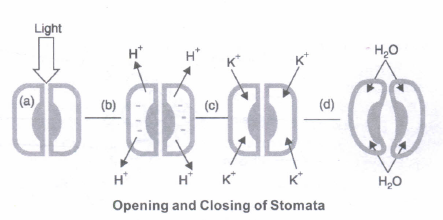
Sometimes, a few epidermal cells, in the vicinity of the guard cells become specialised in their shape and size and are known as subsidiary cells. The stomatal aperture, guard cells and the surrounding subsidiary cells are together called stomatal apparatus.
16.
Cross Section of Dicot Root
17.
Cork Cambium. As the stem continues to increase in girth due to the activity of vascular cambium, the outer cortical and epidermis layers get broken and need to be replaced to provide new protective cell layers. Hence, sooner or later, another meristematic tissue called cork cambium or phellogen develops, usually in the cortex region. Phellogen is a couple of layers thick. It is made of narrow, thin-walled and nearly rectangular cells. Phellogen cuts off cells on both sides. The outer cells differentiate into cork or phellem while the inner cells differentiate into secondary cortex or phelloderm. This is clear how cork cambium forms tissues that form the cork.
18.
The taxonomic characters to be described are habitat, habit, root, stem, leavbes, flowers, inflorescence, calyx,corolla,androecium,gynoecium,fruits, and seeds.
19.
(a) Underground parts of a plant are not always roots. Sometimes stem or stem branches occur underground to perform some special functions. For example, potato tubar is a modified stem which is underground. A potato tubar shows nodes and internodes, scale leaves and buds at the nodes.
(b) Flower is a modified shoot consisiting of a highly reduced stem bracnch to form thalamus in which the nodes are borne only towards the trip. The floral parts, i.e. sepals,petals,stamens and carpels are arranged in their respective whorls and arise from nodes.

11th Standard CBSE Syllabus & Materials
11th Standard CBSE
CBSE 11th Business Studies Forms of Business Organisation Sample Question Papers Study Material - QB365 Set A
NEW11th Standard CBSE
CBSE 11th Business Studies Business, Trade and Commerce Sample Question Papers Study Material - QB365 Set A
NEW11th Standard CBSE
CBSE 11th Physics Waves Sample Question Papers Study Material - QB365 Set A
NEW11th Standard CBSE
CBSE 11th Physics Kinetic Theory Sample Question Papers Study Material - QB365 Set A



CBSE 11th Standard CBSE Subjects
CBSE Standards









