
 100% FREE ACCESS
11th Standard CBSE Syllabus & Materials
11th Standard CBSE
CBSE 11th Economics PART-A - Presentation of Data - New Sample Question Papers Study Material - QB365 Set A
NEW11th Standard CBSE
CBSE 11th Economics PART-A - Organisation of Data - New Sample Question Papers Study Material - QB365 Set A
NEW11th Standard CBSE
CBSE 11th Economics PART-A - Collection of Data - New Sample Question Papers Study Material - QB365 Set A
NEW11th Standard CBSE
CBSE 11th Economics PART-A - Introduction to Economics and Statistics - New Sample Question Papers Study Material - QB365 Set A
NEW11th Standard CBSE
CBSE 11th Business Studies International Trade Sample Question Papers Study Material - QB365 Set A
NEW11th Standard CBSE
CBSE 11th Business Studies Evolution and Fundamentals of Business Sample Question Papers Study Material - QB365 Set A

Published on: 04/09/2019
Anatomy of Flowering Plants
Download CBSE Class 11th Standard CBSE Biology question papers, sample papers, important questions, and previous year solved papers in PDF format. Get free study materials, NCERT solutions, and exam preparation resources for Class 11th Standard CBSE Biology
Questions + Answers key
Take MCQ Biology Test
1.
Draw a well-labelled diagram of sclerenchyma.
2.
Give the functional difference between phellogen and phelloderm.
3.
How does the periderm formation take place in the dicot stems?What are its components?
4.
Name two characteristic bands that are found in endodermis of dicot root.
5.
What constitutes the cambium ring?
6.
Which kind of tissue stores starch in potato and makes the shells of nuts ?
7.
What is the other name of bulliform cells?
8.
How the vessel members in xylems are interconnected ?
9.
What is the composition of collenchyma cells ?
10.
Describe the arrangement of floral members in relation to their insertion on thalamus.
11.
Define the term inflorescence. Explain the basis for the different types inflorescence in flowering plants.
12.
Describe the various types of placentations found in flowering plants.
13.
How do the various leaf modifications help plants?
14.
How is a pinnately compound leaf different from a palmately compound leaf?
15.
Point out between dicot and monocot leaf of peepal (Ficus religiosa) and maize (Zea mays)
16.
List out the important characteristics of meristematic tissue
17.
How the arrangement of vascular bundles in monocots differs from dicots?
18.
Deciduous plants shed their leaves during hot summer or autumn. This process of shedding of keaves is called abscission .Apart from physiological changes, what anatomical mechanism is involved in the abscission of leaves?
19.
What is the difference between lenticels and stomata
1.
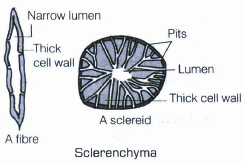
2.
Difference between phellogen and phelloderm is
| Phellogen | Phelloderm |
| It is a ring of meristematic cells that divide and form cork on outside and secondary cortex on the inner side. | It is a tissue made up of suberised parenchymatous cells that transfer nutrients and water to phellogen cells for their activity. |
3.
Cork cambium develops in cortex and cuts off cells on both outer and inner sides of stem.The outer cells differentiate into cork or phelloderm.The various componenets of periderm are phellogen , phellem and phelloderm.
4.
Casparian strips or carsparian strps or casparian bands.
5.
Fusion of intervascicular and intrafascicular cambium strips.
6.
Parenchymatous tissue store starch (food) in potato and sclerenchymatous tissue make the shells of the nuts
7.
Bulliform cells, also known as motor cells, are huge, bubble-shaped epidermal cells found on the top surface of leaves in groups of multiple monocots. These cells are found on the top or adaxial leaf surface.
8.
The vessel members are interconnected through perforations in their end/common walls.
9.
It is made of cellulose, hemicellulose and pectic substances
10.
Floral members, like calyx, corolla and androecium are arranged differently in relation to ovary on the thalamus. Based on this arrangement flowers can be divided as follows
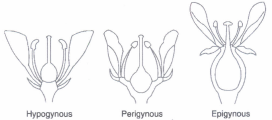
Hypogynous Flower: In hyopgynous flowers, the ovary occupies the highest position. Other floral members are inserted below the ovary, on thalamus. Perigynous Flower: In perigynous flowers, the ovary and other floral members are inserted on the same level on thalamus.
Epigynous Flower: In epigynous flowers, the ovary is at the lowest position on thalamus. Other floral members are inserted above the ovary.
11.
The Inflorescence
A flower is a modified shoot wherein the shoot apical meristem changes to floral meristem. Internodes do not elongate and the axis gets condensed. The apex produces different kinds of floral appendages laterally at successive nodes instead of leaves. When a shoot tip transforms into a flower, it is always solitary. The arrangement of flowers on the floral axis is termed as inflorescence. Depending on whether the apex gets converted into a flower or continues to grow, two major types of inflorescences are defined-racemose and cymose
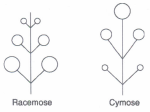
Racemose Inflorescence. In racemose type of inflorescences the main axis continues to grow, the flowers are borne laterally in an acropetal succession. Acropetal succession means that older flowers are at the base and younger flowers are near the apex
Cymose Inflorescence. In cymose type of inflorescence the main axis terminates in a flower, hence is limited in growth. The flowers are borne in a basipetal order. In basipetal succession older flowers are at the apex and younger flowers are near the base.
12.
Placentation. The arrangement of ovules within the ovary is known as placentation. The placentation are of different types namely, marginal, axile, parietal, basal, central and free central.
Marginal. In marginal placentation the placenta forms a ridge along the ventral suture of the ovary and the ovules are borne on this ridge forming two rows, as in pea.
Axile. When the placenta is axial and the ovules are attached to it in a multilocular ovary, the placentaion is said to be axile, as in china rose, tomato and lemon. Parietal. In parietal placentation, the ovules develop on the inner wall of the ovary or on peripheral part. Ovary is one-chambered but it becomes two-chambered due to the formation of the false septum, e.g., mustard and Argemone. When the ovules are borne on central axis and septa are absent, as in Dianthus and Primrose the
placentation is called free central.
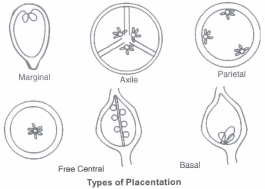
Basal. In basal placentation, the placenta develops at the base of ovary and a single ovule is attached to it, as in sunflower, marigold.
13.
Modifications of Leaves
Leaves are often modified to perform functions other than photosynthesis. Tendrils. They are converted into tendrils for climbing as in peas or into spines for defence as in cacti.
Bulb.
The fleshy leaves of onion and garlic store food.
In some plants such as Australian acacia, the leaves are small and short-lived.The petioles in these plants expand, become green and synthesise food. Leaves of certain insectivorous plants such as pitcher plant, venus-fly trap are also modified leaves.
14.
Pinnately Compound Leaf. In pinnately compound leaf a number of leaflets are present on a common axis. Example, neem leaves.
Palmately Compound Leaf. In palmately compound leaf number of leaflets are attached at the common point. Example, cotton leaves.
15.
Differences between dicot and monocot leaves
|
Dicot leaf (Dorsivenytral) |
Monocot leaf (Isobilateral) |
| The upper surface is darker green as compared to lower surface. | The two surfaces have shade of green colour |
| The upper surfaces has larger and thick walled cells as compared to those of lower epidermis. | The epidermis cells are similiar on the two surfaces of the leaf. |
| Silica does not occur on the ourter wall of epidermal cells. | Silica deposition is common on the outer wall of epidermal cells. |
16.
Characteristics of meristematic tisssues are
(i)Cells are usuall rectangular with thin cell wall made up of cellulose
(ii)They are closely arranged without any intercellular space
(iii)They show a prominent nucleus and are full of cytoplasm.
(iv) They are always capable of division
17.
In dicots, cambium is present between pholem and xylem . These types of vascular bundles are capable to form secondary sylem and pholem tissues.These are konwn as open vascular bundles.In monocots, vascular bundle have no cambium present hence, they do not form secondary tissues.These are known as closed vascular tissues.
18.
The hormones secreted by plant body influence anatomical changes in it. In the future are of abscission , a special narrow abscission zone develops. It consists of a upper lignified amd suberised protective layer. The seperation layer consists of unthicked cells where the hydrolysing enzymes develop.
Pectnases are secreted out to dissolve middle lamallae.Cellulases bring about hydrolysis of cell walls.Due to this, the seperation layer becomes soft and weak.This leads to sheding of leaves from plants.
19.
Difference between lenticels and stomata are given below
| Lenticels | Stomata |
| Found in old stem and root | Found in leaves and young stem |
| Present in crok tissues. Contain a number of comlementary cells permanently remain open |
Present in epidremis stomata contain two guard cells Stomata open and close in response to turgidity of guars cells |

11th Standard CBSE Syllabus & Materials
11th Standard CBSE
CBSE 11th Business Studies Forms of Business Organisation Sample Question Papers Study Material - QB365 Set A
NEW11th Standard CBSE
CBSE 11th Business Studies Business, Trade and Commerce Sample Question Papers Study Material - QB365 Set A
NEW11th Standard CBSE
CBSE 11th Physics Waves Sample Question Papers Study Material - QB365 Set A
NEW11th Standard CBSE
CBSE 11th Physics Kinetic Theory Sample Question Papers Study Material - QB365 Set A



CBSE 11th Standard CBSE Subjects
CBSE Standards









