
 100% FREE ACCESS
11th Standard CBSE Syllabus & Materials
11th Standard CBSE
CBSE 11th Economics PART-A - Presentation of Data - New Sample Question Papers Study Material - QB365 Set A
NEW11th Standard CBSE
CBSE 11th Economics PART-A - Organisation of Data - New Sample Question Papers Study Material - QB365 Set A
NEW11th Standard CBSE
CBSE 11th Economics PART-A - Collection of Data - New Sample Question Papers Study Material - QB365 Set A
NEW11th Standard CBSE
CBSE 11th Economics PART-A - Introduction to Economics and Statistics - New Sample Question Papers Study Material - QB365 Set A
NEW11th Standard CBSE
CBSE 11th Business Studies International Trade Sample Question Papers Study Material - QB365 Set A
NEW11th Standard CBSE
CBSE 11th Business Studies Evolution and Fundamentals of Business Sample Question Papers Study Material - QB365 Set A

Published on: 05/09/2019
Structural Organisation in Animals
Download CBSE Class 11th Standard CBSE Biology question papers, sample papers, important questions, and previous year solved papers in PDF format. Get free study materials, NCERT solutions, and exam preparation resources for Class 11th Standard CBSE Biology
Questions + Answers key
Take MCQ Biology Test
1.
Distinguish between cardiac muscles and striated muscles
2.
Distinguish between simple eputhelium and compound epithelium
3.
Earthworms are bisexual, still, the self-fertilization is not possible in them. Explain.
4.
Explain the term "sclerites"
5.
Why are blood , bone and cartilage callde connective tissues?
6.
What are the divisions of earthworm's body according to clitellum?
7.
Plasma protein acts as acid-base buffer in the blood . Explain
8.
What are the cellular components of haemoglobin?
9.
In which type of bone , bone marrow cavity is present ?
10.
Name the different cells junctions found in tissues.
11.
Name the type of young and mature cartilage cells
12.
Mention briefly about the circulatory system of earthworm.
13.
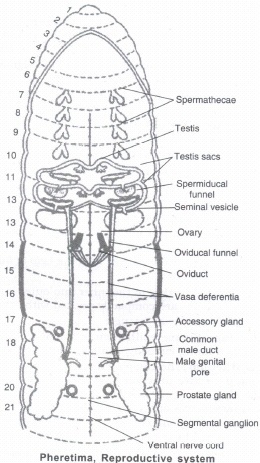
Draw a labelled diagram of reproductive organs of an earthworm.
14.
Mention the special features of eye in cockroach.
15.
Mention the similarities between Cardiac and skeletal muscles.
16.
Name the main excretory organs of cockroach. Write the structure of these organs.
17.
Describe the features of exoskeleton of cockroach
18.
Describe various types of epithelial tissues with the help of labelled diagrams.
19.
Distinguish between a male frog and female frog.
20.
Distinguish between a male cockroach and female cockroach.
1.
Difference between cardiac muscles and striated muscles
| cardiac muscles | striated muscles |
| Present in heart | Attached to bones in all parts of the body like limbs , jaws etc., |
| Striation are faint | Striations are pronminents |
| Involuntary function | Voluntary in function |
| Intercalated discs are present | Intercalated dics are absent |
2.
Differences between simple eputhelium and compound epithelium
| simple eputhelium | compound epithelium |
| There is a single layer of cells | There are several layers of cells |
| All the cells lie on the basement membrane | Only the bassal most layer of the cells lie on thge basement membrane |
3.
Earthworms are protandrous,i.e.,the tests mature earlier than the ovaries. Self fertilisation is not possible in them because of the relative position of the openings of male and female reproductive organs.
4.
Sclerties The body of cockroach is externally covered by hard brown chitinous plates called sclerites, which constitute the exoskeleton.
5.
Blood, Bone and cartilage are called connective tissue because
(i) they connect different tissues and organs
(ii) provide support to other structures of the animal body
6.
The clitellum divides the earthworm's body into three basic regions
(i) Preclitellar Anterior 13 segments
(ii) Clitellar Only 3 segments
(iii) Postclitellar Last 84-104 segments
7.
plasma protein maintains the pH of the blood by neutralising the strong acids and bases so it acts as acid base buffers
8.
Haemoglobin contains a protein called globin and Fe2+ (ferrous)-porphyrin complex called haeme
9.
Bone marrow cavity is present in long bones, such as humerus , femur , etc.
10.
(i) Gap Junction
(ii) Tight Junction
(iii) Adhering Junction
11.
Young cartilage cells - Chondroblasts
Mature cartilage cells - Chondrocytes
12.
Blood Vascular System. Pheretima exhibits a closed type of blood vascular system, consisting of blood vessels, capillaries and heart. Due to closed circulatory system, blood is confined to the heart and blood vessels. Contractions keep blood circulating in one direction. Smaller blood vessels supply the gut, nerve cord, and the body wall. Blood glands are present on the 4th, 5th and 6th segments. They produce blood cells and haemoglobin which is dissolved in blood plasma. Blood cells are phagocytic in nature. Earthworms lack specialised breathing devices. Respiratory exchange occurs through moist body surface into their blood stream.
13.
14.
In cockroach, there are two types of eyes, i.e., apair of simple eye and a pair of compound eyes. A compound eye has upto 2000 hexagonbal units called ommatidia. These are responsible for producing mosaic vision. The adjacent ommatidia are separated internally by the pigment cells. An ommatidium has two parts
(i) Outer dioptoric or focussing part, which consisits of a corneal lens, two corneagen cells, a crystalline cone and four cone cells or vitrellae.
(ii) Inner receptive part has a spindle-shaped pigment contaning rhadome surrounded by eight retinulae which continue as nerve fibre.
15.
Similarities between cardiac and skeletal muscles The cardiac and skeletal muscles both are made up of elongated fibres, which have numerous myofibrils. The myofibrils of the cardiac muscles have the same structure as those of skeletal muscle and are made up of actin and myosin filaments. The cardiac and skeletal muscles fibres have dark and light bands.
16.
Malphighian tubules are the amin excretory organs of cockroach.
17.
The entire body of cockroach is covered by a hard chitinous exoskeleton (brown in colour) made of touch plates called sclerites. These are formed of chitin, a polymer of acetone cocaine polysaccharide molecule. The exoskeleton protects the body and provides space for the attachment of muscles.
18.
Epithelial Tissue
Epithelial tissues provide covering to the inner and outer lining of various organs. The cells of epithelial tissues are compactly packed with little intercellular matrix. There are two types of epithelial tissues:
(a) Simple Epithelium. Simple epithelium is composed of a single layer of cells and functions as a lining for body cavities, ducts, and tubes.
(b) Compound Epithelium. The compound epithelium consists of two or more cell layers and has protective function as it does in our skin. They cover the dry surface of the skin, the moist surface of buccal cavity, pharynx, inner lining of ducts of salivary glands and of pancreatic ducts.
On the basis of structural modification of the cells, simple epithelium is further divided into three types. These are:
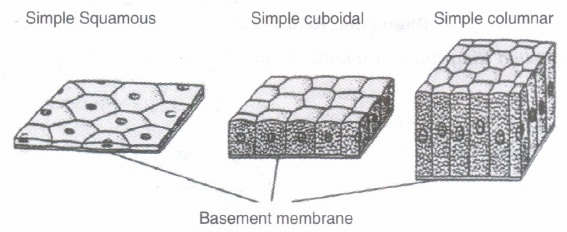
1. Squamous. The squamous epithelium is made of a single thin layer of flattened cells with irregular boundaries. They are found in the walls of blood vessels and air sacs of lungs and are involved in functions, like forming a diffusion boundary.
2. Cuboidal. The cuboidal epithelium is composed of a single layer of cubelike cells. This is commonly found in ducts of glands and tubular parts of nephrons in kidneys and its main functions are secretion and absorption. The epithelium of proximal convoluted tubule (PCT) of nephron in the kidney has microvilli.
3. Columnar. The columnar epithelium is composed of a single layer of tall and slender cells. Their nuclei are located at the base. Free surface may have microvilli. They are found in the lining of stomach and intestine and help in secretion and absorption. If the columnar or cuboidal cells bear cilia on their free surface they are called ciliated epithelium. Their function is to move particles or mucus in a specific direction over the epithelium. They are mainly present in the inner surface of hollow organs like bronchioles and fallopian tubes.
19.
Differences between male and female frog
| Male frog | Female frog |
| Vocal cords are present on ventrolateral side of throat | Vocal sacs are absent |
| Croaking is more louder | Croaking is less louder |
| Forelimbs are stouter and more muscular | Forelimbs are less muscular |
| Amplexusory pads are present on ventral side of index fingers |
Amplexusory pads are absent |
| During breeding season, abdomen does not change much | Abdomen gets swollen during breeding season as it is full of ova released from mature ovaries. |
20.
Differences between male and female cockroach are
| Male Cockroach | Female Cockroach |
| Abdomen is long and narrow | Abdomen is short and broad |
| All nine sterna are visible | Only seven sterna are visible |
| Anal styles are present | Anal styles are absent |
| 7 th tergum coves 8th tergum | 7th tergum covers 8th and 9th terga. |
| Brood pouch is absent | B |
| Antennae are longer in size | Antennae are smaller in size |
| Wings extend beyond the tip of abdomen | Wings extend upto the end of abdomen |

11th Standard CBSE Syllabus & Materials
11th Standard CBSE
CBSE 11th Business Studies Forms of Business Organisation Sample Question Papers Study Material - QB365 Set A
NEW11th Standard CBSE
CBSE 11th Business Studies Business, Trade and Commerce Sample Question Papers Study Material - QB365 Set A
NEW11th Standard CBSE
CBSE 11th Physics Waves Sample Question Papers Study Material - QB365 Set A
NEW11th Standard CBSE
CBSE 11th Physics Kinetic Theory Sample Question Papers Study Material - QB365 Set A



CBSE 11th Standard CBSE Subjects
CBSE Standards









